
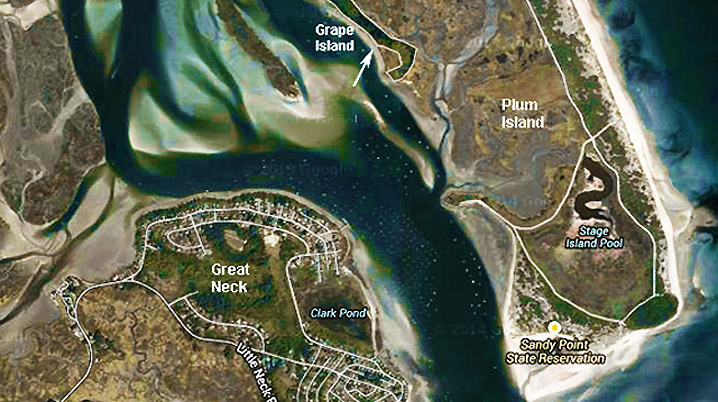
The General Court on October 17, 1649, divided Plum Island among three towns, granted to Ipswich 2/5, Newbury 2/5, and Rowley 1/5. The salt marsh hay, sand, and wildlife were valuable assets to the towns.
In the late 1800s summer resort communities sprung up at the northern end, as well as at Grape Island and “The Bluffs” at the Ipswich end. In the early 1930s, the Massachusetts Audubon Society purchased 1,500 acres on Plum Island and established a bird sanctuary. In 1941 under the Migratory Bird Conservation Act and the Migratory Bird Treaty Act, 3,000 acres, including Grape Island, were purchased by the U.S. government and added to this sanctuary to establish the Parker River National Wildlife Refuge.
The village of Plum Island at the northern end lies within the boundaries of Newbury and Newburyport. At the southern tip of Plum Island is the 77-acre Sandy Point State Reservation. The Town of Ipswich has no administrative powers over its share of Plum Island, and the last house within the boundaries of the refuge was removed in 2017.


 The Early History of Plum Island - Nancy Virginia Weare spent 33 years at her family's summer camp at Plum Island. In 1993 she wrote "Plum Island: The Way It Was," which is reprinted on this site with permission.… Continue reading The Early History of Plum Island
  A Complete History of Plum Island until the year 1915 - The General Court took action on October 17th 1649: "Upon the petition of Newbury, this Court thinketh meete to give & grant Plum Island to Ipswich two parts, Newbury two parts & Rowley to have one fifth part."… Continue reading A Complete History of Plum Island until the year 1915
  The Northern End of Plum Island - Nancy Virginia Weare spent 33 years at her family’s summer camp at Plum Island. After the Parker River Wildlife Refuge was established, she moved to a home on Great Neck in Ipswich overlooking the island. In 1993, after Nancy retired, she wrote “Plum Island: The Way It Was.” … Continue reading The Northern End of Plum Island
  Plum Island The Way It Was - Published in 1993, this 100-page book is copied with permission from the estate of the late Nancy Weare. Read by scrolling this page, or click on any image to read as a slideshow.… Continue reading Plum Island The Way It Was
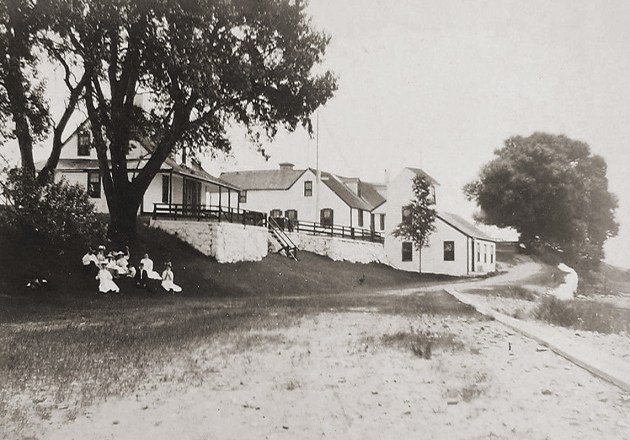
  Ipswich Bluff - The hotel at Ipswich Bluff on the southern tip of Plum Island was a favorite destination of locals in the late 19th Century, who took the steamer Carlotta from the Ipswich wharf with Capt. Nat Burnham.… Continue reading Ipswich Bluff
  The Knobbs - The Knobbs is a small beach in a stretch of salt marsh on the west side of the Ipswich section of Plum Island. On the Atlantic side was the Kbobbs Beach Life-Saving Station, replaced in 1947 by a camp for children who had been victims of polio. … Continue reading The Knobbs
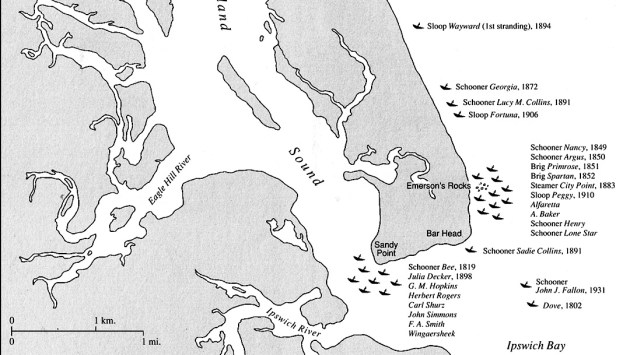
  The Shipwrecks at Ipswich Bar - The Ipswich Bar has a long history of tragic shipwrecks. Its swift currents and shallow waters are especially dangerous during storms, and many ships have gone aground. The hull of the Ada K. Damon sits on Steep Hill Beach.… Continue reading The Shipwrecks at Ipswich Bar
 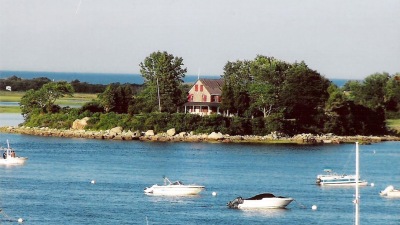 The Last Cottage on Plum Island - (This article was written by Beverly Perna before the cottage was torn down, and has been updated.) An iconic Ipswich landmark, the last privately owned cottage on the Ipswich end of Plum Island, was turned over to the Fish and Wildlife Service and was taken down in 2016. Boaters and Great Neck residents were most familiar with… Continue reading The Last Cottage on Plum Island
  The Cape Ann Sea Serpent - The earliest recorded sighting of a Sea Serpent in North American waters was at Cape Ann in 1639. In 1817, reports spread throughout New England of a sea serpent sighted in Gloucester Harbor.… Continue reading The Cape Ann Sea Serpent
  Life at an Estuarine Front - Shorebirds congregate and drift in rafts along the estuarine front where the mixing of fresh and saltwater stirs up small fish, crustaceans, and other aquatic organisms.… Continue reading Life at an Estuarine Front
  The Ghost of Harry Maine - Harry Maine — you have heard the tale; He lived there in Ipswich Town; He blasphemed God, so they put him down with an iron shovel, at Ipswich Bar; They chained him there for a thousand years, As the sea rolls up to shovel it back; So when the sea cries, the goodwives say "Harry Maine growls at his work today."… Continue reading The Ghost of Harry Maine
  The Plum Island Salt Company - In the 1820s a Frenchman named Gilshenan organized an unsuccessful salt harvesting company on Plum Island with a 10' deep canal and a bull turning an overshot wheel like a hamster. A large sundial survived for a few decades, but no trace remains today.… Continue reading The Plum Island Salt Company
  Adrift on a Haystack, December 1786 - In a northeasterly storm in December, 1786 Samuel Pulsifer and Samuel Elwell of Rowley were digging clams on Plum Island, got caught in the storm, and took refuge in a stack of salt hay for the night. In the morning they found they had been set afloat.… Continue reading Adrift on a Haystack, December 1786
  350 years on Grape Island - Grape Island was once a small but thriving community, and briefly a popular summer resort. In 1941, 3000 acres of Plum Island including Grape Island were purchased by the U.S. government to establish the Parker River National Wildlife Refuge.… Continue reading 350 years on Grape Island
  Nuclear Ipswich, 1967-1970 - In 1967, Ipswich was proposed as a site for an anti-ballistic missile base, and in 1970 opponents prevented construction of a nuclear power plant on Town Farm Road that eventually was built in Seabrook.… Continue reading Nuclear Ipswich, 1967-1970
  The Commons - When the Town of Ipswich was established, ownership of a house and land within the town bounds carried with it the right of pasturage beyond the Common Fence. In 1788, the commoners resigned all their land interests to pay the heavy town debt incurred during the Revolution.… Continue reading The Commons Nancy Weare - Nancy Virginia Weare spent 33 years at her family's summer camp at Plum Island. In 1993, after Nancy retired, she wrote "Plum Island: The Way It Was." … Continue reading Nancy Weare
 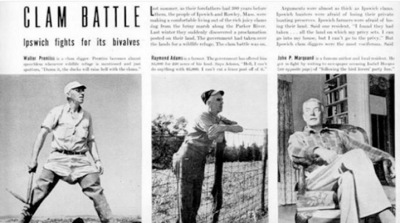 Clam Battle! - Life Magazine, July 16, 1945: The government had taken over the lands for a Wildlife Refuge, and the clam battle was on. Ipswich hunters were afraid of losing their private hunting reserves. Ipswich farmers were afraid of losing their land.… Continue reading Clam Battle!
  The Steamship “Carlotta” - The excursion boat Carlotta was built in 1878 at Rogers Point boat yard, and sailed from Town Wharf to the Neck and Plum Island for 35 years. The small hotels at Little Neck, Ipswich Bluff and Grape Island were favorite destinations for tourists and locals.… Continue reading The Steamship “Carlotta”
  Gathering Salt Marsh Hay - Salt marsh hay is still gathered on the North Shore today. The grass was stacked on staddles to raise it above the high tides, and was hauled away on sleds over the frozen marsh in mid-winter.… Continue reading Gathering Salt Marsh Hay
  Historic Ipswich