Christopher and Sarah Bidlake, who married in Ipswich, Massachusetts, were the common ancestors of the Bidlack family of Windham County, Connecticut. The above sketch of Windham Center in the 1830s is by John Warner Barber.
Sarah Bidlake was the daughter of John Fuller and Elizabeth (Emerson) Perrin, and a granddaughter of Thomas Emerson who was born at Bishop’s Stortford, Hertfordshire England on July 26, 1584. According to family tradition, Emerson came to America on the ship Elizabeth Ann in 1635. He was in Ipswich as early as 1638 when eighty acres were granted to him adjoining land of Goodman Muzzey. This property extended from Turkey Shore to Labor in Vain and Goulds Creek and remained in the hands of the Emerson family for several generations. It was bounded by the planting lot of Robert Cross on the east, the house lot of John Dane on the west, the lot of William Wildes, on the south, and the Town River on the north. Turkey Shore and Labor in Vain were only cart paths during this period. He was a commoner in 1641 and a selectman in 1646. Mr. Emerson built a house and in 1648 sold the house and land, six acres, to Daniel Ringe, “lying next the dwelling house and land of John Dane towards the south” (Ips. Deeds 1: 169). Emerson died on May 1, 1666, at age 81 in Ipswich, and conveyed his farm to his son John. For many years it was claimed that Emerson had built the 1680 William Howard House on Turkey Shore Rd.
The gravestone of Nathaniel Emerson (born 1695), son of Thomas still stands at the Old North Burying Ground, and displays the Emerson coat of arms. (Of interest to this story: Nathaniel’s son John married “Bethia Bedlake.” )
Daniel Hovey
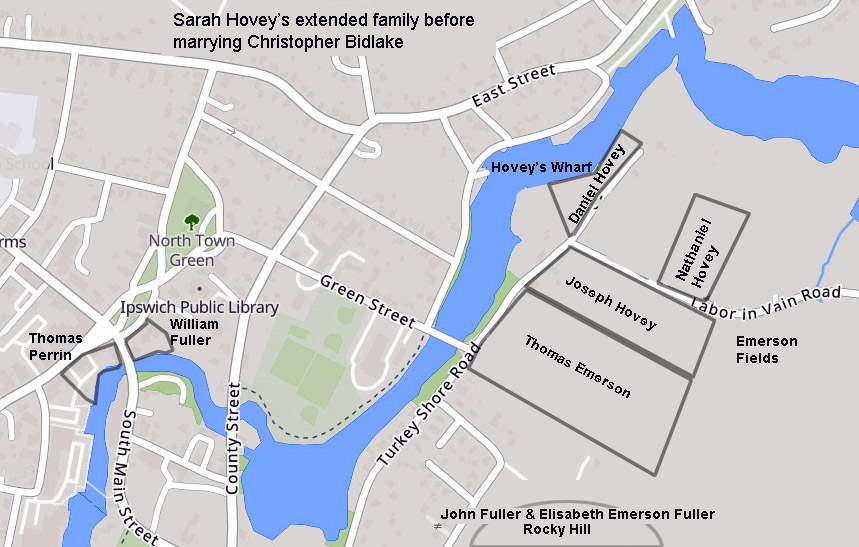
Thomas Emerson’s neighbor at the intersection of Turkey Shore and Labor in Vain was Daniel Hovey. who married Abigail, daughter of Robert and Elizabeth Andrews of Ipswich, about 1641.
Nathaniel Hovey was born to Daniel Hovey in 1657. In 1679 he married Sarah Fuller, the granddaughter of Thomas Emerson. He died March 24, 1692, at age thirty-five, leaving her a widow with children. Sarah married, secondly, Christopher Bidlake of Ipswich before Aug. 15, 1694, when a daughter, Mary, was born to them. Mr. Bidlake’s first wife, Anna, had died Dec. 13, 1692.
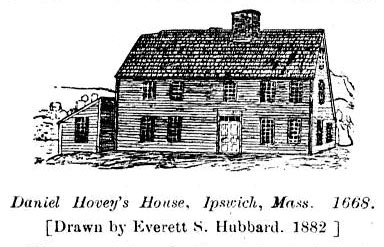
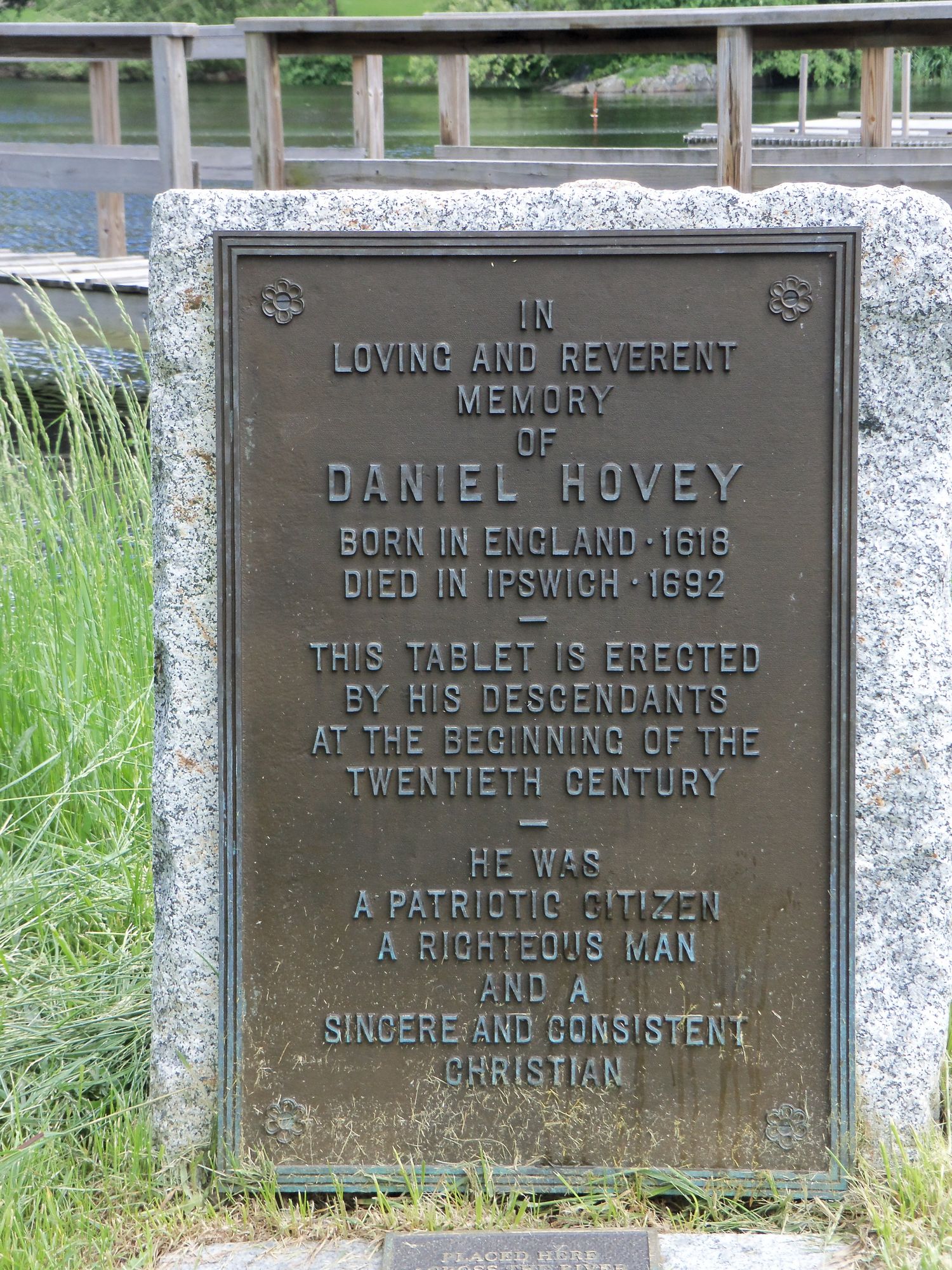
At the foot of Hovey Street along the Ipswich River is a plaque dedicated to the memory of Daniel Hovey, placed there by his descendants. Daniel Hovey was born in 1618 in Waltham Abbey, Essex Co., England. Hovey’s home and wharf were on the south side of the Ipswich River on what is now Tansey Lane. He served as a surveyor of highways in 1648 – 50, was a constable in 1658, and was chosen as an Ipswich selectman in 1659. In May 1668, Daniel Hovey and two of his sons, James and Thomas, joined a group that had departed from Ipswich to the Indian town Quaboag in western Massachusetts. The settlers renamed the town Brookfield, which was famously attacked by Indians during King Philip’s War. Soon thereafter, Hovey returned to Ipswich with his younger son, Nathaniel.
Hovey’s first wife, Abigail Andrews, was born about 1618 in Norwich, Norfolkshire, England, the daughter of Capt. Robert and Elizabeth Andrews. Andrews was the owner of the ”Angel Gabriel” which sank in the Great Colonial Hurricane. Mrs. Hovey died between 1676 and 1683. His will was proved Oct. 31, 1692; he bequeathed his lands in Brookfield to his son Joseph. His farm in Topsfield was already in the possession of John. He willed land and a dwelling house to his youngest son Nathaniel and made provisions for Nathaniel’s children. His second wife Ester was given one room and all of the goods in the house, plus the cows.
The will of Daniel Hovey, 1691-1692
“….I give to my sons Joseph and Nathaniel Hovey one hundred rods of ground apiece. Joseph bounded next to Mr. Emerson’s land from the highway to that land of Daniel Ringe. Nathaniel one hundred rods of my land next to my son Daniel with the dwelling house, barn, part of the orchard to butt on Daniel Ringe, half planting lot, about three acres, with a way to it over the bridge I made to go to it…… The children of my son Nathaniel to have an equal proportion among them, only Nathaniel Hovey the son of Nathaniel Hovey to have a double proportion if he lives to the age of one and twenty. If not, then to be divided amongst the other children of that family.”
This identifies the home of Nathaniel Hovey and his wife Sarah, later the wife of Christopher Bidlake, as being located near the intersection of Labor in Vain and Turkey Shore Roads on the south side of the river. Nathaniel’s uncle Nathaniel Hovey, also a descendant of Daniel Hovey, built the home at 11 Summer Street in Ipswich, and “bought of his nephew Nathaniel Hovey, the latter’s interest in the dwelling house of the latter’s deceased father, in Ipswich, on the south side of the river, April 8, 1718.”
Christopher Bidlake (aka Bidlack, Bedlake, Bedlock, Bedlox)
Christopher Bidlake (1661-1740), believed to be the first of the Bidlake / Bidlack family to immigrate to America, was born in Dartington, County of Devon, England on May 7, 1661. He was only seven years old when his father died late in November 1667, followed by the death of his mother four years later. The earliest record of Christopher Bidlake in Ipswich was the death of his wife, Anna in December 1692. It is believed that they had one son, Benjamin. In the following year, Christopher married Sarah, the widow of Nathaniel Hovey.
There is scant information about Christopher Bidlake’s time in Ipswich. Town records dated September 7, 1710 state that he was assigned to a bench in the rear of the Ipswich meeting house, indicating a low station in the community. When a new church was constructed in 1700, benches in the central floor space became the resort of the commoners and the poor, and galleries were constructed for the wealthy and elite.
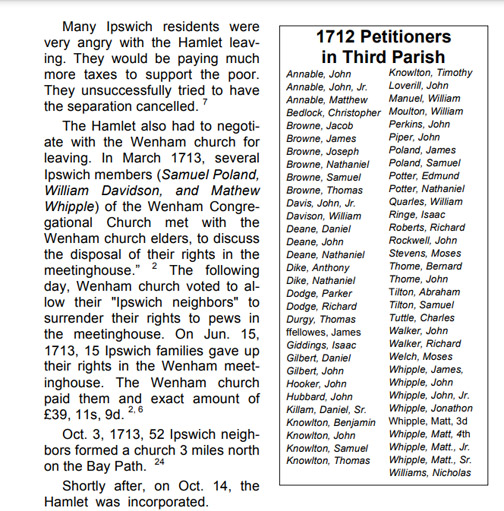
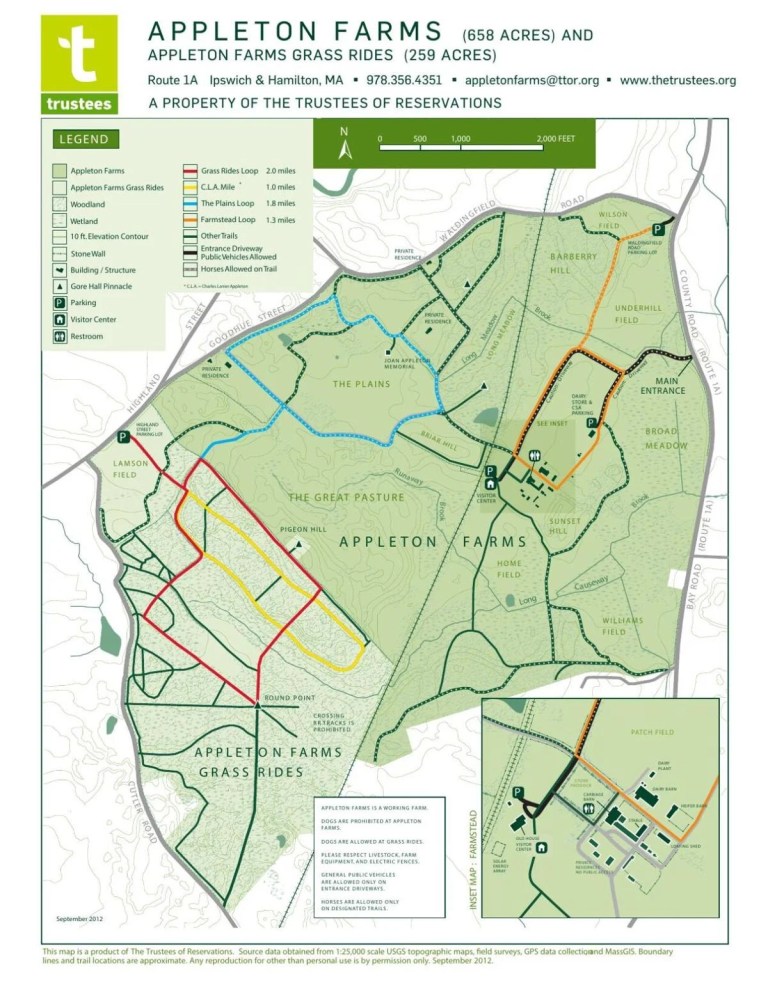
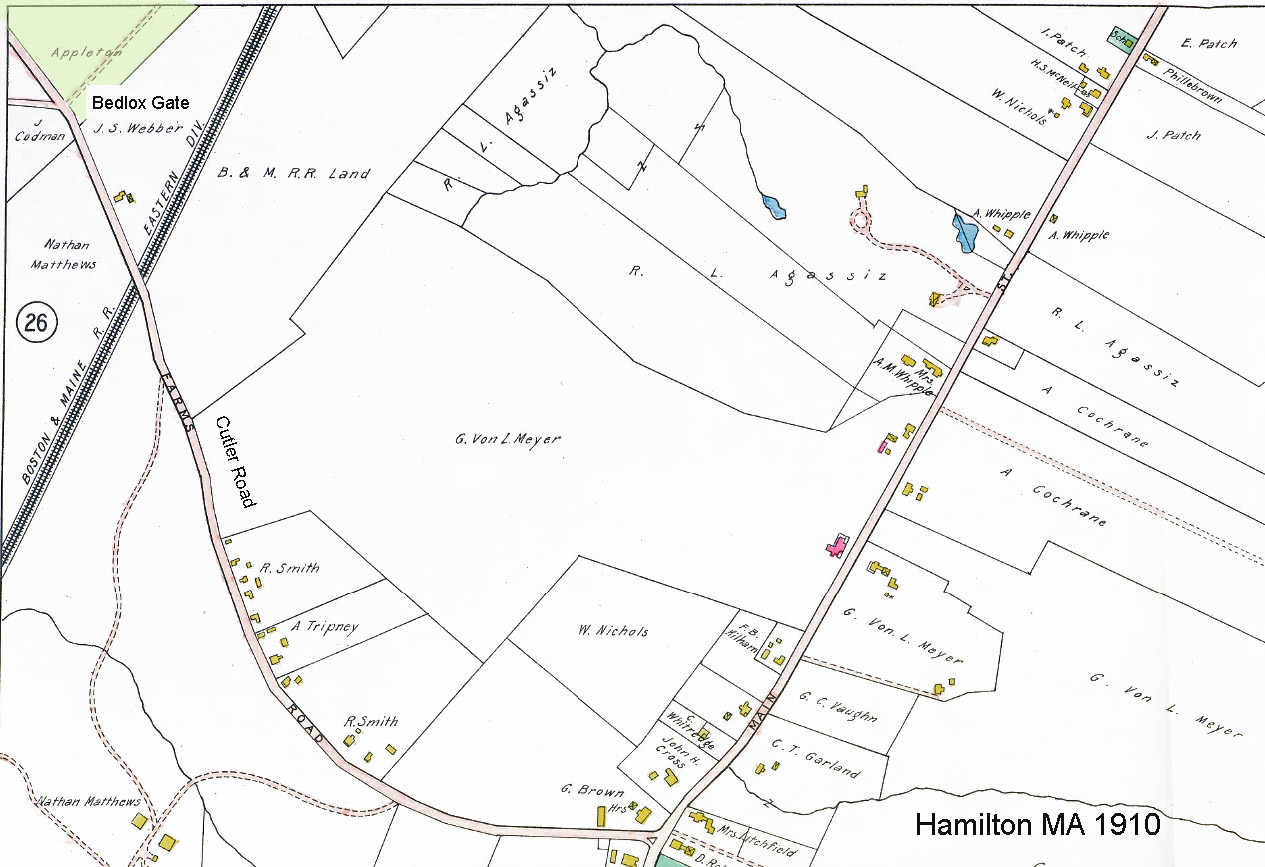
In 1712, Christopher signed a petition to establish a church in the The Hamlet, a parish of Ipswich that is now the town of Hamilton. In the 1700s, Ipswich included two remote parishes, Chebacco, which eventually became the town of Essex, and the Hamlet, which is where Christopher Bidlake is believed to have possessed a lot. Circumstantial evidence suggests it was the “Bedlox Lot” about halfway on today’s Cutler Road, which runs from Bay Road (Rt. 1A to Highland Street in Ipswich, bordering today’s Appleton Farms Grass Rides. The land was acquired by Daniel Fuller Appleton in the 1890s.
Lot in the Commons
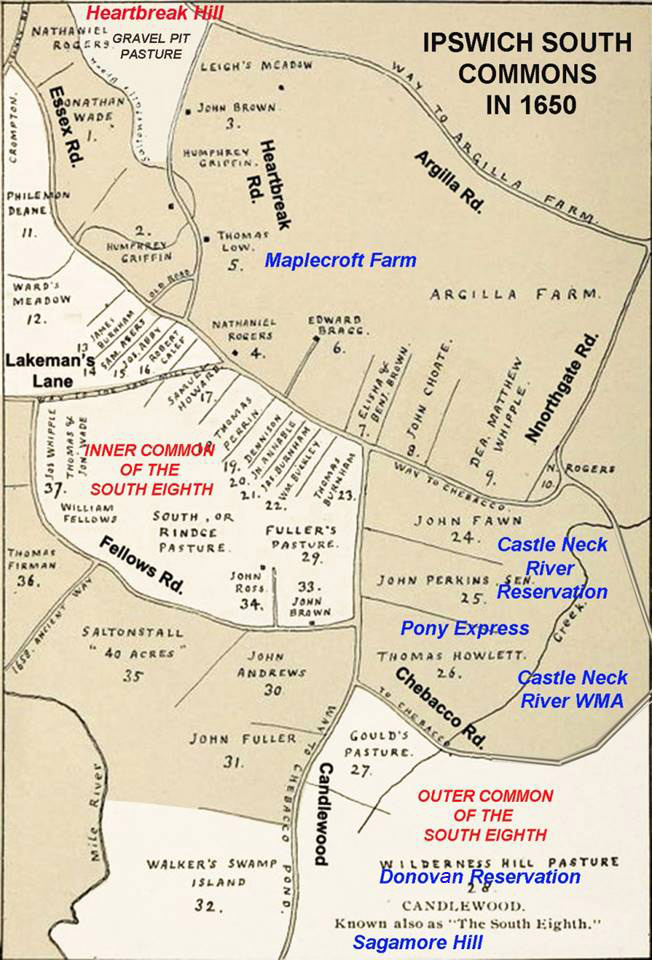
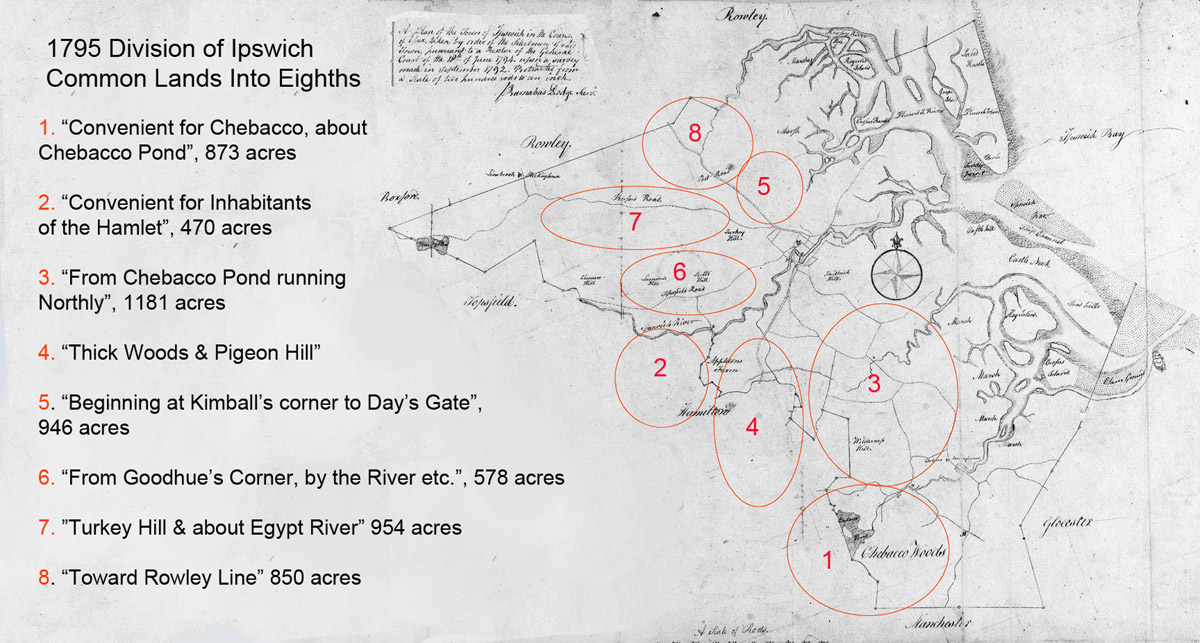
In 1709, a list of old and new commoners was agreed on, and the remaining 5850 acres of common land, about 9 square miles of common lands were divided into eight parts with two-fifths going to descendants of the original settlers and three-fifths to more recent commoners. Daniel Hovey had been granted rights at the Wilderness Hill common which is today’s Donovan Reservation on Sagamore Rd. in Hamilton, known at the time as the Outer Common of the South Eighth. It was about 2 miles from the commons abutting today’s Cutler Road.
Division #4 “Thick Woods & Pigeon Hill” included the Bedlox lot and gate. It is possible that in the division of the commons, Christopher Bedlake was granted possession of his lot and then sold it. It has not yet been determined if or how Christopher Bidlake acquired rights to land in the common. The “Bedlox lot” is at the southeast corner of today’s Appleton Farms Grass Rides, and was acquired by Frances Appleton Jr. in 1942, one of the last lots to be added to the Grass Rides.

The Grass Rides was not part of the original farm assigned to settler Samuel Appleton. On Feb. 25, 1763. Thomas Lamson and (his grandson) Thomas Lamson, Jr., both of Ipswich, yeoman, sold to Solomon Dodge of Topsfield, yeoman, “Pigeon Hill so-called” and “Bedlock land so-called”. Dr. Russell Bidlack was researching Christopher Bidlake when in the summer of 1971 he called upon an elderly lady, Mrs. George H. Srague. She told him that when she was a small child in the late 1800s, her grandfather, whose surname was Adams, owned a farm “along Cutler Road” and that a gate opening on this farm was always referred to as “Bedlock’s Gate”. Dr. Bidlack concluded that Bedlox and Bedlock’s were alternative spellings of Bidlake. The will of Thomas Adams of Ipswich dated March 19, 1750, refers to a “tract of land called Bedlaks” at this location.
The Move to Windham CT
When Christopher Bidlake married Sarah Hovey, he acquired five step-children ranging in age from 13 to less than one year. The youngest son of Nathaniel Hovey and Sarah, Nathaniel Hovey2, was born in Ipswich, Mass., on June 29, 1691, after his father died. For his entire life, Christopher Bidlake was the only father Nathaniel knew.
In Daniel Hovey’s deed, Nathaniel was to receive a double share of inheritance when he reached the age of 21.
“The children of my son Nathaniel to have an equal proportion amount, and only Nathaniel Hovey ye son of Nathaniel Hovey to have a double proportion if he lives to the age of one and twenty.”
In 1711 when Nathaniel reached 21 years old and received his inheritance, he moved over a hundred miles away to an area of Windham in northeast Connecticut, now the town of Hampton, where he was a yeoman. He became a prominent citizen and married Abigail Gennings in Windham. Because of a large land distribution in 1712 in Windham, along with the good quality of its soil and the cheapness of land, many Essex County residents relocated to the settlement in the early years of the history of Windham County, which was at first known as Canada Parish. Nathaniel Hovey married Abigail Gennings on Nov. 25, 1712, and died in Windham on June 26, 1761, aged seventy, the progenitor of many Hovey families in Windham County.
Christopher Bidlake and his wife Sarah joined Nathaniel, moving to Windham sometime between May 1, 1712, ( when he signed the above petition to create a church in the Hamlet) and February 26, 1715, when he registered his “ear-mark” by which he identified his livestock in Windham. He bought and sold several properties, eventually moving closer to Nathaniel. In 1722 Christopher deeded “my house and Land that I now live upon” to his son Benjamin Bidlack “in consideration of the love and affection that I have and do have to my son”. (Benjamin was born in 1696 to Christopher and Sarah.)
Two months later, on 29 Oct 1722, Benjamin signed an agreement “for and in consideration of the love and affection that I have and the duty that I owe to my honored father and mother Christopher and Sarah Bidlake” by which he granted “unto my sd. Father & mother full power good right and lawful authority to have hold use occupy, improve possess and enjoy the whole of it or so much of it as they or either of them shall see meet during their natural lives…” He reserved ownership of the land to himself and his heirs after the deaths of Christopher and Sarah Bidlack. Christopher and Sarah lived for nearly twenty years after they deeded their land to Benjamin. In his eightieth year when Christopher died on February 23, 1740, he was surely one of the oldest men in the community.
Sources:
- Appleton Farms Form A Area Nomination Papers for the National Registry of Historic Places
- The Hovey Book: The English Ancestry And American Descendants Of Daniel Hovey Of Ipswich, Massachusetts
- The last will and inventory of Daniel Hovey
- The Ipswich Emersons. A.D. 1636-1900: a genealogy of the descendants of Thomas Emerson of Ipswich, Mass., with some account of his English ancestry published in 1900 by Benjamin Kendall Emerson.)
- Hammat Papers Early Inhabitants of Ipswich: Christopher Bidlake
- WikiTree Thomas Emerson
- Ipswich Vital Records to 1849
- The Hamlet, 1638-1793
- Will of Thomas Adams, March 19, 1950: “A Tract of land called Bedlaks”
- Biography of Christopher Bidlake by Dr. Russell Bidlack
- BIDLAKE/BIDLACK FAMILY
- Bidlake Genealogy
- History of Windham County, Connecticut ..by Bayles, Richard M. (Richard Mather)
- Historic Ipswich: Daniel Hovey
- Whitworth, Kimberly A.: The Exodus From Andover: Migration Case Studies, 1700-1750
 Historic Ipswich