

Alexander Hamilton, one of the three authors of the “Federalist Papers”
“The process of election affords a moral certainty, that the office of President will never fall to the lot of any man who is not in an eminent degree endowed with the requisite qualifications. Talents for low intrigue, and the little arts of popularity, may alone suffice to elevate a man to the first honors in a single State; but it will require other talents, and a different kind of merit, to establish him in the esteem and confidence of the whole Union.”
In establishing the Electoral College, the framers of the Constitution adopted a compromise which creating a political advantage for slave-holding states. Slavery ended with the Civil War, but the Electoral College survives today as a historical remnant of slavery.
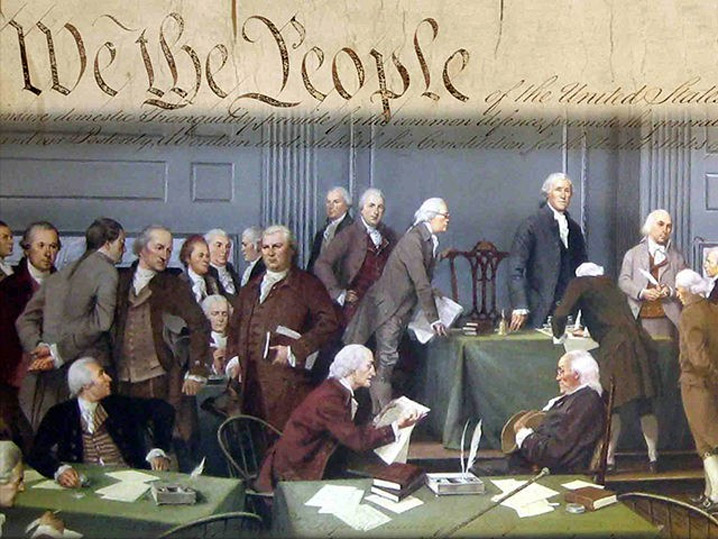
The Constitutional Convention
The Constitutional Convention took place in Philadelphia on May 14, 1787. If some of the most famous Patriots of the Revolution had attended, a dark blemish on the history of the United States may well have been quite different. Thomas Jefferson was in Paris serving as minister to France and John Adams was in London, serving as minister to Great Britain. Boston patriots Samuel Adams, John Hancock and Virginia’s Patrick Henry, who are referred to today as “Anti-Federalists,” declined to participate. Rhode Island boycotted the Convention altogether and didn’t sign the Constitution until 1790, when they received a promise that a Bill of Rights would be added.
Article II, Section 1, Clause 2 of the Constitution states:
Each State shall appoint, in such Manner as the Legislature thereof may direct, a Number of Electors, equal to the whole Number of Senators and Representatives to which the State may be entitled in the Congress: but no Senator or Representative, or Person holding an Office of Trust or Profit under the United States, shall be appointed an Elector.”
At the Constitutional Convention, a “Three-Fifths Compromise” was reached between delegates from southern and northern states, resolving a heated disagreement about how slaves would be counted when determining a state’s population for legislative representation. Pennsylvanian James Wilson proposed a direct national election of the president by free men, but Virginian James Madison responded that the North would outnumber the South, whose half million slaves could not vote. Under the Electoral College system which Madison proposed, each Southern state could count its slaves as two-fifths of a person in computing its share of the overall count. The more slaves Virginia had, the more electoral votes it would receive. The Compromise resulted in Southern states receiving more seats in Congress and a third more electoral votes.

Until the 12th amendment was passed, members of the Electoral College voted for two names for President. The person with the second highest number of votes would be the vice-president. The outcome of the 1796 election was a Federalist president (John Adams) and a Republican vice president (Thomas Jefferson). In the 1800 election, Vice President Thomas Jefferson defeated President Adams, in part because the ruling Federalists were split between President Adams and Alexander Hamilton. The election resulted in no candidate receiving a majority of the votes, thus putting the decision into the hands of the House of Representatives, which, after 35 tied votes, elected Jefferson on the 36th ballot, with his running mate Aaron Burr as vice-president. Support for Thomas Jefferson throughout the entire Western frontier assured his victory over John Adams in the election of 1800.
In 1804, the Twelfth Amendment to the United States Constitution modified the original Electoral College procedure, stipulating that each elector must cast distinct votes for President and Vice President instead of the original procedure in which two votes were cast for President, and therein created the partisan framework of two competing tickets that prevails today. Massachusetts Congressman Samuel Thatcher urged a return to a direct vote, complaining that “The representation of slaves adds thirteen members to this House in the present Congress, and eighteen Electors of President and Vice President at the next election,” but he did not prevail.
Further Reading:
- Time: The Troubling Reason the Electoral College Exists
- Atlantic: The Electoral College’s Racist Origins
- NY Times: The Electoral College Was a Pro-Slavery Ploy
Related posts
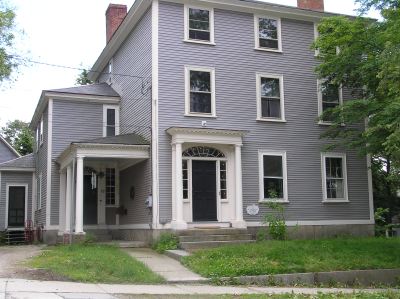 19 North Main Street, Thomas & Margaret Heard Manning House (1799) - This house was built by Dr. Thomas Manning in January, 1799, and remained in the family until 1858, when it became a parsonage. This house is protected by a preservation agreement between the owners and the Ipswich Historical Commission. … Continue reading 19 North Main Street, Thomas & Margaret Heard Manning House (1799)
  The Constitutional Convention and Establishment of the Electoral College - Many of our founding fathers had little trust in the instincts of the common man. John Adams observed that "Pure democracy has also been viewed as a threat to individual rights," and warned against the “tyranny of the majority.” Alexander Hamilton, one of the three authors of the "Federalist Papers" defended the system of electors by which we choose a President today.… Continue reading The Constitutional Convention and Establishment of the Electoral College
  The Civil War Monument - By Harold Bowen: The monument was first erected by the town in 1871 as a memorial to those who died in the Civil War. It had an iron fence all around it and inside the enclosure was a stack of cannon balls in each corner where a flag was inserted.… Continue reading The Civil War Monument
  The Caning of Senator Charles Sumner - Shortly after the Senate adjourned on May 21, Congressman Preston Brooks of South Carolina. attacked Sumner, yelling out, “I have read your speech, a libel on South Carolina.” and began slamming his metal-topped cane onto Sumner's head.… Continue reading The Caning of Senator Charles Sumner
  Names of the Ipswich slaves - In 1641 the Massachusetts Bay Colony adopted a code of laws that made slavery legal. In 1755, the slaves in this town above the age of sixteen numbered sixty-two, but within ten years, public opinion began turn against slavery. In 1780, the present Constitution of Massachusetts was adopted, its first article asserting that all men are born free and equal.… Continue reading Names of the Ipswich slaves
 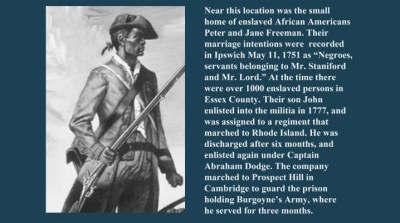 John Freeman, an African American Revolutionary War Soldier from Ipswich - John Freeman, son of enslaved Peter and Jane Freeman of Ipswich, enlisted into the militia of the Revolutionary War in the year 1777, and served in Rhode Island, Providence and Cambridge.… Continue reading John Freeman, an African American Revolutionary War Soldier from Ipswich
  Ipswich, Slavery and the Civil War - In 1765, Jenny Slew, a slave in Ipswich, successfully sued John Whipple Jr. for her freedom. In the mid-19th Century, divisions between ardent abolitionists, moderate anti-slavery people and those who avoided the discussion divided families, churches and the town of Ipswich.… Continue reading Ipswich, Slavery and the Civil War
  Ipswich to Marietta, December 1787 - In December 1787, a group of Revolutionary War veterans and adventurers set out from Ipswich on an 800-mile journey through the wilderness by horseback and rafts to establish the first settlement in the Ohio Territory.… Continue reading Ipswich to Marietta, December 1787
  Her Name Was Patience - "Know all men by these presents I, Thomas Burnam of Ipswich, do by these presents bargain, sell, sett over and confirm unto the said Robert Dodge, a negro girl known by the name of Patience...To have and to hold said negro girl Patience during her natural life."… Continue reading Her Name Was Patience
  Freedom for Jenny Slew - Jenny Slew was born about 1719 as the child of a free white woman and a black slave. She lived her life as a free woman until 1762 when she was illegally enslaved by John Whipple. Jenny Slew is believed to be the first person held as a slave to be granted freedom through trial by jury.… Continue reading Freedom for Jenny Slew
  Col. Doctor Thomas Berry, “Last of the Ipswich Aristocracy” - In the first half of the Eighteenth Century, Col. Thomas Berry was the most conspicuous citizen of the Town, "Autocrat of his time, Magistrate, Military leader, Physician and Statesman."… Continue reading Col. Doctor Thomas Berry, “Last of the Ipswich Aristocracy”
  Choate-Caldwell House, Formerly at the Corner of Elm and County Streets, Now at the Smithsonian - In 1963 this house was slated for destruction, but through the efforts of local preservationists was relocated to the Smithsonian where it resides as the Museum’s largest artifact on permanent display.… Continue reading Choate-Caldwell House, Formerly at the Corner of Elm and County Streets, Now at the Smithsonian
  Chance Bradstreet, a “Negro boy” enslaved in Ipswich. - (This story was made possible by research conducted by Christopher Challender Child and Marblehead historian Bob Booth.) In 1764, Marblehead’s Second Congregational Church’s minister, Simon Bradstreet, moved into a new mansion house with his wife Mary (née Strahan) Bradstreet, whom he had married in 1738. They were accompanied by an African American enslaved woman called… Continue reading Chance Bradstreet, a “Negro boy” enslaved in Ipswich.
  Abolition and the Underground Railroad in Essex County - A network of the Underground Railroad ran north along the coast from Boston to Salem, where it split into three trails; one continued through Beverly, Ipswich, Newburyport and West Newbury to Amesbury where escaped slaves were escorted into New Hampshire. … Continue reading Abolition and the Underground Railroad in Essex County
  19th Century: Religion Divided the Town - Revivalist Rev. John N. Maffit held a "protracted meeting" which was undoubtedly the most extraordinary episode in the history of the churches of Ipswich since the days of George Whitefield and Gilbert Tennent, preaching sixty nights to congregations which occupied every inch of the meeting-house. … Continue reading 19th Century: Religion Divided the Town
  “Dying Confession of Pomp, a Negro Man Who Was Executed at Ipswich on the 6th August, 1795” - On Aug 6th 1795, Pomp an African-American slave was hung for chopping off the head of his master. He was confined in Ipswich jail, and a sentence of death was passed. He was held there until the day of his execution, which was attended by a "cheering crowd of thousands" after a sermon by Rev. Dana.… Continue reading “Dying Confession of Pomp, a Negro Man Who Was Executed at Ipswich on the 6th August, 1795”
  Historic Ipswich
Gordon, excellent piece. Wow, so many Ipswich men died in the Civil War.
“Slavery ended with the Civil War, but the Electoral College survives today as a historical remnant of slavery.” Very interesting point …
And thank you Helen for your wonderful articles on this blog. They can be viewed at https://storiesfromipswich.org/author/helenbreen01/