
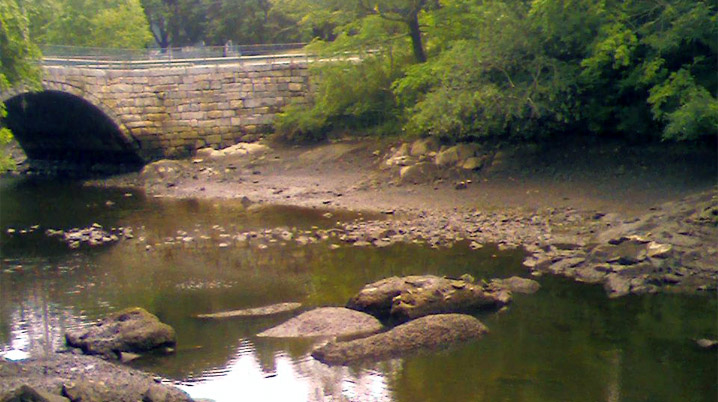
Until 1957, the town of Ipswich had no public sewer system, and the sewage treatment plant finally became operational 18 years later. Previous to that, the creation of a sewage system had been defeated at every year at town meetings and elections since 1928. Untreated sewage and feces flowed down the Ipswich River and collected in the Cove below the County Street Bridge.
In Volume III of Tales of Olde Ipswich, published in 1977, Harold Bowen wrote about the town’s failed attempt to trap the sewage by building a dam just above the Green Street Bridge:
“For years before the sewerage system was installed in Ipswich, much of the effluent flowed into the Ipswich River. At low tide, the odor from this sewage was almost unbearable, particularly in the Cove area. In about 1934 the late Chester Bolles, whose home was on Turkey Shore Road, thought of an idea that would eliminate this odor and was willing to donate $500 towards the project. His idea was to contract a dam three feet high across the river just above the Green Street bridge. In this way, even at low tide, there would be three feet of water in the Cove at all times.

“The idea was a good one. It was during the time of the Great Depression and many people were out of work and had been assigned to the government W.P.A. project. This was a program in which the government provided funds to carry out worthwhile projects that would create employment. The town accepted Mr. Bolles’ offer and sought further funds from the government. These funds were approved and work began in the late fall of 1934.
“However, it was a poor time to build a dam. First, the winter was very severe and at times when the cement was being poured the temperature was below zero and the freshet in the river was very high. The only reason the project was being done at this time was because the men needed work. Forms were washed away and the pounding of the fast-flowing water was too much for the new cement. The center of the dam was soon washed away, and by spring the new structure had almost disappeared.” (Read more stories by Harold Bowen)
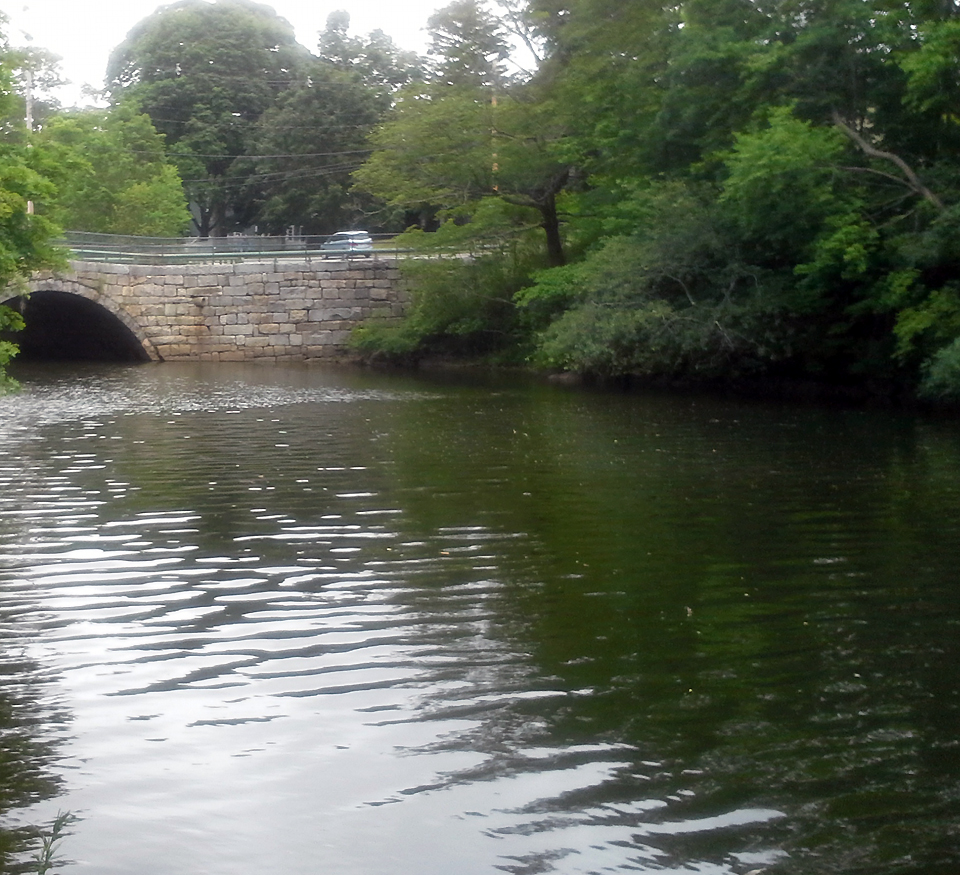
In March 1933, Congress created the Civil Conservation Corps (CCC). On May 6, 1935, President Roosevelt issued Executive Order 7034, establishing the Works Progress Administration, employing millions of men to carry out public works projects. It was through these programs that the old jail on Green Street was demolished, and the short-lived Green Street dam was constructed. The Annual Ipswich Town Reports from that period provide scant information about the dam:
- 1933: Several members of the Unemployment Committee were appointed, including Selectman Brainard Wallace, and member Thomas H. Reedy, who received payments in the town report for his work on misc. projects. $1,000 was appropriated for use by the Committee as the Town’s proportion against C.W.A. projects. Among the eight projects listed were “Ipswich River Bulkhead” but it is unclear if this refers to a dam.
- The 1934 Annual Report stated: “Robert W. Martell was drowned at the dam of the Green Street bridge.
- The 1936 annual report lists several small expenses for the “dam project.”
- The 1937 annual report, listed a single contract payment for the Green Street Dam: Thomas H. Reedy $3,800.00. Transferred from W. P. A. $5,000.00. Unexpended Balance $1,200.00. The town’s Unemployment Committee had hired one of its own members to construct the dam!
- The 1938 annual report states: “Green Street Dam: Contract Payments, Thomas H. Reedy $1,000.00. Balance, Jan. 1, 1939, $1,200.00. Unexpended Balance $200.00.”
- The 1939 and 1940 reports show the same unexpended balance of $200.00.
Attempts were made to finish the dam after its initial failure, but plans were put on hold when the United States entered World War II. Selectman Brainard Wallace, who was also the WPA agent, provided more information about the dam in the 1941 annual report: “There is at the present time set up in Washington a board known as the Federal Works Reserve Board for the purpose of drawing up a nation-wide program of public works projects to be carried on in the future… to include the construction of a retaining wall around the entire waterfront, with the reconstruction of the Green Street Dam, together with the improvement of the area now used as a town dump and the erection of permanent bleachers at the football field.” He repeated this statement the following year, but by that time the CCC had been terminated, followed by the WPA in June 1943.
In 1947, the Board of Selectmen voted to “close the lower Ipswich River to swimming from the dam at the Sylvania plant to the Town Wharf …and that it be kept closed until such time as a sewerage system has been installed.” In 1953, the State Department of Public Health gave notice to the Town that “if the nuisances were not abated the State would institute legal proceedings to command the Town to construct a sewer system.” In 1957, construction of Stage I of the Sewerage System was approved by the voters with the $600,000 bond issue to be borne by the Town, and $143,000 granted by the Federal Government. Odoriferous Farley Brook was put underground in the downtown parking area. It would be 1977 before an operational sewer plant was constructed, “a source of pride to the Town.”
 Historic Ipswich
My wife’s grandfather. It was always called “ Bolles folly” when I was growing up in Ipswich in the 50’s and early 60’s l
I remember hearing about this project as a child, my grandfather was Chester Bolles. It’s a shame the timing was Off.
Sent from my iPad
>