

(This story was made possible by research conducted by Christopher Challender Child and Marblehead historian Bob Booth.)
In 1764, Marblehead’s Second Congregational Church’s minister, Simon Bradstreet, moved into a new mansion house with his wife Mary (née Strahan) Bradstreet, whom he had married in 1738. They were accompanied by an African American enslaved woman called Phyllis and her two-year-old son, Chance. When Rev. Bradstreet intestate died in 1771, the appraisal of his inventory listed, “Negro Woman Phillis [£]28. Negro Boy Chance [£]40.”
An announcement was published in the Essex Gazette, March 16, 1773, two years after Bradstreet died: “We hear from Marblehead, that the Rev. Mr. ——- [Story] of that Place lately re-married his Negro Woman to a Negro Man, who were, about nine or ten Years ago, imperfectly joined together, by the Rev. Mr. ———- [Bradstreet], the former Master of the Woman. —- That Rev. Gentleman, deceased, had made an egregious Blunder, in not obliging the Negro Man, by Promise, to maintain his Wife in the late Ceremony conscientiously rectified, by the Rev’d Son-in-law and Successor. An Instance of Prudence, religious Zeal, and final Respect, which is not expected that many Christians will have the Firmness to imitate.”
Ownership of Chance was assumed by Bradstreet’s son-in-law, the Reverend Isaac Story, who had succeeded Bradstreet as pastor of the Marblehead church. In the Marblehead Vital Records under Marriages, Negros, there are listings for “Story, Fillis [Priscilla. int.], and Francis Glover, Feb. 26, 1773” and “Story, Phillis, and Mark Pedrick, Oct. 21, 1779.”
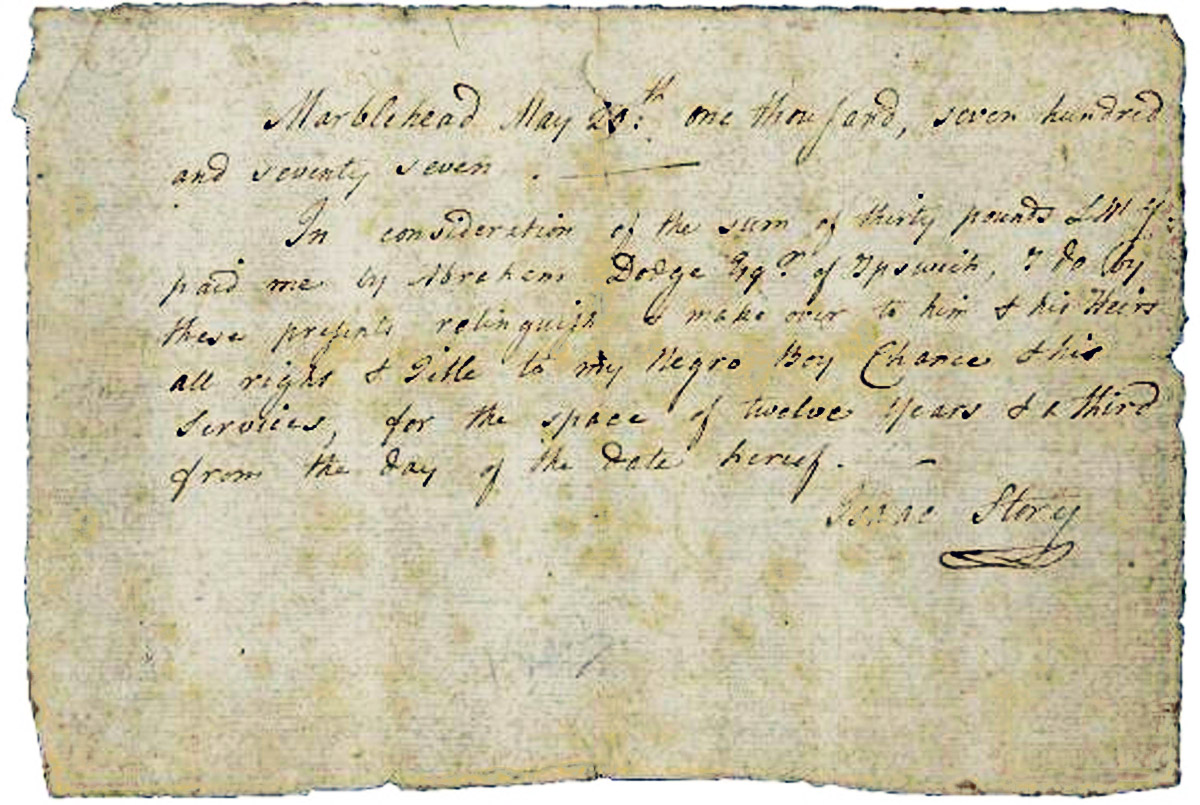
On May 20, 1777, Rev. Isaac Story leased Chance (now fourteen years old) for a period of twelve years to his in-law, Capt. Abraham Dodge of Ipswich, for £30. Abraham Dodge, born in Ipswich in 1740, was the son of prosperous merchant William Dodge and his wife Rebecca Appleton, and as an adult engaged in shipping. Returning to Ipswich from the West Indies in Feb. 1770, his schooner grounded on the Ipswich Bar as it returned, and his vessel and cargo were reported a total loss. He married Abigail Cogswell in April 1762, and after her death, he married the widow Bethiah Staniford in 1781, who died in April 1829 at age 87.
Captain Dodge was in charge of a group of soldiers from Ipswich and Chebacco Parish (now the town of Essex) in Col. Moses Little’s 12th Continental Regiment. Ironically, among his troops was John Freeman, a young black man from Ipswich who signed up with Dodge’s company after his first tour of duty. The Genealogy of the Dodge Family states that his business affairs suffered during his absence, resulting in his estate becoming insolvent.

Chance was a member of the household when Col. Dodge purchased the former 16 Elm Street in Ipswich after his service in the War. In 1963, the Smithsonian acquired the house, which is now the centerpiece of the “Within These Walls” exhibit at the National Museum of American History in Washington.

Chance was listed as property in Col. Abraham Dodge’s 1786 will and was hired out to work by Abraham Dodge’s widow and son Abraham. This would have been illegal, for the Massachusetts Constitution, adopted in 1780, had outlawed slavery, and the 1783 Quock Walker case ruled that slave owners had no recourse in court. Chance probably gained his freedom in 1789 when the lease from Isaac Story expired, and he was living in Marblehead in the 1790s. We have no further records of Chance Bradstreet until the record of Chance’s death in 1810 lists him as Chance Bradstreet, indicating that he kept the surname of Simon Bradstreet.
Sources and Further Reading:
- American Ancestors: Chance Bradstreet (1762-1819), Servant of Abraham Dodge of Ipswich, Massachusetts
- Waters, Thomas Franklin: “Ipswich in the Massachuetts Bay Colony” Vol. II
- National Museum of American History: “Finding new stories in an old house: Chance Bradstreet and “Within These Walls “
- Archive.org: Genealogy of the Dodge family of Essex County, Mass. 1629-1894, Abraham Dodge
- Wikitree: Abraham Dodge
- Childs, Christopher: American Ancestors: “Updating an Exhibit.“
- Smithsonian, Nodjimbadem Katie: “Newly Uncovered Documents Address the Mystery of One Slave’s Life
- National Park Service: African Americans in Essex County
- Historic Houses of New England: Simon Bradstreet House
- The Free and Enslaved People of Color in Marblehead Online Database
- Harris, Gordon: Historic Ipswich, “John Freeman, an African American Revolutionary War Soldier from Ipswich“
- Harris, Gordon: Historic Ipswich, “Names of the Ipswich Slaves.“
- Harris, Gordon: Historic Ipswich, “Abolition and the Underground Railroad“
- Harris, Gordon: Historic Ipswich, “Choate-Caldwell House, Formerly at the Corner of Elm and County Streets, Now at the Smithsonian“
 Historic Ipswich