

Featured image: Map from Plum Island: The Way It Was by Nancy V. Weare
The Ipswich sandbar, known by local boaters as “the Bar,” has a long history of tragic shipwrecks. Its swift currents and shallow waters are especially dangerous during storms, and many ships have gone aground. In 1802 and again in 1852, the Merrimack Humane Society of Newburyport constructed shelters at Sandy Point for shipwreck victims, and massive timbers can still be seen protruding from its dunes. Several ships that made safe passage between Sandy Point and Crane Beach went ashore at Steep Hill Beach, where the remains of the Ada K. Damon protruded from the sand until a few years ago.
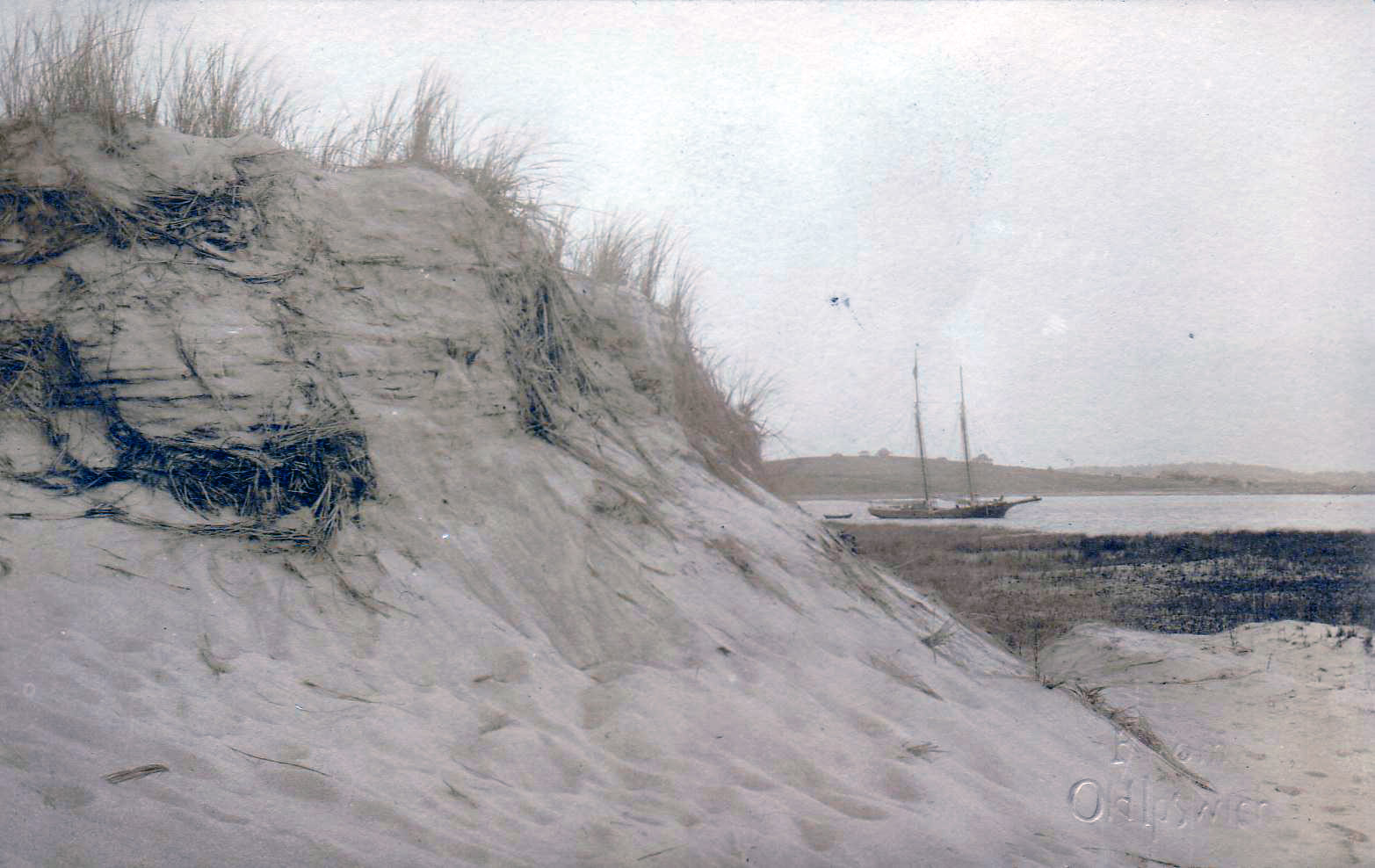
Records of the loss of small boats began in the 18th century. They went aground on the beach or on the bar in winter. The boats’ crew, attempting to reach shore, died in the surf or on the beach. As those buried in the sand did not stay buried, a cemetery was established for them on Bar Island (the original name of Bar Head, the drumlin at the end of Plum Island).

Among the disasters of greater magnitude was the wreck of the Falconer, a 360-ton brig from Belfast captained by Joseph Rolerson, of the same city. She was transporting 350 tons of coal from Cape Breton, Nova Scotia, to Boston when she encountered the northeaster of December 15, 1847. The ship carried 53 passengers and crew, and the wreck resulted in 17 deaths. After a funeral procession winding through Ipswich, they were interred in a mass grave at the Old North Burying Ground, except for the captain and his family, who were shipped back to Belfast.

On December 3, 1849, the ship Nancy, with a cargo of bricks, went aground on Plum Island at Emerson’s Rocks. The crew of five was lost. A year later, on December 24, 1850, the Argus with a cargo of worked stone also foundered on Emerson Rocks. The captain and some of the crew were lost. The footprints of two of them tracked through the snow to a thicket, where they were found dead.
The Genealogy of the Wilcomb Family continues the list of Ipswich shipwrecks.
- 1872.
- Schooner “J. R. Lawrence” went ashore on Plum Island. The Schooners “J. A. Ford” and “Harriet Samantha” wrecked on Oct. 26. The Schooner “James Freeman” sank in Ipswich Bay. The brig “Ida C.” went ashore on the beach on February 20.
- 1878.
- A sand schooner was destroyed on Ipswich bar in a storm on April 20.
- Schooner “Hop Vine” went ashore on Ipswich bar, Sept 6.
- Schooner “Sarah Ann” went ashore on Ipswich bar on November 2.
- 1879. Schooner “G. F. Higgins” was driven ashore on the point on August 20, 1881.
- Schooner “Alice Oakes” was wrecked on Ipswich bar on June 10.
- Schooner “Lucy K. Cogswell” sunk by collision with Stmr. Wm. Crane.
- 1883. Steamship “City Point wrecked on Plum Island and is a total loss.
- 1884. Schooners “Alfaretta” and “Ella M. Johnson” wrecked on Plum Island.
- 1885:
- Schooner “Isabella Thompson” wrecked on Castle Neck and three drowned.
- Schooner “Beta” wrecked on Plum Island, April 7, and three drowned.
- Schooner “Lizzie” of Machias, Me., wrecked on Ipswich bar.
- Schooner “Mark Gray” was seriously damaged by a collision.
- Schooner “Franklin” wrecked on Plum Island on Nov. 13
- 1886.
- Schooner “Lizzie” of Machias, Me., wrecked on Ipswich bar.
- Schooner “Mark Gray” was seriously damaged by a collision.
- Schooner “Franklin” wrecked on Plum Island on Nov. 13.
- 1887: Schooner “E. M. Branscome” wrecked in Ipswich Bay.
- 1889:
- Schooner “Isaac Chaplain” went ashore on Bar Island end, on Mar. 5.
- A schooner loaded with sand for Boston sank in Ipswich River.
- 1892:
- Sand schooner W. H. V. Hackett went ashore on Little Neck in Feb.
- The schooner Jonathan Cone went ashore on the beach on Nov. 21.
- 1893.
- The schooner Celia went ashore on Ipswich bar on April 18.
- Schooner A. Baker went ashore on Ipswich bar on Dec. 15.
- 1894. Schooner E. F. Willard, of Portland, wrecked on the beach on Feb. 5.
Wrecks of the Sand Schooners

Sand schooners delivered sand from local beaches to Boston to be used in concrete for the construction industry. The captains would bring the schooners broadside to a beach at high tide and anchor the bow and stern. A long gangplank would be extended from the ship for men to roll wheelbarrows full of sand, which would be dumped into the hold.
In January 1894, the sand schooner A. Baker sank and was abandoned in Plum Island Sound near the southerly end of Plum Island in Ipswich, and was an obstruction to navigation. Upon investigation, it was found that the owner had no means of removing her. The matter rested for a while until Mr. Anton Graf of Georgetown removed the wreck for $195 on May 29, 1894. (from the Annual Report of the Board of Harbor and Land Commissioners of Massachusetts). In October 1922, the Edward S. Evelyth rolled over when a wave rushed over her deck and pushed her onto the edge of the beach. Filled with sand, each tide buried her deeper. Her remains were visible for several years.
In 1909, Capt. A. K. Brewster sold his farm in York, Maine, and invested everything in the sand schooner Ada K. Damon. The ship was wrecked during the “Great Christmas Snowstorm” on his first trip for a load of sand from the plentiful supply on Plum Island. On the 26th of December, she stranded 3.5 miles south-southwest of the Plum Island Coast Guard station. The gale swept down from the northeast, thick with snow, the anchors dragged and parted, and the ship wrecked at Steep Hill Beach at high tide.


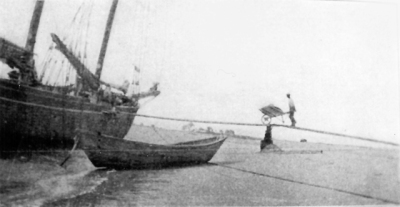


The 66-ton schooner M. L. Wetherell, named after a Gloucester pharmacist, was built in Essex, MA in 1865, owned or fitted by Henry Hardy, and is among the 1887 Gloucester List of Vessels. In the early years, it fished in the Gulf of St Lawrence along with the William W. Hutchins of Gloucester. The ship had several tragic stories.
In the book Down to the Sea, we read that in October 1870, Albert Faulk was lost overboard from the M. L. Wetherell. The following year, Finley McFadden, Michael Key, and Thomas Mackay were lost as well. On April 11, 1872, George T. Sanford, of Deer Isle, Maine, and Alex McDonald, of Prince Edward Island, were lost on Grand Bank from the schooner M. L. Wetherell.
There is an odd report by the Rye Beach Life Saving Service of a man who was adrift in a boat belonging to the M.L. Wetherell, and was rescued near the Rye Beach Station on the coast of New Hampshire: “While going from Newburyport to Plum Island, the boatman broke an oar and was carried out to sea on the ebb tide, and drifted all night before a southwest wind. In the morning, he was seen and rescued by the Rye Beach life-saving crew, who gave him breakfast, provided spare oars, and replenished his supply of clothing. When he was sufficiently refreshed (the wind having hauled meanwhile and moderated), he left the station to pull down the coast to his vessel, the schooner M. L. Wetherell, 13 miles distant.”
In the History of Newburyport, John J. Currier wrote that on December 6, 1891, the schooner M. L. Wetherell, loaded with sand, was stranded near Lighthouse Point at the northern end of Plum Island, MA. The vessel was a total loss.
The Thomas H. Lawrence
Coal schooners were generally larger with three masts. The 374-ton Thomas H. Lawrence stranded at Crane’s Beach on September 4, 1939. A channel was dug, and the ship was refloated.


Other sources:
- Annual Report of the Operations of the United States Life-saving Service, Gloucester, MA, documents.
Shipwrecks
 Wrecks of the Coal Schooners - Walking near Steep Hill Beach, you might be surprised to see lumps of anthracite coal lying on the sand. This would be a mystery were it not for the tragic history of brigs and schooners transporting coal in the 19th century.… Continue reading Wrecks of the Coal Schooners
  Wreck of the Watch and Wait, August 24, 1635 - Many ships and lives were lost in the Great Colonial Hurricane, including 21 passengers who had set out from Ipswich on August 21, 1635 on a small bark named "Watch and Wait." As they rounded Cape Ann they were suddenly met by the force of the winds.… Continue reading Wreck of the Watch and Wait, August 24, 1635
  Wreck of the Hesperus, Dec. 15, 1839 - "It was the schooner Hesperus,
That sailed the wintry sea;
And the skipper had taken his little daughtèr, To bear him company."… Continue reading Wreck of the Hesperus, Dec. 15, 1839
Wreck of the Hesperus, Dec. 15, 1839 - "It was the schooner Hesperus,
That sailed the wintry sea;
And the skipper had taken his little daughtèr, To bear him company."… Continue reading Wreck of the Hesperus, Dec. 15, 1839  Wreck of the Falconer, December 17, 1847 - On December 17, 1847 the brig Falconer, loaded with bituminous coal, wrecked at Crane Beach during a fierce winter storm. A dozen of the crew and passengers are buried in a common grave at the Old North Burying Ground. … Continue reading Wreck of the Falconer, December 17, 1847
  Wreck of the Edward S. Eveleth, October 1922 - In October 1922, the sand schooner Edward S. Eveleth rolled over when a wave rushed over her deck and pushed her onto the edge of Steep Hill Beach. Filled with sand, each tide buried her deeper. Her remains were visible for several years. The skeleton of the hull is just off-shore a short distance from the wreck of the Ada K. Damon.… Continue reading Wreck of the Edward S. Eveleth, October 1922
  Wreck of the Deposit, December 23, 1839 - Dec. 23, 1839 two days before Christmas a storm caught the schooner "Deposit" on her passage out of Belfast, Maine. Capt. Cotterall was lost, and several of the crew were buried at the Old South Cemetery.… Continue reading Wreck of the Deposit, December 23, 1839
 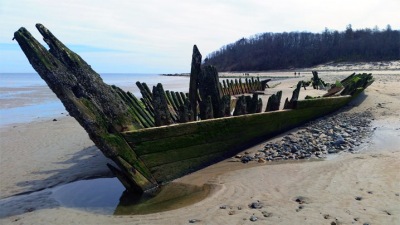 Wreck of the Ada K. Damon - Christmas, 1909 witnessed the heaviest storm in many years. The ship was wrecked during the captain's first trip for a load of sand from the plentiful supply on Plum Island.… Continue reading Wreck of the Ada K. Damon
  The Spectre Ship of Salem - On the fourth day after the ship left port, the sun came out and in the distance could be seen the same ship sailing effortlessly back into port directly into the wind. As the Noah’s Dove approached, its passengers including the young couple were visible but ghost-like.… Continue reading The Spectre Ship of Salem
  The Shipwrecks at Ipswich Bar - The Ipswich Bar has a long history of tragic shipwrecks. Its swift currents and shallow waters are especially dangerous during storms, and many ships have gone aground. The hull of the Ada K. Damon sits on Steep Hill Beach.… Continue reading The Shipwrecks at Ipswich Bar
 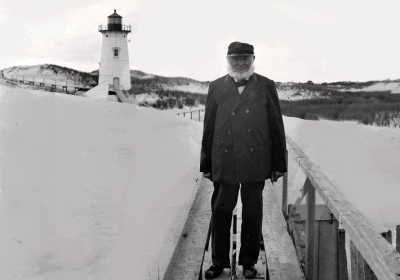 The Ipswich Lighthouse - In 1881, a 45-foot cast iron lighthouse was erected at Crane Beach, replacing an earlier structure. By 1913, the sand had shifted so much that the lighthouse was 1,090 feet from the high water mark. Use of the light was discontinued in 1932 and in 1939 the Coast Guard floated the entire lighthouse to Edgartown on Martha's Vineyard.… Continue reading The Ipswich Lighthouse
  The Great Colonial Hurricane and the Wreck of the Angel Gabriel, August, 1635 - In August 1635, the 240-ton Angel Gabriel sank in Pemaquid Bay after sailing into the most intense hurricane in New England history. Among the survivors were members of the Cogswell, Burnham and Andrews families, who settled in an area of Ipswich known as Chebacco.… Continue reading The Great Colonial Hurricane and the Wreck of the Angel Gabriel, August, 1635
 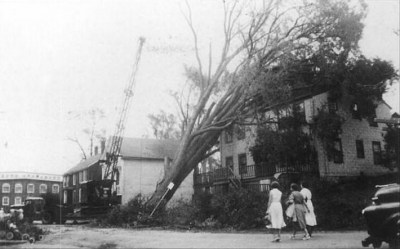 Hurricanes and Winter Storms - Massachusetts has the highest probability of all of the states to be hit by an ocean storm, which includes hurricanes and nor'easters.… Continue reading Hurricanes and Winter Storms
  Awful Calamities: the Shipwrecks of December, 1839 - Three gales of unequaled fury and destructiveness swept along our coast carrying desolation and death in their stormy pathway, and overwhelming many families in the deepest mourning.… Continue reading Awful Calamities: the Shipwrecks of December, 1839
  Historic Ipswich
Excellent work, Gordon. Thank you.