
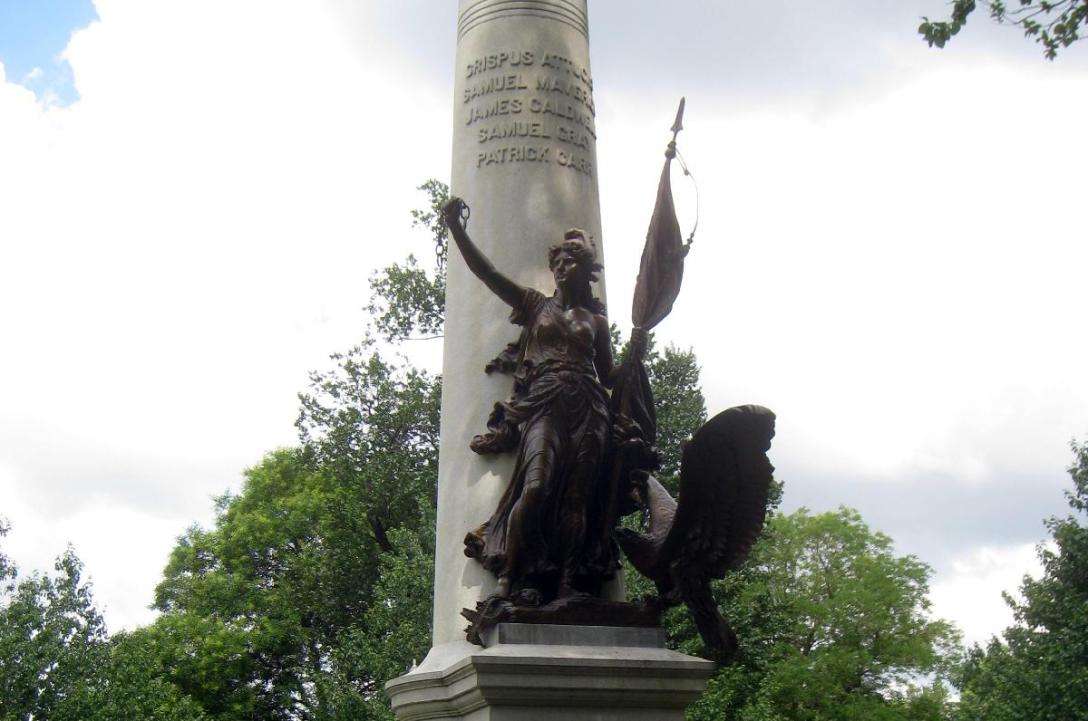
The following is an excerpt from a presentation given on November 14, 1889, at the dedication of the Boston Massacre and Crispus Attucks Monument at Boston Common, which memorializes victims Crispus Attucks, Samuel Maverick, James Caldwell, Samuel Gray, and Patrick Carr.
ADDRESS BY MR. JOHN FISKE
The troubles and disorders in Boston, which led to the Revolution, began soon after the grant of writs of assistance to the revenue officers in 1761. Into the midst of this irritation came the Stamp Act of 1765, a law that was repealed the next year because it was found impossible to enforce it in any of the colonies. The immediate fruits of the Stamp Act were riots in New York and Boston and elsewhere; and one of these riots in Boston was perhaps the most shameful affair in all the history of this town. It is quite characteristic of mob law to strike in the wrong places and to punish those who have not offended. An impression spread that Chief Justice Hutchinson had favored the passage of the Stamp Act and had acted as an informer against certain merchants suspected of breaking the revenue laws.
This impression was entirely incorrect, but under the influence of it, one night in August, 1765, a drunken mob broke into Mr. Hutchinson’s house, threw his furniture and pictures into the street, and destroyed the noble library which he had been thirty years in collecting, and which contained many priceless historical documents, the loss of which can never be repaired. Let us here particularly observe that this disgraceful affair was at once disowned and condemned by the people of Boston. The next morning, before Governor Bernard had time to summon the Council, a town meeting in Faneuil Hall had expressed its abhorrence of the work of the rioters, and similar expressions of feeling were soon heard from town meetings all over the Commonwealth. The ringleaders were imprisoned, and the Legislature, chosen by the people, hastened to indemnify Mr. Hutchinson, so far as possible, for the damage inflicted by the mob.
Affairs in Boston, reported with gross exaggeration by the Governor and revenue commissioners to the ministry, produced in England the impression that Boston was a lawless and riotous town, full of cutthroats and blacklegs, whose violence could only be held in check by martial law. Of all the misconceptions of America by England, which brought about the American Revolution, perhaps this notion of the extreme turbulence of Boston was the most ludicrous. During the ten years of excitement which preceded the war of independence, if we except the one shameful riot in which Hutchinson’s house was sacked, there was much less uproar and confusion in Boston than might reasonably have been expected. In all this time, not a drop of blood was shed by the people, nor was anybody’s life for a moment in danger at their hands. The only fit ground for wonder is that they behaved themselves so quietly.
The disturbance attending the seizure of John Hancock’s sloop “Liberty” was a fair sample of the disorders which occurred at moments of extreme excitement. Even before the affair of the “Liberty,” the Government had made up its mind to send troops to Boston. The avowed purpose in sending them was to preserve order, and such events as the sacking of Hutchinson’s house must have gone far toward creating in England a public opinion which should sanction such a measure. But beneath this avowed purpose lay the ultimate purpose, on the part of the king and his friends, of intimidating the popular party and enforcing the Townshend Acts.
The people of Boston understood this perfectly well. They knew that the Townshend Acts were contrary to the whole spirit of the British constitution, and in this they were at one with many of the ablest and most liberal statesmen of England. There were no disorders that had not directly originated in British aggression, not one. Let this unjust and mischievous act of legislation be repealed, and there would be no disorders to repress. Whatever the ostensible purpose by which the sending of these troops was justified to the British people, there could be no doubt as to its real meaning. It meant the substitution of brute force for argument; it meant military tyranny. And this, I say, the people of Boston knew full well, although some of their descendants seem to have forgotten it.
In September 1768, it was announced in Boston that the troops were on their way and would soon be landed. There happened to be a legal obstacle, unforeseen by the ministry, to their being quartered in the city. In accordance with the general act of Parliament for quartering troops, the regular barracks at Castle William in the harbor would have to be filled before the town could be required to find quarters for any troops. Another clause of the act provided that if any military officer should take upon himself to quarter soldiers in any of His Majesty’s dominions, otherwise than as allowed by the act, he should straightway be dismissed from the service.
At the news that the troops were about to arrive, the Governor was asked to convene the Assembly, so that it might be decided how to receive them. On Bernard’s refusal, the selectmen of Boston issued a circular, inviting all the towns of Massachusetts to send delegates to a general convention, so that deliberate action might be taken upon this important matter. In answer to the circular, delegates from ninety-six towns assembled in Faneuil Hall, and, laughing at the Governor’s order to “disperse,” proceeded to show how, in the exercise of the undoubted right of public meeting, the colony could virtually legislate for itself in the absence of its regular Legislature.
The convention, finding that nothing was necessary for Boston to do but insist upon strict compliance with the letter of the law, adjourned. In October, two regiments — the Fourteenth and Twenty-ninth — arrived and were allowed to land without opposition, but no lodging was provided for them. Governor Bernard, in fear of an affray, had gone out into the country, but nothing could have been further from the thoughts of the people. The commander, Colonel Dalrymple of the Fourteenth, requested shelter for his men, but was told that he must quarter them in the barracks at Castle William. As the night was frosty, however, they were compassionately allowed to sleep in Faneuil Hall.
The next day, the Governor, finding everything quiet, came back and heard Dalrymple’s complaint. But in vain did he apply in turn to the Council, to the selectmen, and to the justices of the peace, to grant quarters for the troops: he was told that the law was plain, and that the Castle must first be occupied. The Governor then tried to get possession of an old dilapidated building which belonged to the colony, but the tenants had taken legal advice, and told him to turn them out if he dared. Nothing could be more provoking. General Gage was obliged to come on from his headquarters at New York, but not even he, the commander-in-chief of His Majesty’s forces in America, could quarter the troops in violation of the statute, without running the risk of being cashiered on conviction before two justices of the peace.
So the soldiers stayed in tents on the Common until the weather grew so cold that Dalrymple was obliged to hire some buildings for them at exorbitant rates and at the expense of the crown. By the time this question was settled, two more regiments — the Sixty-fourth and Sixty-fifth — had arrived, and were quartered in some large storehouses on “Wheelwright’s wharf.” The Fourteenth was quartered in a building on Brattle Street, owned by James Murray, and henceforth known as “Murray’s Barracks.” The Twenty-ninth was quartered between King and Water streets, and the main guard was accommodated in King Street near the Town House. Small detachments were posted at the ferries and on Boston Neck, and two cannon were planted on King Street with their muzzles pointing toward the Town House — for what purpose it would be hard to say; but it could hardly be otherwise interpreted by the people than as a menace and an insult.
No sooner were the soldiers thus established in Boston than Samuel Adams published the series of letters signed “Vindex,” in which he argued that to quarter an army among the people of Massachusetts without the consent of the Legislature was as unjustifiable and as gross a violation of the Bill of Rights as it would be to quarter an army in London without the consent of Parliament. In other words, the troops were intruders and trespassers in Boston; they had no right to be here at all, since the Government had transcended its constitutional powers in sending them.
This was part and parcel of Adams’ doctrine, that the Massachusetts Legislature was as supreme in Massachusetts as the Parliament in Great Britain; that Americans must be governed by lawmakers chosen by themselves, and not by lawmakers chosen by other people. It was to maintain this doctrine that the Revolutionary War was fought; and our forefathers, who maintained it, were quite right in holding that the soldiers were intruders, who might with entire propriety be warned off the premises or forcibly ejected, should occasion require it.
For the present, the milder course of petition to the king was the proper one; and in the annual March meeting of 1769, a paper was adopted, praying for the removal of the troops. In April, the ministry, without consulting Governor Bernard, instructed General Gage at New York to use his own discretion as to keeping the troops at Boston or withdrawing them. Early in June, Gage ordered the Sixty-fourth and Sixty-fifth Regiments away from Boston, and in the letter in which he advised Bernard of this order, he asked him if it would not be better to remove the other two regiments also.
The citizens, hearing of this, held a town meeting and declared that the civil magistrates were quite able to protect life and property, so that the mere presence of the troops was an insult to the town. Bernard, however, wrote to Gage that it would not be prudent to remove the troops, though perhaps one regiment in the town and one at the Castle might be enough. The result was that nothing more was done, and the Fourteenth and Twenty-ninth Regiments remained at their quarters. In July, Bernard sailed for England, leaving affairs in the hands of Hutchinson as lieutenant-governor.
While these things were going on, the soldiers did many things that greatly annoyed the people. They led brawling, riotous lives, and made the quiet streets hideous by night with their drunken shouts. Scores of loose women, who had followed the regiments across the ocean, came to scandalize the town for a while, and then to encumber the almshouse. On Sundays, the soldiers would race horses on the Common or would play “Yankee Doodle” just outside the church doors during the services. Now and then, oaths, or fisticuffs, or blows with sticks were exchanged between soldiers and citizens, and at length a much more serious affair occurred.
One evening in September, a dastardly assault was made upon James Otis at the British Coffee House by one Robinson, a Commissioner of Customs, assisted by half a dozen army officers. It was a strange parallel to the assault upon Charles Sumner by Brooks of South Carolina, shortly before the War of Secession. Otis was savagely beaten and received a blow on the head with a sword, from the effects of which he never recovered, but finally lost his reason. The popular wrath at this outrage was intense, but there was no disturbance. Otis brought suit against Robinson and recovered two thousand pounds in damages, but refused to accept a penny of it when Robinson confessed himself in the wrong, and humbly asked pardon for his irreparable offence.
During the next six months, the tension of feeling steadily increased. Dr. Franklin wrote from London that he lived in constant dread of the news of some outbreak that might occasion irreparable mischief. In the course of February, 1770, there was an unusual number of personal encounters. In one or two instances, criminals were forcibly rescued from the hands of the constable. Citizens were pricked with bayonets. On the 22d of that month, a well-known informer named Richardson, being pelted by a party of school-boys, withdrew into his house, opened a window, and fired at random into the crowd, killing a little boy, Christopher Seider, about eleven years of age, and severely wounding a son of Capt. John Gore. The funeral of the murdered boy took place on Monday, the 26th, and was attended by a grand procession of citizens.
It was with some difficulty that Richardson, on his way to jail, was protected from the wrath of the people. On his trial in April, he was convicted of murder, but after two years in prison was pardoned. We can well understand that the state of feeling in the days following the little boy’s funeral must have been extremely intense. Quarrels and blows were constantly occurring that week. The Twenty-ninth Regiment, according to Hutchinson, contained a number of rough and ill-disciplined fellows, and as their quarters were very near Mr. John Gray’s ropewalk, they came into frequent collision with the workmen.
On Friday, things assumed a decidedly warlike aspect. About noon, a soldier put his head into one of the windows of the ropewalk and gave vent to his spleen in oaths and taunts, until presently a workman came out and knocked him down, while another took away his sword. The soldier then went to the barracks and returned with a dozen companions armed with clubs. A fight ensued, in which the soldiers were worsted and beat a retreat. Presently, they returned again, reinforced to the number of thirty or forty; but all hands in the ropewalk were now ready to receive them, and they were again beaten off with bruises and scars. Cutlasses were used, and some blood was drawn, though no one was seriously hurt.
On Saturday, Colonel Carr, commander of the Twenty-ninth, complained to Governor Hutchinson, and on Monday the complaint was laid before the Council, and several members of that body declared their opinion that the only way of insuring against a deadly affray was to withdraw the two regiments from the town to the Castle. In the afternoon, a handbill was posted by the soldiers, informing the rebellious people of Boston that they were determined to join together and defend themselves against all opponents. There was some anxiety among the citizens, and people gathered in groups on street corners, discussing the situation. The loud and angry threats of the soldiers led many to believe that a massacre was intended. It was time, they said, to wet their bayonets in the blood of these New England people.
At about eight in the evening, a crowd collected near the barracks in Brattle Street. Conspicuous among the throng was a very tall, colored man, who seemed to be acting as a leader. From bandying abusive epithets with the soldiers, the crowd went on to pelt them with snowballs, while, in turn, blows were dealt with the butt-ends of muskets. Presently, Captain Goldfinch, coming along, ordered his men into their barracks for the night, and thus seemed to have stopped the affray. But meanwhile, someone had got into the Old Brick Meetinghouse, opposite the head of King Street, and rang the bell; and this, being interpreted as an alarm of fire, brought out many more people into the moonlit streets.
It was now a little past nine o’clock. Bands of soldiers and of citizens were hurrying hither and thither, and the accounts of what happened are as disorderly and conflicting as the incidents which they try to relate. There were cries of “Town-born, turn out! The red-coats are going to kill us!” and responses from the soldiers, “Damn you, we will walk a lane through you all!” Between the limits of what are now known as Dock square and School street in the one direction, and Scollay square and Long wharf in the other, there was the surging of the crowd, — not a vast and continuous crowd, but a series of groups of enraged men, gesticulating and cursing, actuated by no definite plan, but simply giving inco- herent utterance to the passions which had been so long restrained, and were at last wrought up beyond endurance.
In Dock Square, a tall gentleman in a large white wig and red cloak “harangued the crowd for a few minutes, and they listened quietly while he was speaking. Who this mysterious person was, or what he said, has never been ascertained. Presently, there was a shout of “Hurrah for the main guard! There is the nest!” and the crowd began pouring into King Street, through Exchange Lane, while the tall colored man, whose name was Crispus Attucks, led a party in the same direction through the lower part of Cornhill, now included in Washington Street.
In front of the Custom House, on the corner of King Street and Exchange Lane, a sentinel was pacing. A few minutes before, as Captain Goldfinch passed by on his way to stop the affray in Brattle Street, a barber’s apprentice had reviled him for having had his hair dressed and gone off without paying. The sentinel knocked the boy down, and was forthwith pelted with snowballs by other boys. While this was going on, the crowd from Dock Square arrived upon the scene, and the sentinel retreated up the steps of the Custom House and called for help. Someone ran to the guard-house and cried, “They are killing the sentinel; turn out the guard! “Captain Preston and seven or eight privates from the Twenty- ninth came up the street upon the double-quick, prodding people with their bayonets and shouting, “Make way, damn you, make way! Are you going to murder people?” asked a sailor. “Yes, by God! Root and branch,” was the reply.
As the soldiers formed in a half-circle around the sentry box, and Preston ordered them to prime and load, the bookseller Henry Knox, afterward major-general in the Continental Army, seized the captain by the coat and warned him that if blood was shed, he would have to answer for it with his life. “I know it,” said Preston.” I hope,” said another gentleman, “you do not intend to fire on the people.” “By no means,” said Preston. The crowd pressed up to the muzzles of the guns, threw snow in the soldiers’ faces, and dared them to fire. Amid the clamor and scurry, there were so many cries of “Fire!” that it would not have been strange had one of them been mistaken for an order. It is most likely that no such order was given by Preston, but all at once, seven of the levelled pieces were discharged, not simultaneously, but in quick succession like the striking of a clock.
The first shot, fired by a soldier named Montgomery, killed Crispus Attucks, who was standing quietly at a little distance leaning upon a stick. The second, fired by one Kilroy, slew Samuel Gray, who was just stepping toward the fallen Attucks. The next Killed was James Caldwell, a sailor, standing in the middle of the street. Samuel Maverick, a boy of seventeen, and Patrick Carr had heard the church bell and come out to see where the fire was. They were shot and mortally wounded as they were crossing the street. Maverick died the next morning, Carr nine days later. Six other men fell, dangerously, but not fatally, wounded.
The church bells now began pealing, the alarm was spread through the town, people flocked by hundreds to the scene, the drums beat to arms, the Twenty- ninth Regiment was called out and drawn up for platoon firing, and a general slaughter seemed imminent, when the arrival of Hutchinson put an end to the tumult. The scholarly lieutenant-governor, in his study in North Square, had heard the bells and supposed there was a fire somewhere; but soon there came knocks at his front door, and flurried and breathless cries that “the troops had risen on the people.”
Making all haste to King Street, he shouted indignantly to Preston, “Are you the commanding officer?” — “Yes, sir.” — “What do you mean by firing on the people without an order from a civil magistrate?” All that could be heard of Preston’s reply was something about saving the sentry. A sudden surge of the crowd pushed Hutchinson in through the door of the Town House. He ran upstairs into the Council Chamber and came out on the balcony. In spite of his Tory sympathies, his lofty character and the memory of his splendid public services still gave him much weight with the people, and they listened quietly as he addressed them.
A court of inquiry was ordered, the soldiers were sent to their barracks, Preston and his squad were arrested, the people slowly dispersed to their homes, and it was three o’clock in the morning before Hutchinson left the scene. In the forenoon the Council advised the removal of the offending regiment, — the Twenty-ninth, — but in the afternoon an immense town meeting, called at Faneuil Hall, adjourned to the Old South Meetinghouse; and as they passed by the Town House, the lieutenant governor, looking out upon their march, judged their spirit to be “as high as was the spirit of their ancestors when they imprisoned Andros, while they were four times as numerous.”
All the way from the church to the Town House, the street was crowded with people, while a committee, headed by Samuel Adams, waited upon the lieutenant governor and received his assurance that the Twenty-ninth Regiment should be removed. As the committee came out from the Town House to carry the lieutenant-governor’s reply to the meeting in the church, the people pressed back on either side to let them pass; and Adams, leading the way with uncovered head through the lane thus formed, and bowing first to one side and then to the other, passed along the watchword, “Both regi- ments or none!” When, in the church, the question was put to a vote, three thousand voices shouted, “Both regiments or none!” and armed with this ultimatum, the committee returned to the Town House, where the lieutenant governor was seated with Colonel Dalrymple and the members of the Council.
Then Adams, in quiet but earnest tones, stretching forth his arm and pointing his finger at Hutchinson, reminded him that if, as royal governor of the province, he had the power to remove one regiment, he had equally the power to remove both; that the voice of three thousand freemen demanded that all soldiery be forthwith removed from the town; and that if he failed to heed their just demands, he did so at his peril. “I observed his knees to tremble,” said the old hero afterward, “I saw his face grow pale, and I enjoyed the sight!”
Before sundown, the order had gone forth for the removal of both regiments to Castle William, and not until then did the meeting in the church break up. This removal of the instruments of tyranny at the behest of a New England town meeting was certainly one of the most impressive scenes in history, and it summed up the coming Revolution as an overture sums up the musical drama to which it is prefixed.
It was four years before British troops were again quartered in Boston, and on the sixth anniversary of the memorable scene in the Council Chamber, General Howe looked with rueful gaze at Washington’s threatening batteries on Dorchester Heights, and decided that it was high time to retreat from the town. When the news of the affray in King Street, and the consequent removal of the troops, reached England, the king’s friends were chagrined, and there was some discussion in Parliament as to whether it would do to submit tamely to such a defeat. It was suggested that the troops ought to be ordered back into the town, when Colonel Barre pithily asked, “If, under the circumstances, the commanders over there saw fit to remove the troops, what minister here will venture to order them back?” As nobody was ready with a reply to this question, the subject was dropped; but for many years afterwards, the Fourteenth and Twenty- ninth Regiments were familiarly known in Parliament as “The Sam Adams Regiments.”
It was the sacrifice of the lives of Crispus Attucks, Samuel Gray, James Caldwell, Samuel Maverick, and Patrick Carr that brought about this preliminary victory of the American Revolution. Their death effected in a moment what seventeen months of petition and discussion had failed to accomplish. Instead of the king’s representatives intimidating the people of Boston, it was the people of Boston who had intimidated the king’s representatives. Nature is apt to demand some forfeit in accomplishing great results, and for achieving this particular result, the lives of those five men were the forfeit. It is, therefore, historically correct to regard them as the first martyrs to the cause of American independence; as such, they have long deserved a monument in the most honorable place that Boston could give for the purpose; and such a place is Boston Common.
Source: Fiske, John: The Boston Massacre, from A memorial of Crispus Attucks, Samuel Maverick, James Caldwell, Samuel Gray, and Patrick Carr, printed by order of the Boston City Council, 1889.
John Fiske (March 30, 1842 – July 4, 1901) graduated from Harvard Law School in 1865. He was an American philosopher and lecturer on American history, and lived in Cambridge, Massachusetts.
 Historic Ipswich