
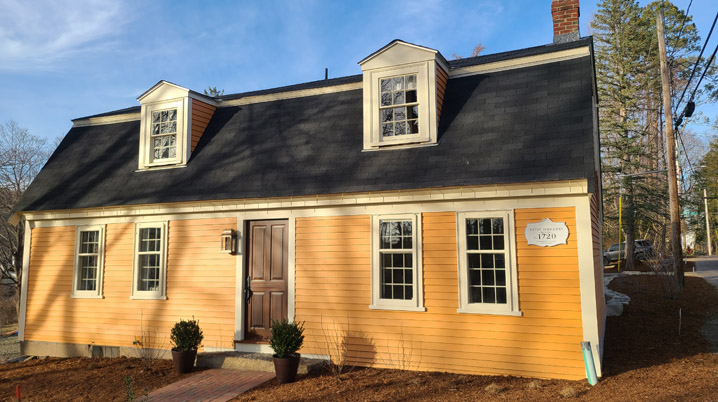
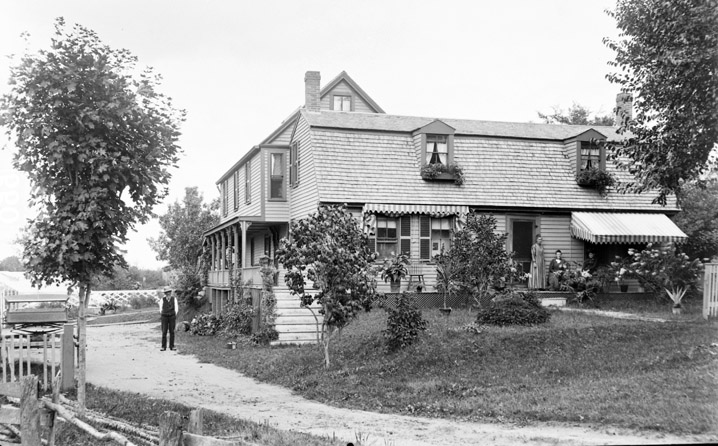
The lot at 48 Turkey Shore Rd. was purchased in 1720 by Nathaniel Hodgkins when he married Abigail Hovey. The house is one of three five-bay gambrel capes in Ipswich, with two windows on either side of a central front doorway. Over the past three hundred years, the house has been significantly altered several times. In 2022, rear additions to the original gambrel house were removed and replaced with a connecting breezeway to a large addition, and a second building was constructed on the property. The entire process was featured on the PBS program This Old House.
The oldest section of the house at 48 Turkey Shore Road is believed to have been built by Nathaniel Hodgkins in 1720 on land formerly owned by Daniel Hovey. The house stayed in the Hodgkins family until 1813, and in the Andrews family for the next half-century. In 1886, Benjamin Fewkes purchased the property, and it remained in possession of the Fewkes family until 1948.
The house was greatly altered in the 19th Century with the removal of the central chimney, which permitted the construction of a more generous central stairway. In the early 20th Century, interior and exterior walls were reframed, and electrical and plumbing systems were added. The remaining post and beam construction, including beaded corner posts, and the existence of the early stone central chimney base, along with the deeds, are the primary indicators of its early construction. The gambrel roof precludes construction before the early 18th Century.
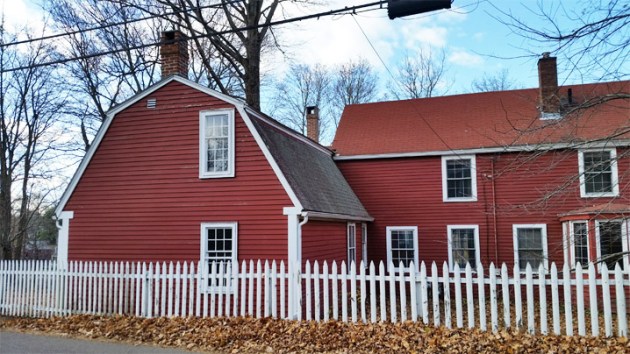
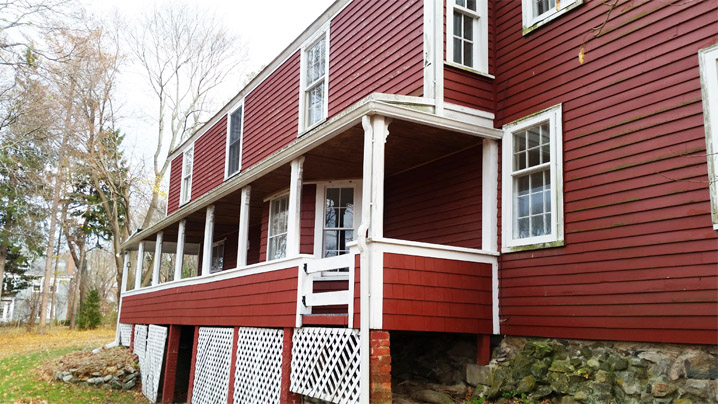
The former rear ell was almost certainly constructed at the same time as an attached kitchen and utilitarian building. A cantilevered second floor was added to the ell in the 19th Century. These additions were removed and new additions were added in 2022 in a This Old House project.
Before and after the This Old House construction


Cape Ann Gambrels
For thirty years, the late Prudence Fish recorded the small gambrel roof houses of the Gloucester fishermen that dotted the shoreline of Cape Ann in the 18th century. All of the houses she studied, including this one, were constructed facing south. Of approximately 350 that were constructed in the 18th century, there are about 50 still standing. This gambrel cottage is one of only three in Ipswich, including the Joseph Fowler house (1720 – 1756) at 100 High Street (which is believed to have been moved from Mineral St.) and the nearby Francis Merrifield – Mary Wade house (1792), at 9 Woods Lane.
Most, if not all, of the Cape Ann gambrel cottages found in Gloucester and Rockport are 3 or 4 bays, while the three gambrel cottages in the Ipswich area are uniquely 5 bay houses (4 windows and a door) with almost identical footprints. The wealthier coastal towns of northeastern Massachusetts, especially Newburyport and Marblehead, have a wealth of surviving two-story gambrel roof houses constructed in the period after 1850.

Daniel Hovey
Daniel Hovey, an early settler of Ipswich, owned land from this point to the end of Tansey’s Lane and built one of the town’s first wharves along the river. When the Hovey homestead, including half an acre, was sold by Thomas Hovey to William Fuller, on Jan. 18, 1719-20, the deed specified that it was bounded on the west “by a narrow lane that goes down to Nathaniel Hodgkin’s land.” Thomas Franklin Waters, in his book Ipswich in the Massachusetts Bay Colony, indicated that this portion of the old Hovey farm had been sold to Nathaniel Hodgkins, who he suggested must have built the house.
The last will and testimony of Daniel Hovey granted “to Abigel Hodgkins, the wife of Thomas Hodgkins y’ brafe pan and a putter falfeller, my part of y’ mare and colt to grandchild Daniell and lvory. “
Nathaniel Hodgkins
Nathaniel Hodgkins, son of John Hodgkins and grandson of settler William Hodgkins, was born January 29, 1684, and married Joanna Giddings in 1706. He was also related to Abigail Hovey, the daughter of Daniel Hovey and Esther (Treadwell) Hovey, who married Thomas Hodgkins, the brother of John Hodgkins.
Nathaniel Hodgkins died on August 22, 1740. His son Nathaniel (4) married Martha Smith and was lost at sea while fishing on Canso Bank on April 7, 1737.
Thomas Franklin Waters noted that “a narrow lane goes down to Nathaniel Hodgkin’s land and so by his land that was bought of Daniel Hovey Sr. to the River.” Waters suggested that Nathaniel Hodgkins may have built the house, which was afterward conveyed by Hanna Hodgkins, spinster, to William Fuller, “except one lower room and one-quarter acre during my life, and then it will go to William Fuller and Lucy Hodgkins.”
Col. Joseph Hodgkins
Col. Joseph Hodgkins ( 1743 -1829) was the son of Thomas Hodgkins, born in 1692, who was the son of Thomas Hodgkins and Abigail (Hovey) Hodgkins. Col. Hodgkins was the last of the Hodgkins family to have ownership of this house. The deed included 1 1/4 acres, a house, a barn, and a joiner’s shop.
Col. Joseph Hodgkins conveyed the same 1/4 acre property to David Andrews on April 23, 1813, with a house, barn, and a joiner’s shop. The transfer of deed states that Hodgkins was “lawfully seized,” establishing a clear title.
Also of interest is Col. Hodgkins’ sale of two acres from the former homestead of Thomas Hodgkins on Turkey Shore near Woods Lane to John Appleton (156:34). Mr. Appleton had previously acquired part of the Thomas Hodgkins estate from the other heirs. (Waters, Vol 1, page 480).
Col. Joseph Hodgkins, a cordwainer, married Sarah Perkins (1750 –1803), and served under Captain Nathaniel Wade in the Revolutionary War. His first wife, Joanna Webber, and four of their five children had all died.
The Letters between Joseph Hodgkins and his second wife, Sarah Perkins, during the war are preserved and provide important insights into the war and its relationship to the local community. After the war, he returned to their home, which may have been the Perkins-Hodgkins house on East St. He remained in Ipswich throughout the rest of his life, and served in various political capacities in the town, as a colonel in the Massachusetts Militia and in the Massachusetts Legislature. After Sarah died in 1803, Hodgkins married his third wife, Lydia Treadwell, relict of Elisha Treadwell, and daughter of Deacon John Crocker. At the end of his life, he was the owner of the Whipple House and died there at its original location on Saltonstall St.
David Andrews
In the early 19th Century, William F. Andrews possessed the ancient Daniel Hovey house and farm on the adjoining property at Tansy Lane, which is no longer standing. Daniel Hovey’s wife was Abigail, the daughter of Robert Andrews. For some time, the Hovey house was known as the ” Old Andrews House,” having been in possession of members of the Andrews family for many decades.
Col. Joseph Hodgkins conveyed the 1/4 acre property at 48 Turkey Shore to William’s son David Andrews, a farmer, on April 23, 1813, with a house, barn, and a joiner’s shop for $675.00. David’s wife was Mehitable Pearson. The Andrews family remained in possession for the next half-century.
Thomas Franklin Waters wrote that “The Daniel Hovey homestead was sold to William Fuller Andrews, Sept. 30, 1807 (182: 229)…. David Andrews sold the (Hovey) house and land to Mark Foss on April 7, 1853 (477: 147). The (Daniel Hovey) house fell into decay, and was used by Mr. Foss for the storage of hay until it was destroyed by fire.”
Benjamin F. Fewkes
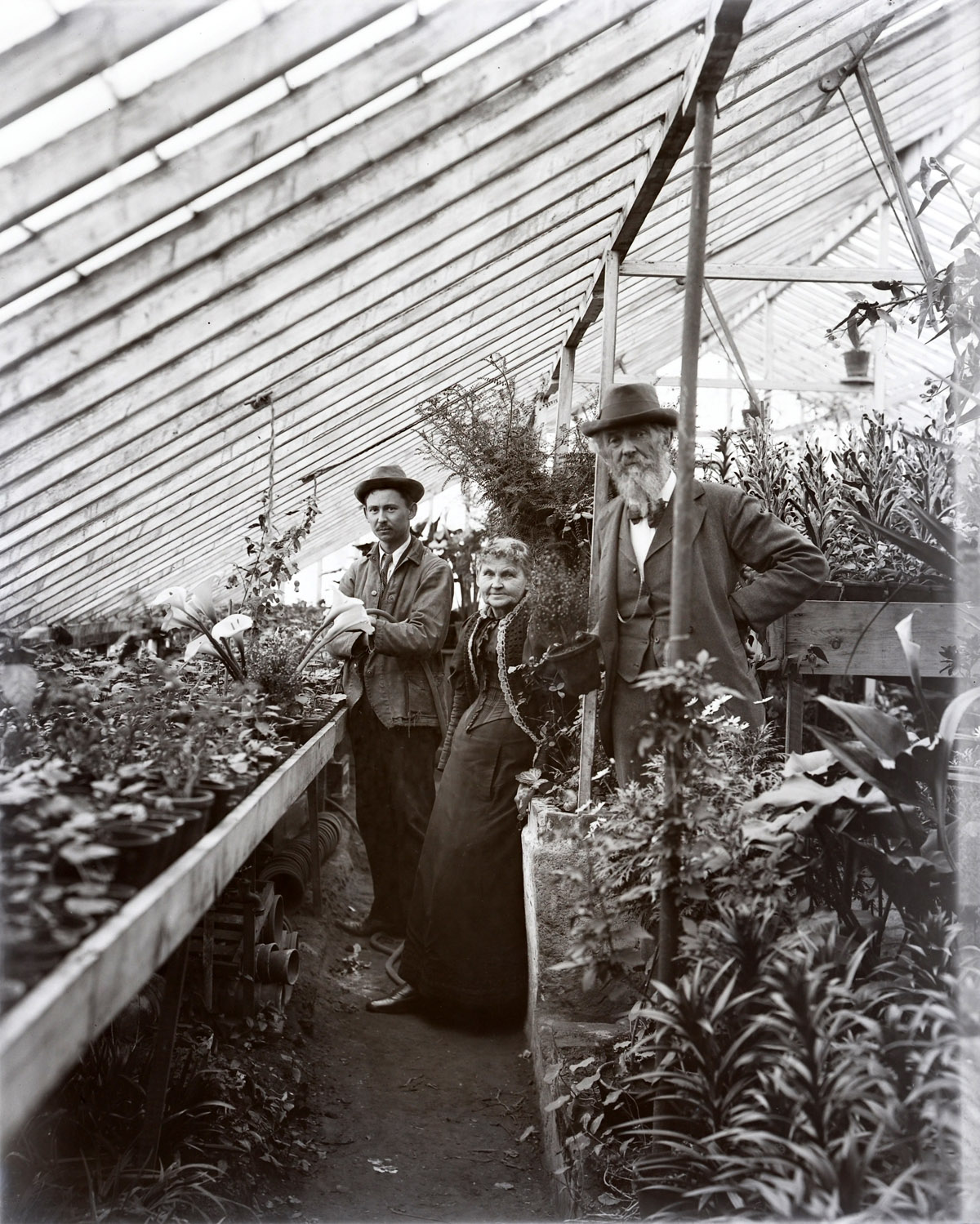
Benjamin F. Fewkes Jr., the son of Benjamin and Elizabeth Fewkes, purchased this house in 1886 and operated a nursery at this house. He was born in 1852 and died in 1915, aged 63 years. The 1893 Ipswich annual town report shows the following real estate and property tax valuation for Benjamin Fewkes at this location: horse $75, 2 cows $60, swine $10, 20 fowl $10, carriage $50, boat $25, house $1000, barn $100, greenhouses $400. The house stayed in the Fewkes family until 1948.


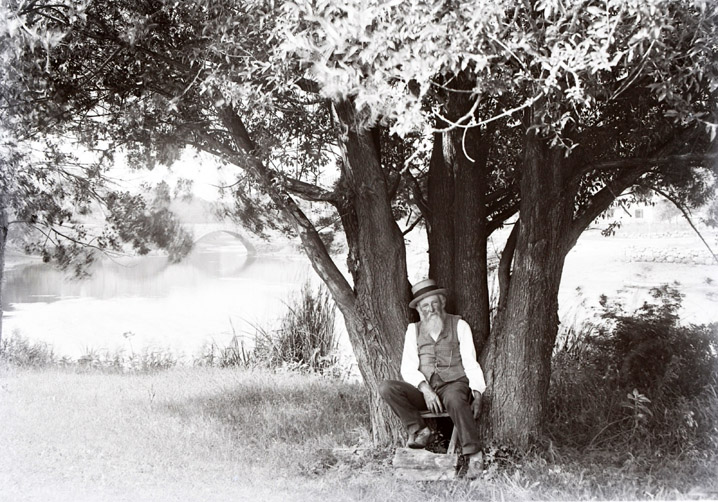
Benjamin Fewkes Sr.
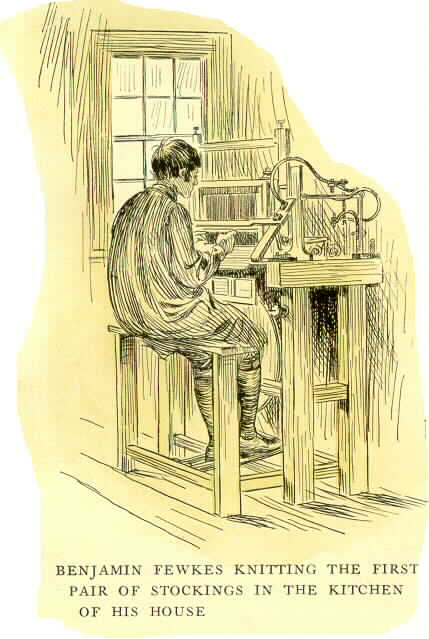
Fewkes’ father, Benjamin Fewkes, was born in England Apr 13, 1788. Benjamin Fewkes Sr. emigrated from England to the United States in 1818. He was a lace maker by trade and in 1822 introduced to Ipswich the first lace-making machine to arrive in America, said to have been smuggled in a box of salt, in violation of an English embargo. His shop was on High Street behind the Phillip Lord house.
Benjamin Fewkes Sr. died Dec. 27, 1869, aged 81 years. His wife was Elizabeth Wilkins Fewkes. His fourth son, Jesse Fewke,s was born in 1826 and presented a paper titled “Fine Thread, Lace and Hosiery” before the Ipswich Historical Society in 1905. Read also, Ipswich Hosiery, Page 3.

Structural observations
The front entry of the gambrel is spacious with what appears to be newer stairs, although the newel and railings may be reused. An original central fireplace and chimney were probably removed to accommodate a larger entry and stairway. The inside wall of the half-cellar indicates the existence of a massive stone fireplace base, which was observed by pulling up a floorboard in the rear of the gambrel. An examination of the second-floor flooring and roof sheathing provided evidence of the chimney removal. The present fireplaces are smaller with modern bricks, on either end of the gambrel.
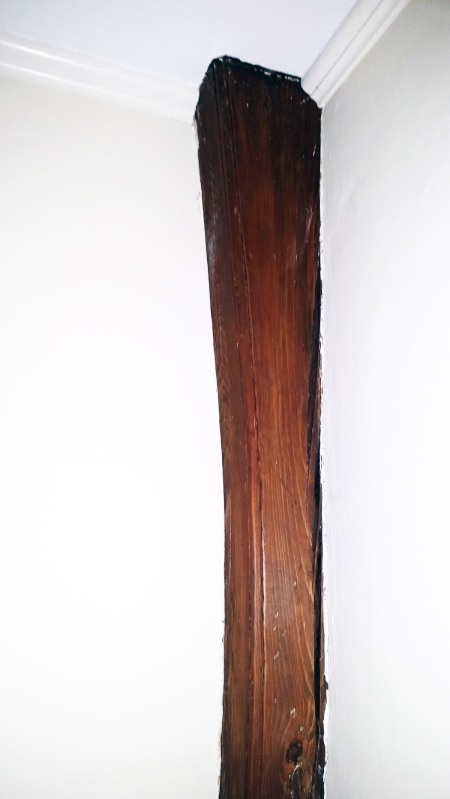
The front gambrel section has eight gunstock corner posts, found in First Period construction and into the 18th Century. The suspected date of construction is confirmed by how the posts were decorated. For a brief period beginning about 1710, frames were often finished with “quirked beading” along the exposed edges of the timbers. By about 1725, the frame was likely to be boxed instead of decorated and exposed, as the Renaissance influence of the Georgian style reached New England. Quirked beading continued to be used on the boards boxing the framework.
Rear Ell
The gambrel house appears to have been originally constructed with an attached single-floor ell, possibly a kitchen, and a connected utilitarian structure. The ell was converted, possibly under the Bachelder ownership in the mid-1860s, to a two-story residential ell over an attached side porch facing the river. The ell was completely removed in 202,2 and a new ell was added.

The diagram above is how the gambrel and ell may have been originally laid out, consisting of the gambrel roof house, a single-floor kitchen ell, and a carriage house, wood house, barn, or other outbuilding at the rear, sharing a continuous cellar. The incorporation of the cistern into the rear cellar wall accommodated access and kept water from freezing. Thomas Hubka’s description of the Tobias Walker farm in Kennebunk, Maine, is an excellent example of the evolution of a cottage with attached buildings into a large “New England connected farmstead“. In the outskirts of rural communities throughout New England, connecting buildings facilitated small-scale mixed agricultural and home-industry applications.
Cistern
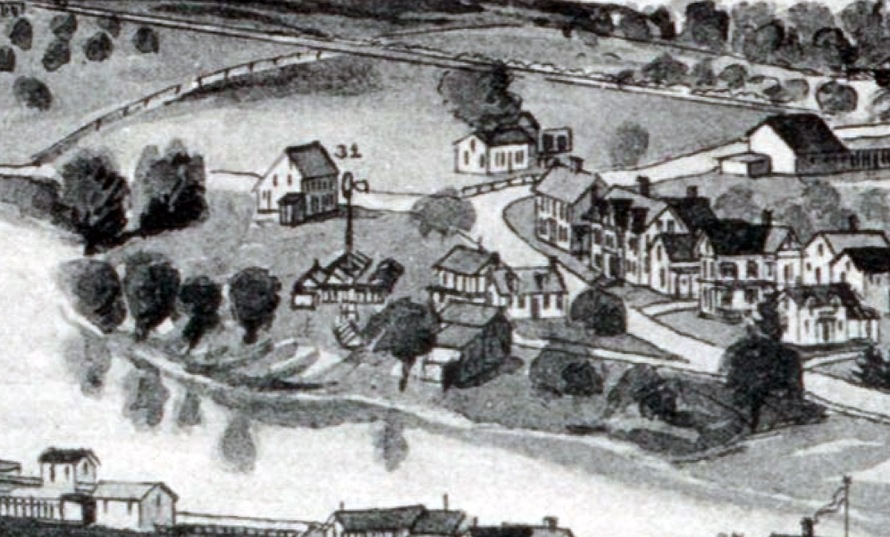
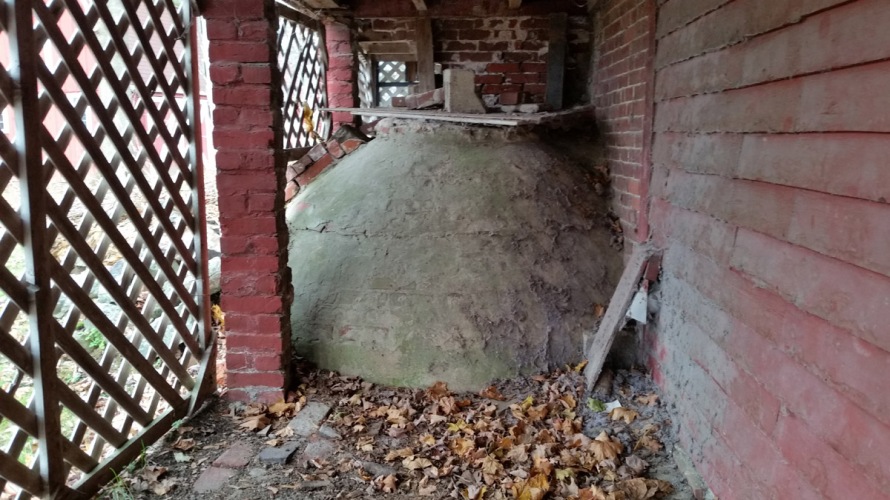
The rear of the ell foundation overlapped an intact cylindrical domed brick cistern. Masonry cisterns were frequently built against or into the home’s foundation, and water was drawn with a hand pump or from a tap located low on the basement wall. The warmth of the cellar may have helped prevent the water from freezing. Rainwater cisterns were used from the mid-17th to the 19th century primarily for laundry and other domestic chores and agricultural needs. A similar rainwater cistern was constructed in the Tobias Walker cellar in Kennebunk, as was suggested in the agricultural journals of that time. Cisterns went out of vogue at the beginning of the 20th Century with the advent of indoor plumbing. The 1893 Ipswich Birdseye Map shows a windmill on the property, which would have been used for pumping water.
Deed History
When Roger Preston arrived in Ipswich, he first purchased this lot along the river, across from what is now the intersection of Turkey Shore and Labor in Vain Roads. Thomas Franklin Waters wrote in Ipswich in the Massachusetts Bay Colony (1905) that “evidently the neighborhood did not prove popular,” and by 1644, every lot had been transferred. Records next show the lot belonging to William Lamson, who died Feb. 1, 1658. Waters noted: “William Lampson was granted a house lot “in the beginning,” and it was expected that this attractive locality, called the Turkey Shore, would become a compact neighborhood, but the houses disappeared, however, and some lots were never utilized. William Lampson and William Story, who owned adjoining lots there, sold their property, now owned by Mr. Benjamin Fewkes (in 1905), prior to 1644.”
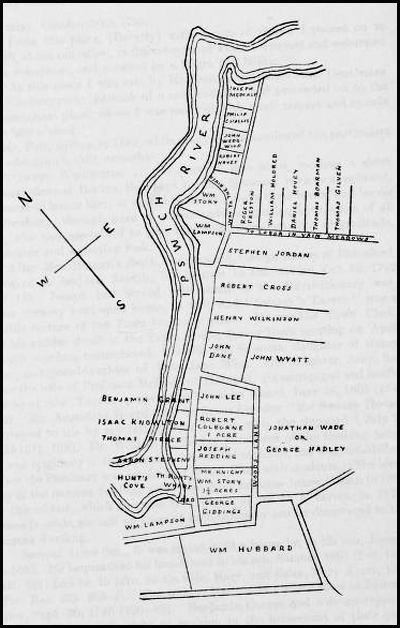
Thomas Franklin Waters recorded the deed record through the 19th Century in his book Ipswich in the Massachusetts Bay Colony:
Daniel Hovey owned land from this point to the end of Tansey’s Lane, where he built a wharf. “The Daniel Hovey homestead, which had been owned by his heirs for many years, was sold by Thomas Hovey (1668-1719) to William Fuller, “my house he now lives in,” with half an acre, Jan. 18, 1719-20.
The deed of Thomas Hovey to William Fuller of the land now owned by Mr. Josiah Mann specifies that it was bounded on the west, “by a narrow lane that goes down to Nathaniel Hodgkin’s land, and so by his land that was bought of Daniel Hovey Sr., to the River.” Jan. I5, 1719-20 (38: 272). Waters concluded, “The Fewkes estate as it appears from this, was originally part of the Daniel Hovey land, and was purchased by Nathaniel Hodgkins. He may have built the house.”
The house was conveyed by Hannah Hodgkins, spinster, to William Fuller, beginning at the south corner on the Town road opposite widow Elizabeth Ringe, “except one lower room and one-quarter acre during my life and then it will go to said William Fuller and Lucy Hodgkins,” June 2, 1786, 1 1/4 acre with a dwelling house, for 65 pounds. (book 152, page 260)
Col. Joseph Hodgkins conveyed the same 1/4 acre property to David Andrews on April 23, 1813, with a house, barn, and a joiner’s shop for $675.00 (246: 54). The 1832 and 1856 Ipswich maps show this lot owned by David Andrews.
Andrews sold to Mrs. Annie P. Batchelder, wife of Calvin Batchelder, yeoman (farmer), on April 5, 1865, a dwelling house with other buildings thereon (754: 48) for $1000.
Calvin and Annie P. Batchelder sold to Daniel Newell, March 4, 1870 (794: 30), with a dwelling house and other buildings thereon, for $2500. (*Note: The cemetery at the South Green has a grave for Calvin Batchelder, born Oct. 1811, d. Feb. 23, 1886. The 1888 Agawam directory of Ipswich lists Annie P. Batchelder, widow, living on Poplar St. *The 250% increase in the price of the house in 5 years suggests that the Bachelders added the rear wing before they sold to Newell.
The 1872 Ipswich map shows the rear ell and the owner as S. Newell. Newell sold to Gustavus Kinsman, on Aug. 16, 1875 (935: 203) for $1900, with a dwelling house and other buildings.
Gustavus Kinsman sold to Benjamin Fewkes, Sept. 1886, for $2200, with a dwelling house and other buildings. (1181: 258)
Benjamin Fewkes sold to Louis A. Fewkes, on Jan. 3, 1911, for $1.00, with a dwelling house and other buildings. (2061: 230)
The estate of Lora Fewkes was sold to Alice P. Lowry on April 29, 1948, for $9000, a certain parcel of land with the buildings thereon (3603:396)
Summary
The 1720 gambrel-roof cottage at 48 Turkey Shore Rd. is one of only a handful of rare 5-bay, story-and-half gambrels, three of which are in Ipswich, especially unique as a “transitional” early Georgian house with late First Period quirk-molded gunstock posts. The house is significant as a home for members of two prominent Ipswich families, Hodgkins and Fewkes, and offers one of the most commanding views of the domestic and natural landscape along the Ipswich River.
The previously attached rear ell lost much of its historic and architectural value in the 19th Century when it was enlarged and converted into a residential wing. When the ell was replaced with a modern addition in 2022, beams and boards were reused and are now exposed, and the 19th-century domed brick cistern was preserved.
View: This Old House, Restoring a 1720 Cape Ann Gambrel
Watch: This Old House, S44 E15: This Really Old House: The crew takes on a first-period home in the town of Ipswich, MA, Episode 1, and continues for 10 episodes.
Sources and further reading
- T.F. Waters, Ipswich in the Mass. Bay Colony, vol. I, p. 484.
- MACRIS
- Hammatt Papers: Early inhabitants of Ipswich, Mass. 1633-1700 by Abraham Hammatt
- Fine Thread, Lace, and Hosiery presentation by Jesse Fewkes before the Ipswich Historical Society in 1905.
- Big house, little house, back house, barn: the connected farm buildings of New England by Thomas Hubka
- “Reclaiming the Old House” (1913) by Charles Edward Hooper
- The Wartime Letters of Joseph and Sarah Hodgkins
- The Hovey Book (search: Joseph Hodgkins)
- Daniel Hovey
- History of the Andrews family
- This Old House: Restoring a 1720 Cape Ann Gambrel
Hodgkins Genealogy (from Geneanet)
Nathaniel Hodgkins’ father, John Hodgkins was the son of Ipswich settler William Hodgkins II(1622-1693) and Grace Dutch (1633-1694).
John Hodgkins, father of Nathaniel Hodgkins
- John Hodgkins /1667- married Elizabeth Foster 1663-1729 with
 John Hodgkins ca 1682-
- Nathaniel Hodgkins †1740 Married after 11 May 1706, Ipswich, Essex Co., MA, to Joanna Giddings, ca 1680- with:
- Stephen Hodgkins 1687-
 Sarah Hodgkins 1690-1725 Married 10 December 1710, Ipswich, Essex Co., MA, to Timothy Keyser 1683-1726 with:
- Mary Keyser 1720-1782
Thomas Hodgkins, Nathaniel’s cousin
Thomas Hodgkins’ father, Thomas, and Nathaniel’s father John, were sons of William Hodgkins II, who was a son of Ipswich settler William Hodgkins. Thomas Hodgkins’ four-acre lot was nearby on the south side of Turkey Shore, west of Woods Lane (Waters, Ipswich in the Massachusetts Bay Colony Vol. 1).
- Thomas Hodgkins 1668-1719, with Abigail Hovey ca 1668-1754 with
- Daniel Hodgkins 1690-1773 Married in 1714 to Abigail Hunt 1692-
- Thomas Hodgkins 1691..1692-1788 Married (AFT 26 FEB 1746/47) to Elizabeth Humphrey ca 1726-1798 with:
- Elizabeth Hodgkins /1749-
- Jeremiah Hodgkins /1752-
- Samuel Hodgkins /1756-
- Bethiah Hodgkins /1758-
- Stephen Hodgkins /1762-
Daniel Hovey sold a lot to Thomas Hodgkins. In his will dated 1692, Hovey bequeathed to his daughter, “Abigail Hodgkins, wife of Thomas Hodgkin,s the brass pan and pewter salt seller my part of the mare and colt to grandchild Daniel and Ivory.” An old tombstone at the Old North Burying Ground reads “Mrs. Abigail Hodgkins, Relict of Capt. Thomas Hodgkins, who died Oct. 22,1837, Aged 87.” Thomas Hodgkins was the commander of the 60-ton schooner “John” owned by John Patch.
A deed from Jeremiah Hodgkins to Daniel Hodgkins (sons of Capt. Thomas, jr.), June 5, 1741, for 45 pounds, ceded rights to the “homestead of my Honorable Father (Thomas) Hodgkins…and is now improved by my Mother Hodgkins as her right of thirds to my father’s estate,” consisting of a dwelling house and 4 acres on the south side of the river, (81:273).
 Historic Ipswich
Sandra here again..I’ve just read the above responses apparently to what is being done to this beautiful HISTORIC home!!!! If this is true?!!! How could the city ALLOW (through a building permit I would imagine) a HISTORIC HOME to be mangled!
I am searching this out!!!!!!!
This was my Grandparents home (Ernest and Clara Bernier) when we visited them off and on in the 1950’s! There was a barn on the property where we would play up in the hayloft… swing back and forth from one side to the other. How I loved that place!! I’d love to see it once again!!
Sandra Klug
sklug323@gmail.com
The resulting house is a travesty to those of us who truly love to preserve and conserve New England’s early architecture. It’s an outrage. The town of Ipswich let you do that? I’m appalled.
It is unfortunate that the current owners of the property have demolished most of the 18th century structure and are keeping the 1720 house merely as an entryway to a new modern building built to look old. I understand the many shortcomings of both the gambrel and the old ell structure, but just using the beams, even with all their compromises, merely as decorative elements seems rather disingenuous. Of course the new owners can afford to do what they desire, even if it is historically inaccurate. I do not like what we are seeing in the show episodes so far and am very disappointed that the This Old House producers did not present much of the history of the property as found in this article. I have to think that in the Vila/Abram/Morash years the project episodes would have looked very different from confusing mess we are currently seeing. The show has gone steeply downhill in recent years.
This house just doesn’t look like first period; small size, lack of detailing on girts. Framing is light, reminds me of late 18th century work. Is that one beaded corner post the only first period feature in the house?
The house is post and beam, and all of the corner posts in the gambrel are beaded. It underwent at least one significant modification, but the chain of ownership indicates it’s the same transitional house that Nathaniel Hodgkins built in 1720.
Compared to other ca. 1720 buildings surveyed by architectural historians, this house has very little to date it to that era. Very light framing is the key clue for me. I definitely think this is mid-to-late 18th century. There are only a couple proven first period gambrels (Johnson House in North Andover, for one). I’m surprised This Old House didn’t test the wood before doing the project; or maybe they did?
You’re correct. The house is a mid-18th century gambrel. It could have been done so effectively with the restoration of the center chimney, the three accompanying fireplaces, and raised paneling and feather edge sheathing and good period hardware reused throughout. Not to say real plaster and lath. Another missed opportunity by this NEW house.