
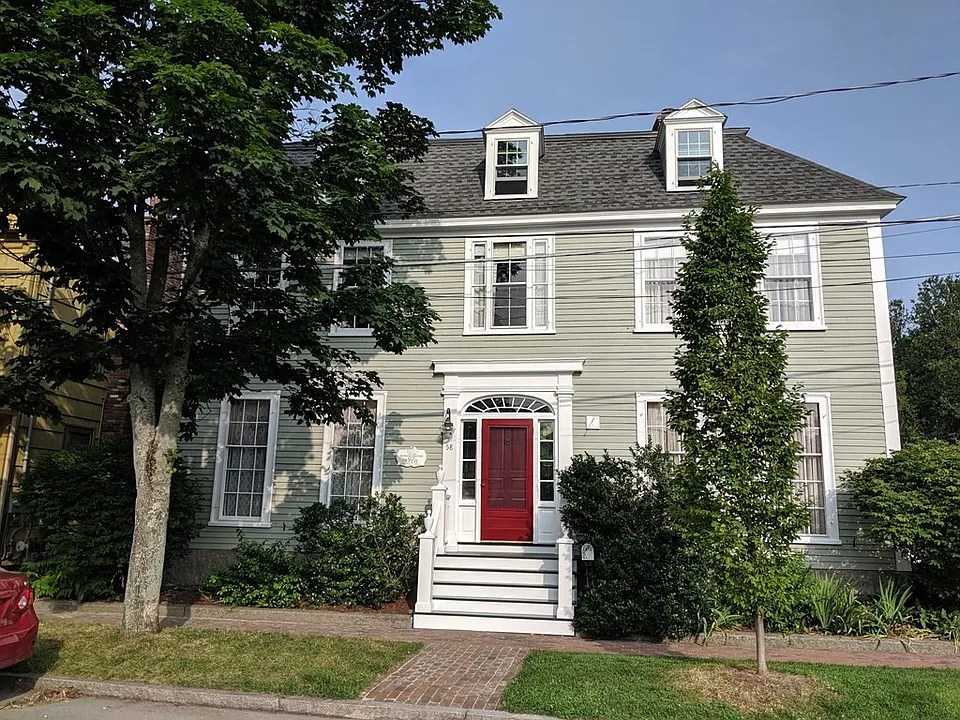

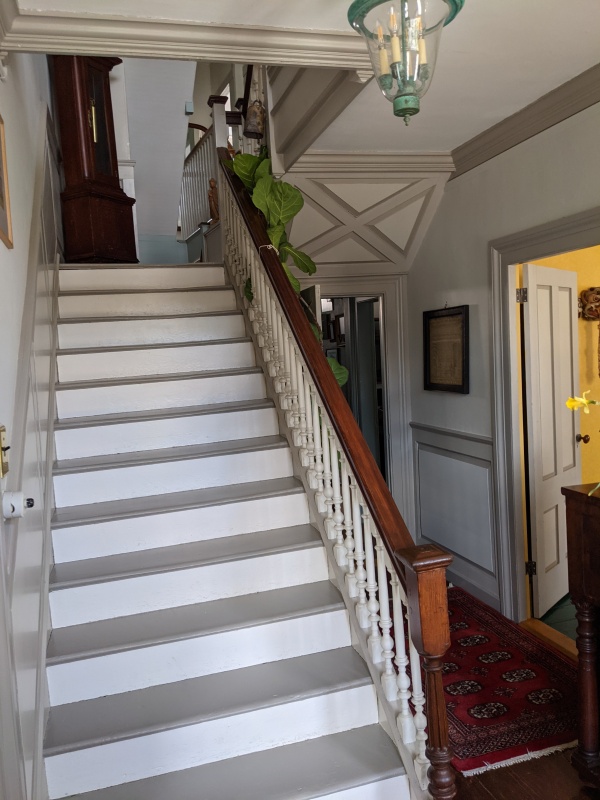
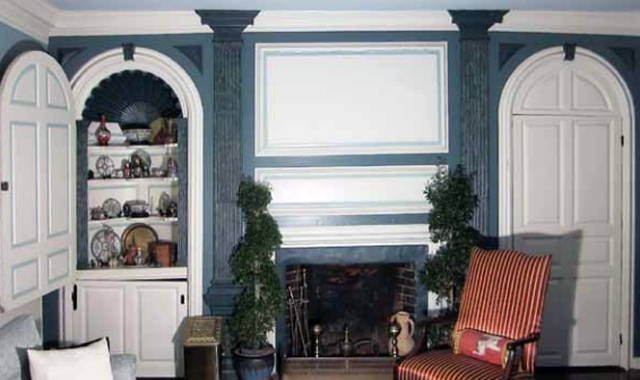
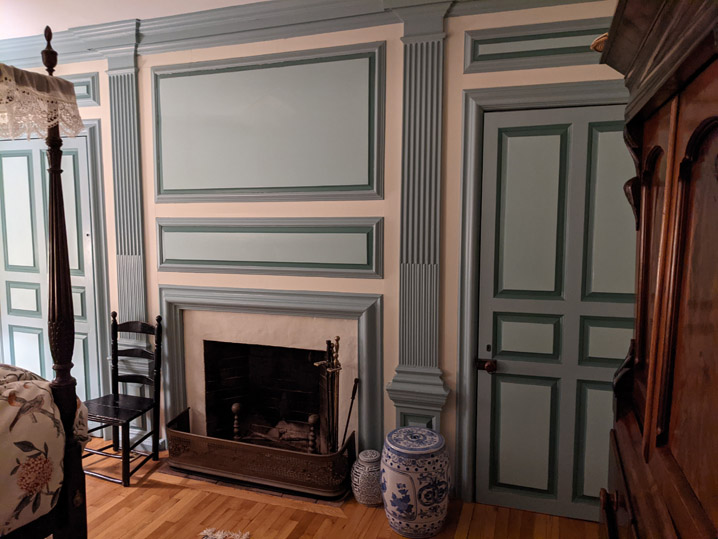
The Capt. Richard Rogers House at 58 North Main Street in Ipswich is historically significant because of its fine early Georgian styling. Richard Rogers was a descendant of Rev. Nathaniel Rogers, who lived on the South Green. The house was built in 1728, about the same time as the Nathaniel Rogers Manse across High Street. The central hallway with a closed string-course balustrade and the two chimneys suggest a high-style Georgian influence. The front room has exquisite Georgian paneling, while the rear fireplace wall has very fine shell cupboards in bolection molding with fluted pilasters. The home is one of the finest of its style and vintage in New England.

As described in Something to Preserve:
“The rear fireplace wall includes one of the finest shell cupboards in New England, enframed in bolection molding, with fluted pilasters on either side. The shelves are scrolled and molded and raised panels form the rear of the cupboard inside the shelves. In looking at the wall, the eye travels over a dazzling display of classic Georgian detail from the molded mop board to the stopped fluted pilasters on either side of the fireplace, to the double molded cornice work at ceiling level. In addition, the other walls have bold forty-inch wide raised field panels with cyma-curve step-down molding along the edge of the panels, all encompassed by bolection molded trim.”. View the MACRIS site. (This was renumbered to 58 N. Main, formerly #64.)
Captain Richard Rogers House Preservation Agreement
This house is protected by a preservation agreement. Protected elements include:
- The front and side facades facing N. Main and High Streets
- Central frame including primary and secondary members
- Wooden architectural elements, including stairs, paneling, moldings, mantelpieces, doors, and a cupboard in the left front room facing N. Main St.
Covenanted woodwork in the Richard Rogers house
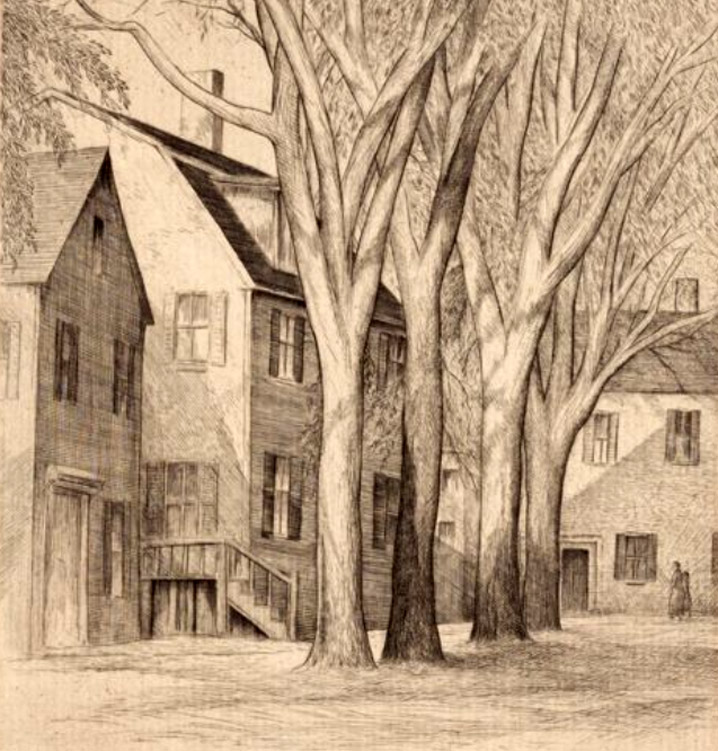

The Captain Richard Rogers house was built in 1728 and is considered to be one of the finest early Georgian houses in New England. Exquisite Georgian paneling in the front room exhibits an early high-style influence. The basement level of the house has an intact Second Period beehive oven and a fireplace in the summer kitchen that was created when the rear ell was filled in.
The Captain Richard Rogers house is protected by a preservation agreement which includes the front and side facades facing N. Main and High Streets, the central frame including primary and secondary members, wooden architectural elements including stairs, paneling, moldings, mantelpieces, doors, and the shell cupboard.
Abraham Knowlton, “Workman of rare skill”
by the late John Fiske
In the nave of the First Church, a short distance from the Captain Richard Rogers House, is a pulpit and sounding board created by Abraham Knowlton that many believe to be the most innovative masterpiece of its time.
In 1727-8, Abraham Knowlton created the elaborate balusters in the staircase of the Reverend Nathaniel Rogers House at 1 High St., with the most rococo newel post that he had yet produced. A year later, in 1728, he produced the baluster turnings across the street at the home of Nathaniel’s brother, Captain Richard Rogers.
It was in the Captain Richard Rogers House that Abraham Knowlton produced the masterwork of his early period. A shell cupboard set at one end of a Georgian paneled wall, whose opposite end contained a fine doorway that balanced the cupboard with perfect symmetry. The raised panels throughout the wall and doors were set in molded frames that were, in turn, set into a mortise-and-tenoned framework.
Flanking the fireplace were the newest things to come out of classical times, wooden copies of marble, stop-fluted pilasters. The tops of the door and the cupboard were arched with central keystones, in wood, of course, not marble. Nobody in Ipswich had ever seen a wall paneled like that.
2020 Mary Conley Award
Since 1991, the Ipswich Historical Commission has presented the annual Mary P. Conley Preservation Award, named in honor of Mary for her endless dedication to preserving historical sites.
The Award is given each year to an individual or organization that has been outstanding in a voluntary work of historic preservation. Properties that have been recently restored or maintained over long periods to a high level of historical architectural integrity may be nominated.
The Mary Conley Award for 2020 was awarded to Ingrid and Stephen Miles, former owners of the historic Captain Richard Rogers house at 58 N. Main St. Steve and Ingrid Miles purchased the Captain Richard Rogers house in 1983 and worked tirelessly to preserve and restore the house with integrity. Over 37 years, interior doors, stair treads, and other woodwork were stripped of multiple layers of paint; the sealed fireplace and hearth in the living room were restored. In 2009, after educating themselves about historic preservation, Steve and Ingrid restored the front room, including the elaborate clamshell cupboards. Much of the electrical wiring and plumbing in the house has been replaced and updated.
On the exterior, the granite foundation was repaired was reset using wooden levers; inappropriate windows and doors, the front steps, and the balustrade were all replaced with architecturally appropriate elements. The roofing and some siding have been replaced, windows were re-glazed and the house was recently repainted.
Ingrid Miles states, “Of maximum importance regarding the preservation/restoration/renovation of this early Georgian Colonial is that no alteration has been made to the integrity of the room spaces throughout the residents’ occupancy since 1983. In other words, all rooms are intact as chamber rooms for the ell (original house). This is important because most antique homes have moved or removed walls to accommodate modern conveniences. From the beginning, our intention was to preserve the integrity of the Georgian symmetry of interior spaces as well as the exterior front façade.”
“How did inhabiting such an antique affect our lives? We joined the Ipswich Historical Society, for one thing, where Steve followed Paul McGinley and George Mathey as President. As John Updike described in his experience of moving to town, “First-period houses, mixed in with creditable specimens of the Georgian and Federal styles, were strung up and down our street, called High at one end and East at the other. Architectural conservation was freshly in the air; Ipswich’s old houses, left for centuries to fend for themselves, were no longer being torn down and, rather, were being fixed up by newcomers—commuters and artisans with beards, pigtails, and regard for history. We felt part, deeply and effortlessly, of the community because we owned a piece of its past, sleeping and eating in rooms where fourteen or so generations had left their scuff marks. We are fortunate to live in a heritage property.”
The Ipswich Historical Commission is proud to present the 2020 Mary Conley Award to Ingrid and Stephen Miles for their many years of service and contributions to the historic preservation of our community. View a list of past recipients of the Mary Conley Award.
 Historic Ipswich
