

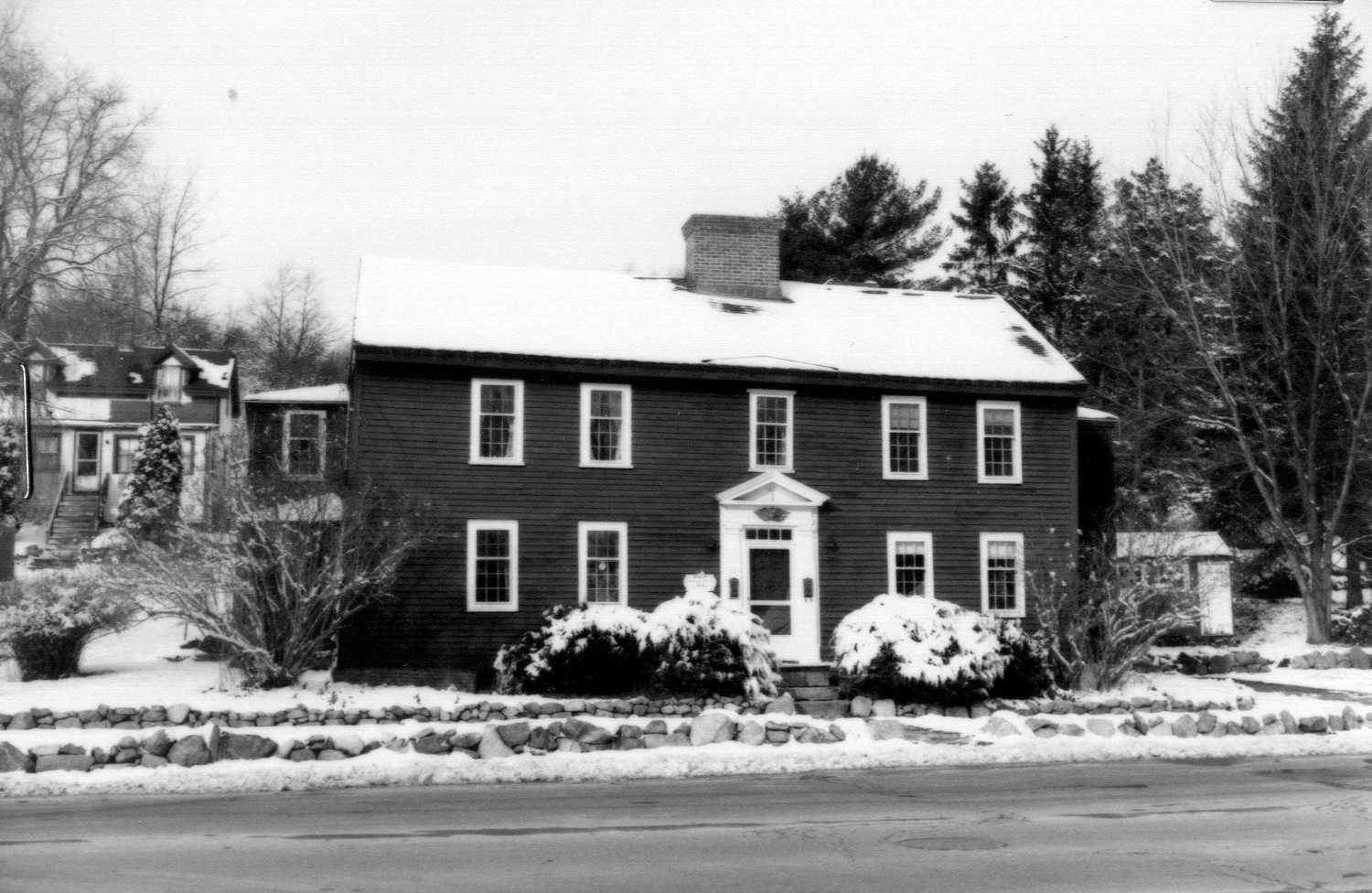
The first known owner of a house at this location was William Hodgkins III, who in 1668 secured permission from the town to cut oaks to build a house. Hodgkins was the grandson of William Hodgkins, who settled in Ipswich in 1640. The house was sold in 1718 to Archelaus Lakeman, and his wife, Rebekah Rindge, and it was during this time that the house was enlarged and acquired its present form. Architectural features on the front left side indicate that it is the original section to be constructed.
The house stayed in the Lakeman family for 200 years. Archelaus Lakeman and his brother Tobias (whose house is also still standing) were sons of William Lakeman, who was born in 1650 in Rye and was a fisherman at Smuttynose Island in the Isles of Shoals before moving to Ipswich in 1697.
Architectural Features
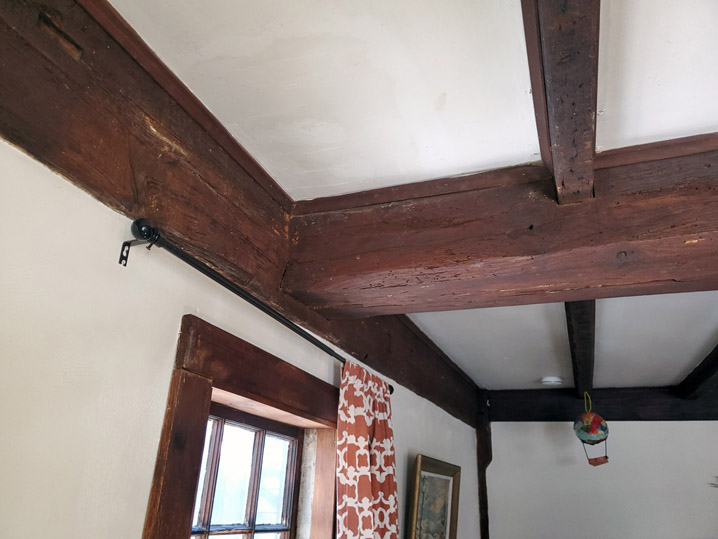
Architectural features indicate that this house was constructed in several stages, beginning in 1668 when William Hodgkins, who came to Ipswich from England in 1640 with his father William, received permission to cut oaks to build a house. The house gained its present hall and parlor appearance after 1718 when Hodgkins sold the house to Archealus Lakeman. In 1746 Lakeman’s son Archealus sold his half to his brother Richard (90:129), and a lean-to was added during the 18th Century. When the house was restored in 1954, the chamfered frame was exposed in the front west room, and its original fireplace was uncovered.
The oldest section is the west side, which William Hodgkins built as a one or two-story half-house. A large oak summer beam extends from a girt in front of the chimney stack to another girt over the window. The summer beam has a 45-degree “draw” chamfer, terminated at each end on both sides with a “run-out stop” before the ends are inserted into the girts mortises. (The run-out stop was used as early as the medieval period in England, but is a rare alternative to lambs-tongue stops in New England.) A single corner post, in the northwest corner of this room, is haunched, sometimes referred to as a gunstock post. This suggests that William Lakeman’s early house may have been a single floor with a gable roof over it, but it may be possible that the post was reused. On the right side of the room is a large brick fireplace measuring 8 feet wide.

As in most First Period and many Georgian houses, the front door opens to a vestibule, often called a “porch” during colonial times, which was constructed with doors opening to the rooms on the left and right, and a set of winder stairs to the second floor, with a small door under them that opens to stairs leading to the basement. On the back wall of the stairway is the massive chimney stack. At some point in the 20th Century, the wall between the entryway and the west downstairs room was removed. Removal of this wall exposed the shape of a closed-up beehive oven buried in the hall (large west room) fireplace and chimney stack. There is also an unusual 3″ step down from the entryway into the west room, lending further evidence that the two front halves of the house were constructed at different times.


Arthur Johnson is said to have installed a wall of paneling from this house in the Lakeman-Johnson House on Upper East Street. A pre-Revolutionary wall painting was removed as well and is now located In the Whipple House.
The Right Side
The right downstairs room is smaller than the left side. The ceiling plaster has not been removed, and the post-and-beam frame is boxed and beaded, a Georgian feature that began about 1725 at the end of the First Period. Its fireplace is relatively small, with tapered walls on the sides and back, indicating a Rumford design circa 1800. It probably hides an earlier, larger fireplace dating to when this side of the house was constructed. The front upstairs rooms have boxed framing, like the downstairs east room. The uneven ridge of the roof line is further evidence that the front of the house was constructed in two stages.
The Lean-to
Probably around the middle of the 18th Century, a lean-to was added in the rear, giving the house a saltbox shape. Typically, the kitchen would have been moved at that time to the lean-to, but the wall where the fireplace should be is boarded. There is a smaller Rumford-style fireplace on the east wall, and a doorway beside it that enters a large two-story “Beverly jog.” An examination of the attic shows that the original rear rafters were removed and replaced by longer, less steep rafters, allowing a second floor over the rear extension.
History of the House and Lot
William Clark sold one and a half acres to Thomas Clark, in 1639, and on the west of this was a lot owned by Thomas Bishop, in 1639, then by his son, Samuel. These two lots apparently were combined in the three-acre lot which was owned by William Hodgkins, who married Grace Dutch of Gloucester and died in 1693. He had a son named William as well, born in 1668, who apparently built this house about 1690. William Jr. died in 1719, a year after he sold the house to his brother Christopher Hodgkins, who sold the house to Archelaus Lakeman, bounded west by Francis Wainwright, and east by Andrew Burley, on May 13, 1718 (34: 207). Solomon and Archelaus Lakeman already owned a lot near the intersection with Jeffreys Neck Road.
Archelaus Lakeman was a tailor and died in 1745, willing the property to his sons Archelaus and Richard (Probate March 31, 1746, 326: 547-9.) Archelaus(2) transferred his half to Richard on Dec. 6, 1746 (90:129). This deed lists the eastern abutters as Andrew Burley and Thomas Treadwell. When Richard Lakeman died, in 1764, the inventory of his estate (Probate Rec. 342: 255), included two-thirds of the homestead, and a warehouse opposite the house at the wharf. His son, also named Richard, succeeded and the inventory of his estate in 1790 included the dwelling-house, a barn, and about three acres of land with an old warehouse (Probate Rec. 360: 385, 507). Richard’s son Ebenezer bought half the house on Feb. 7, 1823 (230: 238). The house and lot remained with the Lakemans, a sea-faring family for almost 200 years, with various members of the family owning half or a third of the house.

From Ipswich in the Massachusetts Bay Colony by Thomas Franklin Waters:
Sources:
- MACRIS (Massachusetts Historical Commission)
- Sue Nelson’s 2008 study of the Hodgkins-Lakeman House (PDF)
- T.F. Waters, Ipswich in the Massachusetts Bay Colony, Vol I., p. 400
- Deed: Christopher & Tabitha Hodgkins, three acres of upland at this location to Archelaus Lakeman: May 13, 1718 (34:207)
- Site visit by local historian Gordon Harris in January 2024
Ipswich homes of the Hodgkins family
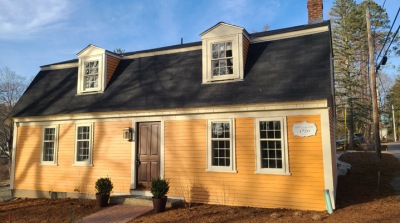 48 Turkey Shore Road, the Nathaniel Hodgkins House (1720) - The house at 48 Turkey Shore Road is believed to have been built by Nathaniel Hodgkins in 1720 on land formerly owned by Daniel Hovey. The gambrel roof indicates early Georgian era construction. A 19th Century rear ell was removed in 2022 and replaced with a modern but compatible addition.… Continue reading 48 Turkey Shore Road, the Nathaniel Hodgkins House (1720)
  76 East Street, the Hodgkins-Lakeman House (1668 -1718) - William Hodgkins built the oldest part of this house before 1700. In 1718 he sold the dwelling to Archelaus Lakeman and the property remained in the Lakeman family for almost 200 years.… Continue reading 76 East Street, the Hodgkins-Lakeman House (1668 -1718)
 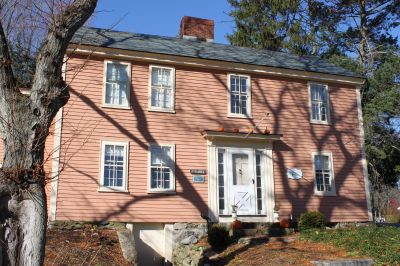 80 East Street, the Jacob Perkins House (c. 1700) - The Perkins-Hodgkins house is believed to have been built in 1700 on the foundation of the earlier Jacob Perkins home. The house has been greatly expanded over the years, but the original asymmetrical structure continues to anchor the corner with Jeffreys Neck Road.… Continue reading 80 East Street, the Jacob Perkins House (c. 1700)
 Ipswich homes of the Lakeman family
 19 Summer Street, the Solomon Lakeman House (before 1745) - This lot was owned or occupied by Solomon Lakeman in 1745, but could have been constructed earlier. The 1832 map shows the owner as "The widow Lakeman."… Continue reading 19 Summer Street, the Solomon Lakeman House (before 1745)
  2 Turkey Shore, the Heard – Lakeman House (1776) - Nathaniel and John Heard bought this land in 1776 and built the present house. Nathaniel sold the house to Richard Lakeman III in 1795. The house was added to the National Register of Historic Places in 1980, and has a preservation agreement with the Ipswich Historical Commission. … Continue reading 2 Turkey Shore, the Heard – Lakeman House (1776)
  38 Newmarch Street., the Tobias Lakeman House (1732) - In 1732, Stephen Minot acting on behalf of the heirs of Francis Wainwright, deeded a three acre parcel for £75 to Tobias Lakeman, a fisherman who drowned 6 years later in Casco Bay.… Continue reading 38 Newmarch Street., the Tobias Lakeman House (1732)
  5 Wildes Court, the James H. and Frances Lakeman House (c. 1900) - Until the early 20th Century, Central and Hammatt Streets did not exist. This lot with a house was owned in 1910 by J. J. H. Lakeman, the Ipswich postmaster.… Continue reading 5 Wildes Court, the James H. and Frances Lakeman House (c. 1900) 76 East Street, the Hodgkins-Lakeman House (1668 -1718) - William Hodgkins built the oldest part of this house before 1700. In 1718 he sold the dwelling to Archelaus Lakeman and the property remained in the Lakeman family for almost 200 years.… Continue reading 76 East Street, the Hodgkins-Lakeman House (1668 -1718)
  Historic Ipswich