


Colonel John Appleton was one of the leaders in the 1687 Ipswich revolt against Governor Andros and taxation without representation, for which they were jailed in Boston. In 1707, he built a three-story house at this location, which was in a state of decay when it was purchased by Daniel Noyes in 1768. Noyes removed the upper floor and renovated the house to its present Georgian appearance.
In 1962, the John Appleton House was purchased by Exxon to build a gas station on the site. The Ipswich Heritage Trust was formed in response, and succeeded in acquiring and preserving the Appleton house, followed by several others on N. Main St. Today, it houses offices and is known as the Appleton Professional Building.
Colonel John Appleton acquired the lot and built the home on what is now the northwest corner of North Main St. and Central St. in 1707 after commanding a regiment in the expedition against Port Royal.
John Appleton II was the son of John Appleton, who was among the five children of Samuel Appleton, settler of Ipswich. Samuel Appleton, the immigrant, was born Aug. 13, 1586, in Waldingfield, England, and died Feb. 24, 1670, buried in Rowley, MA.
John, his father, and his father’s brother, Samuel Appleton, were among the leaders in the effort of the townspeople to refuse Royal taxation – the action known as the “Andros Rebellion” – for which they were jailed in Boston.
John Appleton lived in this home for the rest of his life. He represented the Town in the General Court in 1697 and was a member of the Council from 1698 to 1723. After many years of service as Judge of the Court of Common Pleas, he was removed from the bench in 1732 by Governor Belcher on the grounds of his age, as he was then eighty, but was made Judge of Probate in the following year and lived until 1739. His death was the occasion of many eulogies.


This was the first house in Ipswich to have a third story, which was removed by Daniel Noyes around 1768 after he bought the house. He replaced the windows and restored the aging house throughout. Daniel Noyes served the town as schoolmaster, postmaster, a member of the Committee of Correspondence and Inspection in the Revolution, delegate to the Provincial Congress, and Register of Probate.
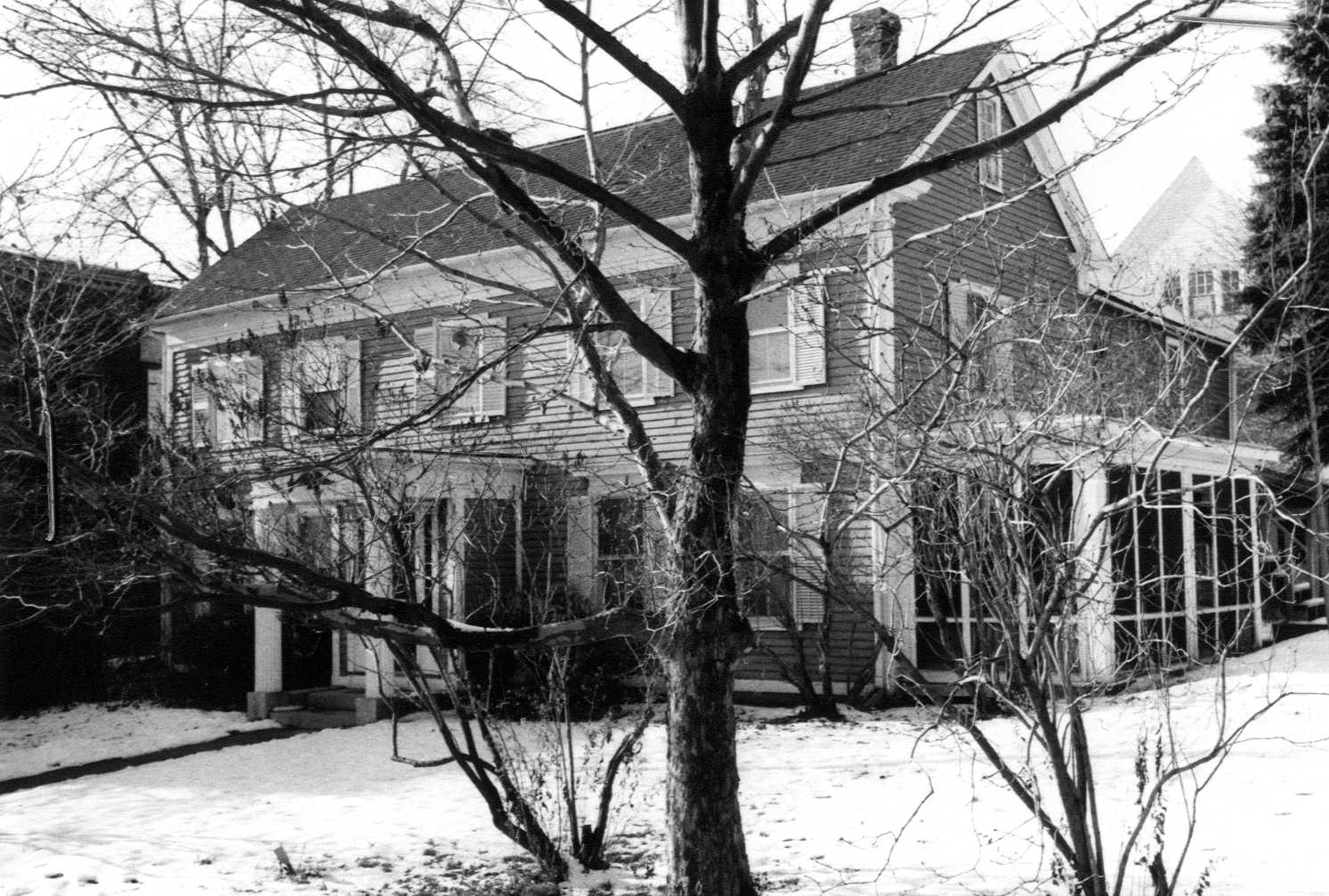

In 1962, the Appleton House was purchased by Exxon to construct a gas station on the site. The Ipswich Heritage Trust was formed in an effort to purchase the house for preservation. After intensive efforts, they succeeded, and the house is now protected by a covenant. This was the first successful effort to preserve historic structures in Ipswich and laid the ground for future covenants and the formation of the Ipswich Historical Commission. Only by the intervention of a few dedicated people was this historic home saved. It now serves as the Professional Building.
Permission to demolish the house and allow construction of the service station was placed on the shoulders of the selectmen, and the Old Town Hall was packed one evening at a hearing.
As Alice Keaton noted, “The hearing droned on for some time, the arguments pro and con dutifully heard and recorded. The smiling representative from the oil company listing all the benefits that the town would accrue– and all the preservationists disputing him every step of the way.” The assembled crowd was shocked when the selectmen cast their vote with the oil company.
Taking matters into her own hands, Kay Thompson spearheaded the formation of the Ipswich Heritage Trust under the aegis of the Ipswich Historical Society (now known as the Ipswich Museum). After a long negotiation, the oil company relinquished title for a payment by the Trust of the full purchase price plus attorney’s fees and other costs. With the help of outside donations, the project was financed. Within two years, and at a price far less than cost, the house was sold for use as a professional center, with deed restrictions assuring the trustees that no significant changes would be made to the structure’s frame and outer appearance.

Meanwhile, the Trust took an option, and exercised it, on two more buildings on Meeting House Green, which were both in deplorable condition and threatened with disastrous conversions or even demolition. The Dr. John Manning house was built in the Eighteenth Century. He was a surgeon, inventor, and early crusader for smallpox inoculation. The other building on the same property was constructed before 1769, had been the town’s first post office, and is perhaps the earliest in the country still standing. The two buildings were later sold as a unit with deed restrictions covering interior details and outside appearance.
It was through individual efforts and personal monetary sacrifice that, instead of a service station at Market Square, we have a beautiful historic home housing business offices. These homes are now a source of pride to the owners and the town. Their efforts eventually gave rise to the Ipswich Historical Commission.
Col. John Appleton House, 2 North Main Street Preservation Agreement
- North-main-2-appleton-preservation-agreement-page-1
- North-main-2-appleton-preservation-agreement-page-2
- North-main-2-appleton-preservation-agreement-page-3
- North-main-2-appleton-preservation-agreement-page-4
Antiquarian Papers, Volume 1: History of Mr Hammatt’s House
by Abraham Hammatt
“The house was possessed and probably built by the Honorable Col. John Appleton, son of Samuel Appleton, who was born at Little Waldingfield, England, in 1586 and came to America and settled in Ipswich with his father, Samuel Appleton, in 1635. He was married on Nov. 23, 1681, to Elizabeth, daughter of John Rogers, President of Harvard College. He died Sept 11, 1739, aged 87, and his wife died in 1754, aged 91. By his will dated Feb. 8, 1734, he bequeaths to his wife Elizabeth “besides various other property, the Mansion house and all the buildings, and land adjoining which is my orchard, during her natural life.” He bequeaths to his son Daniel the mansion house after his wife’s decease and makes him residuary legatee. Col. Daniel Appleton, son of John and Elizabeth, died in 1762 intestate. He married in 1715 Mrs. Elizabeth Berry of Cambridge, who outlived him and became his administratrix. In the appraisal of the estate, the mansion house and homestead with other buildings are appraised at £266, Jan. 19 1768.”
“When the property came into the possession of Daniel Noyes Esq., the house was three stories and much decayed. He reduced it to two stories and put it in thorough repair, making new windows and window frames, new sills, and replacing the lower posts of the frame, which had decayed. From the state of decay in which the house was when Mr. Noyes purchased it, there is reason to infer that it could not have been less than eighty or ninety years old, and it was built about the time John Appleton was married in 1681.”
“I found at that time the sills and posts of the frame, which Mr Noyes had put in, were quite free from decay. The northeasterly parlor, the chamber over it with the front entry and staircase, are, I presume, as they were when the house was built. The southeasterly parlor appears to be more recent. The chamber over it had never been finished when I came into possession of the house in 1835. The chamber over the kitchen I refinished, and the passage to it from the front stairs in 1838.”
Excerpts from The Memorial of Samuel Appleton by Isaac Appleton Jewett:
“In this opposition of the town of Ipswich, three of the Appletons appear to have been parties. Capt. John, at whose house the meeting was held the evening previous to the town meeting; his son, Lieutenant John, who was town clerk and selectman; and Major Samuel, who had been Assistant previous to the arrival of Sir Edmund Andros.
Samuel Appleton, emigrant, the First Generation
Samuel Appleton, the common ancestor, so far as known, of all of that name in New England, was born in 1586 at Little Waldingfield, Suffolk County, England. He emigrated to America in the year 1635. He settled at Ipswich, where he had a grant of lands; a building lot of eight acres in the town, on the Topsfield road, running down to the river; also four hundred and sixty acres, constituting what is now called Appleton Farms, lying on the line of the town of Hamilton, and bounded on one side by Ipswich River, and on the other by Mile Brook. A large portion of this farm is now in possession of his descendants. He was Deputy at the General Court, 17th May 1637, and was chosen with Captain Daniel Denison to assist at the particular Court at Ipswich.
Samuel Appleton married Mary Everard (or Everett), but nothing further is known of her other than that the family of Everard was a highly respectable one in the County of Suffolk. She accompanied her husband, with their five children, to this country. Samuel Appleton died in June 1670, at Rowley, Massachusetts, where he was buried, and where he had resided with his daughter, Mrs. Phillips, during the latter part of his life. By Mary Everard, he had the following children:
- John
- Samuel
- Sarah
- Judith, who married Samuel Rogers, 1657, son of the Rev. Nathaniel Rogers of Ipswich, and brother of John, President of Harvard College,
- Martha, m. Richard Jacob of Ipswich, who died in 1672. Their children were Richard, d. 1676, Thomas, John, Martha, and Judith.
John and Samuel Appleton of the Second Generation
John Appleton was born in 1622 at Little Waldingfield. He was the eldest son of the preceding and came to New England with his parents at age thirteen. He was Deputy to the General Court as Lieutenant John Appleton, from the year 1656 to 1664, when he had the title of Captain, and was Deputy by that title, during the years 1665-67-69-70-71-74-78. In the year 1687, during the administration of Sir Edmund Andros, the town of Ipswich determined to resist his arbitrary measures in that ill mode of raising money without a General Assembly. This was decided on at a meeting of several of the principal inhabitants assembled at the house of Mr. John Appleton, the evening before the town meeting called for the purpose of carrying the illegal edict into effect. The town meeting was held when the following vote was passed :
“At a legal town meeting, August 23, 1687, assembled by virtue of an order from John Usher, Esq., Treasurer, for choosing a Commissioner to join with the Selectmen to assess the inhabitants, according to an act of his Excellency the Governor and Council, for laying of rates; the town then considering that the said act doth infringe their liberty as free-born English subjects of his Majesty, by interfering with the statute laws of the land, by which it was enacted that no taxes should be levied upon the subjects without consent of an Assembly chosen by the Freeholders, for assessing the same: They do therefore vote that they are not willing to choose a Commissioner for such an end, without said privilege, and moreover consent not that the Selectmen proceed to lay any such rate until it be appointed by a genuine Assembly concurring with the Governor and Council.”
On the 17th of September, a warrant was issued for the apprehension of John Wise of Chebacco, together with Thomas French, John Andrews, Sr., John Appleton, Robert Kinsman, and William Goodhue, Jr. They were brought to answer for it without the privilege of habeas corpus, to a Court at Boston, where the parties were severally sentenced.
John Appleton was sentenced not to bear office, a fine of £50, to pay costs, and enter into a £1000 bond for good behavior for one year. John Appleton died in 1699. His will is dated February 16, 1697-8, and was proved March 27th, 1700. He married Priscilla Glover in 1651. Their children were John, Samuel, and Jose.
Major Samuel Appleton, who emigrated with his father in 1635 at the age of eleven years, is the one who fills the largest space in this memorial. The perseverance with which he held out under the persecution of Sir Edmund Andros is a circumstance to which his descendants may refer with some degree of pride. The opposition made by the town of Ipswich to the arbitrary act of Sir Edmund Andros and his council in levying a tax without an assembly, or in other words, to the principle of taxation without representation, has hardly received the notice in history to which it seems to be entitled. It was, in fact, the premonitory symptom, the shadowing forth of that greater struggle for the same principle, which resulted in the independence of the country.
At length, on the 19th of October, Major Appleton was brought before the Governor and Council, and was ordered to stand committed until he gives bond for one thousand pounds to appear at the next Superior Court, at Salem, to answer what shall be objected against him, and in the meantime to be of good behavior.” This bond he refused to give, whereupon, at a Council on the 30th of November, he was ordered to be imprisoned in Boston jail. “Major Samuel Appleton was kept in prison till the Supreme Court met at Salem, March 7, 1688, and when, by giving bond for 1000 pounds to appear at the next Court to sit there, and affirming to be of regular behavior, and pay unreasonable charges, he was released.
John Appleton of the Third Generation
John Appleton, b. 1652. It appears by the proceedings of Sir Edmund Andros vs. the Town of Ipswich, that he was the town clerk at the meeting on the 23rd of August 1687, and some circumstances make it probable that he was the person imprisoned and fined, and not his father, as heretofore stated. He was Deputy to the General Court in 1697, with the title of Lieutenant-Colonel. He was of the Council from 1698 to 1702; from 1706 to 1715; and from 1720 to 1722. He was for many years Judge of Probate and sustained through life a most excellent character. His death gave occasion to two funeral sermons, one by the Rev. John Rogers, entitled, “The Perfect and Upright Man Characterized and Recommended,” another by the Rev. Nathaniel Rogers, entitled, “The Character, Commendation, and Reward of a Faithful Servant of Jesus Christ.”
He married Elizabeth Rogers on November 23rd, 1681. She was the daughter of President Rogers, was born in 1663, and died in 1754. John Appleton died in 1739.”

Sources:
- The Memorial of Samuel Appleton
- A Genealogy of the Ipswich Descendants of Samuel Appleton
- Something To Preserve
, published by the Ipswich Historical Society, 1975
- Alice Keaton
- The Memorial of Samuel Appleton by Isaac Appleton Jewett
- T.F. Waters, Ipswich in the Mass. Bay Colony, vol. I, p. 343
- MACRIS
- Salem Deeds book=05171; page=629
 Historic Ipswich
Who were the Selectmen in 1962 and how did they vote?
Thank you,
Jack Dziadul