
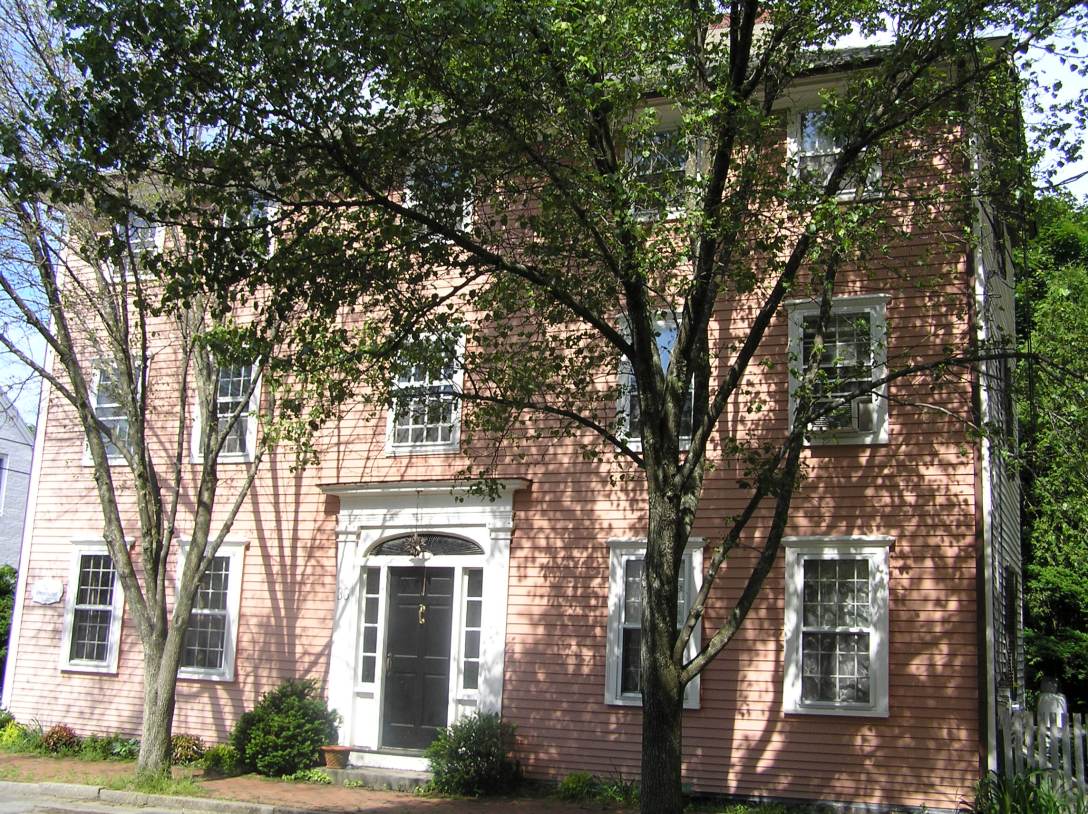

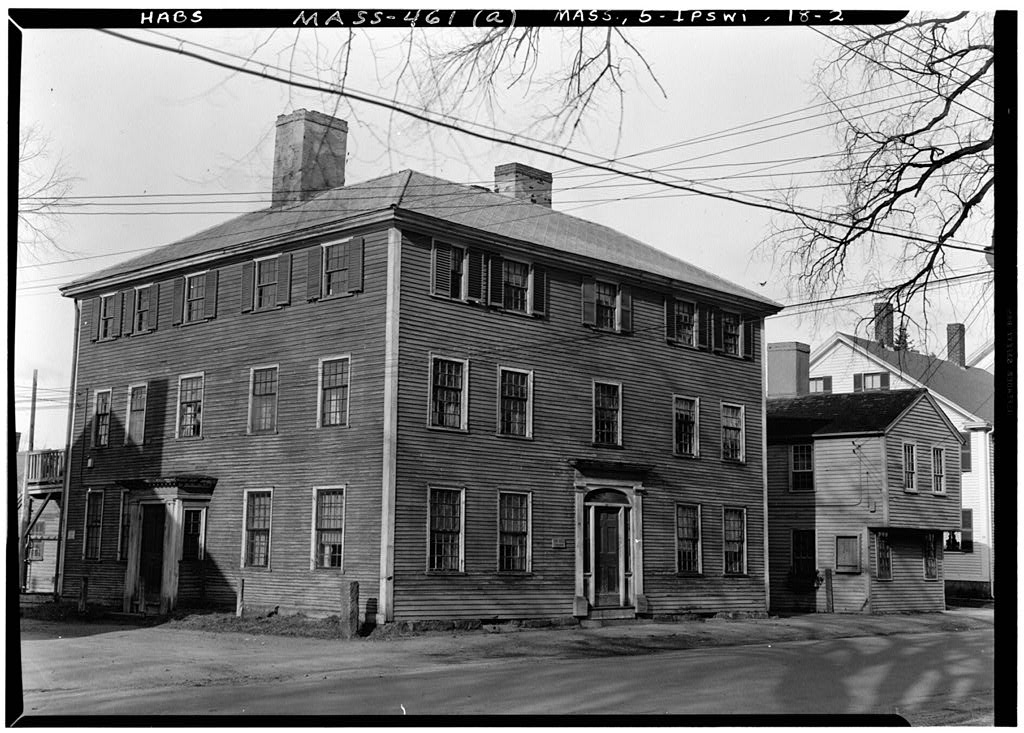
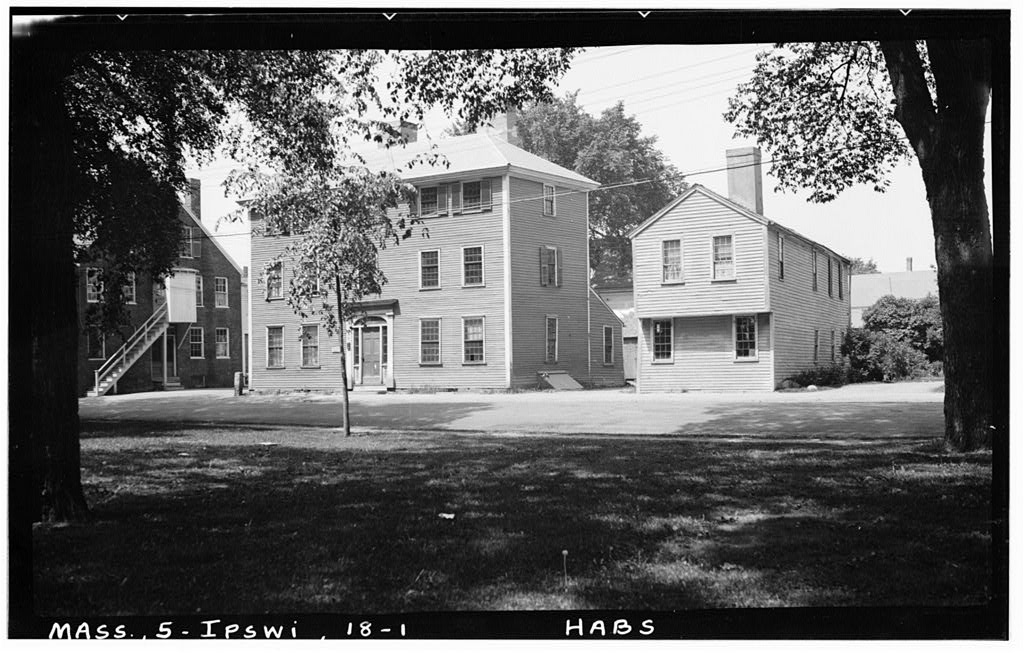
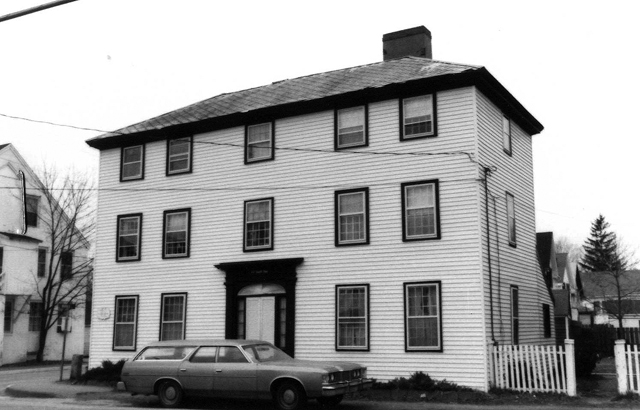
The house at 36 North Main Street was built sometime after 1763 by Dr. John Manning, who sold it in 1769 to John Potter, with an acre of land and a barn (125:173). John Potter sold to William McKean in 1777 (135:214) and McKean to Dr. Joseph Manning in 1792. In 1799, Dr. Joseph Manning sold the house, lot, and barn to Daniel Rogers, a goldsmith. Rogers’ widow sold the property to Frederick Mitchell in 1822 (299:168), and for many years it was known as the “Mitchell House.” The height of the house was increased from two to three stories, and much of the Federal trim that was added still survives. Thomas Franklin Waters wrote that the main body of the house was constructed by Dr. John Manning, and that the later enlargements could be “easily traced.” This house has one of the first preservation agreements in Ipswich, created by the Ipswich Heritage Trust, and now administered by the Ipswich Historical Commission.
Dr. John Manning
Historian Thomas Franklin Waters wrote that Dr. John Manning was the “most progressive citizen the town ever knew.” Manning was a pioneer in the distribution of the early smallpox vaccine. When he drove his chaise to Boston to bring his sister-in-law back to the safety of Ipswich on the day of the Battles of Lexington and Concord, he was allowed to enter Boston by first agreeing to treat British casualties of the battle. After returning to Ipswich with his sister-in-law, he spent that evening collecting medical supplies from Ipswich residents and then returned to treat casualties from both sides for seven weeks.
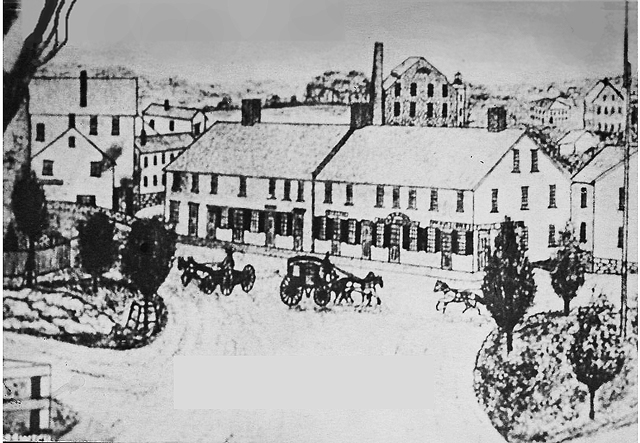
Dr. Manning was also an inventor and built an unsuccessful wind-driven woolen mill on the site of the present Caldwell Block next to the Choate Bridge. The mill at the Willowdale Dam, funded by his son, Dr. Thomas Manning, was more successful.
Dr. Manning was a member of the First Church, where his family occupied a pew assigned to the highest-ranking members of town. In about the year 1801, attendance at the church was languishing, and it was about this time that the violin, flute, and bass violin appeared in service. Thomas Franklin Waters wrote that Dr. Manning “manifested his displeasure at the worldly innovation by leaving his pew, while the orchestra played and danced up and down the broad aisle, much to the mortification of the elder worshipers, but to the great delight of the youth and the lighter-minded.” Manning later became one of the founders of the original Ipswich Baptist Church.
In April, 1795, Dr. John Manning proposed that if the Town would grant him the use of the pest house, Mr. John Harris’s house and land, or any other equivalent, and pay him £400 annually, he would undertake the maintenance of the poor, providing subjects of the Town’s suppor with food, clothing, “and every kind of attendance in sickness & in health.” The Town voted to purchase the Harris house, and an agreement was made with Dr. Manning to provide food, clothing, fuel, washing, medical attendance and nursing, and decent burial, and settle all claims against other Towns, for three years. John Harris sold his two-acre lot and house to the Town, July 10, 1795 (166: 106). It was occupied as the Town Poor House until the Poor Farm on Town Farm Road was established. The Town then sold the “work house” and land to Jacob Manning Jr. on May 10, 1818 (224: 176). The frame of that house is on display at the Boston Museum of Fine Arts.
Dr. Manning owned the lot with the house that he constructed on North Main Street for only six years and was active in real estate, owning various properties over the years. His eventual home was on High Street. A lace factory was constructed at that location in the 19th century, and it is unclear if Dr. John Manning’s High Street house was converted into the factory. The lace factory soon failed, and the property was sold in 1835 to Joseph Manning Smith, later to Joseph Ross, who converted it (back) into a mansion, which was demolished in 1935. The present brick colonial revival house at that location is owned today by the Manning family. A Massachusetts Tercentary marker is in front of that location. Dr. Manning’s residency on High St. made him a proponent of establishing the North school district and the construction of the Payne School at Lord Square.
Documents and Sources
- MACRIS
- T.F. Waters, Ipswich in the Massachusetts Bay Colony, vol. I, p. 351, Vol. II, pp. 520, 577, 628.
- Ipswich Historical Commission, Something to Preserve
- Biography of John Manning
- Dr. John Manning House, 36 North Main Street Preservation Agreement (Ipswich Heritage Trust, assigned to Ipswich Historical Commission)
- North-main-36-38-preservation-agreement-page-1
- North-main-36-38-preservation-agreement-page-2
- North-main-36-38-preservation-agreement-page-3
Biography of Dr. John Manning (4)
The Genealogical and Biographical History of the Manning Families of New England
By William Henry Manning
86 JOHN MANNING Joseph Thomas Richard bap 1738 Nov 12 at Ipswich, Mass. He studied medicine under his father’s direction and then commenced practice at the age of twenty at Newmarket, NH. After one year, he returned to Ipswich, where he resided and practiced the remainder of his life. As there were no medical colleges or hospitals in America at that time, Dr. Manning, at the age of thirty-three and after some twelve years of active practice, crossed the ocean to perfect his medical education in England.
Returning to this country, 1772 May 8, after a course of six months of training in the hospitals and lecture rooms of London, his practice soon became extensive. On the 19th of April 1775, the day of the battle of Lexington, he drove to Boston to bring his sister, Mrs. McKean, to Ipswich. When near Boston, he overtook a British officer severely wounded, to whom he freely gave the medical attention which he greatly needed. For this humane act, the officer gave Dr. Manning a pass, which enabled him to enter Boston and depart with his sister. He arrived at Ipswich at night, aroused his family, and when he had collected such articles as he knew would be needed, hastened to the relief of those wounded in the battle, giving to his suffering countrymen such aid as his skill and medicine could accomplish. His grandson, Joseph Bolles Manning Esq., is the authority for the further statement that when this was done, he assisted the British surgeons in caring for their wounded and by his direction, both parties of wounded were removed to Cambridge, where he attended six weeks until they were discharged. This was, on his part, an early application of the doctrine, since common to all civilized nations, that in the presence of those suffering after battle, all partisan feeling should be forgotten. Later in the war, he served as a surgeon at Newport, RI.
In 1777, he strongly advocated inoculation for the prevention of smallpox, which caused so much opposition and hostility that, for a time, it is said his life seemed in danger. He was active in business enterprises. He bought and sold real estate outside of his own county, having transactions of this kind in Worcester Co, Mass, Hillsborough Co, NH, and Cumberland Co, ME. In 1788, he with others made proposals to the Legislature for taking the poor of the Commonwealth which was in the almshouse at Boston and removing them to Ipswich, where with the selectman of that town to act as overseers; the projectors of the plan would supply them with lodging, good wholesome food, medical attendance, etc. for three-fourths of the then present expense. A paper was drawn up by the House to accept the proposal, but it shows no sign of having been acted upon (House Document 2640). Ten years later, however, the doctor petitioned for the payment of expenses that he had incurred, because by direction of the selectmen of Ipswich, he had during the past year supported several of the poor of the Commonwealth, proving that his plan had in some degree been carried into effect.
The Acts and Resolves of Massachusetts for 1790 show that he petitioned for payment of certain dues from the Commonwealth to enable and encourage him to carry on a woolen manufactory at Ipswich. The State agreed to pay from its treasury the interest due him on the State notes he held in his own name, and so much of the principal as should amount with the interest to £1,000, he first giving bond that the £1,000 should be within one year employed in a woolen manufactory in Ipswich. Whether this official action was satisfactory and was accepted has not been learned, but the enterprise was consummated. In 1792, the town of Ipswich granted Dr. Manning land for the erection of the factory. This was perhaps the first woolen mill in the country. It stood upon the bank of the river and was run by a windmill. It was a two-story building about 60 x 30 feet and was at the foot of the hill at the northwest corner of Choate Bridge. The structure now on the site is called Caldwell’s Block. At the end of the building, away from the bridge, was a signboard about 5 x 23 feet with Massachusetts Woolen Manufactory painted upon it, this being the name by which it was known. Blankets and flannels were made at the factory, which went into operation in 1794, but the enterprise was not a success, and it was closed in 1800. The doctor’s son, Capt. Richard Manning was the superintendent of the mill, and his pattern book is now in the possession of Mr. Francis H. Manning. Dr Manning’s hospitality was widely known. The house he built on High Street, Ipswich, still standing, was constructed with a view to indulging this characteristic. The partitions of the lower story were hung upon hinges at the ceiling so that they could be raised, thus making one room of the hall and the rooms on each side.
As an illustration of this hospitable proclivity, his grandson Richard H. Manning related this incident: “Dr. Manning was riding one summer afternoon about 1818 toward Hamilton when he met a Company of Horse known as the Salem Troop. Drawing up before the captain, whom he saluted as only he could do it, for he was an exceedingly courteous gentleman, stately and venerable withal, he invited the Company to ride on to his house in Ipswich and take supper with him. The invitation being accepted, the doctor turned his horse and rode back to Ipswich at the head of the Troop, which soon drew up in front of the mansion on Pudding Street, now High Street. This was the first intimation the family had of the intended feast, and I, a shaver of eight or nine years, was dispatched to all the neighbors for spoons and cooked food to eke out the entertainment.”
Dr. Manning was elected representative from Ipswich in 1781, 82, 84, 87, 89, 92, and 94 for a total of nine years. His skill and experience rendered him for a long time eminent in the medical profession; all publications dealing with his county mention this fact. He had his own opinions on politics and religion and was fond of power and resolute in carrying out his purposes. His character was marked by unvarying courtesy, a broad charity, and great kindness of heart. In person, he was tall and slender. His dress sword descended through the family of his eldest son and was presented about 1890 by his grandson James Manning to the latter’s nephew, Dr. Joseph Manning, and was by Dr. Joseph given to his own grandson, John Manning..
Dr. John Manning married at Ipswich, 1760 Nov. 27, Lucy, daughter of Charles and Lucy Kimball Bolles and granddaughter of Joseph and Lucretia Derby Bolles, b. 1742 Apr 5 and died 1817, Aug 23. Dr Manning died 1824 October 25 at Ipswich. A family record says Oct 24. Felt’s Ipswich says Oct 19.
Children born at Ipswich:
- 159 JOHN b 1761 Oct 19,
- 160 LUCY b 1763 Jan 3 d 1791 June 6 at Topsfield. She married 1787 Oct 6 Nehemiah Cleveland
- 161 LUCRETIA b 1765 Mch 23
- 162 JOSEPH b 1767 Mch 7
- 163 ELIZABETH b 1769 Sep 26 – 1794 June 17 at Gloucester
- 164 THOMAS b 1775 Feb 7
- 165 RICHARD b 1777 Jan 9
- 166 SARAH b 1779 Mch 10
- 167 PRISCILLA ABBOTT b 1781 Aug 4 d – 1843 May 3 in Brooklyn, NY
- 168 MARY twin b 1781 Aug 4
- 169 ANSTICE b 1784 Aug 3 d unmarried, 1809 Apr 12 at Ipswich
 Historic Ipswich