

The Olde Manse at 1 High St. is a 2-story, gambrel-roofed house with a wood frame and clapboards, constructed for the Rev. Nathaniel Rogers in 1727 by Ipswich cabinetmaker Capt. Abraham Knowlton. The semicircular portico and dormers were modifications during the Colonial Revival era.
Following the settlement of Ipswich in 1634, the first owner of this site was Samuel Varnum, who immigrated to Ipswich in 1635 with his parents, Hannah and George. His father was granted land on High Street, and they built a house and barn. After he died in 1649, Samuel, at the age of 28, inherited his father’s house, lands, and marsh lots. He was a yeoman and worked for the town as a surveyor and inspector of fences. 1664 Samuel Varnum purchased land near Chelmsford, prepared to create a new settlement in “ye wilderness north of the Merrimack.” He named his new home “Draycot-Upon-Merrimack,” founding the Town of Dracut.
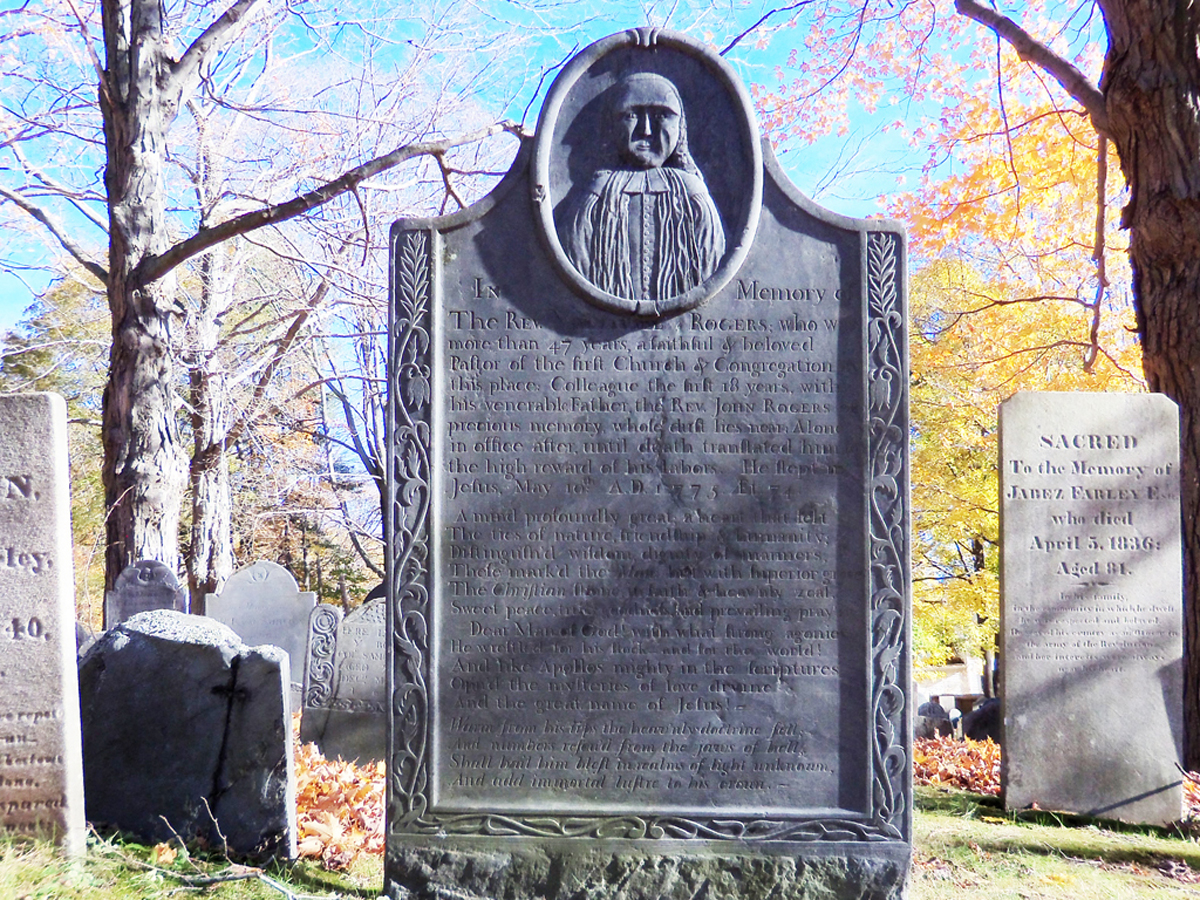
Varnum sold his Ipswich house to Edward Deare in 1665, who sold it to Rev. Nathaniel Rogers in 1727. Town Records state that Rogers petitioned and was granted additional frontage for his lot. Within a year, the Reverend removed the original house to build the larger house that stands today, known as “The Old Manse.” (Ips. Deeds 2:246). Several Rogers men (Nathaniel, John, and John Jr.) served as pastors of the First Church for 137 years.
In the late 19th century, the house was used as an inn and stagecoach stop. Otis P. Lord, who became Chief Justice of the Commonwealth, lived in the family home from about 1835 till 1844, when he moved to Salem. The executor of his will sold the house in 1885 to Samuel Baker. The property was purchased in 1914 by Ralph W. Burnham, an antique dealer, and was called “Ye Olde Burnham Inn.”
The most notable Georgian feature is the central hall with raised paneling and a fine staircase. Unusual Colonial Revival details exist in the rest of the house. Some of the original paneling was removed about 1900 and was installed in the Whipple House.
The building is now the House of Peace, providing a home for young people from war-ravaged countries of Africa and the Far East. View MACRIS
Rev. Nathaniel Rogers House, 1 High Street Preservation Agreement
- High-1-nathaniel-rogers-preservation-agreement-page1
- High-1-nathaniel-rogers-preservation-agreement-page2
- High-1-nathaniel-rogers-preservation-agreement-page3
- High-1-nathaniel-rogers-preservation-agreement-page4
- High-1-nathaniel-rogers-preservation-agreement-page5
- High-1-nathaniel-rogers-preservation-agreement-page6
- High-1-nathaniel-rogers-preservation-agreement-page7
- High-1-nathaniel-rogers-preservation-agreement-page8
This house is protected by a preservation agreement between the owners and the Ipswich Historical Commission. Exterior protected elements include:
- Wooden trim on the south, east, and west sides, including cornice boards, moldings and window frames.
- South portico door, doorway, and fan window over door
- East porch with stained glass and bullseye windows
- Semicircular bay window and associated curved glass and leaded glass windows
- South dormer windows, 3rd floor
- West bay windows (dining room and second-floor bedroom)
- Palladian window on the north side
Interior protected elements include:
- The woodwork in most rooms, including mantles, molding, paneling, bookcases, cupboards, post and beam cases
- Fireplaces (all three floors)
- Major staircase, 3 floors, and associated woodwork
Sources:
- MACRIS
- T.F. Waters, Ipswich in the Massachusetts Bay Colony, vol. I, pp. 157, 385, vol. II, pp. 116, 442.
 Historic Ipswich
I’m a descendant of Rev. Nathaniel Rogers (first minister) and the “Rogers Family” through Rev. John “Roaring” Rogers who’s my 13th great-grandfather. It’s been so fascinating looking back on my family’s genealogy and the history. It all started with Nathaniel, clergyman-minister, whom was the second son of Rev. John Rogers by his first wife Bridget Ray.
June 1, 1636, Nathaniel sailed with his wife and family for New England, where, after a passage of 168 days, arrived in Boston on Nov. 17, 1636.
He was invited by some emigrants in his father’s parish to settle with them in Dedham, New England, but as all could not be accommodated there, he accompanied the rest to Ipswich. There he took the place of Rev. Nathaniel Ward (a stepson of his grand uncle Richard Rogers of Weathersfield, England) whose ill health obliged him to give up his pastoral charge,… “In whose stead the church called to office this holy man of God whose labors in this western world have been very great, a very sweet heavenly minded man.”
He was ordained in Ipswich Feb. 20, 1638.
Cotton Mather called him one of the greatest men that ever set foot on American land. Though usually cheerful, he had some seasons of great despondency. But during his last sickness, he was full of pleasant conversation and one of his last acts was to bless the three children of his only daughter, Margaret, the wife of Rev. William Hubbard who had been particularly dutiful to him.
He expired in the afternoon of July 3, 1655, aged 57 years. His last words were, “My times are in thy hands”.
Nathaniel Rogers had six children with Margaret Crane, the last two being born in Ipswich:
1. Margaret, baptised at Coggeshall on Feb. 8, 1628; d. about 1690 in Ipswich; m. Rev William Hubbard in 1646. They had three children. After Margaret’s death, Rev Hubbard remarried on Mar. 15, 1694 to Mary Giddings (widow of Samuel Pearce).
2. John, baptized at Coggeshall, Essex, on Jan. 23, 1630, who became President of Harvard. He married Elizabeth Denison, daughter of Gen. Daniel Denison and Patience Dudley.
3. Nathaniel, (1632-1680)
4. Samuel, (1634-1693), m1. Judith Appleton; m2. Sarah Wade, They had eight children.
5. Timothy (1638-1638)
6. Ezekiel (1638-1674) born in Ipswich, Massachusetts; m. Margaret Hubbard, widow of Thomas Scott, daughter of William Hubbard and Judith Knapp, (and brother of Rev William Hubbard). This youngest son of Nathaniel was expected to be left heir by his great granduncle and namesake Rev. Ezekiel Rogers, pastor at Rowley, but he was declined “because he would not consent to have his hair cut short”.
Nathaniel’s father was Rev. John Rogers (“Roaring John”) who was born in Moulsham, England in 1571; died in Dedham, England on Oct. 18, 1636. Nathaniel’s mother was Rev. John Roger’s first wife, Bridget Ray who was from Stradishall, Suffolk, England.
Nathaniel’s wife, Margaret, was the daughter of Robert Crane (1574-1658) of Coggeshall, Essex, England. Margaret (Crane) Rogers died on Jan. 23, 1675, 20 years after her husband had passed away. She lived to be 75 years old.
His descendants in America were at that time more numerous than those of any other early English emigrant family.
I’m also a descendant of Samuel Varnum in Denver, Colorado. Thank you, Historic Ipswich for preserving the house and posting photos, maps and history online. Very much appreciated!
Samuel Varnum . Father was my 8th Great Grandfather
cool….doing family genealogy, and just started filling out my Varnum line, saw a map of Ipswich in the Varnum Genealogy, and the location of Samuel Varnum’s land on High Street, and this was the place.