
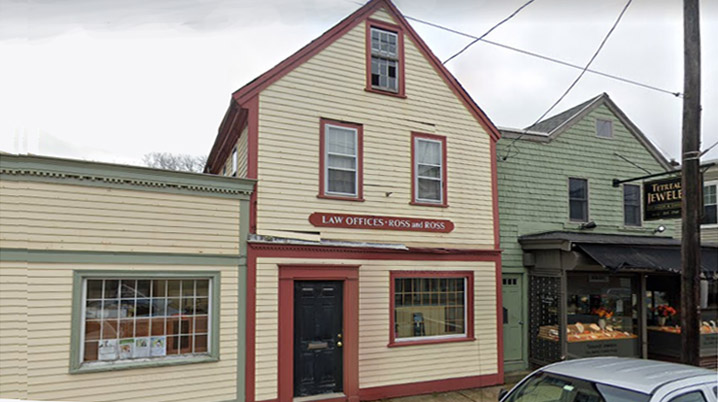

The Stacey-Ross house was constructed for elderly John Stacey in 1734 between North Main Street and the ledge on the lower section of the North Green. One hundred years later, the town voted to widen the road for Stagecoaches and paid Joseph Lakeman Ross for the property. He moved the dwelling to Market Street, where it is known today as the Stacey-Ross House, the oldest structure in downtown Ipswich. The Ross family continued to reside in the house until sometime after 1910. Since that time, it has served as a boot and shoe shop, package store, and barber shop, and is now the Ross & Ross law office. With its gable end facing the street, the early Georgian details of the house are hidden by the adjoining buildings on either side.

History of the Stacey-Ross House
In 1733, John Stacey, “being incapable of labor,” petitioned the town that, “there is a convenience on the northerly side of the rock by Ebenezer Smith’s for setting a house upon…for selling cakes and ale for my livelihood.” Stacey’s petition was granted, and the house was constructed beside the rocky ledge on the lower North Green.
John Stacey died in 1735, and his widow Jemima sold the property to John Wood, who immediately sold the land with a house on it to Samuel Ross, a blacksmith, in April 1737 (75:88). Ross added a blacksmith shop. The property was sold in 1794 to Samuel Ross Jr. and Joseph Lakeman Ross.
The house is moved
In the book, Ipswich in the Massachusetts Bay Colony, Thomas Franklin Waters wrote that the Stacey house was removed to widen the road to the Choate Bridge:
“In March 1829, the Town and County began to consider plans for widening the ancient Choate Bridge, which had been built in 1764, and was now too narrow for the great volume of travel which passed through the Town. Nothing was decided, and in 1834, Joseph Wait and 194 others came to the Town with a proposition that, in addition to the widening of the bridge, the Town should secure the widening of the road up the hill. The County Commissioners relocated the way over a portion of land belonging to Joseph L. Ross, and paid him $800, and removed the house, barn, and blacksmith shop. A public subscription netted $654, the buildings were sold for $470.00, and the Committee reported on Dec. 8, 1834, that only $126 more was needed to cover the expense. The Town voted to raise this sum, provided the land be in the highway forever, and petitioned the County Commissioners to include it within the highway bounds.”
Elsewhere in the book, Waters wrote about the Stacey house:
“The ledge in front of the old Seminary building was occupied by a house and shop for many years. In 1733, John Stacey, being incapable of labor, presented a petition to the Town, setting forth “that there is a convenience on the northerly side of the Rock by Ebenezer Smith’s, for setting a house upon” and “praying he may obtain a grant for setting a house for selling cakes and ale, etc., for his livelihood.” This singular request was granted, and he built a house accordingly. His widow, Jemima, sold the house and land on the rock to John Wood, and he conveyed at once to Samuel Ross, blacksmith, April 29, 1737 (75: 88). Samuel Ross built a blacksmith shop and carried on his trade. He sold his dwelling, barn, and blacksmith’s shop to Samuel Ross Jr. and Joseph Lakeman Ross, Oct. 3, 1794 (160: 105). Joseph Lakeman Ross, it has been said, bought the Moses Lord house in 1831, and removed the dwelling from the ledge to a place on that lot where it still stands next to the Jolm Holland estate.”
John Lakeman Ross was paid $800 by the Essex County Commissioners, and then moved the buildings to Market Street between the Moses Lord House to the east and the John Holland House to the west. Ross bought the Moses Lord House that same December and continued to live at his new compound until his death in 1850 at age 84. Ross’s daughter, Abigail, married brick mason Eben Kimball some four years after her father’s death when she was thirty-nine years old. The 1860 Census shows the Kimballs in residence along with Mary Ross, age 61, and Polly W. Ross, Abigail’s mother, age 85. Map legends for maps of 1872, 1884, 1897, 1902, and 1910 list the property as a “dwelling” occupied by “heirs of J. Ross.”
By 1919, boot and shoe-maker Gus Vlahos appears in the Directory at the Stacey-Ross house. By the close of World War II, the small house was a package store under the management of F.H. Lesveque, and by 1959, Lesveque had been joined by C. D. Costopoulous, barber. In November 1967, attorney Arthur Ross bought the old house, which still houses the law offices of Ross and Ross.

Sources:
- MACRIS
- Ipswich in the Massachusetts Bay Colony by Thomas Franklin Waters
 Historic Ipswich
Seems to be deteriorating now-broken upstairs windows and drooping shingles