
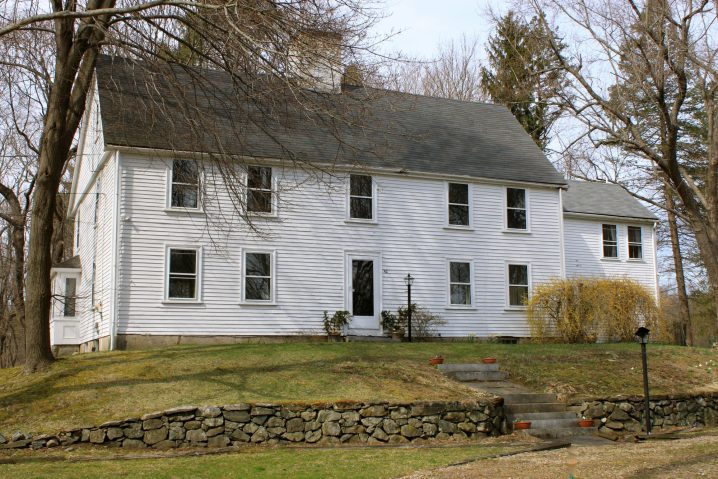
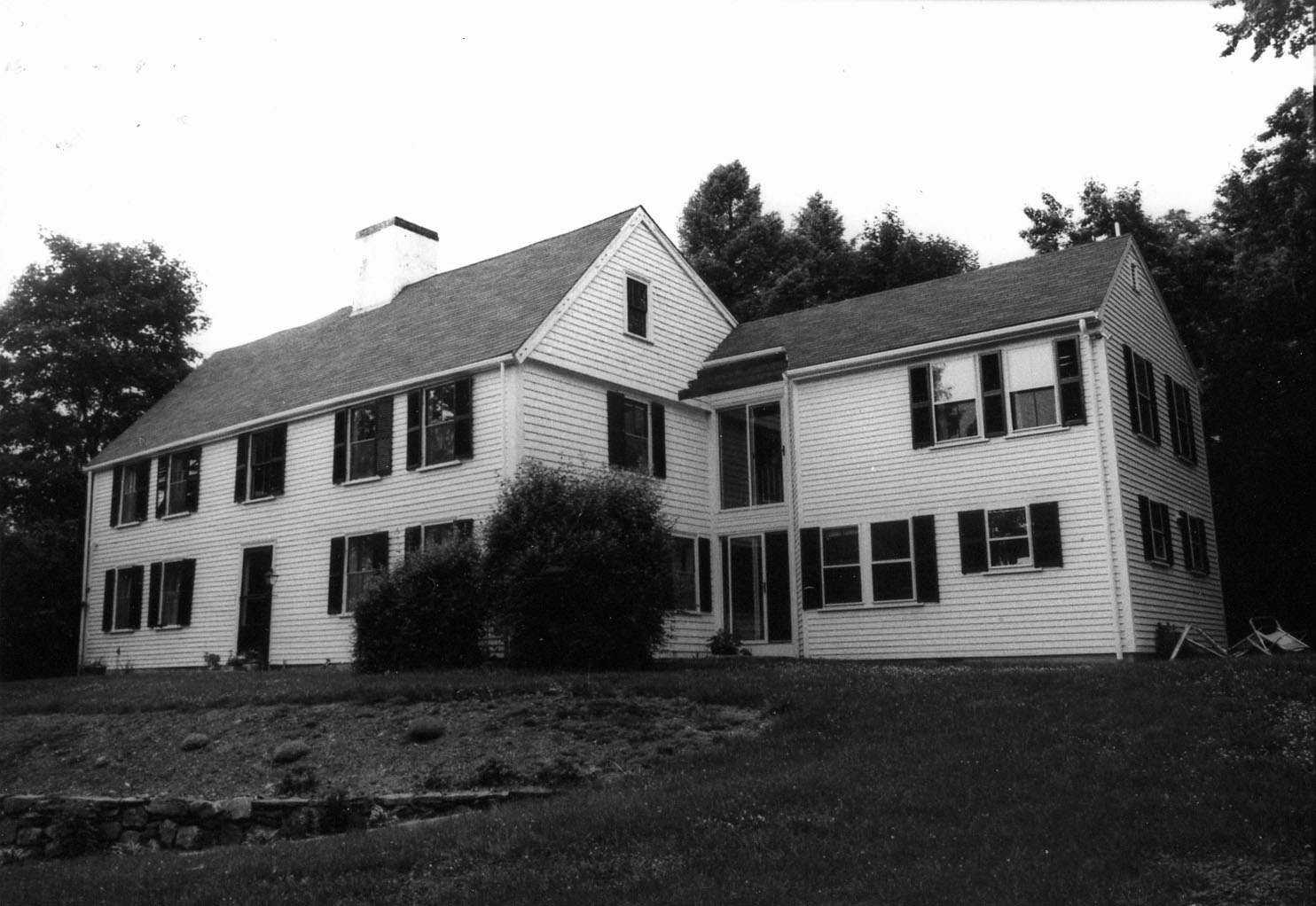
The house at 42 Heartbreak Road is traditionally called the Thomas Low House, but was constructed during the ownership of his grandson, Thorndike Low.
Thomas Low Sr. was born about 1605 in Boxford, Suffolk, England. He married first, Margaret, in 1630. With their young child, Thomas Jr., the family is believed to have sailed to Massachusetts with Reverend Nathaniel Rogers’ party in June 1636, arriving in November. They are believed to have settled in Ipswich within a year. After his wife died, he married the widow Susannah Stone Kimball in 1648. The will of Thomas Low Sr. is dated 20 Apr. 1677, and his son John was living with him at the time.
Structural Examination of the House
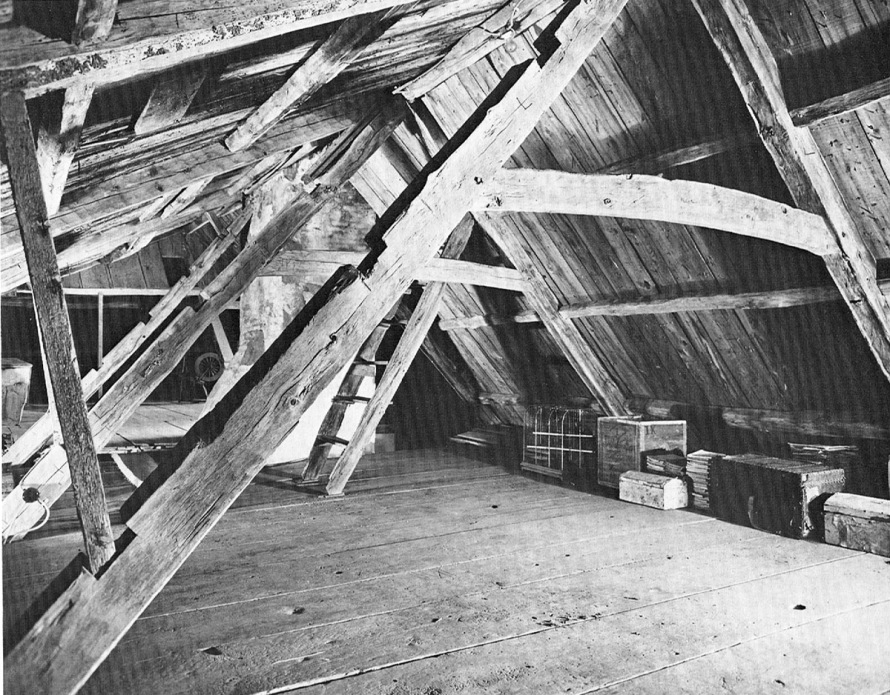
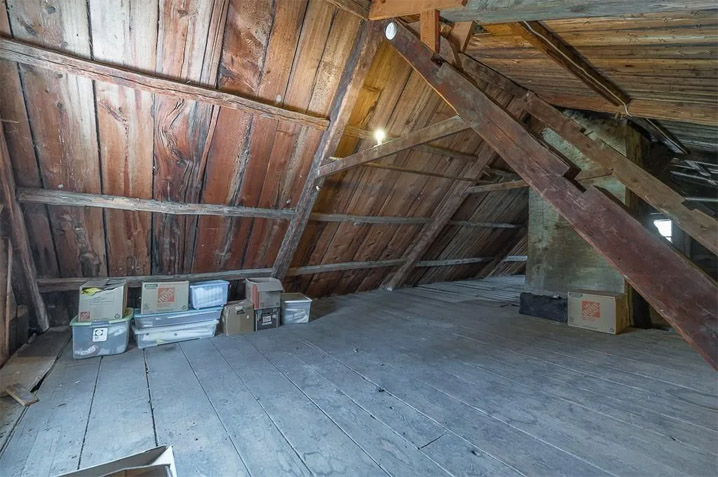
Projecting girts on the gable ends support “facade gables”, generally found toward the end of the Post-Medieval Revival period (1680-1710). Examination of the attic framing indicates that the entire two-story hall and parlor front section of the house was constructed during the late First Period or transitional era (1710-25). The saltbox shed addition was probably constructed in the 1760s during ownership of the property by the Kinsman family. The original rear rafters were left in place.
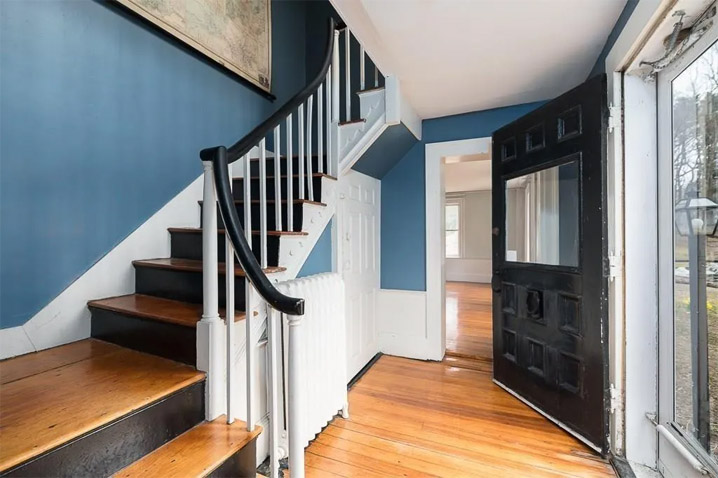
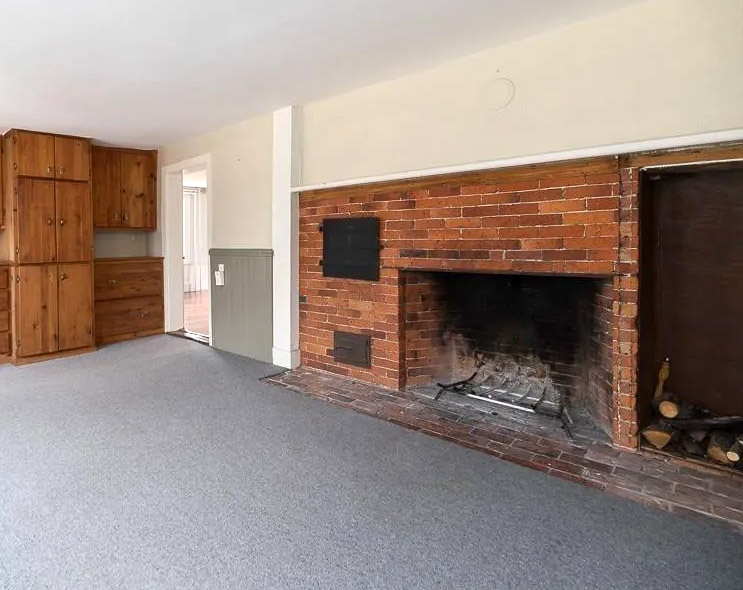
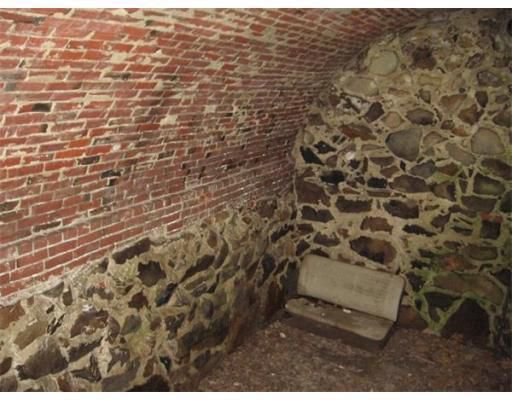
A massive central arched brick chimney foundation in the basement supports five Rumford-style fireplaces, indicating a significant renovation after 1800. The kitchen fireplace features a Federal-era bake oven with its opening in a brick wall. This lot abuts a former Colonial-era brickyard. In the rear yard is a rare mounded stone and brick vault. The present central entrance stairway replaced an earlier configuration when the fireplaces were remodeled.
Collar beams in the attic also suggest the age of the house. In his landmark study, “Massachusetts and its First Period Buildings” (1979), Abbott Lowell Cummings wrote, “Of houses with principal rafter and purlin roofs, only a dozen of the earliest retain evidence of the use of collar beams, and many are found only on the part of the roof covering the oldest section.”
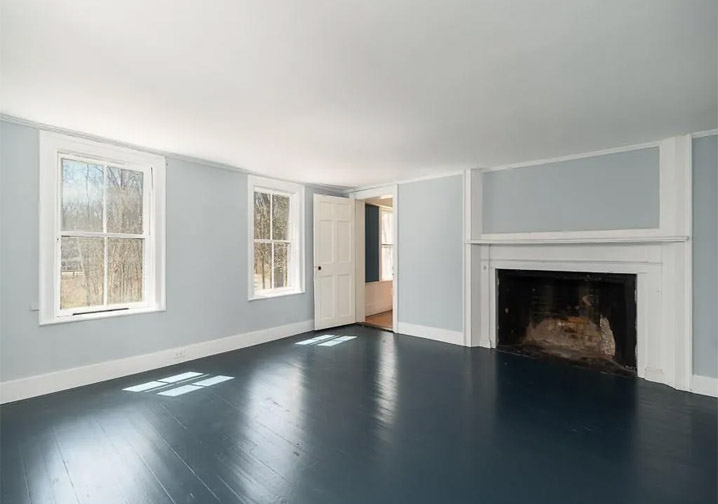
The house was completely restyled during the Federalist period by George Washington Heard. The exterior walls are almost a foot thick to accommodate pocket shutters on several windows. Interior framing is boxed, preventing easy examination of the frame. In the 1985 MACRIS inventory report, Anne Grady wrote, “The combined evidence of the very wide chimney bay, wide summer beam boxes, the overhangs at the gable ends, and the roof framing make it virtually certain that the concealed structure (and possibly finish) of the rest of the house is First Period in origin.” However, no section of the boxed frame has been opened to test this hypothesis. The beaded boxed beams and posts are typical of the early Georgian era.


Thomas Low Sr.
Thomas Low Sr. came to New England with the Rogers’ party from Gravesend, England, in 1636, and arrived at Ipswich in 1637. He first settled in Chebacco Parish, where he was a maltster (malted grains to make beer and spirits). He was first mentioned in the records of Ipswich on April 6, 1641, when he was granted ten acres of upland at Chebacco next to his existing ten acres. It appears that late in life, Thomas Low Sr. and his wife were sharing the house with their son, John.
The will of Thomas Low Sr. is dated 20 Apr. 1677 (Essex Probate Files 17242) and mentions wife Susanna and children John, Thomas, Margaret, and Sarah, and grandchildren Thomas Low, Margaret Davisson, Sarah Safford, and Sarah Low:
“I give & bequeath unto Susannah my Loving wife what goods she brought with her and also I give her the use of that room which I lye in & the free use of those things that are in it and also the use of one cow which she liketh best & will is that my Sonne John shall maintain it wintere & summer & also my will is that if the Cow come to any casualty hee shall find her another Cow & maintain it likewise as beforesaid.
“Also I give unto my wife one-fourth part of her labor that she hath spunn both Lening & wollen & also she shall have her beere as she hath now & also free use of the fire: & also John shall reare her one Sheoate yearly for sume meate for her & also a little ground to sow half a peck of flax seede yearly. And also to give unto her thirty shillings yearly to be paid by my executor in such things as she shall stand in need of during her natural life.
“Moreover I give unto my loving wife five pounds to dispose of as she shall thinke good, and my will is that in case my wife shall thinke meete to remove from my sonne John, then my will is that John Low pay or cause to be paid to her forty shillings yearly & every yeare during her natural life in such pay as she needeth. And I also give her the Cowe to be her owne & John to send the pay to Boston or CharlesTown.”
“To John: All my housing and all my lands in Ipswich, both meadow and upland, including half the house and half barn, the malt house and the things belonging to it.” Among other goods, one sword, belt, powder, and bullets.”
Record of Ownership of 42 Heartbreak Rd.
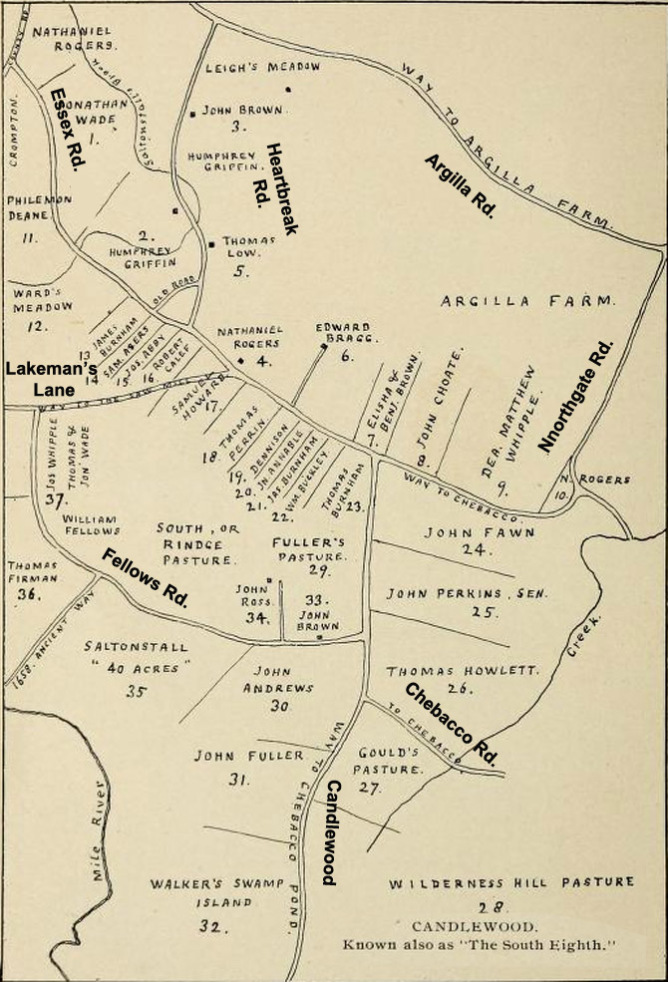
Thomas Franklin Waters: Candlewood, an Ancient Neighborhood
Low Family Ownership, 1647-1761
- Thomas Low‘s lot abutted the Rogers homestead on the south and faced the ancient Lane on the west. In his will, to son Thomas (living in Chebacco) he gave £30, to daughter Margaret £40, and to daughter Sarah £40, to be paid within two years of his death. To grandchildren Thomas Low £5, Margaret Davison £5, Sarah Safford £5, and Sarah Low £5, to be paid when they were twenty-one or on their marriage days. The estate totaled £290.11, and the residue, including the homestead, went to his son John, executor. (Probate Records of Essex County).
- John Low, son of Thomas, a carpenter, inherited his father’s land and “half the house.” When Thomas Low died at age 72 in 1677, his wife received only “the room that I (Thomas Low) now lay in.” John’s older brother, Deacon Thomas Low, was already established in Chebacco.
- On Jan. 28, 1705/6 Widowdeclined administration of her husband John Low’s estate. Also signed by Daniel Low and Joseph Low. Son Thorndike Low administered the estate of his father, John Low. A committee assessed John Low’s debts in October 1706, found him to be insolvent
- In 1708, John Low Jr. and his wife Sarah Thorndike, now living in Portsmouth, sold eight acres and “the homestead of my father, John Low deceased” to his brother Thorndike Low for £103.00 (36:218)
- Under the will of Thorndike Low (proved Oct. 17, 1750, Pro. Rec. 336: 425), the real estate passed to his son, Nathaniel Low. The inventory lists a house, barn, and 6 acres (Pro. Rec. 338: 496). The oldest section of this house was likely constructed during the ownership of Thorndike Low (born 1670 – died 1759).
Kinsman Family Ownership, 1761-1790
- Daniel Low, a joiner, sold to Capt. John Kinsman, two-thirds of the Nathaniel Low homestead and 10 acres, April 22, 1761, for £131. (131:75). Daniel Low’s widow, Sarah Foster, Dr. Nathaniel Low, and others, conveyed to John Kinsman half a dwelling and 6 acres for £660. March 25, 1779 (138: 166). New England was experiencing inflation of over 24% per year, but the more than four-fold increase in the price may indicate a major renovation and construction of the rear saltbox shed addition. With this purchase, Captain John Kinsman now owned the original James Burnham farm, the ancient Thomas Low estate, and the former Samuel Rogers estate.
- Captain John Kinsman died in 1785. His will (proved March 7, 1785, Pro. Rec. 351: 356) devised to his wife Elizabeth, the improvement of a third of a dwelling and garden, and to his son, Samuel Kinsman, “the house I now live in” with barn and outbuildings… with a portion to his grand-daughter, Mary Remick.
Burnham Family Ownership 1790-1814
- Samuel Kinsman sold 79 acres and buildings to Isaac Burnham, Feb. 15, 1790 (152: 96)
- Isaac Burnham conveyed to Josiah Burnham, March 18, 1795 (158: 290), Josiah to his brother, Aaron Burnham, 88 acres, Jan. 9, 1812 (196: 109).
George W. Heard Ownership 1814-1901
- Aaron Burnham conveyed to John Heard, with cider mill, press, etc., Feb. 2, 1814 (201: 282). Mr. Heard also bought 6 acres of Asa Andrews, July 7, 1819 (221: 213), which Mary Remick and James of Barrington, N. H., had sold to Andrews, “being part of the estate of James Kinsman,” July 9, 1819 (221: 212).
- Mr. Heard sold the 88-acre farm to his son, George W. Heard, on April 2, 1830 (282: 162). He conveyed to Thomas Low, 83 acres, April 1, 1835 (315: 270).
- Abby S. Stone, widow of Augustine, conveyed to Aretas D. Wallace, March 27, 1901 (1636: 517). Augustine and Abby Stone had sold a two-acre lot to Robert W.Bolles, Feb. 11, 1888 (1223: 462), on which he built, at once, his dwelling and other buildings.
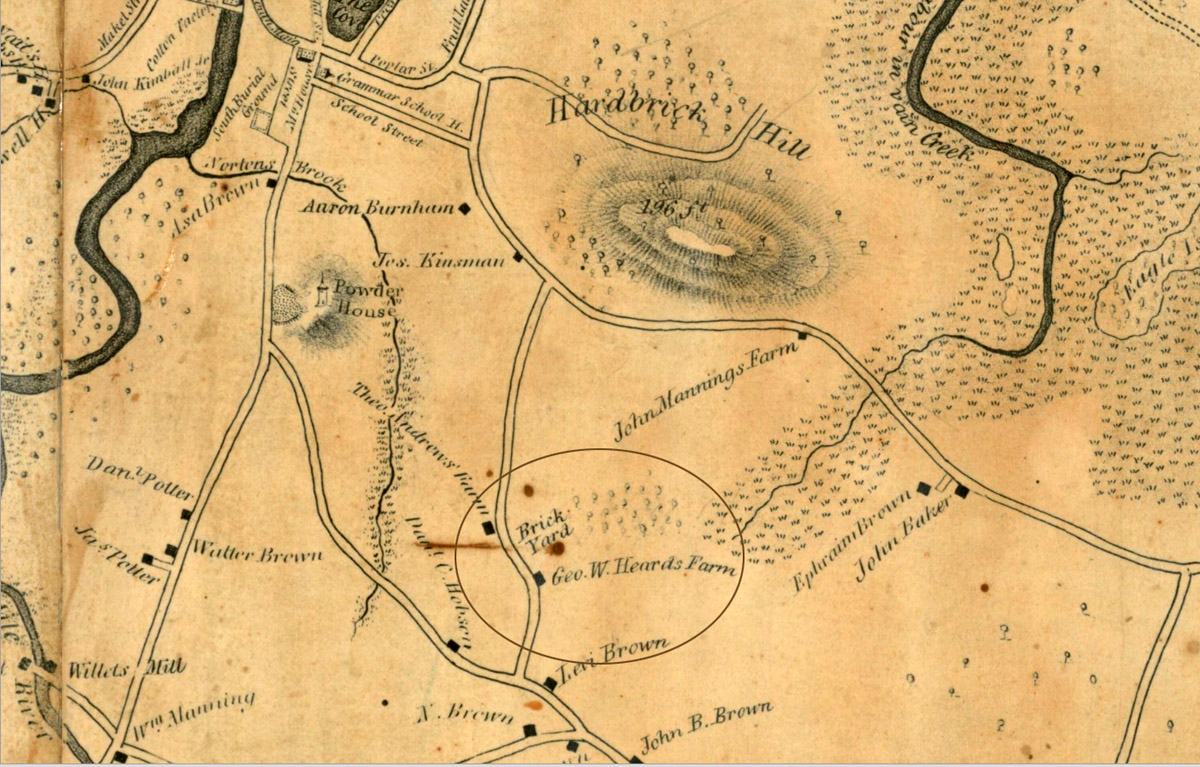
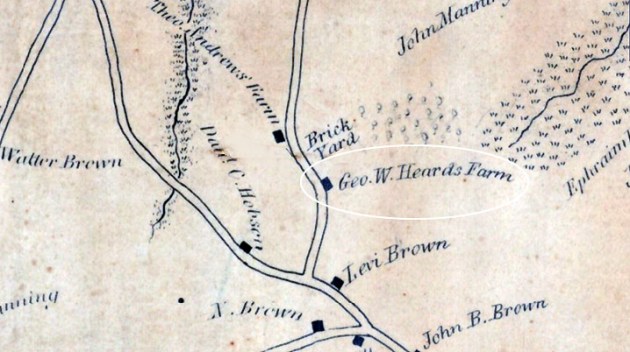
- The ancient dwelling is the one surviving link that binds this compact group of eighteenth and seventeenth-century dwellings with the present. The old brickyard has been so long disused that its existence is only indicated by the leveling of the clay field. A brickmaker, Daniel C. Hobson, is thought to have made bricks on this site c. 1800.
George Heard’s Farm
George Washington Heard (1793-1863) was born in Ipswich in 1793 and graduated from Harvard in 1812. He married Elizabeth Ann Farley (1802-1865) in 1823 and had six children: John (1824-1894); Augustine (1827-1905); Margaret (1830-1831); Albert Farley (1833-1890); and George Washington (1837-1875), who later legally changed his name to George Farley Heard. He was involved in business in Ipswich until 1837, when he moved to Boston to become a partner in James Haughton & Company, a dry goods dealer. When the company failed, he moved back to Ipswich and founded the Ipswich Manufacturing Company with his brother and brother-in-law. He died in 1863.
George W. Heard, Jr., legally changed his middle name to Farley. He sailed to China in 1859 as private secretary of the American delegation at the negotiation of the Treaty of Tientsin. After the Treaty negotiations were complete, he entered his uncle’s business as manager at Canton. He was the last of his brothers to serve the company. After the firm filed for bankruptcy, he sailed for the United States aboard the S.S. Anadye, but died at sea in 1875. (*Heard Records)
SOURCES AND FURTHER READING
- MACRIS
- Cummings, Abbot Lowell: First Period Houses of Massachusetts
- View photos from inside the house
- Candlewood by Thomas Franklin Waters
- Bill Sholtz.org: Thomas Low
- Geni: Thomas Low
- Miner Descent: Thomas Low
- The Framed Houses of Massachusetts Bay by Abbott Lowell Cummings
- Rumford fireplaces
 Historic Ipswich
Thomas Low Sr. is my 9th Gr-Grandfather. I’m also a genealogist and would love to settle which ship and party he came with. So many pointing to different landing parties that I’m just not sure. Thanks.
I love this!
Sara Lowe (Valli) loving currently in New Hampshire grand daughter of Robert Porter Lowe
anyone have an up to date family tree with all of these people on it? Patience lowe 413 624 3494 patiencelowesms@gmail.com
I too am a descendant of Thomas Low
This is my 8th great grandfather. Great information. Thanks
I am a direct descendant of Thomas Low Sr and his son Deacon Thomas Lowe. My father, Edward Lowe, researched our family genealogy for decades.
Hi Linette. As I am also a direct descendent it would be great to get additional nformation.
I love this!
this is my 7th Great Grandfather Love any information or name of Books about them any further family information
He is our 11th great grandfather. Scott Lowe
Scott I am related, I would like to see your research