

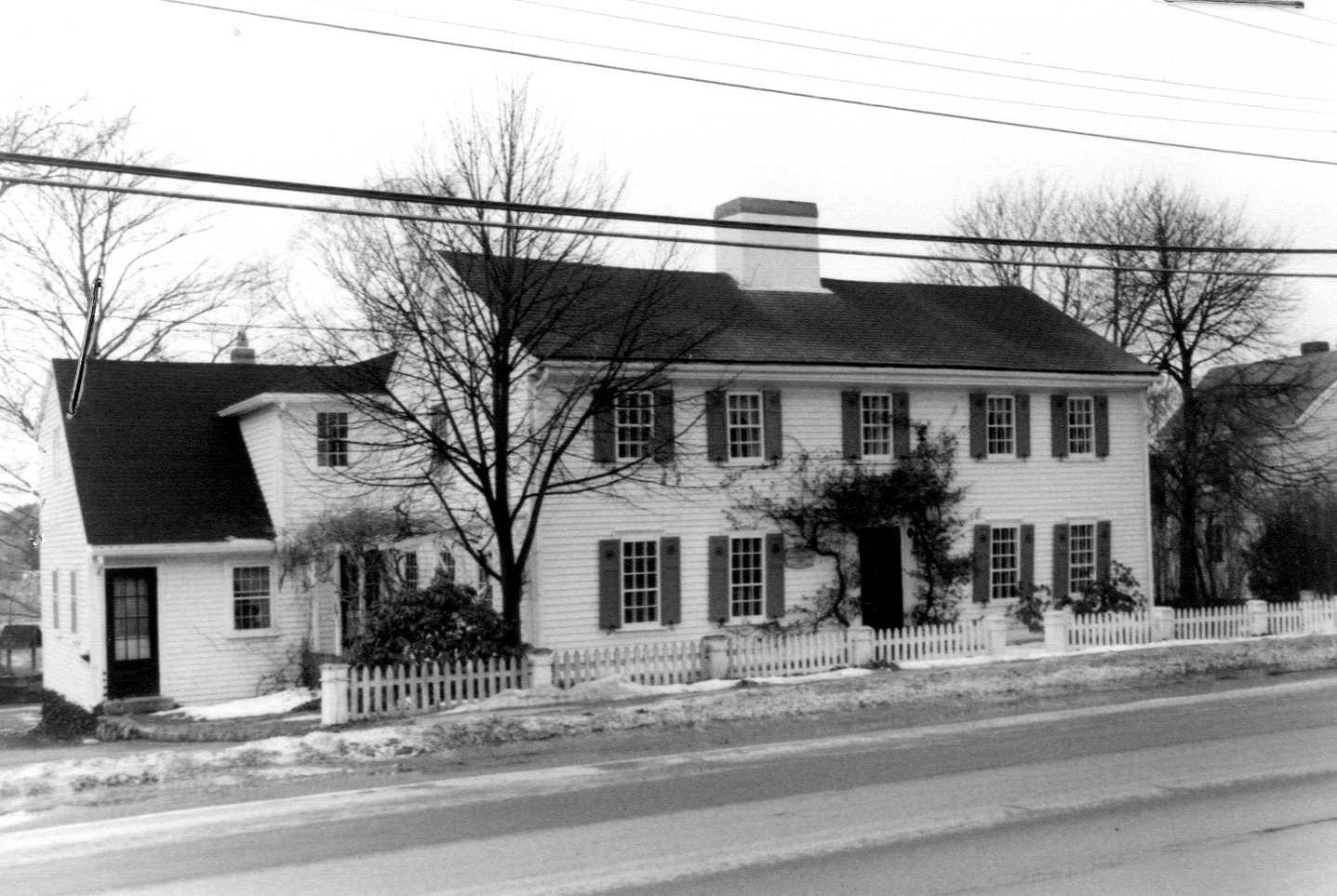
The Caleb Kimball house, or the “House with Orange Shutters” as it is commonly known, is at 106 High Street in Ipswich, a First Period house built between 1690 and 1715. The orange shutters are a long tradition.
Caleb Kimball (1) was born in 1639 in Ipswich, Essex County, Massachusetts. His parents were Richard Kimball and Ursula Scott. He was a farmer and married Anna Hazeltine on November 7, 1660. Anna was born April 1, 1640, the daughter of Robert and Ann Hazeltine of Rowley. Anna’s sister, Mercy, married Caleb’s brother, Benjamin Kimball.
Caleb Kimball (1) bought this land from Richard Kimball in 1665 (4:257). The owner restored the interior of the left side as a First Period home, with exposed beams and a large fireplace. The right inside has Georgian features, plaster ceilings, and a Rumford fireplace.
A few years ago, the sills on this First Period house had rotted to the extent that the structure was leaning forward by 8” from the sill to the front edge of the roof. Woodwright James Whidden jacked up the house and repaired the sills, posts, and girts. Whidden referred to this as the “A. Kimball house,” but the name is unknown. Whidden’s death at age 49 was a great loss to the town of Ipswich.
The House with Orange Shutters was chosen as the 2013 recipient of the Mary Conley Award for Historic Preservation by the Ipswich Historical Commission. View MACRIS.

Thomas Franklin Waters wrote:
The lot originally assigned to John Cooley, Diagram 2: “The two venerable houses beyond the Fowler location are on the ancient house lot of John Cooley, who was in possession in 1638. Richard Kimball, then of Wenham, sold to Caleb Kimball, the house, late John Cooley’s, deceased, bounded by Simon Tuttle southeast, Robert Day, southwest, Thomas Smith northwest in 1665 (Ips. Deeds 4: 257). Caleb, probably the son of Caleb, conveyed to his son John, a third of the homestead, containing two acres, “on that side of the homestead next Simon Tuttle’s, 4 rods 6 ft. and a half next the Street,” on June 1, 1715 (36: 23) . The residue of his estate, Caleb bequeathed to his son Benjamin (Pro. Rec. 320: 261-3), Feb. 28, 1736. Lieut. Jeremiah Kimball succeeded to the John Kimball estate, and at his death, the northwest part was allotted to his widow, and the northeast to his eldest son, Jeremiah (Pro. Rec. 351: 458, 1765). His son, Jeremiah, inherited it, and in the division of his estate, it was allotted to his sons, Jonathan C. and Charles, March 25, 1831 (264: 103), who sold to Thomas Stamford, Oct. 3, 1832 (266: 246). This ancient dwelling was probably built by John Kimball, soon after the year 1715.
“The other part of the estate was sold by Benjamin Kimball, son perhaps of the earlier Benjamin, to Capt. Daniel Goodhue, March 1, 1775 (160: 54). But it returned to its old family line. Capt. Goodhue sold it to Jeremiah Kimball Jr., with an acre of land, June 25, 1801 (170: 24). He sold to William Heard, Dec. 7, 1819 (228:197), and Heard to Aliraham Lord, Dec 6, 1827 (246: 306). It is impossible to determine when the ancient dwelling was built, but it was probably erected long before the Revolutionary War.”
Sources
- View MACRIS
- American Family History
- Waters, Franklin Thomas: Ipswich in the Massachusetts Bay Colony, Vol. 1
 Historic Ipswich
