
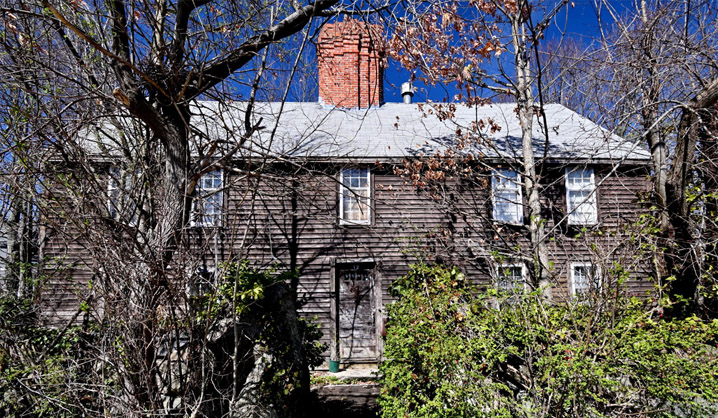
The lot at 12 Green St. came into the possession of Andrew Burley before 1688. He bequeathed to his son Andrew “all my housing and land where I now dwell” in 1718. In that year, Andrew Burley Jr. married Lidia Pingry, and following her death in 1735, he married Hannah Burnham, the widow of William Cogswell. He became a wealthy merchant and a representative to the General Court and updated his father’s house with fine Georgian features. Andrew Burley died in 1753, and his will included detailed directions for the care of his widow, Hannah.
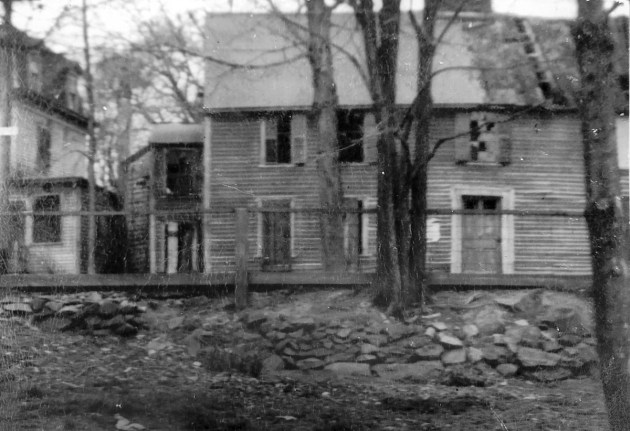
Capt. John Smith purchased the Andrew Burley house on April 15, 1760, from the estate of Andrew Burley’s widow, Hannah, and operated it as Smith’s Tavern. His two daughters, widow Elizabeth Perkins and Eunice, wife of Isaac Stanwood, inherited the house, and the two families continued to each own half of the house throughout the 19th Century. The present owner, who has owned the house since 1984, replaced the chimney. An overgrowth of trees and other vegetation has caused this house to fall into a state of disrepair.
The house at 12 Green Street was built in 1688 by Cornet Andrew Burley, son of Giles and Elizabeth Burley, who was born at Ipswich on Sept. 5, 1657, and died in 1718. The location was originally granted in 1639 to Thomas Scott, “an acre for a house lot, lying to the Lane called Bridge Lane (now Green St.), near the meeting house, the house lot of Philip Fowler on the southeast and the house lot granted to Humphrey Bradstreet, on the northeast,” in 1639. It came into the possession of Andrew Burley before 1688 (Ips. Deeds 5: 338).
Andrew Burley and his wife Mary Conant, had three daughters and a son, Andrew Burley, who was born in 1694. The senior Andrew Burley bequeathed to his son Andrew “all my housing and land where I now dwell, on ye north side of ye way,” Feb. 1717-18. The younger Andrew became the owner of the senior Andrew’s extensive land holdings, including land with a house near the beginning of Jeffreys Neck Road, and the senior Andrew’s dwelling and one-acre lot at the corner of County Road. and Green Street.
In 1717, Andrew Burley Jr. married Lidia Pingry, and after she died in 1735, He married the widow Hannah Burnham, whose husband William Cogswell had died in 1727. Andrew Burley became a wealthy merchant, justice of the Sessions Court, and was elected as a representative to the General Court in 1741, and updated his father’s house with fine Georgian features. He died in 1753. Andrew Burley’s will left detailed instructions for the care of his widow, Hannah. He left her: “the improvement of the land and buildings where I now live, and to be yearly procured for her, put in her barn, by my executors one load of salt, one load of English hay, also twelve bushels of corn, four of rye, four of malt, two hundred pounds of good pork, as much beef, thirty of butter, fifty of cheese, twenty of flax from the swingle, ten of sheep’s wool, and six cords of wood, to be delivered at her said dwelling house yearly while she remains my widow, and for the same time to find her a horse and a chair to ride to meeting or elsewhere as her occasion requires. I also give her one cow and my household goods.”

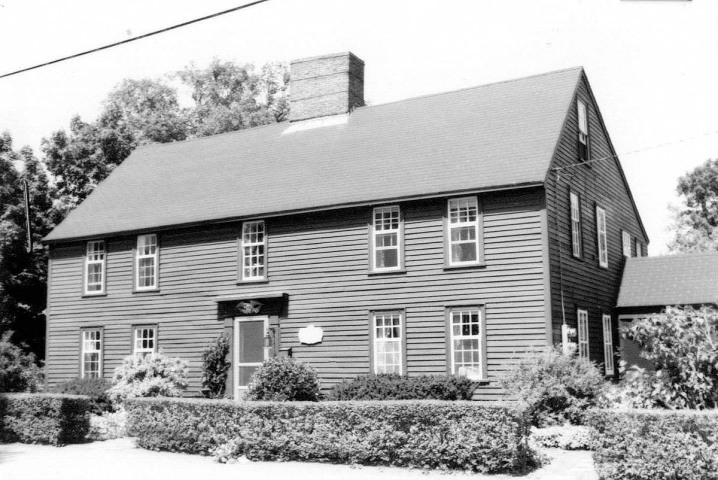
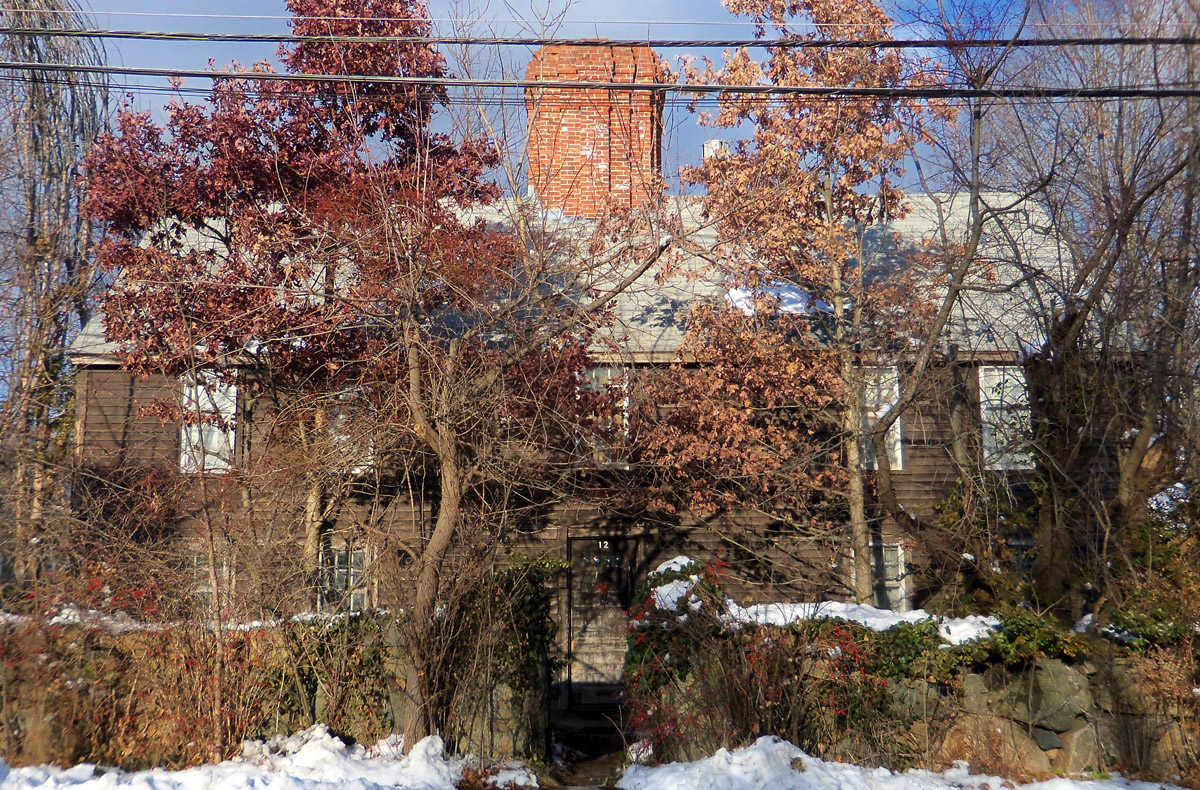
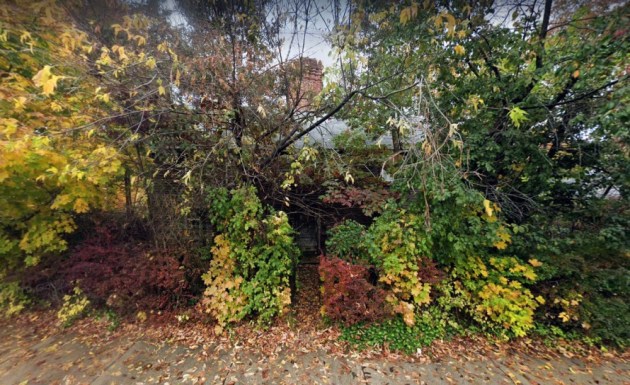
Capt. John Smith purchased the Andrew Burley House on April 15, 1760 (110: 73) from the estate of Andrew Burley’s widow, Hannah, and operated it as Smith’s Tavern. Susanna (How) Smith ran Smith’s Tavern from 1760 to 1790. Capt. Smith’s inventory (Pro. Rec. 345: 61 1768) included “one house and one acre of Land adjoining, formerly of Andrew Burley E.sq., £120.” He kept a tavern and bequeathed his wife, Susanna, “all tavern stores in the house.” The residue of the estate, after specific bequests, was given to his son Charles. John Hodgkins was in possession in 1791. His two daughters, widow Elizabeth Perkins and Eunice, wife of Isaac Stanwood, inherited the house (Pro. Rec. 367: 505). Isaac Stanwood Sr. and Eunice conveyed to Isaac Jr. the life estate that Isaac Sr. had in the estate, Sept. 16, 1819 (221: 220). The northwest half of the house remained in the Perkins family into the 20th Century. John and Lucretia Perkins sold to William Baker the corner lot on which he built his house on July 13, 1830 (2.57: 275).
Andrew Burley
“ANDREW BURLEY, born June 14, 1694, was a justice of the Sessions Court and represented the town in the General Court in 1741. He inherited the homestead from his father. He was a member of the committee to repair the prison, but died before the work was completed. His son Andrew was authorized to complete the work in 1753. He married Lydia Pengry in 1717. She died Aug 25, 1736, at 39 years. He married second on Dec. 9, 1738, the widow Hannah Boardman. His will was dated Dec. 4, 1753. His widow, Hannah, lived in the family mansion after her husband’s death, and on her decease, Andrew Jr sold the estate, including 1 acre of land, to Captain John Smith on April 15, 1760 (110: 73). She died in 1759. In addition to the children of her husband mentioned in his will, she mentions daughter Elizabeth Boardman of Stratham, NH, and son Stephen Boardman of the same place.”
Capt. Smith’s inventory (Pro. Rec. 345: 61 1768) included “one house and one acre of Land adjoining formerly of Andrew Burley Esq., £120.” He kept a tavern and bequeathed his wife, Susanna, “all tavern stores in the house.” The residue of the estate, after specific bequests, was given to his son Charles. John Hodgkins was in possession in 1791. His two daughters, widow Elizabeth Perkins and Eunice, wife of Isaac Stanwood, inherited the house (Pro. Rec. 367: 505). Isaac Stanwood Sr. and Eunice conveyed to Isaac Jr. the life estate that Isaac Sr. had in the estate, Sept. 16, 1819 (221: 220). The northwest half of the house remained in the Perkins family into the 20th Century. John and Lucretia Perkins sold to William Baker the small corner lot on which he built his house on July 13, 1830 (2.57: 275, which no longer stands.

Sources & further reading:
 Historic Ipswich
Wood rot is initiated by ultraviolet in direct sunlight. Paint peels first on the South side of a house. Current owner planted heirloom Quercus Alba (White Oaks) to shield facade from UV radiation. Facade stays dry due to 10 foot gap between trees and house. So existing greenery in front serves to protect and preserve the Burley House. 19th C. photos show American Elms where White Oaks now stand. It used to be standard practice to protect a house with shade trees. Existing eye-level greenery absorbs road dust from cars, provides a privacy screen, and helps prevent trespassing. A historic district is not a Disneyland. It is a living neighboorhood of private homes.
If you ever want to sell that house, I’m a Perkins descendant. Let me know.
Wood rot is initiated by the ultraviolet component of direct sunlight. An observant homeowner (who lives in a house long enough to get to know it) sees that paint peels first on the South side of a house, and the South slope of an asphalt roof gets replaced years before the North slope. The current owner of the Burley House planted heirloom Quercus Alba (White Oak) specimens on the South side of 12 Green St to protect the house from the intense UV radiation in summer sunlight. Whereas in winter, pale sunlight reaches the facade directly because the deciduous trees have lost their leaves. The facade stays dry because of the ten foot gap between the trees and the house. Thus the existing greenery in front serves to protect and preserve the Burley House. The 19th century photos of 12 Green St show American Elms used to stand in the positions now occupied by the existing White Oaks. It used to be standard teaching to protect a house with shade trees. The greenery at eye level at 12 Green St serves to absorb road dust from car traffic and provides a privacy screen and helps prevent trespassing. A historic district is not a Disneyland. It is a living neighboorhood of private homes.
I was wondering the same thing William Burley. The house back in the day was gorgeous. Why would someone want to live there the way it is now. I just don’t get it, not to mention when I walk by I just want to go clean it up, lol.
Does anyone have a clue why the current homeowner of 12 Green Street is letting the vegetation get so overgrown. Is there no city ordinance that would address the homeowners neglect of the outside maintenance around this home?
The owner is destroying the house, but doesn’t seem to care. Unfortunately Ipswich doesn’t have a preventative maintenance bylaw, but it should.
I agree they should have the town condemn the house at this point .
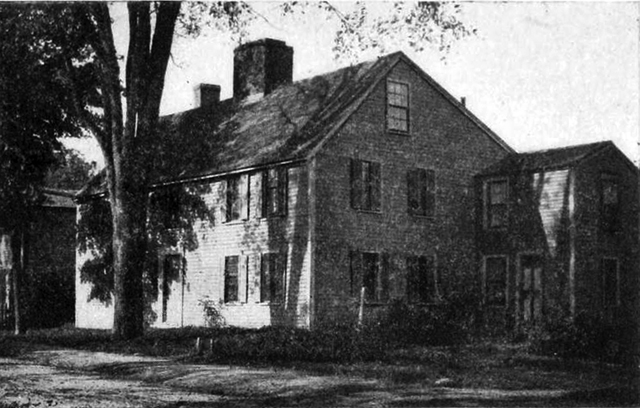
The plain chimney stack ABOVE the roofline replaced in 1980 was not the “original.”
It was made of wire-cut bricks which dates it to late nineteenth or
more likely early twentieth century.
The decision to remove it was reached with S.P.N.E.A.
The stack BELOW the roofline is of handmade bricks
set in clay and probably is original 17th century work,
and has an Elizabethan style ornamental pilaster on the front.
The 1980 reproduction stack above the roofline continues
the existing pilaster on the front and conjecturally adds
pilasters on the sides and back.
Why is the chimney so much more ornate and substantial looking in the modern picture?
The present owner replaced the original chimney with this one many years ago.