
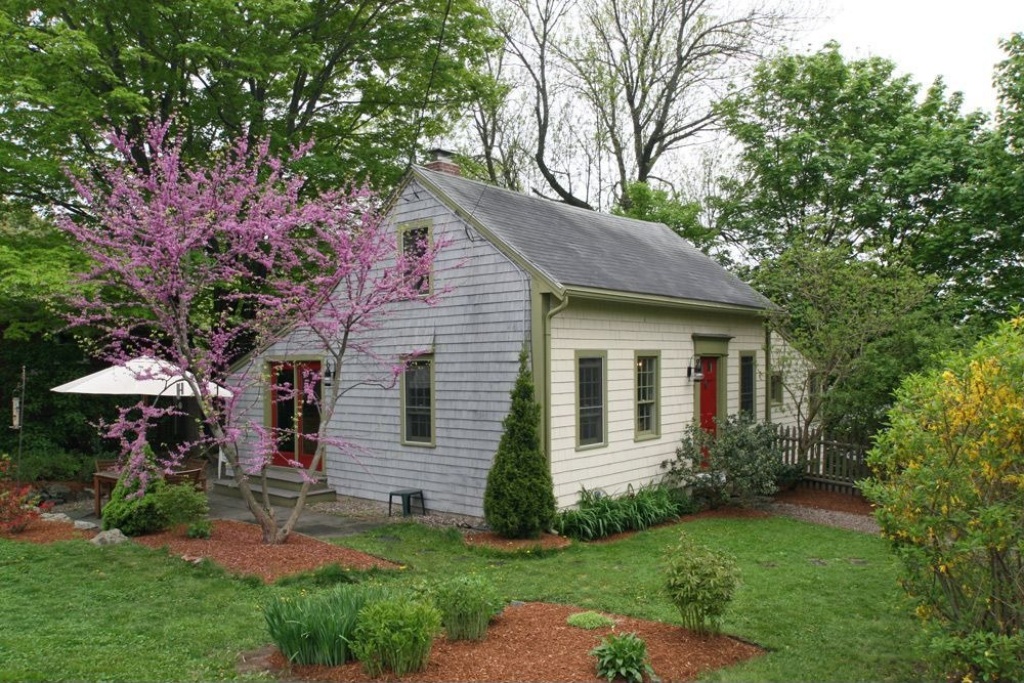

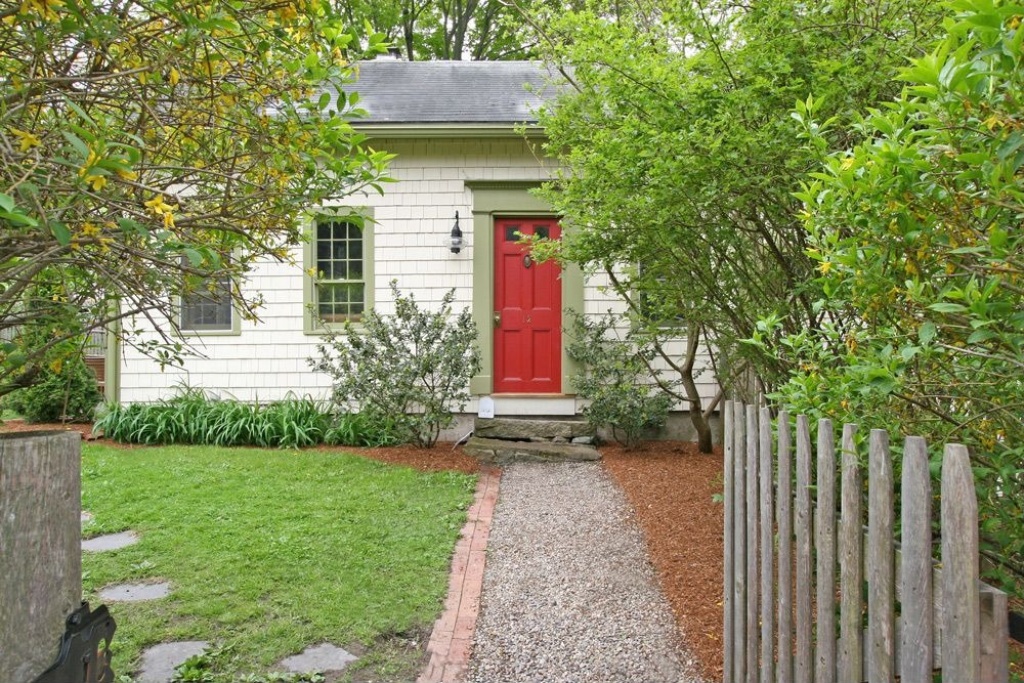
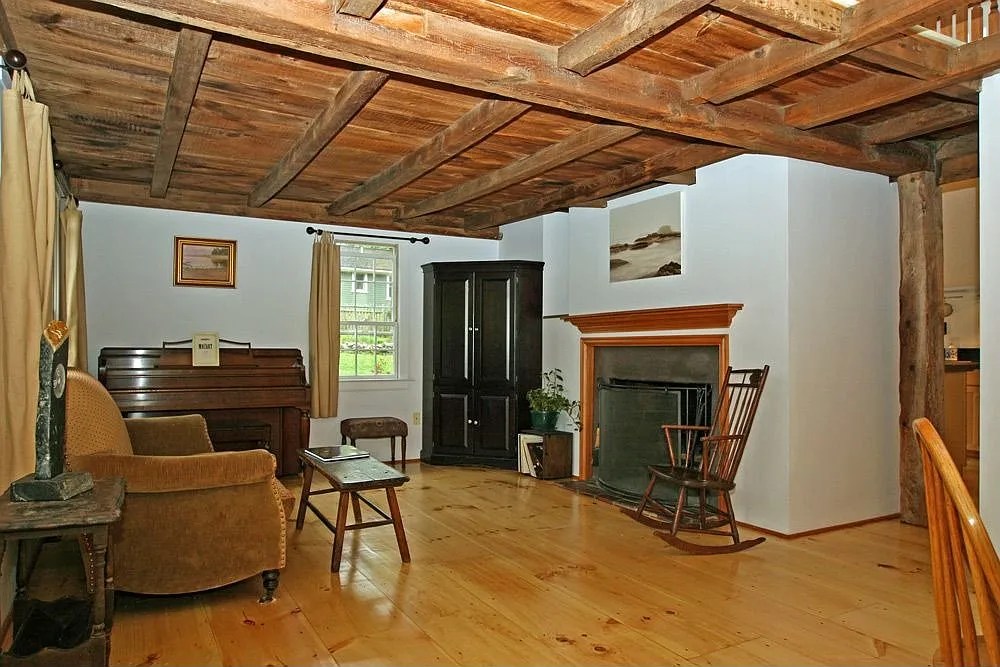
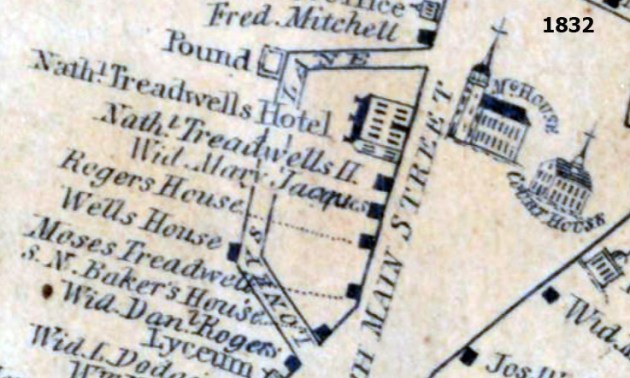
The small “broken back” cottage at 12 Warren Street in Ipswich is listed on the town assessors’ site as having been built in 1700, but the house lacks First Period features, indicating a later date. It was moved a short distance to this location, which had been the site of the town pound in the 18th and 19th centuries. This house is not shown in the 1832 map, and first appears in the 1856 map in its original location, owned by “S. Wells.”
This was the small home of “Mrs. Wells,” widow of Stephen Wells, listed in the 1888 Agawam Directory of Ipswich. Stephen Wells, whose father was John Wells, married Louisa Stiles in 1839 and died in 1852, but she lived until 1893. They were the parents of John Wells and Aaron Day Wells, who sold and mortgaged property on Loney’s Lane to his mother, Louisa Wells, in 1876 (934: 221).
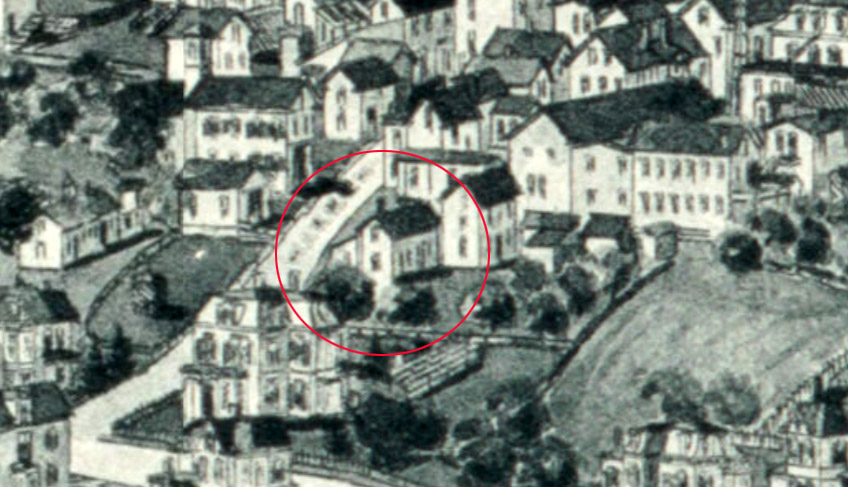
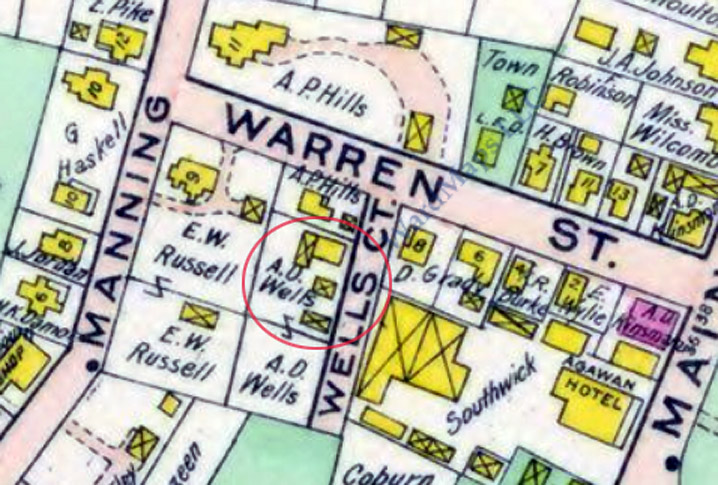
The house is shown in the 1892 Birdseye map, slightly farther back on the lot and facing the opposite direction. After Manning Street was constructed, Warren Street was extended, and the old Town Pound was removed. The small house was moved to Warren Street after the death of Louise Wells in 1893.
The Town Pound
The first Town Pound in Ipswich was located at 12 Meeting House Green. It was simply a fenced-in area where stray animals were herded to prevent damage to fields and gardens. The lot was deeded by John Heard in 1832 to be used as the First Church Vestry or Meeting House.
In 1719, a large log almshouse was constructed “near the Town Pound on Loney’s Lane.” In the 1832 village map, the enclosed animal pound was located at the corner of Warren St. and Loney’s Lane.
Loney’s Lane
Loney’s Lane is named for Anthony Loney, who owned the lot at 12 N. Main St. from 1739 to 1742. He sold that lot to Nathaniel Treadwell, who opened a well-known inn.

Thomas Franklin Waters wrote, “Loney’s Lane, as it has been called, but formerly Pinder’s Lane, was originally an open thoroughfare which descended the hill back of the North Main Street Lots. Originally, the Old Pinder Lane crossed the present Central St. and led across the low lane to the ancient Bridge Street.” A hand-drawn map from 1717 shows six house lots on the west side of Pindar’s Lane, but there were only two houses, Symon Pinder’s and Thomas Pinder’s, which stood at 3 Loney Lane, where the Aaron Wells House is located.
In the 1856, 1872, and 1884 Ipswich Village maps, there are two small structures at the rear of this lot facing Loney’s Lane, but no building is shown on the corner with Warren. In the 1910 Village map, this house had been moved to the corner, and was owned, perhaps incidentally, by Mary and Albert P. Hills, the Town Pound keeper, who resided at 9 Manning St., the Albert P. Hills House (c. 1890). They sold several lots on Manning Street when it was created in the second half of the 19th Century. This lot and house were sold by Mary E. Hills to Walter and Ethyl Poole, who then sold it in 1921. (Deeds, book 2494, page 350).
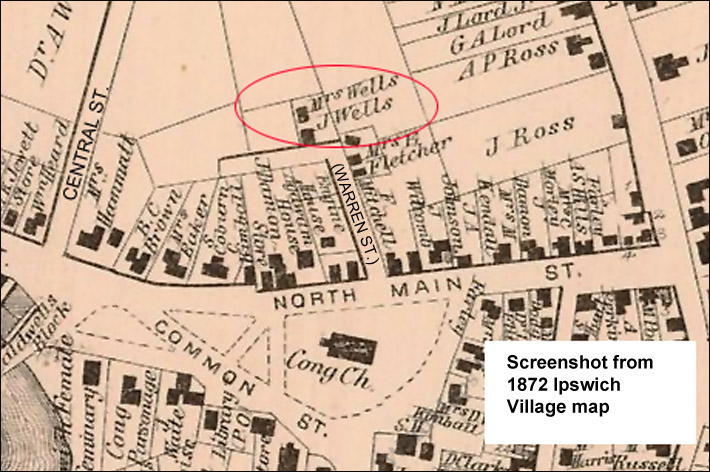
Screenshot from the 1872 Ipswich map. The house now at 12 Warren St. was the small home of “Mrs. Wells” shown in the 1892 Birdseye map. The 1888 Agawam Directory of Ipswich lists Louisa, widow of Stephen Wells at this location.
Jonathan Wells
Thomas Franklin Waters wrote about an earlier member of the Wells family whose home was nearby on North Main Street, in his two-volume set, Ipswich in the Massachusetts Bay Colony:
“Jonathan Wells enlisted in Capt. Abraham Dodge’s company on May 3, 1775, and took part in the battle of Bunker Hill on June 17. He enlisted again on January 1st, 1776. He was a seaman in the Brigantine for five months and fourteen days in 1777, being discharged on July 31st. He was in the privateer “Fair Play” in December 1777, in the “Black Prince” in July 1778, and in the “Gen. Wadsworth’ in February 1781. It is a family tradition that Mr. Wells was wounded during his first enlistment. While at home, recovering from his wound, he went one day to the Meeting House Green, where recruits were being enrolled, and was so fired with enthusiasm that he reenlisted and marched away with his arm in a sling. Entering the Navy, he passed from ship to ship, without being allowed an opportunity to return home and see his family. He used to say that he thought he had seen war before he became a seaman in the navy, but his land service was not to be compared with the fight between the “Bon Homme Richard” and the “Serapis.” He stood at his gun when nine men and a boy lay dead around him. He always expressed great admiration for John Paul Jones, telling how small a man he was, and of his brilliant ability and dauntless courage. On his return home after this battle, his house was besieged for days by friends and neighbors, who desired to hear from his own lips the story of the great sea fight. His wife picked the powder from his face with a fine cambric needle.”
Sources:
- Ipswich in the Massachusetts Bay Colony, Volume I by Thomas Franklin Waters
- Hammatt Papers: Early inhabitants of Ipswich, Mass. 1633-1700 by Abraham Hammatt
- Ipswich Vital Records, Marriages
- Findagrave: Stephen Wells
 Historic Ipswich