
Capt. Michael Farley and Mr. Daniel Noyes represented Ipswich at the Provincial Assembly on October 5, 1774, which met in Salem, and then adjourned to Concord as the Provincial Congress three days later. A resolution was adopted that companies of Minutemen be organized and that “each of the minute men not already provided therewith, should be immediately equipped with an effective firearm, bayonet, pouch, and knapsack, Thirty rounds of Cartridges and Ball, and that they be disciplined three times a week and oftener as opportunity may offer.”
Meanwhile, the First Continental Congress met in Philadelphia from September – October 1774. The representatives from Massachusetts were Thomas Cushing, Samuel Adams, and John Adams, all of Boston. At the urging of John Adams, Paul Revere rode from Boston to Philadelphia twice in September, bringing a copy of the Suffolk Resolves, and carrying letters both ways.
At the Ipswich Town Meeting, held on November 21, 1774, the Proposals and Resolves of the Continental Congress were read and put to a vote, passing unanimously. The town approved the enlistment of soldiers according to the Proposals of the Provincial Congress, and a plot of land at the easterly end of the Town House, fifty feet long and twenty-five feet wide was selected to “Erect a House for the Encouragement of Military Discipline.” Every Ipswich man was bound with a contract to “attend duty two half days in each week,” with a wage of one shilling to each enlisted man for each half day he attended muster.
Paul Revere’s ride to Portsmouth
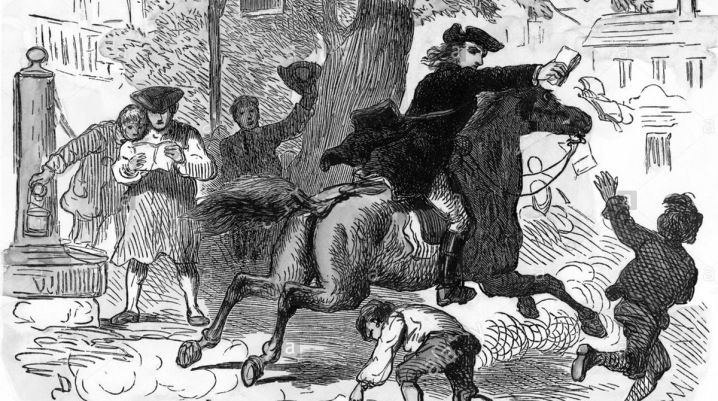
On the cold icy morning of December 13, 1774, Paul Revere headed out on a 60-mile gallop from Boston along the Old Bay Road to warn the citizens of Portsmouth that British troops may be landing to secure British munitions at Fort William and Mary at New Castle.
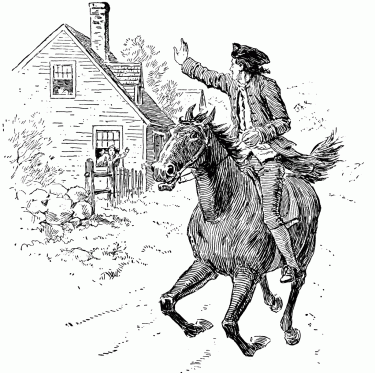
Revere passed through Ipswich before noon and arrived in Portsmouth about 4 pm, where he called on the members of the Portsmouth Council of Correspondence for an impromptu meeting at the home of Samuel Cutts. Although the rumored arrival of two regiments of British soldiers turned out not to be the case, it sparked the anticipated confrontation nonetheless. Loyalists in Portsmouth sent word to the fort, and a courier was sent by horse along the Old Bay Road to summon General Gage and General Graves in Boston. Graves ordered the sloop HMS Canceaux to head to Portsmouth, and while they were in transit, Revere rode back to Boston.
Four months later, Paul Revere would take the ride that made him famous, but this run is believed by some historians to have begun the Revolutionary War. When the British soldiers arrived, Portsmouth men had already stormed the fort, ripped down the British flag, and stole all of its weapons and gunpowder.
Contrary to the image portrayed in Longfellow’s poem of a lone hero, Paul Revere was a member of a secret Whig intelligence network known as the “Mechanics,” and undertook his heroic rides as an agent for the Boston Committee of Correspondence.
On his passage back through Ipswich, Revere surely called on our own Committee of Correspondence, which the town had formed two years earlier. In anticipation of the war, Capt. Michael Farley, Dr. Daniel Noyes, and Maj. John Baker were instructed by town meeting to “Receive and Communicate all salutary measures that shall be proposed or offered by any other Town.”

The Committtee concerning instructions to the Delegates is as follows, viz.
To Col. Michael Farley
February 4, 1775
The Choice which this Town has made of you to represent them in the Provincial Congress to be held at Cambridge on the first day of February. next is clear proof of their Opinion of your Integrity they cannot doubt, but that you will feel The Weight of the Trust reposed in you, more especially as it is devolved upon you at this Critical Juncture when everything that is dear and valuable is threatened to be ravished from us. And although we presume not to dictate to the Fathers of this people, in whose ability we place the greatest Confidence, yet in this day of Doubtful Expectation, when the wisest are at a loss what is best to be done, we think there ae some things which we may safely enjoin upon you.
(1) From a serious & affecting Consideration of the increasing Wickeness & Infidelity in the British Nation in general, and from a humble sense of our own Degeneracy & Departure from the good ways of our forefathers in New England, we think it the indispensable Duty of this People under their great Difficulties, by Fasting and Prayer immediately to humble themselves before god, for their innumerable offenses against him, and with united Voice at one time earn3stly to seek forgiveness of him, and that he would turn from his anger towards us, we would therefore instruct you that you use your best Endeavors, that among the first Doings of the expected Congress, a Day be Set apart for that Purpose.
(2) We would also have you make strict Enquiry whether any of the Towns in this Province have neglected to comply with the Resolves of the Continental or Provincial Congress, & that if any have, it may be known, & that a proper Censure may be passed and no Connnection had with them, as we look upon it that this whole People ought to pay as full & great Regard to these Resolves as if they had been Acts or Laws of the General Assembly, and we would have the Committee of Correspondence of every Town oblige to publish the Names of the Persons in each Town (if there are any) who do not conform to the Association agreement.
(3) “It is with Regret that we find there are Enemies among ourselves, who insinuate & endeavor to persuade others that This Province is seeking after Independency & want to break off from their allegiance to the Crown of Great Britain, which is a thing that has not the Least Foundation in Truth; neither can these wicked Persons, we believe, Produce so much as one single Instance thereof …. Nevertheless to avoid giving them the least handle against us, we desire you would Endeavor that nothing be done by the Congress to change or alter the Form of Government appointed by Our Last Charter, but that with patience and due Fortitude we bear the Injuries brought upon us, waiting for the time of our deliverance.”
(4) As we fully approve of the Wise Recommendations of the late provincial Congress relating to our own manufactures, so we should be glad if some particular method might be thought of that may be instrumental of promoting the same.
We do not pretend to instruct you concerning your Conduct in every Respect, but leave other things to your wise and prudent conduct expecting you will pursue what is hereby given you as our Minds, & Wishing the all Wise God may direct the whole Congress to pursue such measures as shall be approved of by him, and be instrumental of extricating us out of our Difficulties.
—Voted that the Report of the Committee be Accepted. Voted that this meeting be adjourned to Tuesday ye 14th day of February next to this place. Attest John Baker, town clerk
Sources:
- Joseph Felt: History of Ipswich, Essex, and Hamilton
- Smithsonian: The Mid-day Ride of Paul Revere
- New England Historical Society, When Paul Revere Rode to New Hampshire
- Waters, Thomas Franklin: Ipswich in the Massachusetts Bay Colony, Vol. II
- Ipswich and the Breach with Great Britain with excerpts Ipswich in the Massachusetts Bay Colony by Thomas Franklin Waters
- The Schiller Institute, “This Week in History”
- Journal of the American Revolution: “Paul Revere’s Other Rides”
- Ipswich Town Clerk’s vault
Further reading on this site:
- Ipswich and the Breach with Britain
- The Detested Tea
- John Adam’s letters from Ipswich, May-June, 1774
- Leslie’s Retreat, or how the Revolutionary War almost began in Salem: February 26, 1775
- The Ipswich Convention and the Essex Result
- Valiant Ambition: George Washington, Benedict Arnold, and the fate of the American Revolution
- Ipswich at war
- 5-7 Poplar Street, the Dr. John Calef house (1671)
- 88 County Road, the Col. Nathaniel Wade House (1727)
- 12 North Main Street, Treadwell’s Inn (1737)
- 2 North Main Street, the John Appleton house (1707)
- 1774: Ipswich mob attacks Loyalist John Calef
- Ipswich Massachusetts: Birthplace of American Independence
- The Rev. John Wise of Ipswich
 Historic Ipswich
Great record of American History
Great story that i had previously not known about ! Thanks for sharing.🇺🇸