

Crane Beach belongs to the Trustees of Reservations and is part of the historic Crane Estate. The property includes Crane Castle, miles of shoreline, and over 5 miles of marked trails through the dunes at Castle Neck and Steep Hill Beach, open year-round.
Beginning Thursday, May 16th, 2024, passes are released at noon on Monday for the upcoming Tuesday-Thursday and noon on Thursday for the upcoming Friday-Monday. Passes are required for daily admission in the Summer Season beginning May 15th, 2024. Anytime the beach reaches its operating capacity, ALL visitors except those with a Timed Entry Pass or valid 2024 Ipswich Resident Sticker will be turned away until more space becomes available.
- Admission & Hours, Directions, Property Map, and Regulations
- 2024 Admission Fees
- Get your pass here.

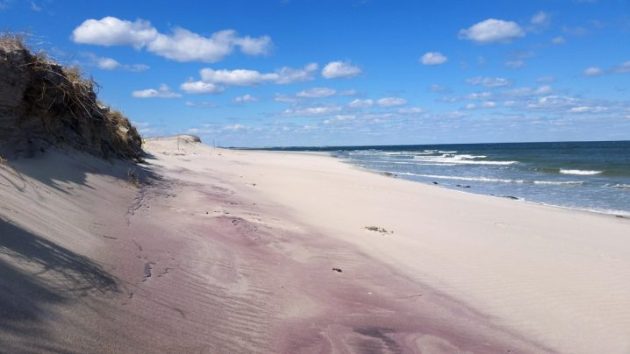
Why does Crane Beach have purple sand?
Sandy Tilton explained, “The mineral garnet comes to us via the streams & rivers from the White Mountains. Water & wind erode the rock & it is carried in the waters here until it meets the ocean & gets deposited on our beaches! As the storms erode our dunes & beaches, lots of garnet sand is exposed. It is heavier than the white quartz sand, so it doesn’t wash away as easily. In the spring & summer, the winds blow the white quartz sand & easily cover the garnet again….look in the eroded edges of the dunes…you can often see the layers of purple & white there….pretty cool!!”


JEOL is a global supplier of electron microscopes, ion beam instruments, mass spectrometers, and NMR spectrometers. After some of their employees found purple sand at Plum Island, they analyzed it using an optical microscope, a scanning electron microscope (SEM), and an energy-dispersive X-ray spectrometer (EDS).
“At first look under the optical microscope, the granules of sand appeared like scattered jewels of many colors; predominantly glassy pink angular grains, with smaller quantities of milky white rounded grains, clear angular grains, black grains (some magnetic and some not), and even the occasional green. When large amounts of fine-grained pink are intermixed with a smaller number of darker grains and dampened by rain or sea water the human eye will “see” the sand as a much darker pink to almost purple. The two most common pink minerals are rose quartz, which is found only in a few isolated pegmatite deposits in NH & southern Maine, and the solid solution series of almandine and pyrope garnet, which is quite common in the Seacoast area from the abundance of metamorphic rocks called mica schist and from contact metamorphism.”
The electron microscope provided a scientific breakdown:
- The pink-purple color comes from the abundance of almandine-pyrope garnet.
- The white grains are K-feldspar (potassium alumino-silicates) and quartz.
- The black nonmagnetic grains were a mix of a pyroxene called augite and a mix of ilmenite and hematite which are the magnetic components.
- The green was confirmed to be epidote.
Why does the sand at Crane Beach sometimes squeak?
Manchester by the Sea is famous for its “Singing Beach” but occasionally in the summer the sand at Crane Beach also squeaks beneath our feet. Wikipedia provides some answers:
“On some beaches, dry sand will make a singing, squeaking, whistling, or screaming sound if a person scuffs or shuffles their feet with sufficient force. It has been found that quartz sand will do this if the grains are very well-rounded and highly spherical. It is believed by some that the sand grains must be of similar size, so the sand must be well sorted by the actions of wind and waves, and that the grains should be close to spherical and have matter-free surfaces. The “singing” sound is then believed to be produced by shear as each layer of sand grains slides over the layer beneath it. The similarity in size, uniformity, and cleanness means that grains move up and down in unison over the layer of grains below them. Even small amounts of pollution on the sand grains reduce the friction enough to silence the sand.

Others believe that the sound is produced by the friction of grain against grain that has been coated with dried salt, in a way that is analogous to the way that the rosin on the bow produces sounds from a violin string. It has also been speculated that thin layers of gas trapped and released between the grains act as “percussive cushions” capable of vibration, and so produce the tones heard.
Water also influences the effect. Wet sands are usually silent because the grains stick together instead of sliding past each other, but small amounts of water can actually raise the pitch of the sounds produced. The most common part of the beach on which to hear singing sand is the dry upper beach above the normal high tide line, but singing has been reported on the lower beach near the low tide line as well.”
“Singing sand” has been reported throughout the world, including several beaches along North America’s Atlantic coast.
Related Posts:
 The Ipswich Visitor Center - 1820 Hall-Haskell House sits at the heart of our town on the Center Green, in one of several national historic districts in town.… Continue reading The Ipswich Visitor Center
  The Crane Estate at Castle Hill (1928) - Castle Neck and Crane Beach have a long history of ownership by several families before being granted by the Cranes to the Trustees of Reservations.… Continue reading The Crane Estate at Castle Hill (1928)
 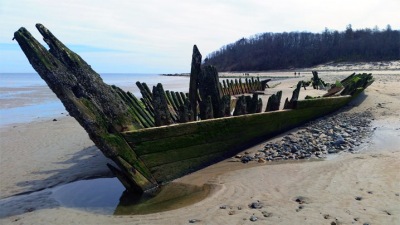 Wreck of the Ada K. Damon - Christmas, 1909 witnessed the heaviest storm in many years. The ship was wrecked during the captain's first trip for a load of sand from the plentiful supply on Plum Island.… Continue reading Wreck of the Ada K. Damon
  The Missing Dunes at Castle Neck - The "Great Dune" at the end of Castle Neck has disappeared, the point is retreating, and the opening to Essex Bay between Castle Neck and Wingaersheek Beach has widened.… Continue reading The Missing Dunes at Castle Neck
  Wreck of the Edward S. Eveleth, October 1922 - In October 1922, the sand schooner Edward S. Eveleth rolled over when a wave rushed over her deck and pushed her onto the edge of Steep Hill Beach. Filled with sand, each tide buried her deeper. Her remains were visible for several years. The skeleton of the hull is just off-shore a short distance from the wreck of the Ada K. Damon.… Continue reading Wreck of the Edward S. Eveleth, October 1922
 Destination Ipswich: A Walk in the Dunes - Gordon Harris kicks off the first episode of Ipswich ICAM'S "Destination Ipswich" series with a walk in the sand dunes at Castle Neck.… Continue reading Destination Ipswich: A Walk in the Dunes
 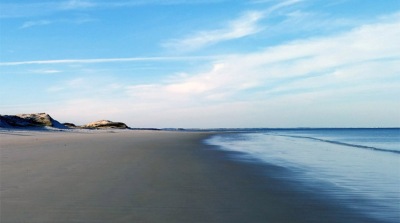 Crane Beach - Crane Beach belongs to the Trustees of Reservations and is part of the historic Crane Estate. The property includes Crane Castle, miles of shoreline, and over 5 miles of marked trails through the dunes at Castle Neck and Steep Hill Beach, open year-round.… Continue reading Crane Beach
  Choate Island and Rufus Choate - Choate Island was originally known as Hog Island, and is the largest island in the Crane Wildlife Refuge and is the site of the Choate family homestead, the Proctor Barn, the White Cottage, and the final resting place of Mr. and Mrs. Cornelius Crane. There are great views from the island summit of the Castle Neck dunes and Plum Island Mount Agamenticus in Maine.… Continue reading Choate Island and Rufus Choate
  Charles Wendell Townsend, Ipswich Naturalist - Charles Wendell Townsend, M.D. was attracted by the natural beauty of Ipswich. He built a summer house overlooking a wide expanse of salt marsh with open sea to the east. From here he wrote a number of books, including Beach Grass, Sand Dunes and Salt Marshes, and the Birds of Essex County. … Continue reading Charles Wendell Townsend, Ipswich Naturalist
  The Fox Creek Canal and Robinson’s Boatyard - The Fox Creek Canal is the oldest man-made tidewater canal in the United States, dug in 1820. In 1938 it was dredged to accommodate ship-building at Robinson's Boatyard, where small minesweepers were constructed for World War II.… Continue reading The Fox Creek Canal and Robinson’s Boatyard
 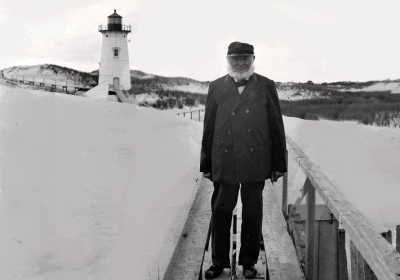 The Ipswich Lighthouse - In 1881, a 45-foot cast iron lighthouse was erected at Crane Beach, replacing an earlier structure. By 1913, the sand had shifted so much that the lighthouse was 1,090 feet from the high water mark. Use of the light was discontinued in 1932 and in 1939 the Coast Guard floated the entire lighthouse to Edgartown on Martha's Vineyard.… Continue reading The Ipswich Lighthouse
  Life at an Estuarine Front - Shorebirds congregate and drift in rafts along the estuarine front where the mixing of fresh and saltwater stirs up small fish, crustaceans, and other aquatic organisms.… Continue reading Life at an Estuarine Front
  The Shipwrecks at Ipswich Bar - The Ipswich Bar has a long history of tragic shipwrecks. Its swift currents and shallow waters are especially dangerous during storms, and many ships have gone aground. The hull of the Ada K. Damon sits on Steep Hill Beach.… Continue reading The Shipwrecks at Ipswich Bar
  The Farm at Wigwam Hill - Symonds Epes bought a large tract in 1726 and built a substantial farm and orchards at Wigwam Hill, named for a group of destitute Indians who briefly camped there. The protecting pitch pines were later cut for lumber, and the farm became a large dune.… Continue reading The Farm at Wigwam Hill
 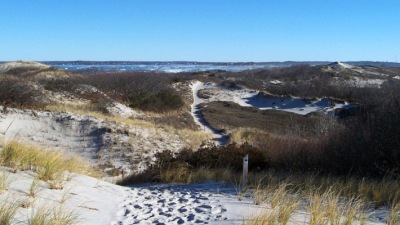 Winter Walks in the Dunes at Castle Neck - Crane Beach and all of Castle Neck are protected by the Trustees of Reservations. Pitch pine and scrub oak rise from the masses of marsh grass, sage green hudsonia and dune lichen lining the trails that wind through the dunes.… Continue reading Winter Walks in the Dunes at Castle Neck
  Historic Ipswich
my grandfather Carl D. Hill and his family including my mother lived at Crane’s beach as my grandfather was the lighthouse keeper in the 1920’s for about 10 years and they all resented the name Crane instead always called it Crane’s beach. I love what the Trustees do but they are dead wrong calling it Crane beach.
Thank you so much for this information.
As a life-long Northshore girl I never knew the scientific reasons behind Singing Beach and the Plum Island purple sand.