
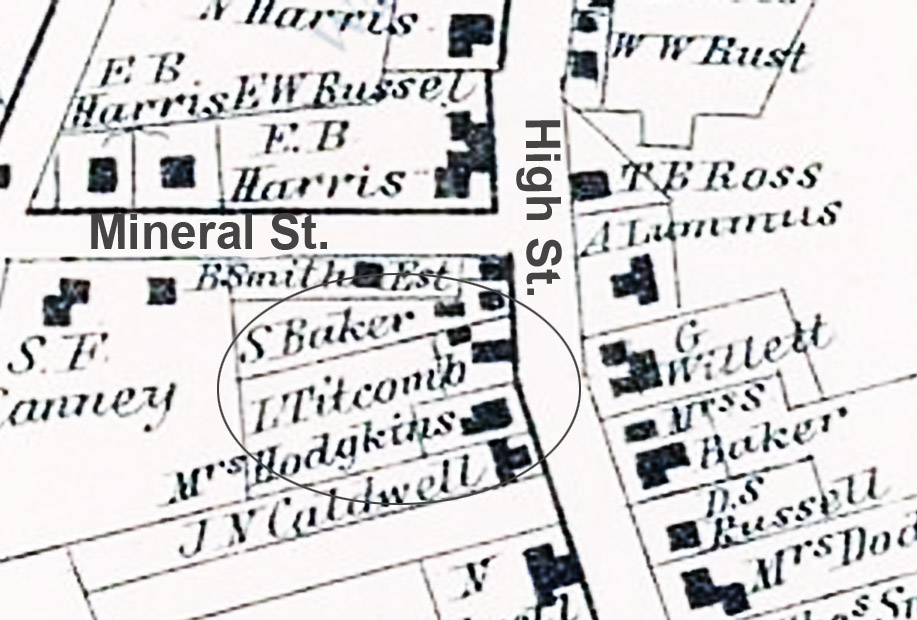
The date of construction for the house at 44 High Street is intriguing. The basement level of the house exhibits early post and beam construction and may have been constructed by Philip Fowler before he sold the property to Francis Goodhue in 1745-46. The first and second floors display refined Federal-era features with high ceilings, wide pine floors and five fireplaces, suggesting that the house may have been built on top of the foundation of the earlier structure.
The house stayed in the Goodhue family into the 19th Century. The next owners of record are Lewis Titcomb (1803 – 1884) and his wife Sarah Titcomb. He was a “manufacturer of guernsey frocks,” and owned and operated a horse team from the barn still standing on the property.
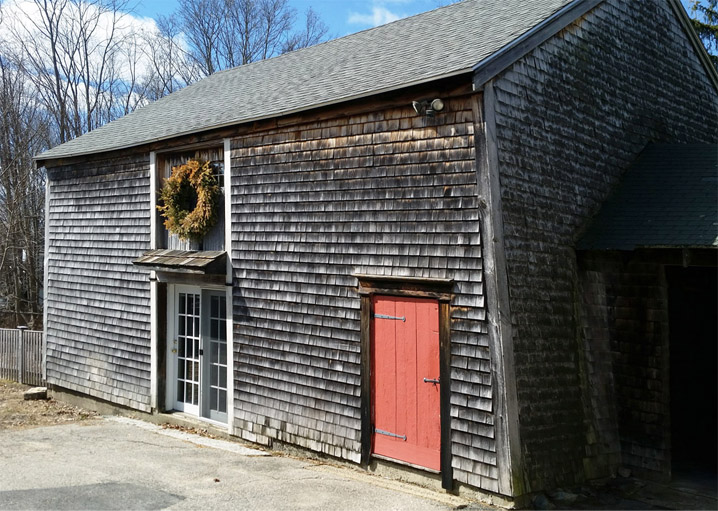
The “English Barn”
Philip Fowler sold “four acres with a dwelling house and barn upon it” to Francis Goodhue on February 3, 1745-6, but we do not know if the existing barn is the one listed in his deed. This “English three bay” barn appears to date at least to the Goodhue ownership in the 18th Century, and is a form popular in the Northeast during the Colonial period. English barns typically stood on level ground, measuring thirty feet by forty feet with unpainted vertical boards covering the walls. A double door on the long side of the barn opens onto the center, dividing the building into two separate areas: one for hay and grain storage and the other for livestock.
The barn is situated with the left end facing south, with a large door to accommodate a horse team and wagon. This orientation typically assisted in keeping the horses warmer in the winter and assured that the manure pile was away from the house and in the sun to help it decompose. A depression in the ground on the north side of the barn provides evidence of a well situated between the barn and the house, and away from the manure pile. It is possible that the well, the barn and the oldest part of the house originated with Phillip Fowler’s ownership of the property in the early 18th Century.
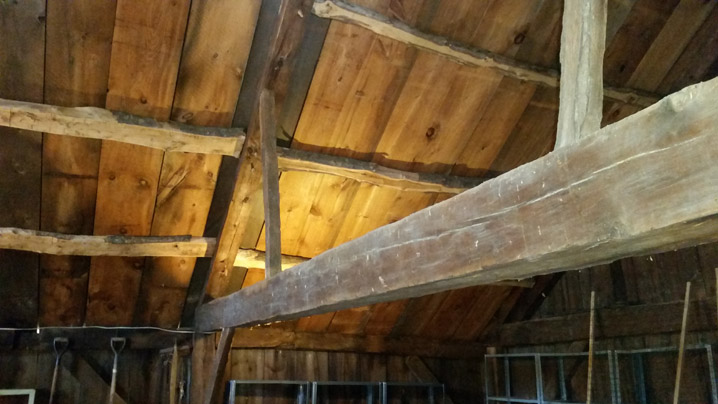
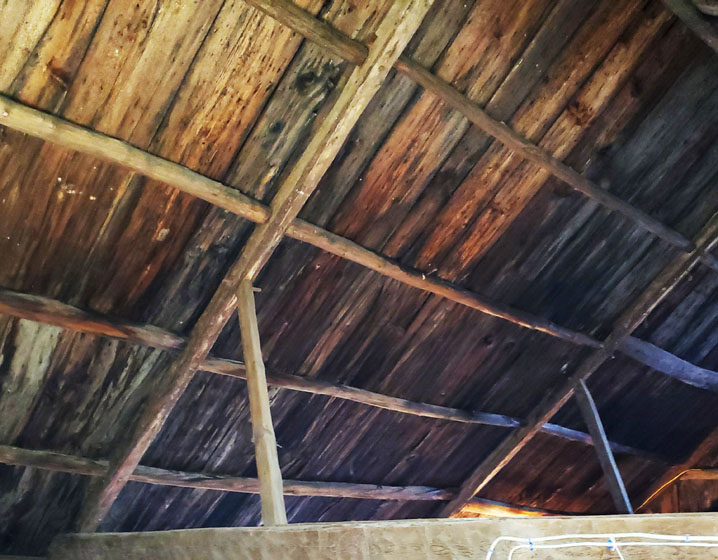
The “principle rafter and common purlin” roofing system in this barn is a form believed to have been invented in the Massachusetts Bay Colony and is unique to the English colonies in Eastern New England, persisting into the first quarter of the 19th Century. Purlins are supported by massive widely-spaced rafters and carry the vertical roof sheathing.
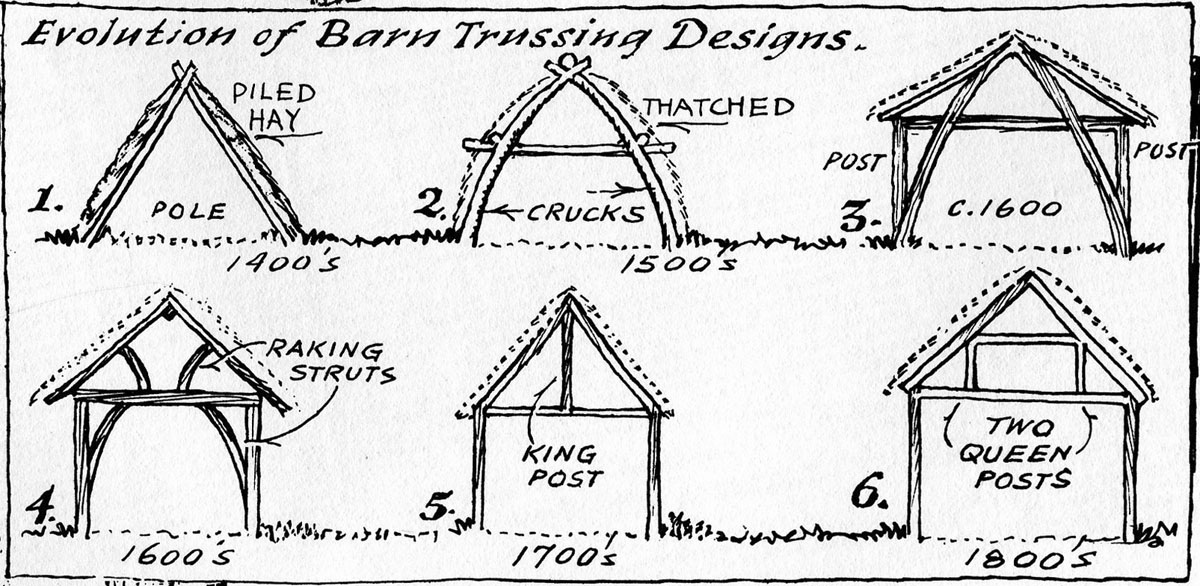
In some barns, including this one, raking (angled) struts perform as a wind-brace and help prevent the principal rafter from bowing under snow load. In England, this form of barn roofing is found in barns constructed as early as the 16th Century.
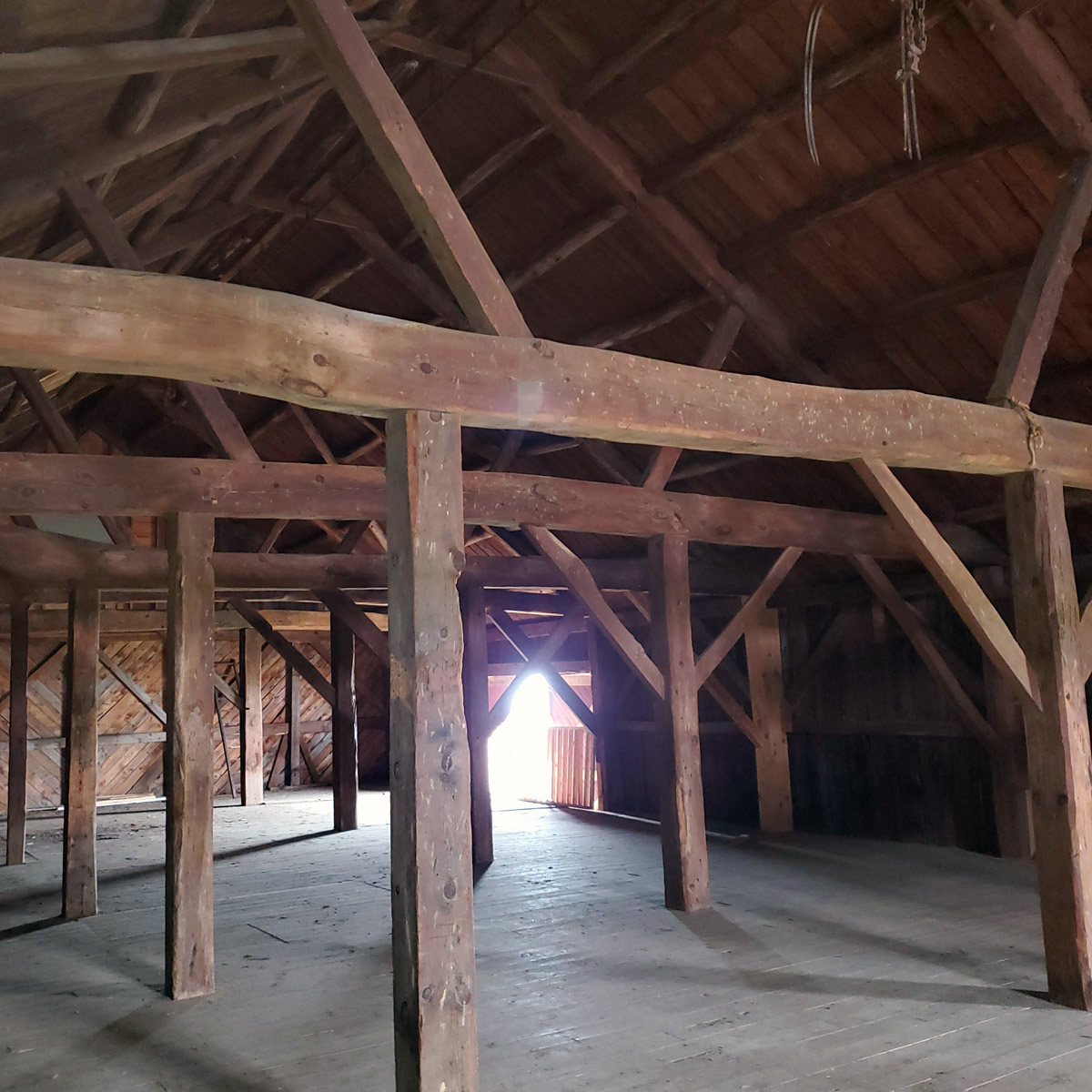
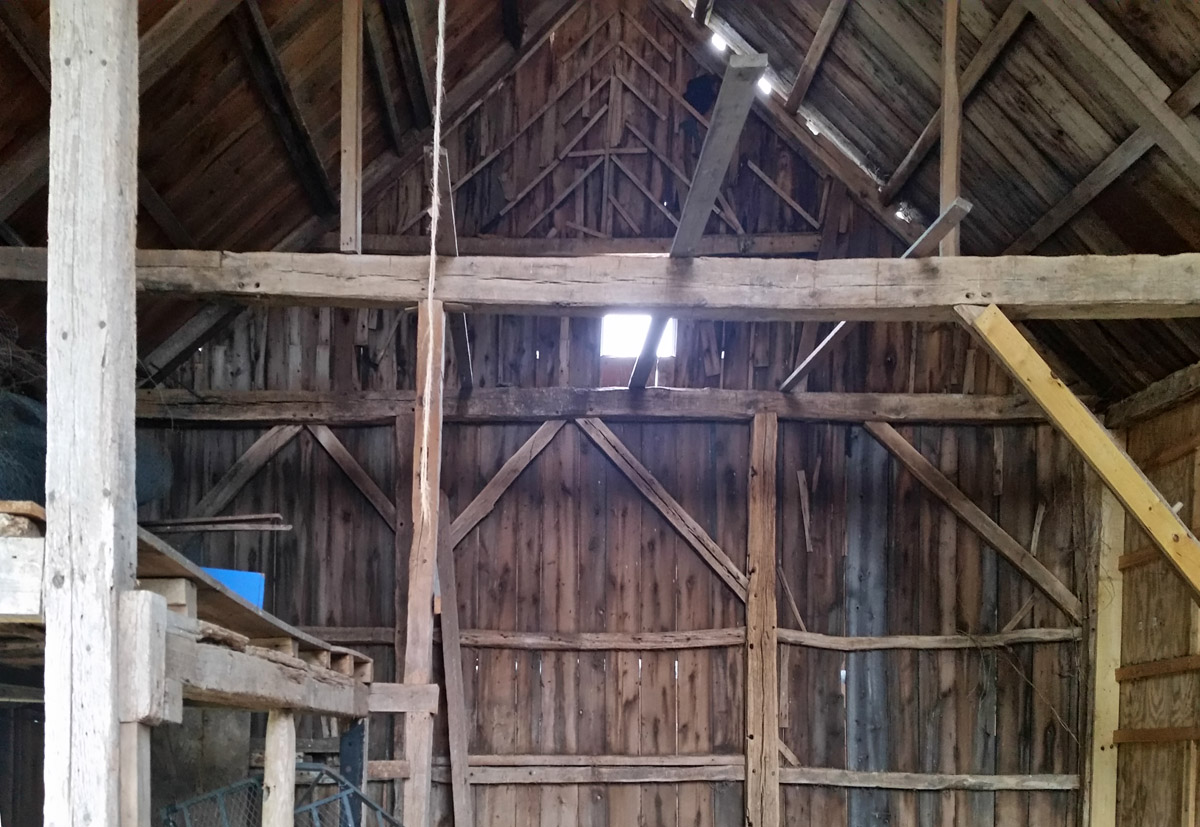
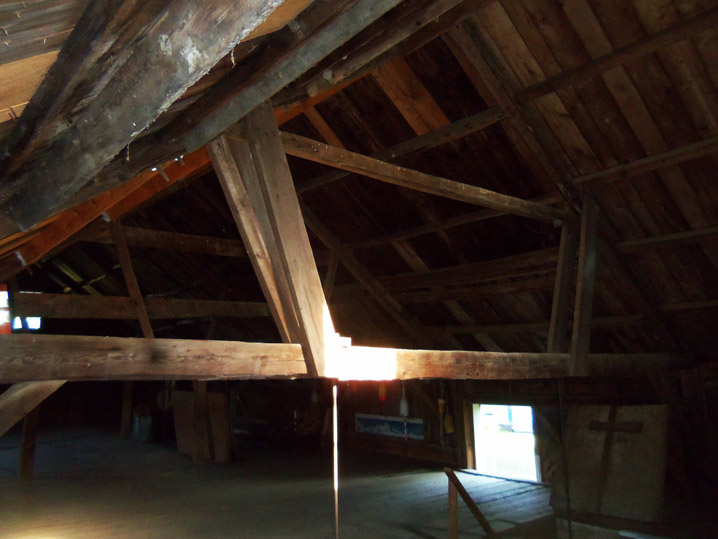
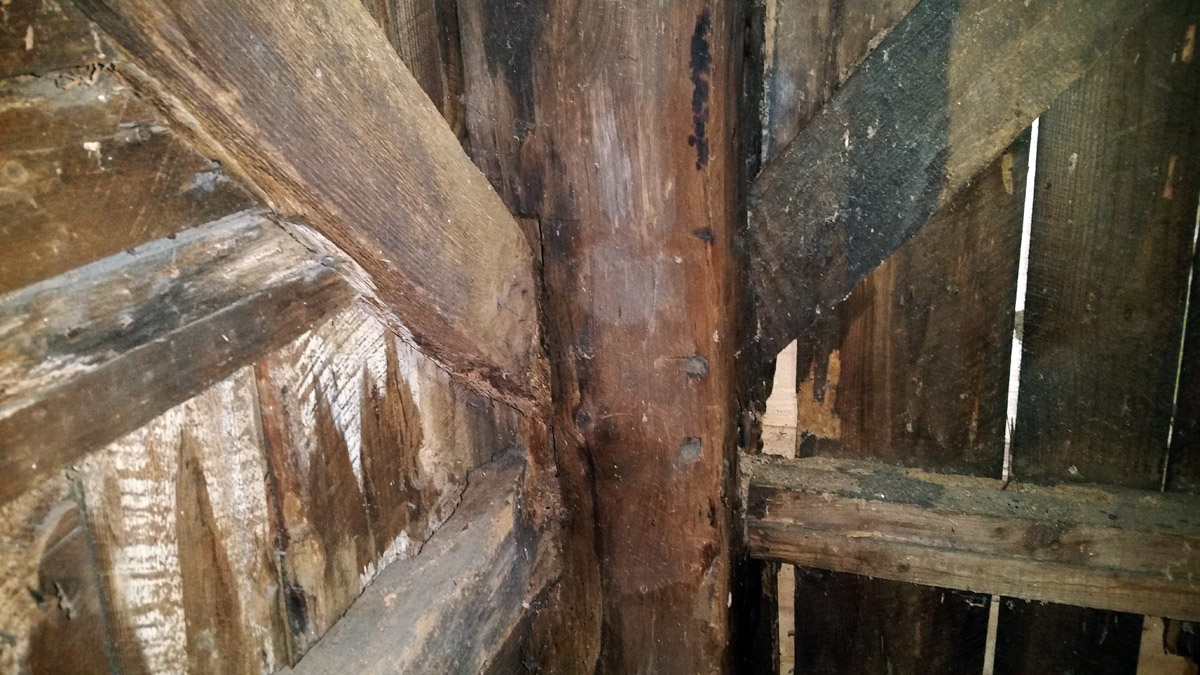
Wind-braces in each corner of this building are mortise and tenon, secured with wood “tree nails.” This form of bracing is found in the Fairbanks house in Dedham MA, the oldest house in New England, and has been observed in early 18th Century houses in Ipswich.

Ann Gourlay Gabler and Mirko Gabler in the Hudson Valley Regional Review
Gable entry “Yankee barns” (a variation on the English form) were introduced in the early 19th century. Stone basements began to be added to English Barns around 1850 to keep cattle. When the barn is built on a slope with a basement entry in the rear, it is known as a “bank barn. By the late 19th Century a new barn construction style known as the “New England Barn” began to replace the English Barn in popularity. Larger and longer, the New England Barn typically has doors on the gable ends, is built with sawn rather than hewn timbers, and has modern roof framing.
The town of Ipswich is fortunate to have several barns still standing behind the houses in its Architectural Preservation District, including a barn nearby at 26 High Street, and a mid-19th-century English-style barn at 12 Woods Lane. The barn at 44 High Street may be the oldest. The former Howe Barn at 421 Linebrook Rd. is said to date to 1725, but was converted into a house.
Resources:
- Waters, Thomas: Ipswich in the Massachusetts Bay Colony, Vol. 1, page 362
- Archaeological Survey of Ipswich (1979)
- Historic Barn Types, Taking Care of Your Old Barn, University of Vermont, Vermont Division for Historic Preservation
- Historic Barns of Connecticut
- The English Barn in the New World
- Little House, Big House Back House, Barn, the Connected Farms of New England by Thomas C. Hubka
- An Age of Barns by Eric Sloane
 Historic Ipswich
Terrific little story!
Great to see this story being told! My wife and I are former owners of 44 High St. I believe the barn was moved around 1800 from what is now 42 High St. The barn leans 6 degrees due to the field stone foundation failing. What appears to be the original door is still in place but hidden by a new interior wall opposite the current door.