
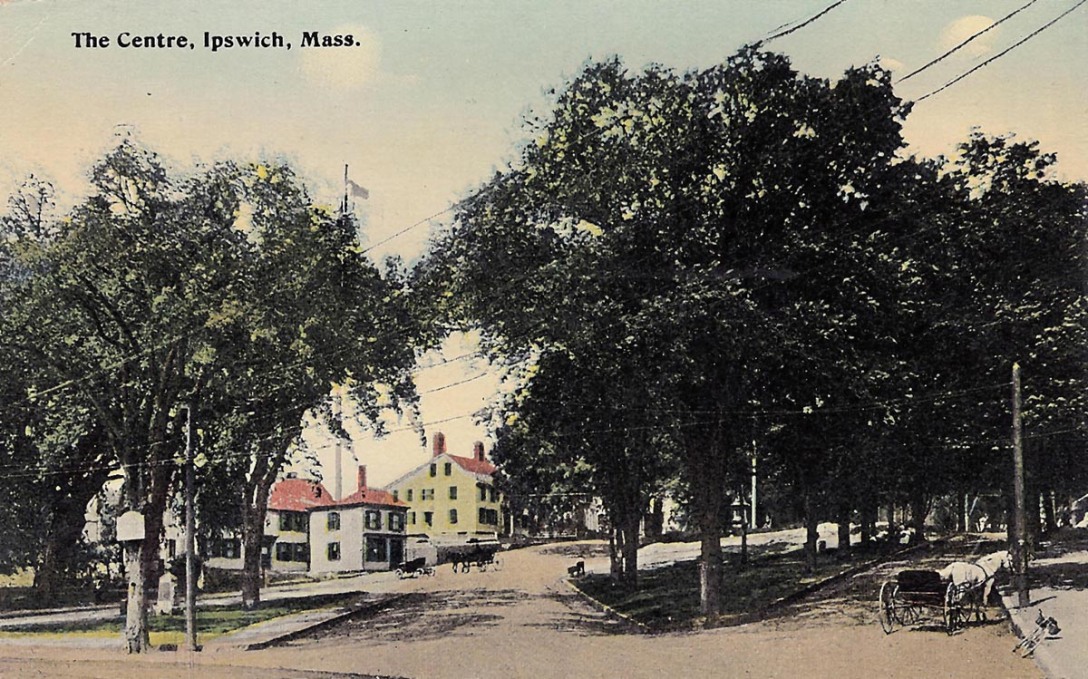
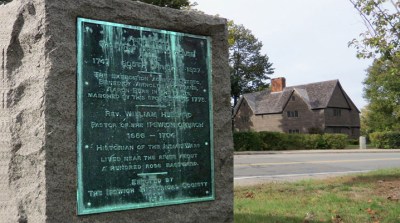
Featured image: Treadwell’s Inn is the yellow house on N. Main St., where the 1774 Ipswich Convention was held.
In 1774, in retaliation for the Boston Tea Party of December 16, 1773, General Gage was sent to Boston with troops and assumed the governorship. The colony’s Charter rights were abrogated by the Intolerable Acts, punitive measures enacted by the British Parliament in retaliation for acts of defiance by the colonists. The acts prescribed that members of the Massachusetts Governor’s Council would be appointed by the King, instead of being elected by the provincial assembly.
Leaders with patriot sympathies called for meetings to create a new provisional government. The Massachusetts Government Act outlawed unauthorized town meetings, so the defiant patriots cleverly scheduled congresses to be held in each Massachusetts county to deal with the political crisis. These meetings set the stage for the establishment of the Massachusetts Provincial Congress.
The Suffolk County Convention was held in private homes in Dedham and Milton on September 9, 1774, and the result of its deliberations, known as the Suffolk Resolves, were delivered by Paul Revere to the Continental Congress meeting in Philadelphia. The Middlesex County Convention took place in Concord in August 1774. The Hampshire Convention was held in Northampton on September 22 and 23, and the Plymouth County Convention was held in Plympton on September 26 and 27.

On Saturday, August 20, 1774, printed notifications were posted in Salem “desiring the Merchants, Freeholders, and other Inhabitants” to meet at the Town House the following Wednesday at 9 in the morning to appoint representatives to meet at Ipswich on September 6 along with the representatives of the other towns in the county “to consider and determine on such measures as the late acts of Parliament, and our other grievances render necessary and expedient.“
Governor Gage, in turn, issued a proclamation to prevent this meeting in Salem from choosing delegates to the convention at Ipswich. Eighty troops marched to within one-eighth of a mile of the Salem Town House under Col. Peter Frye, but failed to intimidate the assembled crowd. The Governor was outwitted while delegates were quickly chosen, and the meeting adjourned. Two of the chosen committee members were arrested, but charges were dropped under public pressure, and Col. Frye soon issued an apology.

The Worcester Revolt
In the early morning of September 6, before Essex County representatives convened their meeting in Ipswich, over 4000 militiamen from 37 Worcester County towns marched on Worcester to shut down the courthouse to prevent the new Crown-appointed judges from taking their seats.
The Ipswich Convention
Sixty-seven delegates representing every Essex County town arrived in Ipswich at Treadwell’s Inn on Tuesday, Sept. 6, 1774, and the Convention began two days of deliberations, with Jeremiah Lee of Marblehead as the chairman. Ipswich was represented by Captain Michael Farley, Mr. John Patch 3rd, Mr. Daniel Noyes, Mr. Jonathan Cogswell, and Mr. Nathaniel Farley. Resolutions were adopted by unanimous vote, binding themselves to stand together in opposition to the Crown, demanding the resignation of officials holding office by Royal appointment, and declaring the Provincial Congress, soon to assemble, as absolutely necessary for the common safety.
The Convention resolved that the representatives would adjourn for a general assembly to be held at Salem on October 5, where representatives were to choose representatives to a new Provincial Congress which would meet in Concord on October 7, 1774. The Provincial Congress met in three sessions, each spanning several weeks. The third Provincial Congress dissolved itself on July 19, 1775, when the General Court convened in Cambridge as the new official government of Massachusetts, and confirmed the resolves of the Provincial Congresses.
Resolutions of the Essex Convention Gathered at Ipswich
After two days of deliberations, the 1774 Essex Convention meeting in Ipswich issued the following report, declaring allegiance to the Crown, but calling for the creation of a Provincial Congress:
THE DELEGATES appointed by the several towns in this county to meet together at this alarming crisis, to consider and determine on such measures as shall appear to be expedient for the country to adopt; deeply impressed with a sense of the importance of this delegation, of the abilities and gratifications necessary for conducting our public affairs with wisdom and prudence, but with the firmness and resolution becoming freemen with the respect and difference due to the sentiments of our brethren in the other counties of the province, with submission to the future determinations of a provincial assembly, and the decisions of the great American Congress, do in the name of the country make these resolves, vis:
- FIRST. That the several acts of Parliament, which infringe the just rights of the colonies, and of this province in particular, being subjects of deliberation before the continental congress, renders it expedient for this country to suspend after determinations respecting them, except so far as their immediate operations require immediate opposition. That the act of Parliament, entitled, ” An act for the better regulating the government of the province, and destruction of our liberties,” and having been with uncommon zeal with arbitrary exertions and military violence, attempted to be carried into execution; and this zeal, these exertions, and this violence still continuing from the sacred regard, and the inviolable attachment we do to those rights, which are essential to and distinguishes us as Englishmen and free men; and from a tender concern for the peace of this country, we are bound to pursue all reasonable measures by which any attempts to enforce immediate obedience to that act may be defeated.
- SECOND. That the judges, justices, and other civil officers in this country, appointed agreeably to the charter and the laws of the province, are the only civil officers in the country whom we may lawfully obey. That no authority whatever can remove these officers, except that which is contributed pursuant to the charter and those laws; that it is the duty of these officers to continue in the execution of their respective trusts, as if the aforementioned act of parliament had never been made; and that while they thus continue, untainted by any official conduct in conformity to that act, we will vigorously support them therein to the utmost of our power, indemnify them in their persons and property and to their lawful yield a ready obedience.
- THIRD. That all civil officers in the province as well as private persons, who shall dare to conduct in conformity to the aforementioned act for violating the charter and constitution of the province are and will be considered by this country as its unnatural and malignant enemies, and in the opinion of this body, such men, while they persist in such conduct, and so contribute to involve the colonies in all the horrors of a civil war, are unfit for civil society; the lands ought not to be tilled by the labor of any American, nor their families supplied with clothing or food.”
- FOURTH. The fourth resolve, which respected Peter Frye, Esq., was omitted by the direction of the delegates of Salem, Marblehead, and Danvers, they opposing his frank and generous declaration inserted in the papers, would give full satisfaction to the country, and under a publication of this resolve, superfluous and improper.
- FIFTH. That a committee be raised to wait on William Browne, Esq., of Salem, and acquaint him that with grief his country has viewed his exertions for carrying into execution, acts of parliament, circulated to Enslave, and ruin his native land. That, while the country would continue the respect for several years paid him, it firmly resolves to detach from every future connection with all such as shall persist in supporting or in any way countenancing the late arbitrary edicts of parliament; that the delegates in the name of the country, request him to excuse them from the painful necessity of considering and treating him as an enemy to his country, and therefore that he would resign his office as a councilor on the late establishment, and decline as a judge and in every other capacity, to execute the late acts of parliament and all others deemed by the province unconstitutional and oppressive.
- SIXTH. That in the opinion of this body all town meetings in this county ought to be called agreeably to the laws of the province, and the ancient usage of the country.
- SEVENTH. That it is the opinion of this body of delegates that a provincial government is absolutely necessary in our present unhappy situation; and that, as writs are now issued for the election of representatives, for a general assembly, to be held at Salem on the 5th day of October next, the representatives so elected will properly form such provincial congress. And it is further our opinion that these representatives should be instructed by their several towns to resolve themselves into a provincial congress accordingly, if, when assembled, they shall deem it necessary or expedient; in order to consult and determine on such measures as they judge will tend to promote the true interest of his majesty, and the peace, welfare and prosperity of the province.
- EIGHTH. Deeply affected with a sense of the miseries and calamities now impending over the colonies, and this province in particular, we are compelled to form these resolutions; which as we apprehend, being founded in justice and necessity, on the principles of our natural, essential, and unalienable rights, we are determined to abide by it. At the same time, we frankly and with sincerity declare that we still hold ourselves subjects of His Majesty King George the Third; as such, will bear him true allegiance, and are ready with our lives and fortunes to support and defend his person, crown, and dignity, and his constitutional authority over us. But by the horrors of slavery, by the dignity and happiness attending virtuous freedom, we are constrained to declare that we hold our liberties too dear to be sported with, and are therefore most seriously determined to defend them. This, in the present dispute, we conceive may be effected by peaceable means. But though above all things, slavery excepted, we deprecate the evils of a civil war, though we are deeply anxious to restore and preserve harmony with our brethren in Great Britain, yet if the disposition and violence of our enemies should finally reduce us to the sad necessity, we undaunted, are ready to appeal to the last resort of states, and will, in support of our rights, encounter even death, sensible, that he can never die too soon who lays down his life in support of the laws and liberties of his country.
The meeting adjourned without closing because the Governor had forbidden new meetings. The representatives to the General Court, which Gen. Gage had moved to Salem, were now empowered by the resolutions of the Ipswich Convention.
Judge William Browne of Boston gave a written reply to the fifth resolve on September 9: “Gentlemen, I cannot consent to defeat his Majestie’s intentions and disappoint his expectations by which he has been graciously pleased to appoint me, an appointment made without my solicitation, and accepted by me, from a sense of duty to the King and the hopes of serving my country. I wish, therefore, to give him no cause to suspect my fidelity, and I assure you I will do nothing without a true regard to its interests, as a judge and in every other capacity.” Browne, an avowed Loyalist, and his family soon left all of their possessions and fled to Boston. He was appointed by the British Prime Minister to the Governor’s post in Bermuda in 1781; his property in Salem was confiscated by the new State of Massachusetts.
On Sept. 1, Governor Gage ordered a meeting of the Legislature in Salem for Oct. 5, but adjourned it indefinitely on Sept. 28th. Notwithstanding, the representatives met at the appointed time in Salem. Ipswich was represented by Captain Michael Farley and Mr. Daniel Noyes, the schoolteacher and postmaster. After waiting a day for the Governor to appear, the assembled representatives chose John Hancock as their chairman and passed resolutions declaring the actions of the Governor to be unconstitutional. They then resolved themselves to be a Provincial Congress, and recommended that companies of armed Minutemen be organized and that they be “disciplined three times a week and oftener as opportunity may offer.” The assembly adjourned to meet at Concord on October 11, where 250 elected delegates met as the illegal provisional Congress, which governed the state from that time until 1780.
In 1788, representatives from the towns met again in Ipswich to consider the draft of a new constitution for Massachusetts. The assembled representatives registered 18 objections to the draft, which became known as the Essex Result. A new draft Massachusetts Constitution was written by John Adams and won overwhelmingly in a referendum, and it is still in effect today.
Several representatives to the Ipswich and Salem meetings became the local backbone of the Federalist Party, advocating the financial policies of Alexander Hamilton. Among its members were George Cabot, Timothy Pickering, Nathan Dane, and Theophilus Parsons. President John Adams had an intense dislike for Hamilton and coined the name “Essex Junto” for this group. The Federalist Party dominated Ipswich politics until its demise in 1816.
Download this story as a PDF file.
Sources and further reading:
- Smith, Sara Sprague Saunders: The Founders of the Massachusetts Bay Colony
- Proceedings of the Essex Institute, Volumes 1-2, page 99
- Stone, Edward Martin: History of Beverly
- Northern Illinois Digital Library: The Meeting at Salem
- New England Historical Society: The Year 3000 People Came to Town Meeting in Salem
- Waters, Thomas: Ipswich in the Massachusetts Bay Colony
- Wikipedia: Massachusetts Provincial Congress: Essex Convention
- Streeter, Gilbert L: Salem Before the Revolution
- Sons of the American Revolution: The Worcester Revolt of September 6, 1774
- Historic Ipswich: “A State of Nature”, Worcester in 1774
- Historic Ipswich: The 1778 Ipswich Convention and the Essex Result
Articles on this site about the Revolutionary War
 The Revolutionary War Letters of Joseph Hodgkins and Sarah Perkins - Throughout the Revolutionary War, Joseph Hodgkins sent letters home from the battlefronts to his wife, Sarah Perkins Hodgkins.… Continue reading The Revolutionary War Letters of Joseph Hodgkins and Sarah Perkins
  The Price Act, Passed at Ipswich, February 1777 - In 1777, the Ipswich Selectmen and the Committee of Correspondence and Safety, acting under the authority of the General Court, issued a schedule of prices covering all articles of food, clothing, wages of labor of every kind, entertainment at hotels, shipping rates etc.… Continue reading The Price Act, Passed at Ipswich, February 1777
  The Newburyport Tea Party - When Parliament laid a tax on tea, the British locked all the tea that had arrived in Newburyport into the powder house. Eleazer Johnson led a group of men who shattered the door and burned the tea in Market Square.… Continue reading The Newburyport Tea Party
  The Intolerable Acts of 1774 - Despite the failure of the Stamp Act and the Townshend Acts, the British Parliament responded to the "Boston Tea Party" by passing even more restrictive acts to punish the American extremists.… Continue reading The Intolerable Acts of 1774
  The Great Ipswich Fright, April 21, 1775 - A rumor spread that two British ships were in the river, and were going to burn the town. The news spread as far as New Hampshire, and in every place the report was that the regulars were but a few miles behind them, slashing everyone in sight.… Continue reading The Great Ipswich Fright, April 21, 1775
  The Arnold Expedition Arrives in Ipswich, September 15, 1775 - A memorial sits in the intersection between the South Green and the site of the former South Congregational Church in Ipswich. It reads, “The expedition against Quebec, Benedict Arnold in command, Aaron Burr in the ranks, marched by this spot, September 15, 1775."… Continue reading The Arnold Expedition Arrives in Ipswich, September 15, 1775
 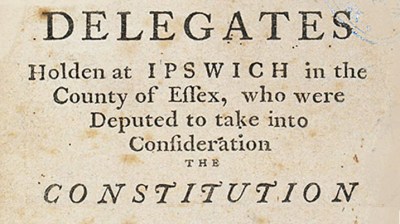 The 1778 Ipswich Convention and the Essex Result - Delegates from 67 towns arrived in Ipswich on Tuesday, Sept. 6, 1774 "to consider and determine on such measures as the late acts of Parliament" and declaring support for a Provincial Congress. They reconvened four years later to debate a draft constitution for Massachusetts. … Continue reading The 1778 Ipswich Convention and the Essex Result
  The 1774 Ipswich Convention “To Consider the Late Acts of Parliament” - Notifications were posted in Salem to gather at the Town House to appoint representatives to meet at Ipswich, on September 6, 1774 along with the representatives of the other towns in the county, to consider "to consider and determine on such measures as the late acts of Parliament, and our other grievances render necessary and expedient."… Continue reading The 1774 Ipswich Convention “To Consider the Late Acts of Parliament”
  The “Detested Tea” and the Ipswich Resolves - On Dec. 16, 1773, the tea brought into Boston harbor was thrown into the sea. A week later, Ipswich citizens met in the most violent mood, and adopted a series of resolutions,… Continue reading The “Detested Tea” and the Ipswich Resolves
  The “Commonwealth” - "Commonwealth" is defined as a state in which authority is vested in the citizenry. In the 17th Century it was the radical philosophy the work and the proceeds thereof should be shared by the people.… Continue reading The “Commonwealth”
  Shay’s Rebellion - On the last Tuesday of August, 1786 some 1500 armed insurgents took possession of the Northampton Court House, initiating a brief war known as Shay's Rebellion.… Continue reading Shay’s Rebellion
  Reply by the Town of Ipswich to the Boston Pamphlet, December 28, 1772 - A document known as the “Boston Pamphlet” was distributed throughout the colony, asserting the colonists’ rights. Ipswich held a Town Meeting, established its own “Committee of Correspondence," passed a series of resolves, and gave instructions to their reresentative in the General Court, Michael Farley.… Continue reading Reply by the Town of Ipswich to the Boston Pamphlet, December 28, 1772
  Prosecution of Loyalists in Essex County - An angry mob surrounded the Haverhill home of Col. Richard Saltonstall, a Loyalist, who opened his door and stated that that he was bound to discharge the duties of the office.… Continue reading Prosecution of Loyalists in Essex County
 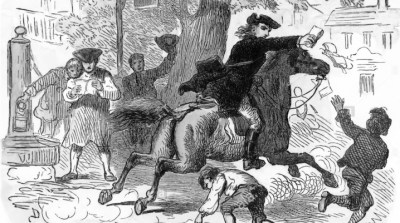 Paul Revere’s Not So Famous Ride Through Ipswich, December 13, 1774 - On the cold icy morning of December 13, 1774, Paul Revere headed out on a 60 mile gallop from Boston along the Old Bay Road through Ipswich to warn the citizens of Portsmouth that British troops may be landing.… Continue reading Paul Revere’s Not So Famous Ride Through Ipswich, December 13, 1774
  Old Toryism, Mock Federalism & the Essex Junto - Baptist minister "Citizen Pottle" gave a toast, "To the Venerable Town of Ipswich. May it be purged of all old Toryism and mock Federalism." As the other ministers were indeed Federalists, his toasts aroused suspicion that the whole celebration was a spirited demonstration of Baptist enthusiasm.… Continue reading Old Toryism, Mock Federalism & the Essex Junto
 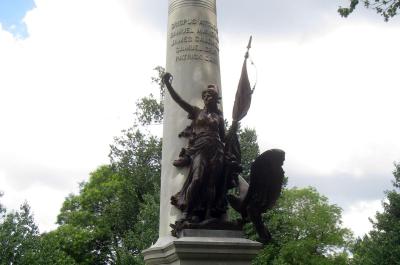 Memorial to Crispus Attucks - The following is an excerpt from a presentation given on November 14, 1889, at the dedication of the Boston Massacre and Crispus Attucks Monument at Boston Common, which memorializes victims Crispus Attucks, Samuel Maverick, James Caldwell, Samuel Gray, and Patrick Carr. ADDRESS BY MR. JOHN FISKE The troubles and disorders in Boston, which led to… Continue reading Memorial to Crispus Attucks
  Madame Shatswell’s Cup of Tea - Madame Shatswell loved her cup of tea, and as a large store had been stored for family use before the hated tax was imposed, she saw no harm in using it as usual. News of the treason spread throughout the town.… Continue reading Madame Shatswell’s Cup of Tea
  Lieutenant Ruhama Andrews and the 1775 Battle of Quebec - On Christmas Day 1823, Gen Benjamin Pierce of Hillsborough, NH held a reunion of twenty-two citizens who had served in the War of Independence. The oldest attendee was Ammi Andrews, born in Ipswich, MA, aged 89 years.… Continue reading Lieutenant Ruhama Andrews and the 1775 Battle of Quebec
  Leslie’s Retreat, or How the Revolutionary War Almost Began in Salem, February 26, 1775 - In our struggle for Independence, the British military received its first setback from the inhabitants of Salem in an episode that could not have been more ludicrous or entertaining if it had been written for Monty Python. … Continue reading Leslie’s Retreat, or How the Revolutionary War Almost Began in Salem, February 26, 1775
 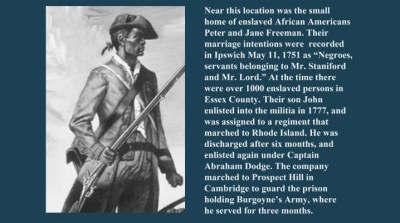 John Freeman, an African American Revolutionary War Soldier from Ipswich - John Freeman, son of enslaved Peter and Jane Freeman of Ipswich, enlisted into the militia of the Revolutionary War in the year 1777, and served in Rhode Island, Providence and Cambridge.… Continue reading John Freeman, an African American Revolutionary War Soldier from Ipswich
  Ipswich Voters Unanimously Support the Massachusetts Circular Letter, February 11, 1768 - The voters of the Town of Ipswich resolved on August 11, 1768, that "Thanks be given to the worthy and much esteemed ninety-two gentlemen of the late Honorable House of Representatives for their firmness and steadiness in standing up for and adhering to the just rights and Liberties of the Subjects when it was required of them at the Peril of their political existence."… Continue reading Ipswich Voters Unanimously Support the Massachusetts Circular Letter, February 11, 1768
  Ipswich Pillow Lace - In the late eighteenth century, Ipswich had 600 women and girls producing more than 40,000 yards of lace annually. Ipswich industrialists imported machines from England to mechanize and speed up the operation, which destroyed the hand-made lace industry. … Continue reading Ipswich Pillow Lace
  Ipswich Mob Attacks Loyalist Representative Dr. John Calef - Dr. John Calef was among a handful of members of the Massachusetts Assembly who voted to retract the "Massachusetts Circular Letter" which was adopted in response to the 1767 Townshend Acts. Ipswich citizens' anger at Calef lingered as war with England approached.… Continue reading Ipswich Mob Attacks Loyalist Representative Dr. John Calef
  Ipswich and the American Revolution: The Breach with Britain - In John Adams’ 1765 opposition to the Stamp Act, he referenced the citizens of Ipswich who resisted a tax imposed by the Crown in 1687. An Ipswich town meeting on August 11, 1768 approved of "the Conduct of those Gentlemen of the late House of Representatives...when it was required of them at the Peril of their Political Existence." The Town meeting on Dec. 28, 1772 supported the rights of the Colonists as British subjects, and established a Committee of Correspondence to communicate resistance with the Committees of other towns. Delegates from throughout Essex County arrived in Ipswich on Tuesday, Sept. 6, 1774, and by unanimous vote, bound themselves together in establishment of the Provincial Congress for the common safety.
… Continue reading Ipswich and the American Revolution: The Breach with Britain
Ipswich and the American Revolution: The Breach with Britain - In John Adams’ 1765 opposition to the Stamp Act, he referenced the citizens of Ipswich who resisted a tax imposed by the Crown in 1687. An Ipswich town meeting on August 11, 1768 approved of "the Conduct of those Gentlemen of the late House of Representatives...when it was required of them at the Peril of their Political Existence." The Town meeting on Dec. 28, 1772 supported the rights of the Colonists as British subjects, and established a Committee of Correspondence to communicate resistance with the Committees of other towns. Delegates from throughout Essex County arrived in Ipswich on Tuesday, Sept. 6, 1774, and by unanimous vote, bound themselves together in establishment of the Provincial Congress for the common safety.
… Continue reading Ipswich and the American Revolution: The Breach with Britain  Ipswich and the American Revolution, Part 2: The Revolutionary War - On June 10th, 1776, the men of Ipswich, in Town-meeting assembled, instructed their Representatives, that if the Continental Congress should for the safety of the said Colonies Declare them Independent of the Kingdom of Great Britain, they will solemnly engage with their lives and Fortunes to support them in the Measure.… Continue reading Ipswich and the American Revolution, Part 2: The Revolutionary War
  General Michael Farley - In 1774, the Town of Ipswich chose Michael Farley, a tanner, as a delegate to the Provincial Congress. He was appointed major-general of the Militia of Massachusetts in 1777. Farley is buried at the Old North Burying Ground beside his wife Elizabeth. The site of his home is now the Richdale store on Market St..… Continue reading General Michael Farley
  Benedict Arnold and the Fate of the American Revolution - In September 1776, the vulnerable Continental Army under George Washington evacuated New York after a devastating defeat by the British Army. One of Washington’s favorite generals, Benedict Arnold, miraculously succeeded in postponing the British naval advance down Lake Champlain that might have ended the war. Thomas Franklin Waters wrote about Arnold’s march through Ipswich on the way to Quebec “The… Continue reading Benedict Arnold and the Fate of the American Revolution
  April 29, 1783: How Ipswich Celebrated the End of the Revolutionary War - The manner in which residents of Ipswich celebrated the end of hostilities was recorded in "The Life, Journals and Correspondence of Rev. Manasseh Cutler."… Continue reading April 29, 1783: How Ipswich Celebrated the End of the Revolutionary War
  Account of the Soldiers of Chebacco Parish at Bunker Hill - Of the men from Chebacco parish who were in the battle at Bunker Hill, the names of six are known: James Andrews, Benjamin Burnham, Nehemiah Choate, Aaron Perkins, Jesse Story Jr., a minor who was killed, and Francis Burnham who was wounded. Two Chebacco boys, Aaron Low and Samuel Proctor, belonged to a Gloucester company which reached Cambridge on the afternoon of the 16th.… Continue reading Account of the Soldiers of Chebacco Parish at Bunker Hill
  A Revolutionary Guest: John Adams’ Letters From Ipswich - John Adams visited Ipswich many times during his tenure as the Boston representative to the colonial legislature from 1770 to 1774.… Continue reading A Revolutionary Guest: John Adams’ Letters From Ipswich
  “A State of Nature”, Worcester in 1774 - "In Worcester, they keep no Terms, openly threaten Resistance by Arms, have been purchasing Arms, preparing them, casting Ball, and providing Powder, and threaten to attack any Troops who dare to oppose them....the flames of sedition spread universally throughout the country beyond conception.” -Gen. Thomas Gage… Continue reading “A State of Nature”, Worcester in 1774
  Historic Ipswich