
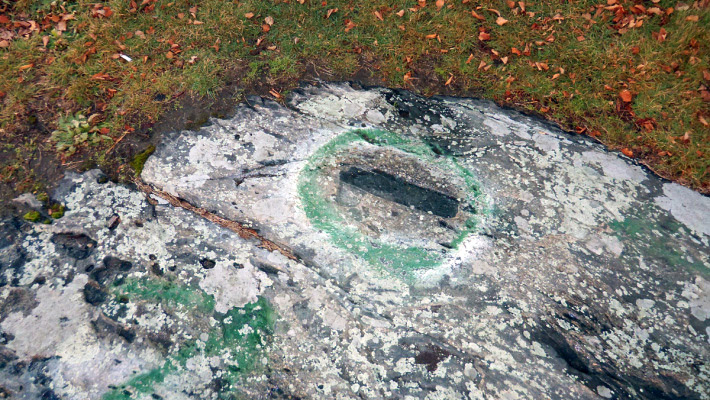
“1 love to think of old Ipswich town, where Whitefield preached in the church on the hill, driving out the Devil till he leaped down from the steeple’s top, where they show you still, embedded deep in the solid rock, the indelible print of his cloven hoof. And tell you the devil has never shown face or hoof since that day in the honest town”
Excerpt from “Ipswich Town” by James Appleton Morgan (1845-1928)

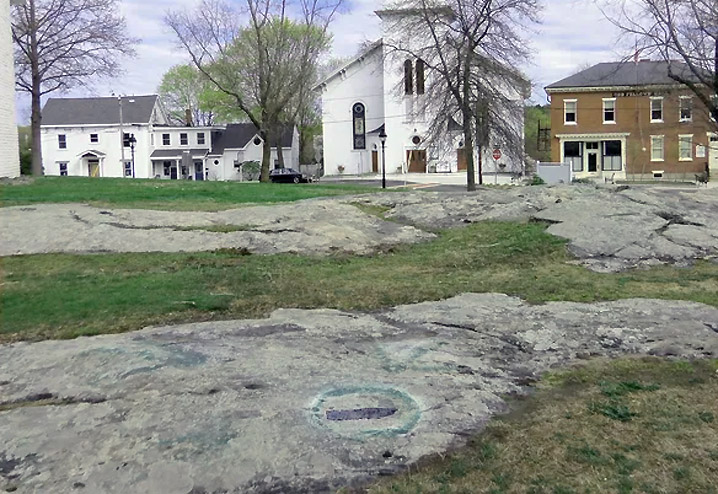
Imprinted into the rocks in front of the First Church in Ipswich is a geological formation known to the people of Ipswich as the footprint of the Devil, left there forever in a legendary encounter with the traveling English evangelist George Whitefield (pronounced “Whitfield”) in early October 1740. Young, energetic, and extremely cross-eyed, the widely proclaimed Whitefield was on a tour of New England, and this was his second trip to the church in Ipswich.
At the end of the 17th century, remorse about the Salem Witchcraft Trials saw a reduction in churchgoing, accompanied by the birth of the Age of Reason. Even among the faithful, there was complacency with worship, but dissatisfaction with the new era of rationalism. By the 1730s, the stage was set for the renewal of Calvinist religiosity known as the Great Awakening, which first took hold in New England with the sermons of Northampton’s Jonathan Edwards. In 1740, George Whitefield, a young, vibrant, and charismatic minister from Britain, made his first trip to the colonies, where he preached nearly every day for months to gatherings of thousands of people who came out to see him.

Whitefield was the greatest celebrity of the era. He first came through Ipswich on his way to Maine and preached to a great assembly. “The Lord gave me freedom”, he entered in his Journal, “and there was a great melting in the congregation.” On his return, he again preached in Ipswich. On that early fall day, he preached a long and energetic sermon of such great intensity that his voice could be heard for miles around. Thousands flocked to the Green. With the sanctuary being insufficient in size for such a gathering, he made the ledge outside of the church his stage. It was said that the listeners were “struck with an awful sense of sin.”
In one version of the legend, there was behind the pulpit in the church a large curved free-standing mirror, the origin and purpose of which has never been known. Religiosity may have waned, but superstition still held its grip. Some folks believed that on Sunday mornings, the Devil would hide behind or inside the mirror and glare at the people seated before him. There are many superstitions regarding the Devil and mirrors.
On this day, the Reverend Whitefield’s resounding voice outside of the walls, complete with condemnation of Satan and threats of fire and brimstone, must have infuriated old Lucifer to the breaking point. The words were harsher than he could bear, and he burst forth before the startled masses gathered on the hill.
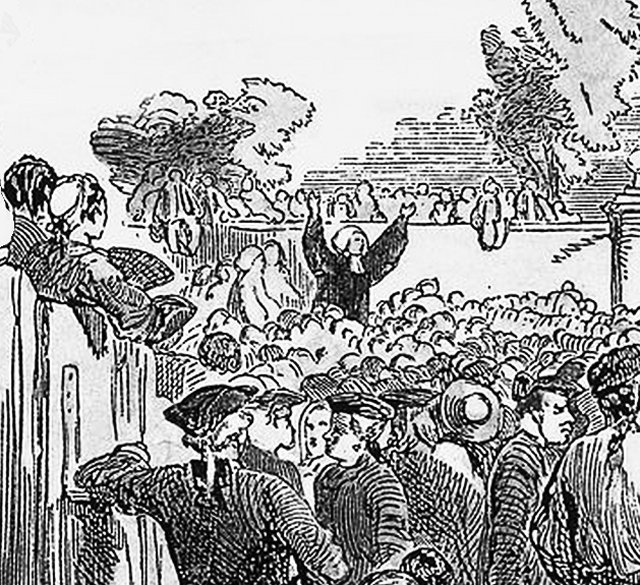
What happened next has been told with many variations since that fateful day, but it is agreed by all that the Devil and the young Reverend went at it, wrestling like maniacs, pushing and shoving each other back and forth. The preacher ran into the church, and soon they were face to face at the pinnacle of the steeple with the horrified congregation watching below. But Whitefield’s weapon was his commanding voice. The esteemed pastor yelled at Old Lucifer, accompanied perhaps by a push, and the Devil was hurled to the rocks below, where he landed on one foot and scrambled down the hill in terrified leaps and bounds, never to return.
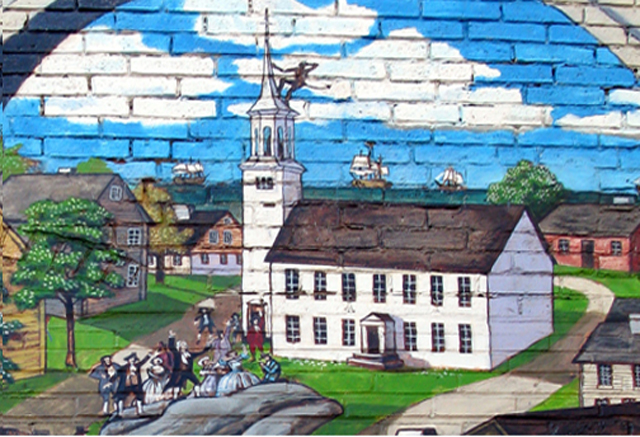
This was apparently such a common occurrence for Rev. Whitefield that he wrote modestly in his journal, “Tuesday, Sept. 30, Preached at Ipswich about 10 in the morning to some Thousands; the Lord gave me Freedom, and there was great Melting in the Congregation.” News of his evangelical prowess spread throughout America, and the “Great Awakening” gave rise to the Methodists, who built a church on the green with an even more massive steeple.
The Devil’s Footprint did indeed have a hellish origin. The pyroclastic rocks that protrude from the North Green were part of a volcanic arc near the South Pole a half billion years ago. After drifting for hundreds of thousands of years, the microcontinent known as Avalonia collided with the American continent, creating our section of eastern New England. During thermal geological episodes, stratified layers of shale were superheated and compressed to give the rocks their gray, featureless appearance, but over the millennia, layers wore away to create the small deformations observed at Meeting House Green, one of which is the Devil’s Footprint.
The Sermon at Pulpit Rock

The first Meeting House for Linebrook Parish was built just inside the Rowley boundary on Leslie Road in 1743. Pulpit Rock is an outcropping about 20 feet high and set back about 50 yards north of Leslie Road near the site of the former church building. At one of the important Church celebrations, this is where Reverend George Whitefield preached to more than 2000 people. The congregation was too large for the small church, so the people sat outside and listened as Rev. Whitefield gave his sermon while standing on top of the huge rock, electrifying the multitude with a sermon about righteousness, temperance, and the judgment to come. The church on Leslie Rd. was later moved to Linebrook Road, and was replaced by the present Linebrook Church in 1848.
![pulpitrowley[1]](https://historicipswich.net/wp-content/uploads/2021/12/8052d-pulpitrowley1.jpg)
This is where the story gets really weird!
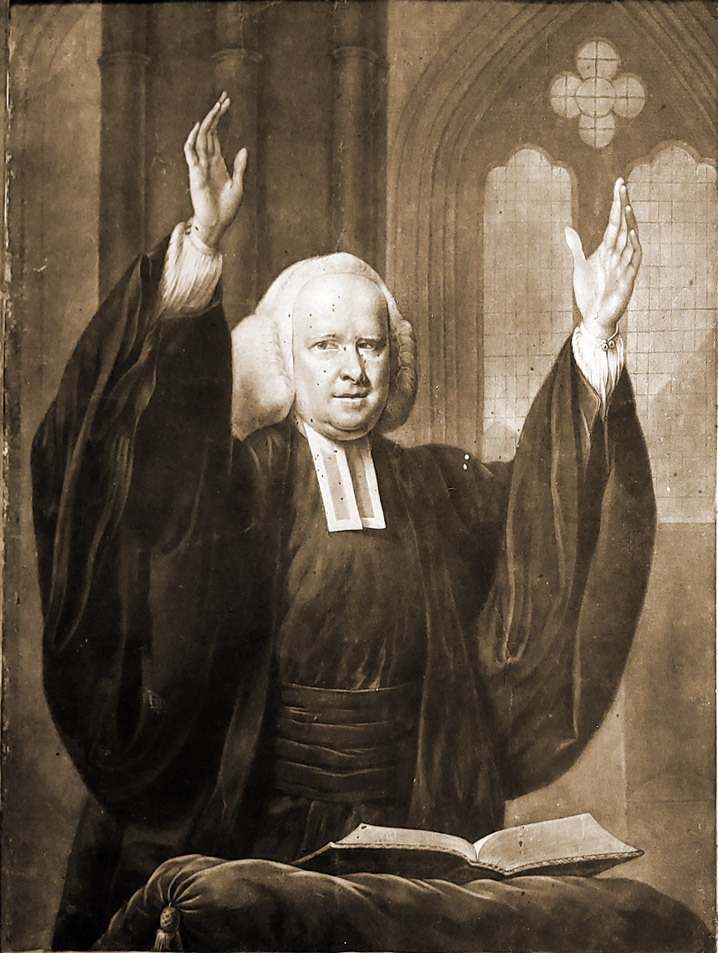
Received so well, the Reverend Whitefield chose to make New England his home. He died on Sunday, September 30, 1770, in Newburyport and is buried there in a crypt under the pulpit at the Old South Church, the very church where he had planned to preach the next day. It is estimated that there have been well over 30,000 visitors to his crypt since it was relocated to the basement in 1829. Visitors are invited to sign the logbook located near the crypt.
For the believers, Whitefield’s body was a sacred relic, and in 1829, a visitor from England managed to steal a bust of Reverend Whitefield, as well as one of the arms from his skeleton. The thief was never apprehended, but the items were anonymously returned twenty years later in a small wooden box. Two thousand people joined the Newburyport procession for the return to the vault of Whitefield’s missing parts, except for his mummified thumb, which is on display at the Methodist Archives Center in Madison, N.J. The year 2020 marked the 250th anniversary of George Whitefield’s death.
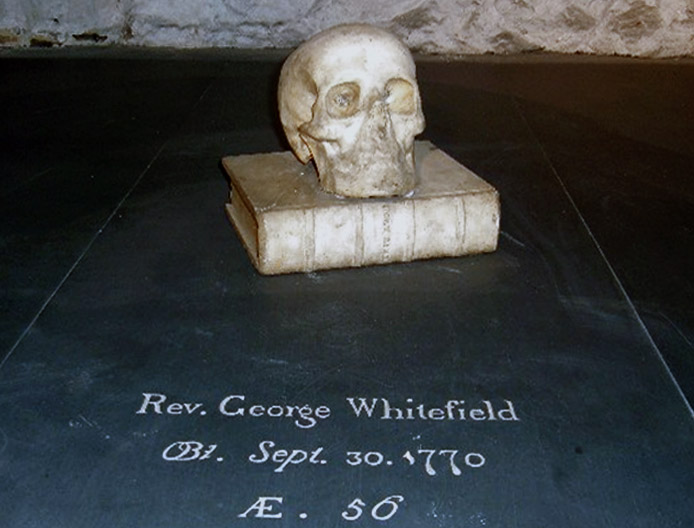
The plaster skull and Bible casting shown above are at the Old South Church and were made from Rev. Whitefield’s skull in 1834 by William B. Fowle in Boston, who sent the skull anonymously to London to a leading expert in phrenology, a pseudoscience that is now discredited. In a letter contained in the church archives to a committee overseeing the casting of Whitefield’s skull, Mr. Fowle remarked, “Perhaps it will interest you to know that those of us who have studied the character of Whitefield, and compared it with his skull, find so great a coincidence that our belief in phrenology is much strengthened. By placing the skull in a natural position, and drawing a vertical line from the orifice of the ear to the top of the head, you will find that what you rarely find in the head of a great good man, the larger part of the brain falls behind the ear. This indicates more feeling than intellect, and is not this the key to his wonderful power over others?”
The size of his skull notwithstanding, Whitefield was not welcomed by the religious establishment. The Rev. Timothy Dwight wrote about the clergy association in New Haven, which in 1744-5, issued a “Declaration concerning the Rev. Mr. George Whitfield. “We can in no wise approve of his itinerancy, in going from country to country, from town to town, and from one place to another, under a pretence of preaching the Gospel. We think him guilty of uncharitable censoiousness, and slanderous reproaching, in the vile aspersions, bitter reflections, and condemnatory censures he hath passed upon the main body of the ministry in this land, though the most of them he was a perfect stranger to. Numbers of illiterate exhorters swarm about as locusts from the bottomless pit. For all which reasons, and others which might be mentioned, it is our judgement that the said George Whitfield should not be allowed to preach any where, or to have communion, and we do hereby publish and declare, that it is our purpose and determination that we will not admit the said Mr. Whitfield into any of our pulpits, nor receive him to communion in any of our churches, and that we will caution the people under our charge against going to hear him anywhere.” (*A Memoir of the Late Timothy Dwight by Joseph P. Thompson)
Further Reading
- Waters, Franklin: Ipswich in the Massachusetts Bay Colony Vol. II
- Old South Presbyterian Church: George Whitefield
- U.S. Geological Survey, National Geologic Map Database for Essex County: Marlborough Formation
 Historic Ipswich
A Sunday at Old Ipswich (1745) https://babel.hathitrust.org/cgi/pt?id=nyp.33433081903027&view=1up&seq=121