


The HMS Falcon, a 14-gun sloop of the British Royal Navy, was built for speed and maneuverability, and captained by Commander John Linzee during the early stages of the American Revolutionary War. On June 17, 1775 the three-masted ship fired “round shot, grape, and small arms” on the rebel fortifications on Breed’s Hill, and transported the wounded from the “Battle of Bunker Hill” across the Mystic River to Boston.
British Vice-Admiral Samuel Graves next ordered Captain Linzee “to put to Sea as soon as possible in his Majesty’s Sloop under your Command and cruise between Cape Cod and Cape Anne to carry into Execution the late Acts for restraining the Trade of the Colonies And to seize and send to Boston all Vessels with Arms Ammunition, Provisions, Flour, Grain, Salt, Melasses, Wood, etc. … and sail again at such uncertain times as you think are most likely to deceive and intercept the Trade of the Rebels.”
Skirmish at Coffin’s Beach
On the 5th of August, the Falcon appeared in Ipswich Bay. Two days earlier, Linzee had impressed Salem fishermen John Beckford and John Cook, and taken their boat. At Squam Harbor, Linzee despatched fifty men to land a barge on Coffin’s Beach and steal sheep from the adjacent pastures to feed British soldiers, who were encircled by the patriot forces in Boston.
Major Peter Coffin spotted the barge from a viewpoint on his nearby farm and quickly organized his neighbors and farm hands to hasten to the beach. They positioned themselves behind sand dunes and fired on the British, who quickly sailed the barge back to the Falcon. Linzee then ordered them to land at Squam Harbor, to capture a schooner, which he mistakenly believed to hold cargo from the West Indies, but when they boarded, it was just an old schooner filled with sand.
The Battle of Gloucester
For the next three days, the Falcon cruised close to Cape Ann, capturing and impressing seamen from local ports. On the morning of August 8, Linzee captured a schooner from Hispaniola, but a second schooner escaped and grounded in the Gloucester Inner Harbor. Running up a white flag, Linzee invited the Gloucester Committee of Safety to board the ship for negotiations but detained the gentlemen until they promised to release the schooner. The delegation returned with this information, but the citizens of Gloucester refused the compromise and began preparing a “warm reception” if he should attempt a landing. Old men and women with their children fled from Gloucester with their valuables to Chebacco Parish and the Town of Ipswich, where they waited for news from the encounter.
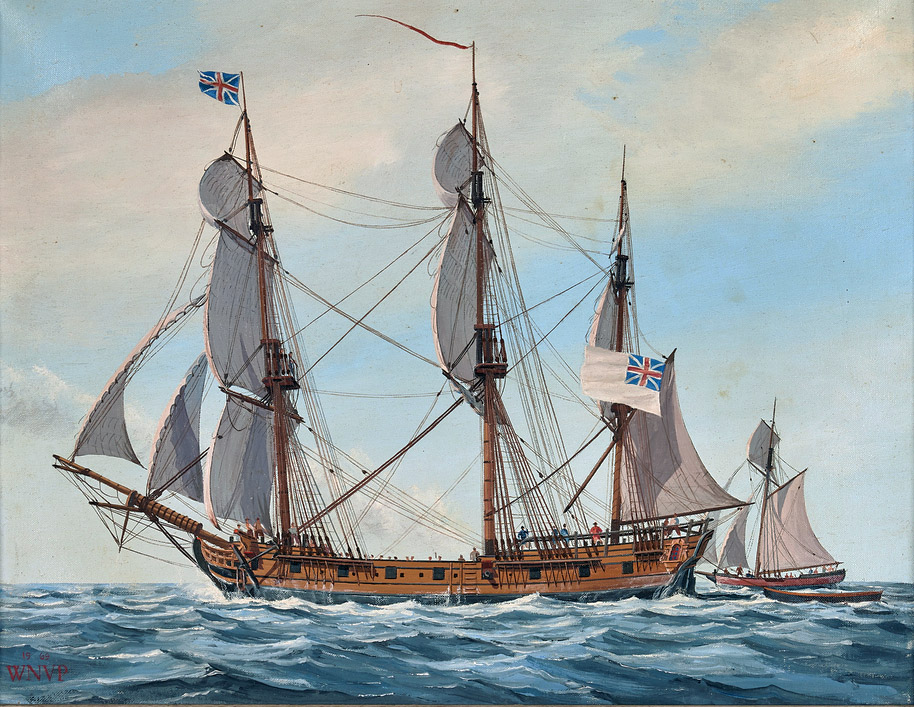
At this point, Linzee forced one of the impressed fishermen to guide the Falcon close to the grounded schooner. Immediately, church bells began ringing, and the Gloucester townspeople rushed to the alarm, despite having no cannons and little ammunition. Two swivel guns were hastily mounted on carriages, under the direction of zealous Captains Joseph Foster and Bradbury Sanders. One was sent to the wharf and the other to a hilltop overlooking the Harbor. Men armed with fowling pieces and flintlocks rushed to the wharf.

Determined to capture the grounded schooner, Linzee sent in two barges with fifteen armed sailors, and six privates in a whaleboat, who were met with surprise when shots were fired upon from the schooner’s cabin windows. The rebels began firing on the barges from behind houses and ships at the wharf, wounding the British lieutenant and killing three of his men.
Linzee ordered the Falcon to begin firing broadsides at the village from its six-pounders and swivel shots, telling them to aim at the church, but to no avail. He next suspended the cannonading and ordered one of his remaining boats to Fort Point to set the village afire. Unfortunately for the boatswain loading the gun, the powder ignited prematurely, blowing off his hand. The Gloucester defenders rushed to the spot and took the British men as prisoners.
At four o’clock, Linzee sent in his remaining forces on the captured West Indies schooner to rescue his trapped and imprisoned men. Finally, after six hours of fire, the British surrendered to the Gloucester defenders. About three dozen British prisoners were taken, twenty-four of whom were sent to a prisoner camp in Cambridge. The other twelve had been impressed by the British, including Duncan Piper of Gloucester, and were allowed to return home. Two Gloucester men, Benjamin Rowe and Peter Lurvey were killed, as well as Deacon Kinsman’s hog. Despite three hundred cannon shots from the Falcon, only minor damage was done to the meetinghouse and neighboring homes.
The War to Come
After securing the captives, the patriots retired to James Prentice’s tavern, and the Gloucester inhabitants who had fled to Ipswich slowly returned. The Gloucester men took possession of both schooners, the cutter, and barges, but the next morning, Capt. Linzee with a skeleton crew on the Falcon was allowed to sail out and rejoin the British fleet at Nantasket Road in Boston.
In response to the attack on Gloucester, General Washington sent a detachment of riflemen from Cambridge, and a company of Ipswich soldiers was ordered to Gloucester to help defend the city. Breastworks were constructed at the Old Battery, Fresh-water Cove, Duncan’s Point, and near the Cut. As the Ipswich company passed through Chebacco, they were joined by Chebacco minutemen at the common. A prayer was offered by the fervent patriot Rev. John Cleaveland, “that the enemy might be blown to hell and damnation,” at which point one of the soldiers added, “to the land of tyranny from whence they came.”
The Battle of Machias
The Battle of Gloucester on August 8 was the second naval encounter of the American Revolutionary War, following the Battle of Machias, which occurred in June 1775. Colonists in Machias, Maine (then part of Massachusetts), seized a British merchant ship, armed it alongside a local ship, then sailed out to confront the British armed schooner Margaretta under Capt. James Moore, who was fatally wounded, and captured his vessel and crew. Each year, Machias hosts the Margaretta Days Festival, celebrating the “Lexington of the Sea,” the first naval battle of the American Revolution.
Download a PDF copy of “The Battle of Gloucester” by Gordon Harris
Sources:

- Babson, John: History of the Town of Gloucester
- Crowell, Rev. Robert: History of the Town of Essex
- Tagney, Robert N: The World Turned Upside Down, Essex County During America’s Turbulet Years, 1763-1790
- Wikipedia: The Battle of Gloucester
- Garland, Joseph: The Fish and the Falcon: Gloucester’s Resolute Role in America’s Fight for Freedom (2006)
- All Things Liberty: Falcon Fans the Flames of Revolution: The Misadventures of Captain John Linzee
- Revolutionary War Journal: The Battle of Gloucester
- Boston 1775: John Linzee and “the appearance of mental derangement”
- 2018 Reenactment of the Battle of Gloucester
 Historic Ipswich
[…] A whole book contextualizing the Battle of Gloucester is Joseph Garland’s The Fish and the Falcon: Gloucester’s Resolute Role in America’s Fight for Freedom (2006). There’s a recent webpage at HistoricIpswich.net (using the same map illustration) here. […]
[…] August 8, 1775, the people of Gloucester fought HMS Falcon under Capt. John Linzee, capturing dozens of men at the cost of two local lives. Read more… […]