

The Massachusetts Circular Letter was a statement written by Samuel Adams and James Otis Jr., and passed by the Massachusetts House of Representatives on February 11, 1768, in response to the Townshend Acts. In the course of a year, the letter was received by assemblies throughout the Colonies. The letter greatly disturbed Parliament, and Governor Bernard was ordered to demand that the vote of the House should be rescinded, under penalty of his dissolving the General Court.

Dr. John Calef represented the town of Ipswich in the General Court, but was among only seventeen members of the Massachusetts Assembly who voted to retract the Circular Letter. Paul Revere responded with a print entitled “A Warm Place Hell,” showing the devil with a pitchfork pushing the 17 men into the mouth of Hell. Dr. John Calef is represented in the engraving with a calf’s head. Anger by Ipswich citizens at Calef’s vote resulted in his replacement in the assembly by General Michael Farley. During the Revolution, Calef fled to Fort George at Penobscot.
Sources & further reading:
- Yale Law School Lillian Goldman Library
- Robertson, William: The History of America … A New Edition
- Tracy, Cyrus Mason: Standard History of Essex County, Massachusetts
- Colonial Society of MassachusettsBoston 1775
Related posts:
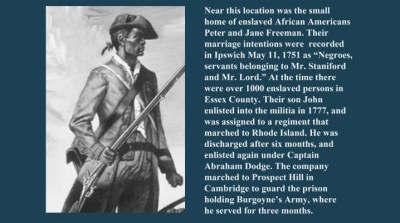 John Freeman, an African American Revolutionary War Soldier from Ipswich - John Freeman, son of enslaved Peter and Jane Freeman of Ipswich, enlisted into the militia of the Revolutionary War in the year 1777, and served in Rhode Island, Providence and Cambridge.… Continue reading John Freeman, an African American Revolutionary War Soldier from Ipswich
  The 1774 Ipswich Convention “To Consider the Late Acts of Parliament” - Notifications were posted in Salem to gather at the Town House to appoint representatives to meet at Ipswich, on September 6, 1774 along with the representatives of the other towns in the county, to consider "to consider and determine on such measures as the late acts of Parliament, and our other grievances render necessary and expedient."… Continue reading The 1774 Ipswich Convention “To Consider the Late Acts of Parliament”
  General Michael Farley - In 1774, the Town of Ipswich chose Michael Farley, a tanner, as a delegate to the Provincial Congress. He was appointed major-general of the Militia of Massachusetts in 1777. Farley is buried at the Old North Burying Ground beside his wife Elizabeth. The site of his home is now the Richdale store on Market St..… Continue reading General Michael Farley
  The Revolutionary War Letters of Joseph Hodgkins and Sarah Perkins - Throughout the Revolutionary War, Joseph Hodgkins sent letters home from the battlefronts to his wife, Sarah Perkins Hodgkins.… Continue reading The Revolutionary War Letters of Joseph Hodgkins and Sarah Perkins
 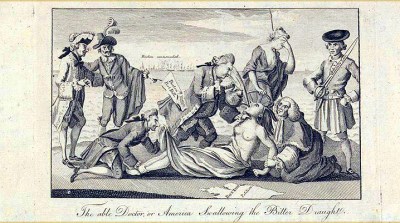 The Intolerable Acts of 1774 - Despite the failure of the Stamp Act and the Townshend Acts, the British Parliament responded to the "Boston Tea Party" by passing even more restrictive acts to punish the American extremists.… Continue reading The Intolerable Acts of 1774
  Ipswich and the American Revolution, Part 2: The Revolutionary War - On June 10th, 1776, the men of Ipswich, in Town-meeting assembled, instructed their Representatives, that if the Continental Congress should for the safety of the said Colonies Declare them Independent of the Kingdom of Great Britain, they will solemnly engage with their lives and Fortunes to support them in the Measure.… Continue reading Ipswich and the American Revolution, Part 2: The Revolutionary War
  The “Commonwealth” - "Commonwealth" is defined as a state in which authority is vested in the citizenry. In the 17th Century it was the radical philosophy the work and the proceeds thereof should be shared by the people.… Continue reading The “Commonwealth”
 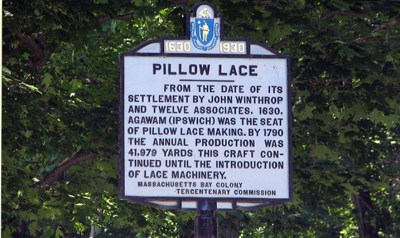 Ipswich Pillow Lace - In the late eighteenth century, Ipswich had 600 women and girls producing more than 40,000 yards of lace annually. Ipswich industrialists imported machines from England to mechanize and speed up the operation, which destroyed the hand-made lace industry. … Continue reading Ipswich Pillow Lace
 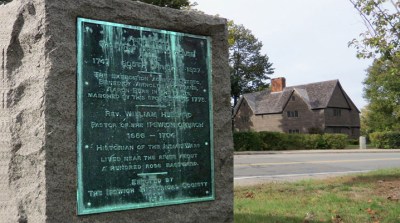 Benedict Arnold and the Fate of the American Revolution - In September 1776, the vulnerable Continental Army under George Washington evacuated New York after a devastating defeat by the British Army. One of Washington’s favorite generals, Benedict Arnold, miraculously succeeded in postponing the British naval advance down Lake Champlain that might have ended the war. Thomas Franklin Waters wrote about Arnold’s march through Ipswich on the way to Quebec “The… Continue reading Benedict Arnold and the Fate of the American Revolution
  Ipswich and the American Revolution: The Breach with Britain - In John Adams’ 1765 opposition to the Stamp Act, he referenced the citizens of Ipswich who resisted a tax imposed by the Crown in 1687. An Ipswich town meeting on August 11, 1768 approved of "the Conduct of those Gentlemen of the late House of Representatives...when it was required of them at the Peril of their Political Existence." The Town meeting on Dec. 28, 1772 supported the rights of the Colonists as British subjects, and established a Committee of Correspondence to communicate resistance with the Committees of other towns. Delegates from throughout Essex County arrived in Ipswich on Tuesday, Sept. 6, 1774, and by unanimous vote, bound themselves together in establishment of the Provincial Congress for the common safety.
… Continue reading Ipswich and the American Revolution: The Breach with Britain
Ipswich and the American Revolution: The Breach with Britain - In John Adams’ 1765 opposition to the Stamp Act, he referenced the citizens of Ipswich who resisted a tax imposed by the Crown in 1687. An Ipswich town meeting on August 11, 1768 approved of "the Conduct of those Gentlemen of the late House of Representatives...when it was required of them at the Peril of their Political Existence." The Town meeting on Dec. 28, 1772 supported the rights of the Colonists as British subjects, and established a Committee of Correspondence to communicate resistance with the Committees of other towns. Delegates from throughout Essex County arrived in Ipswich on Tuesday, Sept. 6, 1774, and by unanimous vote, bound themselves together in establishment of the Provincial Congress for the common safety.
… Continue reading Ipswich and the American Revolution: The Breach with Britain 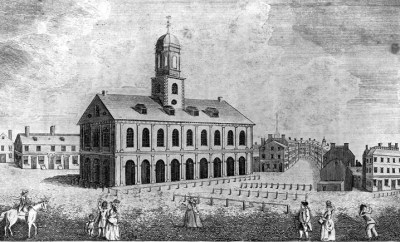 The Massachusetts Circular Letter, February 11, 1768 - Dr. John Calef represented Ipswich in the Massachusetts Assembly and was one of only 17 members who voted to retract the Circular Letter opposing the Townshend Acts. An engraving by Paul Revere portrays Calef being pushed into Hell.… Continue reading The Massachusetts Circular Letter, February 11, 1768
  Prosecution of Loyalists in Essex County - An angry mob surrounded the Haverhill home of Col. Richard Saltonstall, a Loyalist, who opened his door and stated that that he was bound to discharge the duties of the office.… Continue reading Prosecution of Loyalists in Essex County
  The Great Ipswich Fright, April 21, 1775 - A rumor spread that two British ships were in the river, and were going to burn the town. The news spread as far as New Hampshire, and in every place the report was that the regulars were but a few miles behind them, slashing everyone in sight.… Continue reading The Great Ipswich Fright, April 21, 1775
 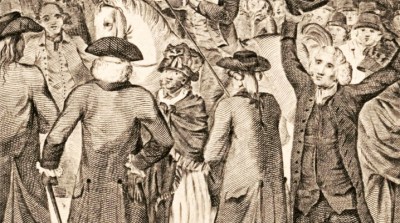 April 29, 1783: How Ipswich Celebrated the End of the Revolutionary War - The manner in which residents of Ipswich celebrated the end of hostilities was recorded in "The Life, Journals and Correspondence of Rev. Manasseh Cutler."… Continue reading April 29, 1783: How Ipswich Celebrated the End of the Revolutionary War
  The Arnold Expedition Arrives in Ipswich, September 15, 1775 - A memorial sits in the intersection between the South Green and the site of the former South Congregational Church in Ipswich. It reads, “The expedition against Quebec, Benedict Arnold in command, Aaron Burr in the ranks, marched by this spot, September 15, 1775."… Continue reading The Arnold Expedition Arrives in Ipswich, September 15, 1775
 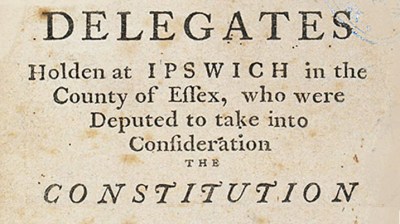 The 1778 Ipswich Convention and the Essex Result - Delegates from 67 towns arrived in Ipswich on Tuesday, Sept. 6, 1774 "to consider and determine on such measures as the late acts of Parliament" and declaring support for a Provincial Congress. They reconvened four years later to debate a draft constitution for Massachusetts. … Continue reading The 1778 Ipswich Convention and the Essex Result
 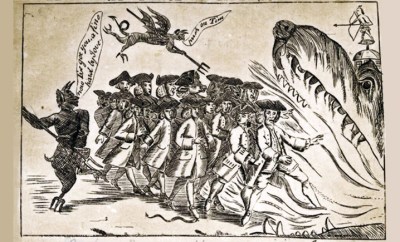 Ipswich Mob Attacks Loyalist Representative Dr. John Calef - Dr. John Calef was among a handful of members of the Massachusetts Assembly who voted to retract the "Massachusetts Circular Letter" which was adopted in response to the 1767 Townshend Acts. Ipswich citizens' anger at Calef lingered as war with England approached.… Continue reading Ipswich Mob Attacks Loyalist Representative Dr. John Calef
 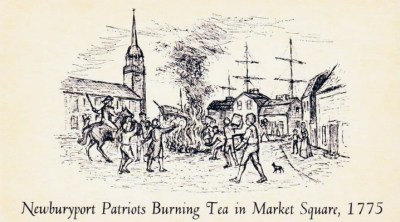 The Newburyport Tea Party - When Parliament laid a tax on tea, the British locked all the tea that had arrived in Newburyport into the powder house. Eleazer Johnson led a group of men who shattered the door and burned the tea in Market Square.… Continue reading The Newburyport Tea Party
  Madame Shatswell’s Cup of Tea - Madame Shatswell loved her cup of tea, and as a large store had been stored for family use before the hated tax was imposed, she saw no harm in using it as usual. News of the treason spread throughout the town.… Continue reading Madame Shatswell’s Cup of Tea
  The “Detested Tea” and the Ipswich Resolves - On Dec. 16, 1773, the tea brought into Boston harbor was thrown into the sea. A week later, Ipswich citizens met in the most violent mood, and adopted a series of resolutions,… Continue reading The “Detested Tea” and the Ipswich Resolves
  Reply by the Town of Ipswich to the Boston Pamphlet, December 28, 1772 - A document known as the “Boston Pamphlet” was distributed throughout the colony, asserting the colonists’ rights. Ipswich held a Town Meeting, established its own “Committee of Correspondence," passed a series of resolves, and gave instructions to their reresentative in the General Court, Michael Farley.… Continue reading Reply by the Town of Ipswich to the Boston Pamphlet, December 28, 1772
 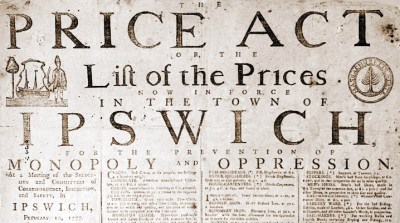 The Price Act, Passed at Ipswich, February 1777 - In 1777, the Ipswich Selectmen and the Committee of Correspondence and Safety, acting under the authority of the General Court, issued a schedule of prices covering all articles of food, clothing, wages of labor of every kind, entertainment at hotels, shipping rates etc.… Continue reading The Price Act, Passed at Ipswich, February 1777
  Leslie’s Retreat, or How the Revolutionary War Almost Began in Salem, February 26, 1775 - In our struggle for Independence, the British military received its first setback from the inhabitants of Salem in an episode that could not have been more ludicrous or entertaining if it had been written for Monty Python. … Continue reading Leslie’s Retreat, or How the Revolutionary War Almost Began in Salem, February 26, 1775
 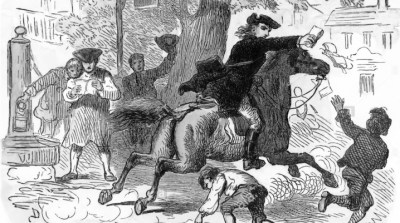 Paul Revere’s Not So Famous Ride Through Ipswich, December 13, 1774 - On the cold icy morning of December 13, 1774, Paul Revere headed out on a 60 mile gallop from Boston along the Old Bay Road through Ipswich to warn the citizens of Portsmouth that British troops may be landing.… Continue reading Paul Revere’s Not So Famous Ride Through Ipswich, December 13, 1774
  Lieutenant Ruhama Andrews and the 1775 Battle of Quebec - On Christmas Day 1823, Gen Benjamin Pierce of Hillsborough, NH held a reunion of twenty-two citizens who had served in the War of Independence. The oldest attendee was Ammi Andrews, born in Ipswich, MA, aged 89 years.… Continue reading Lieutenant Ruhama Andrews and the 1775 Battle of Quebec
  Old Toryism, Mock Federalism & the Essex Junto - Baptist minister "Citizen Pottle" gave a toast, "To the Venerable Town of Ipswich. May it be purged of all old Toryism and mock Federalism." As the other ministers were indeed Federalists, his toasts aroused suspicion that the whole celebration was a spirited demonstration of Baptist enthusiasm.… Continue reading Old Toryism, Mock Federalism & the Essex Junto
  “A State of Nature”, Worcester in 1774 - "In Worcester, they keep no Terms, openly threaten Resistance by Arms, have been purchasing Arms, preparing them, casting Ball, and providing Powder, and threaten to attack any Troops who dare to oppose them....the flames of sedition spread universally throughout the country beyond conception.” -Gen. Thomas Gage… Continue reading “A State of Nature”, Worcester in 1774
  Account of the Soldiers of Chebacco Parish at Bunker Hill - Of the men from Chebacco parish who were in the battle at Bunker Hill, the names of six are known: James Andrews, Benjamin Burnham, Nehemiah Choate, Aaron Perkins, Jesse Story Jr., a minor who was killed, and Francis Burnham who was wounded. Two Chebacco boys, Aaron Low and Samuel Proctor, belonged to a Gloucester company which reached Cambridge on the afternoon of the 16th.… Continue reading Account of the Soldiers of Chebacco Parish at Bunker Hill
  A Revolutionary Guest: John Adams’ Letters From Ipswich - John Adams visited Ipswich many times during his tenure as the Boston representative to the colonial legislature from 1770 to 1774.… Continue reading A Revolutionary Guest: John Adams’ Letters From Ipswich
  Shay’s Rebellion - On the last Tuesday of August, 1786 some 1500 armed insurgents took possession of the Northampton Court House, initiating a brief war known as Shay's Rebellion.… Continue reading Shay’s Rebellion
  5-7 Poplar Street, the Dr. John Calef House (1671) - This house was built on South Main St. between 1671 and 1688 by Deacon Thomas Knowlton. In the mid-18th Century the house was owned by Dr. John Calef, a Loyalist. John Heard moved the house to its present location in order to build his elaborate Federalist home which now houses the Ipswich Museum. … Continue reading 5-7 Poplar Street, the Dr. John Calef House (1671)
  88 County Road, the Col. Nathaniel Wade House (1727) - This house was built in 1727 by Captain Thomas Wade. His son Nathaniel Wade received command at West Point after Generald Arnold went to the enemy. The house has a preservation covenant with the Ipswich Historical Commission.… Continue reading 88 County Road, the Col. Nathaniel Wade House (1727)
  Historic Ipswich