
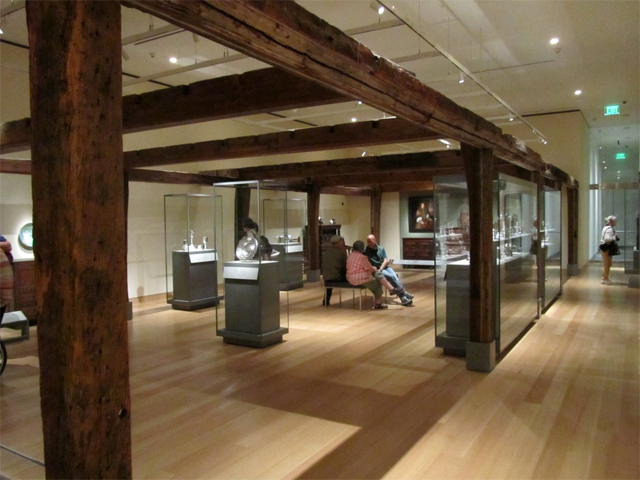
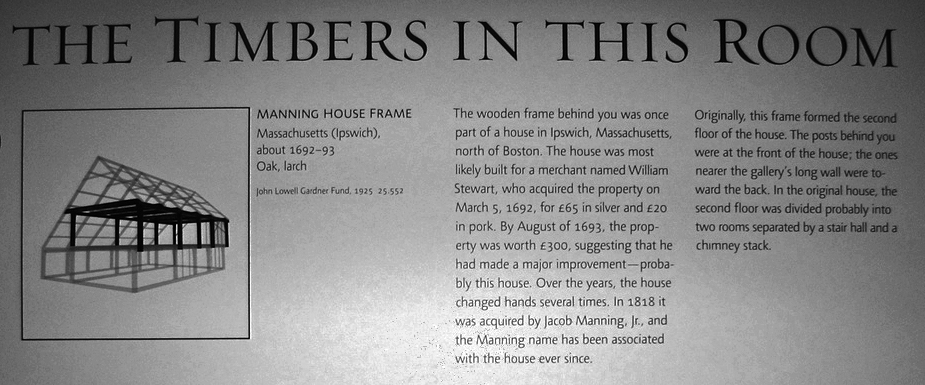
The “Art of the Americas” wing at Boston’s Museum of Fine Arts features building artifacts from Ipswich and the surrounding North Shore area, including the second-floor framing of the Manning house, which was built in Ipswich about 1692 at the intersection of Manning and High Streets. The Manning House was probably built by William Stewart in 1693, and in 1818, the house was purchased by Jacob Manning. It was once used as the town’s almshouse. When it was razed in 1925, the timber frame was preserved and put on display at the Museum.


The framework is now displayed on the first floor of the “Art of the America’s” wing of the museum. Shown below is the summer beam from the Manning house, with its floor beams attached.


“Summer beams” such as this were a standard feature in the First Period architecture of colonial Massachusetts and are still found in many of the houses in the historic district of Ipswich.
Also on this floor is a recreation of a section of the interior of a West Boxford home from the early 1700s, including original beams, bricks, woodwork, and flooring. On the next level is the re-creation of rooms from the 19th-century Oak Hill mansion in what was South Danvers, from land now occupied by the North Shore Mall in Peabody.

The house on the left in the photo above was the Caleb Lord House. Notice the very steep slope of the roof, which hangs over the second-story windows, and the central chimney. These are traditional characteristics of Ipswich’s First Period houses built between 1640 and 1725. Behind the Caleb Lord house is an early double house. Both were demolished in the 20th century along with the Manning House.
Read:
 Historic Ipswich