
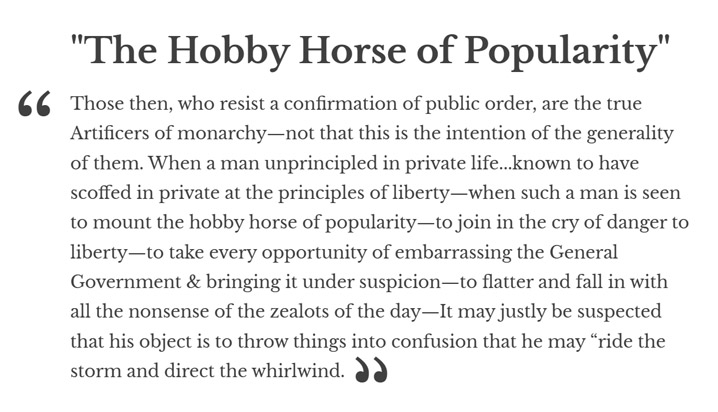

Alexander Hamilton wrote these words in a letter to George Washington on August 18, 1792. Political divisions between the Federalist Party (led by Hamilton) and the Democratic-Republican Party led by Thomas Jefferson were deepening. Jefferson’s adoring supporters organized large, well-attended events where they praised him in speeches and songs, while his political opponents portrayed him as a radical demagogue. Hamilton perceived Washington, a Virginian, as a stabilizing force for the new nation.
Ipswich historian Thomas Franklin Waters wrote: “At the close of the Revolution, the thirteen states were in danger of drifting widely apart. Each had its system of taxation, its currency, its restrictions on trade, and its petty variances with its neighbors. The Federal Congress, which had been vested with authority by common consent because of the common peril, ceased to be recognized as necessary and useful. There was no agreement as to what the form of government of the new nation should be.
“At last, a Convention of fifty-five delegates assembled in Philadelphia, in October, 1787, and after a four-month session, adopted a Constitution which was sent to the different states to be approved or rejected. Two political parties were formed at once. The Federalists, concentrated in New England, urged the adoption of the Constitution as securing a strong Federal government; the Anti-Federalists opposed it on the ground that it gave the national government too much power and threatened the liberties of the people.
“The State Conventions were characterized by hot debates and scenes of violence. In January 1788, the Massachusetts Convention assembled. The Hon. Michael Farley, John Choate, Esq.. Daniel Noyes, Esq. and Col. Jonathan Cogswell were the Ipswich delegates. The Constitution had been read in Ipswich Town meeting on Nov. 20, 1787, paragraph by paragraph, and the delegates had been chosen on Dec. 3. After long debate, the question of ratification was put on the sixth of February, and it was carried by a vote of 187 to 167, the Ipswich delegates all voting “Yes.”
“The crowd awaiting the announcement of the vote went wild with joy. Church bells were rung, cannons fired, and bonfires burned all night in the streets. The vote of the delegates from Ipswich reflected the sentiment of the community, and the result of the Convention was received with great satisfaction.”
The Massachusetts Centinel, one of the most widely circulated newspapers in America, was filled with articles advocating a strong Congress, while the American Herald, the Massachusetts Gazette, and the Boston Gazette published Anti-Federalist articles. The Essex Journal & New-Hampshire Packet of Newburyport and the The Salem Mercury; Political, Commercial, and Moral reflected the Federalists sympathies of Essex County. It was said that during that period, newspapers were “more read than the Bible.”
The presidential election of 1800 witnessed the defeat of the Federalists, and a tie between Thomas Jefferson and Aaron Burr, two members of the Democratic Republican party. Alexander Hamilton had no choice but to support Thomas Jefferson over Burr, a man he believed to have no principles at all.
Hamilton wrote a letter to Massachusetts Congressman Harrison Gray Otis:
“In a choice of Evils let them take the least – Jefferson is in every view less dangerous than Burr. Mr. Jefferson, though too revolutionary in his notions, is yet a lover of liberty and will be desirous of something like orderly Government – Mr. Burr loves nothing but himself – thinks of nothing but his own aggrandizement – and will be content with nothing short of permanent power in his own hand.”
In a January 4, 1801, letter to James McHenry, Hamilton wrote:
Nothing has given me so much chagrin as the Intelligence that the Federal party were thinking seriously of supporting Mr. Burr for president. I should consider the execution of the plan as…signing their own death warrant.”
Alexander Hamilton was very popular in Essex County, and the town of Hamilton, a former parish of Ipswich, was named after him. But in early morning on July 11, 1804 in Weehawken, New Jersey, Aaron Burr shot and killed Alexander Hamilton in a duel. In New England, Burr was labeled by Federalist newspapers as a cold-blooded killer, an “infandel.” Democratic-Republican papers in the South were conciliatory in their portrayal of Burr.
Sources and Further Reading:
- Founders Online: From Alexander Hamilton to George Washington, 18 August 1792
- Founders Online: The Origins of Freneau’s National Gazette, 25 July 1791
- Founders Online: From Alexander Hamilton to George Washington, 9 September 1792
- Virginia Museum of History & Culture
- Center for the Study of the American Constitution, “Massachusetts Newspapers during Ratification”
- Waters, Thomas: Ipswich in the Massachusetts Bay Colony Vol. II
- Wikipedia: Burr–Hamilton duel
 Historic Ipswich