

The term “tramp” came into popular use in the 19th Century and referred to people who lived a wandering homeless lifestyle, whose numbers increased dramatically after the Civil War and the industrial recession of the early 1870s. Ipswich had a major railroad passing through it and saw its share of tramps. The number of tramps in need of assistance grew to over a thousand each year, exceeding the town’s resources. The town made increasingly stringent demands of the tramps, which led to an almost complete cessation of migrants passing through the town for a couple of decades.
The term “Hobo” came into use around 1890. Although the exact etymology of the phrase is uncertain, it may be short for migrant farm workers known as “Hoe Boys”. The phrase generally referred to migrant men traveling around picking up work, as opposed to tramps, who avoided work.
IPSWICH TRAMP REPORT, 1899

“At the police station, long-needed improvements have been made. For years the tramps have made it a practice to sleep on the floor of the guard room, and the unfortunate prisoner who occupied a cell was sure to find plenty of “livestock” in his clothing. The entrance to the guard room has always been poorly arranged, and a dangerous one for an officer to handle an unruly prisoner in. As it is now, a new entrance has been made, doing away with the necessity of going through the dark cellar, and the tramps are not allowed in the cell room. A new hot water heating plant warms both the tramp room and guard room and does it well. Other needed improvements have been made to the hall at a small expense.
–Respectfully submitted, Geo. A, Schofield, John A. Brown, Chas. E. Goodhue, Selectmen, Ipswich, Feb. 20. 1899.”
IPSWICH TRAMP REPORT, 1900
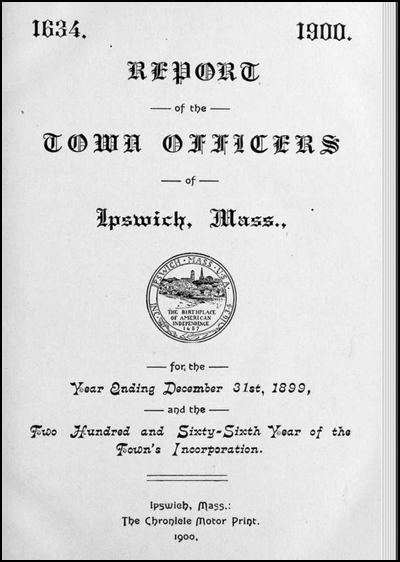
“For the year ending December 31, 1889: Whole number of tramps cared for at the police station, 1018 as seen in the following report: January 186, February 103, March 184, April 157, May 53, June 13, July 11, August 6, September 39, October 50, November 116, December 100, Total 1018.
The number of tramps has decreased by about one-half this year; this we account for partly by working them in the morning when there is anything to be done, and by searching them when being put up, as quite a number of them have money to buy food and lodging which they are made to do, and by so doing they are not dependent on the town.”
–Respectfully submitted, Frank B. Page, Chief of Police, Ipswich, Mass., Jan. 1, 1900.”
IPSWICH TRAMP REPORT 1905

“I desire to call your attention to the fact that since the month of May last, there does not appear in the report submitted to you any care of tramps at your police station. Commencing with the month of June, tramps applying for aid were told that assistance would be furnished to them, but were also told that they would be brought before the court in the morning on the charge of vagrancy; that if it was then shown that they were traveling about from place to place, having no employment, and seeking none, they must take their chances of being sentenced as a vagrant.
Only in rare instances did any of them applying for aid wish their past record inquired into, and there was only one instance where an examination of their records warranted any assistance being rendered, and this was where an old soldier, who had just lost his employment and chance of earning a livelihood, and at the time he asked for aid was looking for employment. In this case, he was given lodging and breakfast at the Franklin House. These “traveling gentlemen” are now taboo in Ipswich, so that now it is a rare thing to have any application made to us, by them, for any assistance.
–Respectfully submitted, Albert S. Garland, Chief of Police. Ipswich, Mass., Jan. 31, 1906″

Tramps and Hobos During the Great Depression
When the Great Depression came, many people lost their jobs and homes, and hobos once again became common. The town used a room at the Ipswich Jail on Green Street for housing transients overnight. Mattresses, blankets, heat, and a few items of food were provided, and the men were often expected to perform some form of labor in exchange for “room and board.”


The New Deal
In 1933, President Franklin D. Roosevelt acted to end the Depression with an executive order that created a relief program known as the Civil Works Administration, which put millions to work on secondary roads, schoolhouses, parks, and other projects. In March 1934, Congress created the Works Progress Administration (WPA) and the Civil Conservation Corps (CCC), providing unskilled manual labor jobs conserving and developing natural resources in rural lands owned by federal, state, and local governments. CCC participants were provided with shelter, clothing, and food, and a wage of $30 a month. Nationwide, CCC enrollees constructed more than 800 parks and built a network of public roadways in remote areas. It was through this program that the old jail on Green Street was demolished. At its height, the program employed up to 20 percent of the U.S. workforce.
With the post-war prosperity of the 1950s and the introduction of diesel locomotives making it difficult to easily jump freight trains, the Hobo era came to an end.
 Historic Ipswich
I’ve read about the tramp signs before, it truly is fascinating to me. There is an episode of Mad Men where these are discussed. Did Hobos invent emojis? 🏄♂️
Tramps, Vagrants, Hobo’s, later Bums, Drunks and Indigent; now homeless, un-housed, street people etc. The story goes on and on. Poverty was and remains the underlying cause fueled by alcohol and now high-test illicit drugs. The Public Workhouse at the terminus of Town Farm Road gave shelter, food and work to those both willing and lucky enough to find housing there. In my early years in town, hard on their luck folks would find a place to live at the old Hayes Hotel in Depot Square. Essentially a rooming house with attached barrooms, (Upper and Lower Deck depending on your preference) the Hayes was owned /operated by Mr. Gaston Nadeau. The proprietor provided a room, meals, shower and weekly allowance in exchange for the residents pension, Social Security check or other public assistance money. Tragically, the Hayes burnt to the ground in the summer of 1969 with several lives lost. The granite entry steps and foundation remained in place well into the early 1990’s until new housing and restaurants replaced it. The steps remained a gathering spot for some of the lost survivors of the fire and other street folk. Some would keep a paper bag nearby containing a preferred beverage. They were good enough not to exploit the privilege and drink when the beat man sauntered by. The adjacent foundation area was a repository for smashed nips and beer bottles year round, and an overgrown jungle in the growing season. Moose Sotiropolous ran the Family Time Pool and Billiards parlor in a basement closer to the corner of Washington and Market Streets. A kind and generous man, he would allow the homeless to sleep overnight on the pool tables during extreme weather.
The old cop-shop “Guard Room” referenced here was a room in the basement of the old Town Hall, (now “The District”; over-priced townhouses and condo’s) beneath the two room police station adjacent to the District Court. A separate area housed two or more locked cells. The guard room is where the constables of yore would store their heavy winter coats, hard hats and other copper paraphernalia of that time. Rumor had it that in the first decades of the previous century, they would also use the space to smoke, play cards, have a warming nip and find surcease from a nagging spouse or a sanctuary from pressing domestic duties. In the 1980’s, I only knew it as a dank, subterranean locker room with a last-resort, sub-standard bathroom.
Lastly, It’s rare to see a homeless street person downtown now. It can be rare to see any person downtown now. Things have changed in our current historical time, and the currency of human contact, conversation and ultimately, kindness, can seem a thing from another era. Go figure.
G.K.