

In 17th-century Ipswich, funeral services were without sermons or eulogies, completely silent, avoiding any appearance of papistry. Over time, extravagant outlays were often made for mourning garments, refreshments, and the coffin. In the procession to the burial ground, there could be as many as four sets of pallbearers. The weight of the casket was carried by under-bearers, young men hidden under the pall or cloth that concealed the coffin.
Walking alongside them were the honorary pallbearers, men of age or dignity who held only the corners of the pall. When the distance to the burying ground was lengthy, the weight of the casket was assumed midway by backup pallbearers. It was customary when females were buried that women led the procession, and when males were buried, men did the same.

The first grave markers at the Old North Burying Ground were probably wood or simply engraved stones, but by the late 17th century, the funeral traditions and gravestones had become quite elaborate. Gravestone carvers traveled from Boston to Ipswich and Newbury, each giving their own style to the monuments. The skull and wings, and oval masks were common designs on the earliest tombstones.
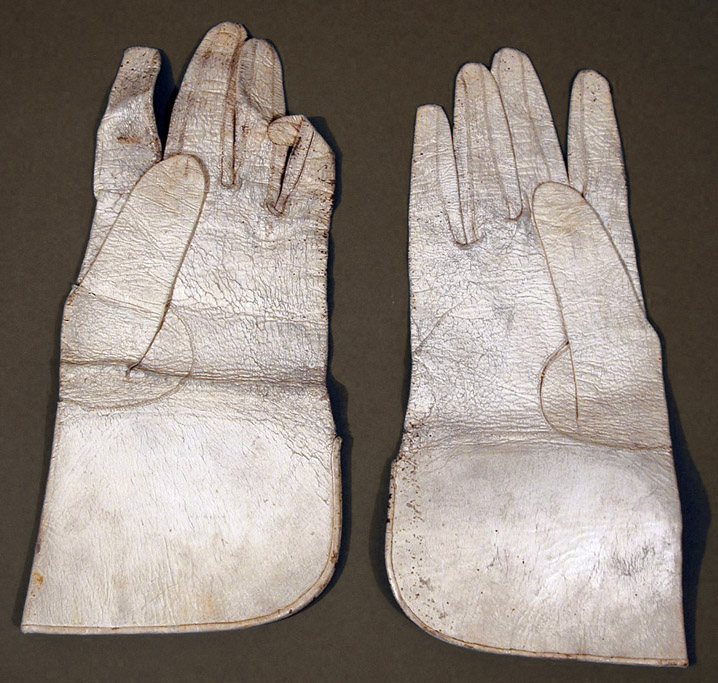
When Rev. Mr. Cobbett died in 1685, the Town of Ipswich assumed the expenses of his funeral. Payments were “not to be deducted out of the assessment of Mr. Cobbett’s account,” even though Cobbett was also one of the principal merchants of the Town.
At a meeting of the Selectmen, November 6, 1685, the following was “agreed with respect to the Reverend Mr. Cobbett’s funeral:”
- That Mr. Rust provide funeral gloves suitable for men and Women. Nathaniel Rust’s tanning establishment was on the site of the residence of the Rogers and Brown Bed and Breakfast on County Road, which is where he made the four dozen pairs of gloves.
- That a man be sent to Lynn to “acquaint friends with ye solemn providence here.”
- That “the Corpse be wrapt up in the Coffin in tarr with canvas.”
- That “persons be appointed to look to the burning of the wine and heating of the syder, against the time appointed for ye funeral next Monday at one of the clock.”
- Payment to Deakon Goodhue for wine: 32 gallons
- Payment to John Annable for wood for the fire.
- Payment to Edward Dear for cider.
- Payment to Nathaniel Lord for making the Coffin.
- Payment to Mr. Wilson for digging the Grave.
- To Abraham Perkins, going to Newbury to inform John Cobbett of his Father’s death.
- To Mr. Norton, going to Lynn to inform friends there.
Until 1769, no burial was allowed on the Sabbath unless leave was granted by a Justice. If a funeral was held on Sunday, all preparations had to be done by the end of Saturday. It was decreed that “No sexton, grave-digger, porter, or bearer shall be assisting at the funeral of any person on the Lord’s Day, or any part thereof, and no person shall toll any bell for such funeral, unless license be given by a justice of peace, on penalty of twenty shillings.”

Gloves and Rings
By the beginning of the 18th Century, the cost of funerals had become so extreme that it could greatly reduce the value of the deceased’s estate, and many a poor family mortgaged their farms to pay for the excesses. Mourning rings were given at funerals to near relatives and persons of note in the community, decorated sometimes with a death’s head or a framed lock of hair, upon which the initials of the deceased were engraved or fashioned. Mourning outfits included everything from long crape bands for men’s hats and cypress for women’s hoods, to shoes and stockings. The total account for the funeral of Ammi Ruhamah Wise was £420, a full quarter of his estate.
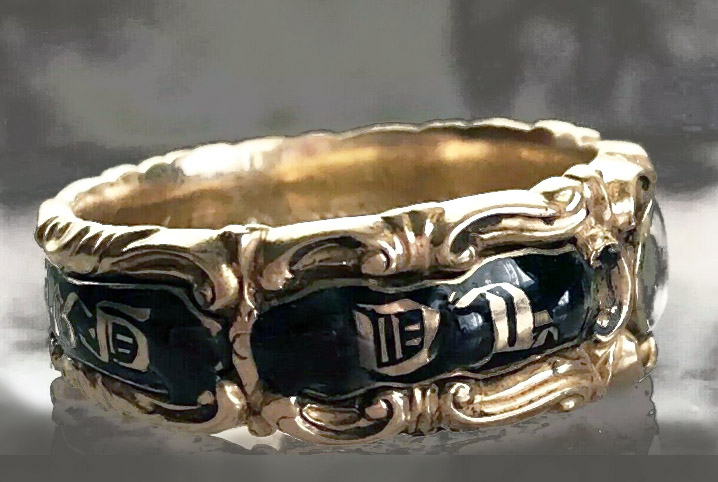
For the funeral of Massachusetts Governor Burnet in Sept. 1729, the General Court ordered mourning clothes for his children, servants, and slaves, funeral trappings for coach and horses, and gloves and rings for the members of the Council, judges, ministers, military officers, and a multitude of others, and an appropriation of £1097 was needed to cover it. Andrew Faneuil, a wealthy but childless widower, gifted Faneuil Hall to Boston in 1742, half a year before his death. At his funeral, three thousand gloves were distributed. The Rev. Mr. Andrew Elliot (1718–1778), pastor of the New North Church of Boston, recorded $640.00 for the sale of 2940 pairs of gloves that he received over the course of his ministry.
By the mid-18th century, public opinion had turned against such excesses. In 1741, the General Court passed a law that “no scarves, gloves (except six pairs to the bearers and one pair to each minister), wine, rum, or rings be allowed to be given at any funeral under the penalty of fifty pounds.” At the Salem Court, on Christmas Day, 1753, Jeremiah Lee of Marblehead was fined £50 “for giving rings and gloves more than are allowed by law at the funeral of his father, Samuel Lee.”
Gradually, this costly display disappeared, and the funeral expense involved only a fine mourning dress for the widow. By the end of the century, modest mourning and simple funerals were the universal custom.
Sources and further reading:
- Waters, Thomas Franklin: “Ipswich In the Massachusetts Bay Colony,” Vol. II
- Felt, “History of Ipswich, Essex and Hamilton”
- Earl, Alice Morse: “Customs and Fashions in Old New England”
- Earl, Alice Morse: “The Sabbath in Puritan New England“
- Earl, Wendy: “The Funeral Practices of the Pilgrims and Puritans“
- Stone Structures of the Northeastern United States
- Old North Burying Ground Gravestone Carvers and Monuments
- Complete guide to the Old North Burying Ground (PDF/Print)
- Streets of Salem: The Era of Excessive Mourning
 Historic Ipswich
[…] Colonial New England Funerals on Historic Ipswich […]
Interesting indeed.
Your article confirms the lack of “ceremony” for the earliest colonial funerals. Great article. Thank you for your extensive research.