


“Within these late years, there hath, by God’s visitation, reigned a wonderful plague, the utter destruction, devastation, and depopulation of that whole territory, so as there is not left any that do claim or challenge any kind of interest therein. We, in our judgment, are persuaded and satisfied that the appointed time has come in which Almighty God, in his great goodness and bounty towards us, and our people, hath thought fit and determined, that those large and goodly territories, deserted as it were by their natural inhabitants, should be possessed and enjoyed by such of our Subjects and People as heretofore have and hereafter shall by his Mercy and Favor, and by his Powerful Army, be directed and conducted thither.” —Plymouth Council Charter (November 3, 1620) granted by King James I.
There is disagreement regarding the number of Native Peoples before the first Europeans set foot in North America, but approximately five to eighteen million is currently the best estimate, and a much larger population of over 100 million, including throughout the Americas and West Indies, is probable. The arrival of Europeans brought a “Pandora’s Box” of epidemics, including measles, chickenpox, influenza, typhus, diphtheria, cholera, scarlet fever, and whooping cough, which resulted in a catastrophic “demographic collapse” of up to 95% of the indigenous population. By the beginning of the 20th century, the number of Native Americans in this country had been reduced to about 237,000 people through disease, war, and relocation.
The arrival of European traders and settlers, including 102 Pilgrims aboard the Mayflower at Plymouth in 1620, and the settlements by the Puritans in Salem, Boston, Ipswich, and other northeast Massachusetts towns a decade later, was accompanied by the further demise of the native population. The first was a widespread, extremely lethal epidemic that began in 1617 and was of undetermined origin. While classic explanations have included yellow fever, smallpox, plague, chickenpox, and trichinosis, a 2010 article in the NIH Library of Medicine suggests leptospirosis complicated by Weil syndrome, a rare but severe bacterial infection, spread by non-native black rats that arrived on the settlers’ ships. This was soon followed by a series of smallpox epidemics. Thousands of Native Americans died of these and other European diseases in less than two decades. The massive die-off of the Indigenous population was often interpreted as an act of God by the European settlers:

As explorers and settlers arrived from Europe, a tidal wave of disease, especially from 1616 to 1619, reduced the native population by up to 90 percent. Pilgrim and Puritan colonists arrived on the New England coast to find empty villages waiting for them to occupy. Among the many diseases introduced to the Native American population were smallpox, bubonic plague, chickenpox, cholera, the common cold, influenza, diphtheria, malaria, measles, scarlet fever, sexually transmitted diseases, typhoid, typhus, tuberculosis, leptospirosis, yellow fever, and pertussis.
Agawam
In April of 1614, Captain John Smith sailed near Ipswich and wrote, “Here are many rising hills, and on their tops and descents are many corne fields and delightful groves.” Native Americans in the North Shore area at that time are believed to have numbered in the thousands. Twenty years later, when Ipswich was settled, the Agawam people, by some estimates, are believed to have been reduced to less than a hundred individuals.
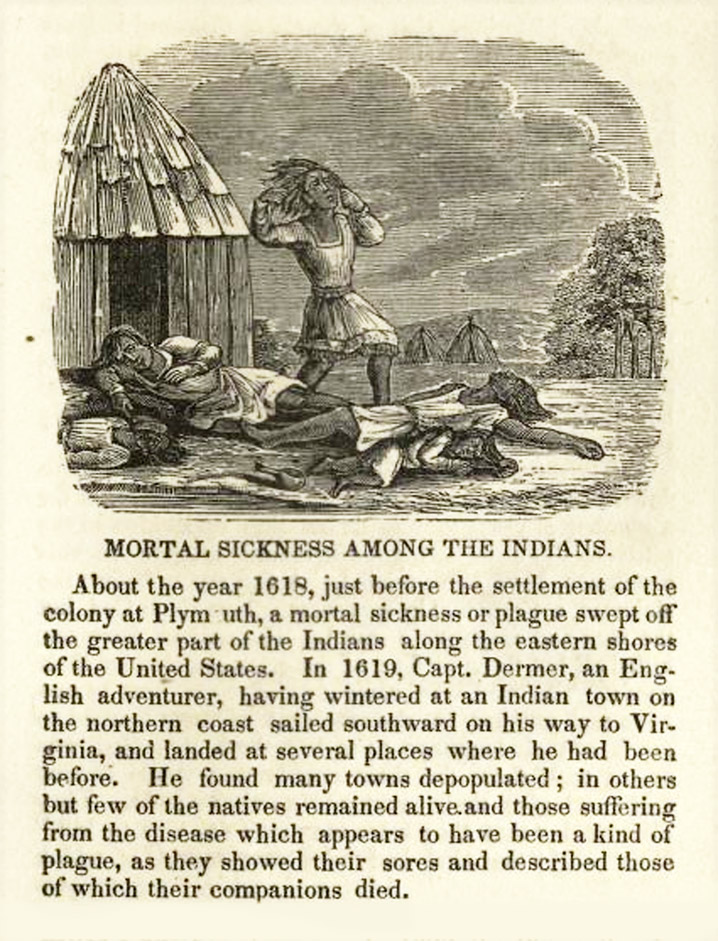
Joseph Felt wrote in his book, “History of Ipswich, Essex and Hamilton published in 1834,
“When we look back on the Aborigines, as the sole proprietors of our soil, on the places which once knew them, but are now to know them no more forever, feelings of sympathy and sadness come over our souls. In the light of history, a tribe of men immortal as ourselves…have irrevocably disappeared from the scenes and concerns of earth. A plague swept off most of the New England Indians about 1617.”
The 1854 book “Indian Narratives,” by Henry Trumbull, Susannah Willard, and Zadock Steele, stated,
“Three years before the arrival of the Plymouth colony, a very mortal sickness, supposed to have been the plague or perhaps the yellow fever, raged with great violence among the Indians in the eastern parts of New England. Whole towns were depopulated. The living were not able to bury the dead, and their bones were found lying above ground many years later. The Massachusetts Indians are said to have been reduced from thirty thousand to three hundred fighting men.”

The colonists interpreted the disappearance of the Native American population as part of a divine plan to make way for Puritan settlements.
“Strangely, they have decreased by the Hand of God… and it hath generally been observed that where the English come to settle, a Divine Hand makes way for them.” — Daniel Denton, (c. 1626 – 1703), who in the 1640s accompanied his father to Massachusetts, Connecticut, and eventually Long Island, and became one of the grantees of a patent at Elizabethtown, New Jersey.
“In short time after the hand of God fell heavily upon them, with such a mortal stroke that they died on heaps as they lay in their houses… For in a place where many inhabited, there hath been but one left alive to tell what became of the rest…And the bones and skulls upon the several places of their habitations made such a spectacle after my coming into those parts, that, as I traveled in that Forrest near the Massachusetts, it seemed to me a newfound Golgatha. And by this means, there is as yet but a small number of Savages in New England, to that which hath been in former time, and the place is made so much the more fit for the English Nation to inhabit in, and erect in it Temples to the glory of God.” –Thomas Morton, among the founders of the settlement at Mount Wollaston (present-day Quincy, MA).
“That the Heathen People amongst whom we live, and whose Land the Lord God of our Fathers hath given to us for a rightful Possession, have at sundry times been plotting mischievous devices against that part of the English Israel which is seated in these goings down of the Sun, no man that is an Inhabitant of any considerable standing, can be ignorant.” –Increase Mather, A Brief History of the Warre With the Indians in New England
“For the natives, they are near all dead of the small pox, so the Lord hath cleared our title to what we possess….The mortality among them was very great, and increased among them daily more and more, insomuch that the poor Creatures being very timorous of death, would faine have fled from it, but could not tell how, unless they could have gone from themselves; Relations were little regarded by them at this time, so that many, who were smitten with the Disease, died helpless, unless they were near, and known to the English…The Winter’s piercing cold stayed not the strength of this hot Disease, yet the English, endeavoring to visit their sick Wigwams, helped them all they could, but as they entered one of their matted Houses, they beheld a most sad spectacle, death having smitten them all but one poore Infant, which lay on the ground sucking the Breast of its dead Mother, seeking to draw living nourishment from her dead breast. Their dead, they left oftentimes unburied, wherefore the English were forced to dig holes and drag their stinking corpses into them.“ –John Winthrop, Massachusetts governor, writing in 1633 and 1634 from Boston
Additional Information by Mary Ellen Lepionka
The population estimate of 18 million is one of many, with a critical consensus still lacking. The problem is that observers often did not identify their unit of measure or its equivalencies; i.e., they variously counted warriors, males, adults, families, wigwams, or villages for their population estimates. Also, they invariably estimated low, as the people often avoided contact or were absent on subsistence rounds, pilgrimages, or attacks on enemies. Each adult male could easily have represented up to 10 unseen others. Each wigwam could sleep 10, and an extended family represented at least 10 individuals.
Based on early observations and survivalist and land use data (on average, each family would have needed around 20 hectares), I estimated that Cape Ann would have seasonally supported around 2,000 people. There certainly were way more than 100 people in Agawam after 1620.
The pre-1620 epidemic was leptospirosis. Smallpox was not epidemic until after 1630. That early epidemic had more devastating effects on the South Shore than the North Shore. Essex County had at least a 50% survival rate, especially inland. The difference was partly due to geography, as the fall line leaves a broader piedmont in the south for greater exposure of more people to soil- and water-borne diseases, whereas the fall line in the north approaches the shore, leaving no piedmont at all. On tidal rivers, the bacterium and many of its animal hosts did not range above the fall line. Also, rivers in the north are more barred and less navigable than those in the south. The rat-urine-infected ballast stones dumped at the mouths of those rivers had less effect than in the south, where large vessels could dump contaminated ballast farther inland.
One also needs to consider that native populations recovered through the acquired immunity of survivors, which increased in the population after each epidemic. There was a “great dying”, of course, but the worst news came from south of Boston (Winthrop was the worst). The idea that the Indians died out from disease has been used in the past as a convenient exaggeration in light of what followed (state-sponsored genocide).
Sources and Further Reading:

- The Significance of Disease in the Extinction of the New England Indians by Sherburne F. Cook
- Counting the Dead: Estimating the Loss of Life in the Indigenous Holocaust, 1492-Present, David Michael Smith, University of Houston-Downtown
- The Great Dying: New England’s Coastal Plague, 1616-1619
- Miraculous Plagues: An Epidemiology of Early New England Narrative by Chritobal Silva
- New Hypothesis for the Cause of Epidemic among Native Americans, New England, 1616–1619
- Wikipedia: Native American Disease and Epidemics
- Avalon Project, Yale University: Charter of New England
- American Minute: Plymouth Council Charter (November 3, 1620)
 Historic Ipswich
Recent DNA analyses show evidence that a type of salmonella very similar to typhoid may be responsible for killing millions of Aztecs. Symptoms described by Spanish friars are very similar to the symptoms of the Great Dying. See https://www.grunge.com/167944/we-finally-understand-why-the-aztecs-disappeared/.
The Europeans that came to New England certainly did not want to eradicate the Native Americans. In the Southern Hemisphere, the Spanish focused on gold and conquest from the very beginning. But in the North, the first French and Dutch explorers who landed in what became Newfoundland and Acadia wanted fish and then beaver and other pelts. The Northeastern Indians in Acadia were the first to welcome them to trade goods especially after they learned about European guns and other metal tools.
Trade inherently entails risk and at least 100 years before the Great Dying the Northeastern Tribes learned that contacts with Europeans frequently resulted in disease outbreaks and deaths in their villages. But they intentionally expanded their trading with these foreign intruders they vastly outnumbered rather than expelling them. Why? Because they were at constant war with their long-time historical enemies – the Iroquois Confederacy, an expansionist rapidly growing power and existential threat to all of its neighbors. So trade with Europeans commenced and expanded, and the Algonquins allied with the French beat back the Mohawk threat in a series of battles.
But as Algonquin Tribes overhunted the beaver in their lands to extinction to fill their demand for European goods, they then turned to war on their Abnaki neighbors in New England to obtain more lands and beaver, see https://en.wikipedia.org/wiki/The_Tarratine_Wars. And then the Great Dying occurred. Ironically, the Tarratines were not exposed at first, but their war parties to Massachusetts carried it back to their Acadian villages where according to one estimate it killed 75% of their people.
By 1620, the tribes along the coast of New England had been decimated by diseases and war primarily caused by the fur trade. Although the Pilgrims were outnumbered by local tribesmen they were befriended because the local tribes were far more afraid of their hostile Native neighbors. And as word grew in England of a depopulated land with the remaining Natives seemingly friendly to colonists, some 40,000 of many Americans’ and Canadians’ ancestors came over from England during the next 20 years to create better lives for themselves and their descendants. Thankfully for us, they succeeded.
The Northeastern Native Americans suffered from being human. They took a big risk for what turned out to be relatively short-term gains and methodically extinguished their most valuable resources for guns and axes and wampum. They paid dearly for their risky decisions and their actions. They were not the first nor will be the last culture / tribe / group of humans to do so.
After the Great Dying, a very similar story of much larger scope played out with The Iroquois Confederacy and the Dutch and then English traders. See https://en.wikipedia.org/wiki/Beaver_Wars. Even after the Great Dying, the Iroquois Confederacy went to extraordinary lengths at the great expense of its neighbors to maintain and expand its fur trading with Europeans. And again, in the long run at great cost to themselves.
If something must be blamed for the demise of the Northeastern Algonquins, Iroquois Confederacy and other Native American Tribes in the Ohio Valley and Great Lakes, blame the fur trade and the Native Americans’ decisions and actions related to it.
I am puzzled that the “Great Dying” happened among Natives of the British colonies in New England but am not aware of comparable evidence of massive death among natives colonized by other European powers, mainly Spain but also Portuguese and French. Were diseases brought by the British more deadly that those brought by other Europeans?
I was born and raised in the highlands of Colombia; 43 percent of my genes are American Native and my ancestry dates back to the mid 1500’s. I never came across any narrative about massive death toll among the native population following the arrival of the Spanish conquistadores to the highlands populated by Muisca and Chibcha tribes. During three years living in Mexico never heard of comparable stories about massive death from diseases among the Aztec or other native groups. I am sure new diseases must have had a toll but nothing comparable to what is being described in the British colonies. Was the Spanish God that much more forgiving the British?
“The pre-1620 epidemic was leptospirosis.” This statement is made without any basis. Considering how leptospirosis is transmitted, including not being primarily human to human, and considering the alleged source, dumped ballast stones, it is a stretch to believe leptospirosis contamination would travel up hydraulic gradients to infect large inland populations. Furthermore I doubt “sores” are a leptospirosis pathology. The Europeans would also be easily infected. They would be equally vulnerable to the leptospirosis bacteria.
Native Americans who didn’t die from disease were killed or driven from their lands. Africans were kidnapped and enslaved to work for the rich white settlers. This country is reaping the rewards of their abuse of Natives and slaves.
Can you provide a citation for your woodcut images of the Abenacki? I’m looking for the original publication. Thanks!
Just added– Illustration from “Historical, poetical and pictorial American scenes; Principally moral and religious; being a selection of interesting incidents in American history: to which is added a historical sketch, of each of the United States” by Barber, John Warner and Elizabeth G., Publication date 1850
It’s there Michelle, a hyperlink in red under the pic, but here it is as well:
https://archive.org/details/historicalpoetic00barbuoft/page/182/mode/2up
I encourage everyone to learn about the Doctrine of Discovery. It’s comprised of a series of Papal Bulls originating with Pope Nicholas, with more added later. The Doctrine of Discovery essential declares that non- Christians and non- Christian nations are not humans, and are therefore ripe for colonization the taking of slaves and all Peter resources. It is responsible for much misery in the world. https://en.wikipedia.org/wiki/Discovery_doctrine
Completely agree.
That’s a good example of the ignorant basis of white supremacy. The colonists brought disease everywhere they settled which killed off a majority of indigenous people very quickly, then attributed it to god and deemed themselves superior. Very tragic and sad.
You summed it up very concisely! I have only 4% Native American DNA but 16% British Isles. Yet I feel ashamed of what that latter population did to the former. It was a crime against humanity, nothing less. I hate it when religion is used to justify racism, sexism, intolerance, and atrocity, all because their god supposedly sanctioned it. The beat of the Native drum I can hear faintly within my soul. These Natives were my people too. Their land was taken but not their soul!
Nice post. The Native Americans suffered under the European belief in Manifest Destiny.