

William Durkee (aka Durgee, Dirkey) was born March 15, 1634, in County Meath, Ireland. His father, Sir William O’Durgy, was killed on Sep 11, 1649, at the Battle of Drogheda, at the outset of Oliver Cromwell’s conquest of Ireland. The son, William Durkee, was captured on the battlefield by Cornwall’s forces and sold into slavery in Barbados, where he toiled on sugar Plantations. Freed by a proclamation of Charles II when the monarchy was restored, he agreed to be indentured to Thomas Bishop and was taken to the Ipswich settlement, the first documented Irish immigrant to North America. William Durkee married Martha Cross in 1664, a year after his arrival, and died 29 Jan 1703/4 at about age 70 in Ipswich.
Durkee, an indentured Irish Catholic, and Martha Cross, the daughter of Robert Cross of Chebacco Parish, were servants in the household of Thomas Bishop in Ipswich. Bishop owned and operated a very early inn in Ipswich, near the present location of the Ipswich Public Library, “bounded and fenced to the ledge of rocks next the meeting house green, from the corner of the lane from the meeting house green leading to the river, etc.,” May 20, 1653 (Ips. Deeds 1: 132 and 154).
When Martha became pregnant by William Durkee in 1664, they were presented in court for fornication, which ruled that they be punished and get married. They found themselves back in court when Martha’s father refused to comply, and Durkee had his own misgivings.
The Essex Co. MA court records provide a detailed account of the case, where gossip and hearsay from their neighbors were presented as evidence. The court clerk recorded William Durkee’s name with several different spellings in the same document:
“William Dirkey, presented for fornication, was ordered to be whipped not exceeding twenty stripes, and to put in the security of 20£ to save the town of Ipswich harmless from the charges of keeping the child, or else go to prison…Martha Dirky, for fornication, is ordered to be whipped unless she brings a note from the treasurer of three £s paid to him.”
Thomas Bishop provided the surety, but after the child’s birth, Durkee filed a suit against Robert Cross when he refused to allow his daughter to marry Durkee.
“Margrit Bishop testified that, being asked by Martha whether she should go home to her father, the deponent told her that it was best for her to do so. At that, William being discontented, she desired me in the presence of God to bear witness that she would have no other man but he. Furthermore, she said, ‘Why will not you trust me as well as I have trusted you hitherto?’ And hereupon she went away to her father.
“Grace Searl testified that she heard Martha Crosse say, when her friends came for her, that she told William that if she went away, she would come again and would not forsake him.
“Thomas Bishop testified that Martha Crosse desired him several times to speak to her father, that she and William Durgy might be married …
“Mary Bishop testified that Martha said it was her greatest comfort that her father had given his consent to her marriage, which was to take place on the nineteenth of the present month.”
The court ruled for the plaintiff, that Robert Cross must give his daughter in marriage or pay 5£s damages. Cross agreed to the settlement: “Honored Sirs, you may easily understand how the Case stands concerning my daughter, and I give them leave to marry, Your servant Robert Crosse.”
Cross also addressed a letter to Thomas Bishop: “Neighbor Bishop, to you & your wife this is to let you understand our minds, the Case standing as it does: we leave your servants to your disposal…and we shall in no way hinder it. –Your much Respected Friend, Mr. Robert Crosse at Ipswich in New England, the 12 of the 7th month 64.”
But by now, William Durkee was having second thoughts about the marriage, and Robert Cross filed charges against Durkee for “abusing his daughter.” Cross frequently appeared in court, suing John Fuller in 1642, Joseph Fowler in 1649, Cornelius Waldo in 1651, William Durkee in 1664, Thomas Wells in 1668, and in 1670 sued Nicholar Vauden and Lawrence Clinton, two of his servants who had run away.
Back to court, they went:
“Goodman Story deposed that Martha Crosse conceived she had been cast out of her father’s favor and family, and was sore horrified and distressed in mind and that her Sister Goodey Nelson came with tears to hear her: ‘Woe, said I,’ I thought my Sister would have died tonight: but she thought she could not live another day in that Condition: I being much affected with their Condition, said, ‘Why do you not go to your Father & make your Condition known unto him? To which she answered, ‘Oh, I dare not go to speak a word on her behalf.’ Then I said, ‘Will you go if I go down with you?’
“Then Goodey Nelson said, ‘I with all my heart,’ so we went down to Goodman Cross, and there we found them in a sad and sorrowful Condition very much horrified in their spirit, not knowing which way to turn or what to say, & as my apprehension then led me, I did treat with them about suffering them to marry, which he did, & that was the way then what we thought to be the best.”
“William Nelson deposed that William Durken said, at the deponent’s house, after Goodman Story had been at his father’s, that he wished he had never spoken as he had, owning the child to be his, but he had eighteen meals a week and would spare six of them to keep the child.
“John Bishop deposed that he heard William Durgee say that he had rather keep the child than keep her, but he presently said if he kept one, he would keep the other, and they agreed to be married the next day.”
William Durkee & Martha Cross married and settled in Chebacco (now the town of Essex). Two weeks later, their first child, John, was born, followed by nine children, including William Durkee (2). Sources list their children as John Durkee, Martha (Durkee) Fuller, Thomas Durkee, Elizabeth (Durkee) Martin, William Durkee, Jane (Durkee) Martin, Mary (Durkee) Peck, Ann (Durkee) Palmer, Henry Durkee, and Mercy (Durkee) Martin. Most Americans with the Durkee surname descend from their three sons: John, Thomas, and William.
Around 1712-1717, many of the second and third generations of the Durkee family in Chebacco and Gloucester sold their properties and relocated to Windham, Connecticut. Martha Cross Durkee remarried in 1726 in Windham and died on 11 January 1727 in Windham (location now in the Town of Hampton), Connecticut.
Ancestry of William Durkee & Martha Cross
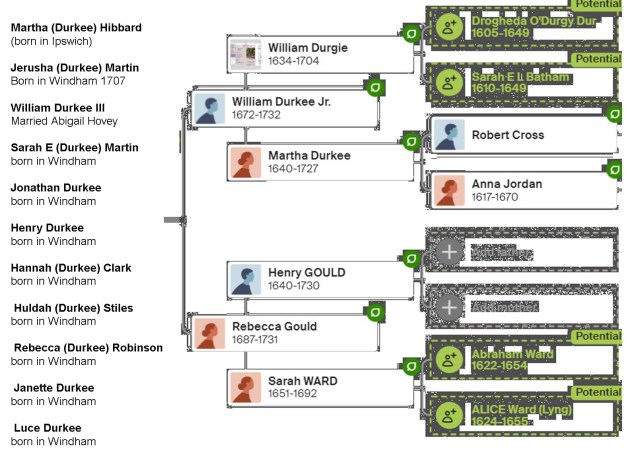
William Durkee (aka Durgee, Dirkey was born March 15, 1634, in County Meath, Ireland. His father, Sir William O’Durgy, was killed on Sep 11, 1649, at the Battle of Drogheda, at the outset of Oliver Cromwell’s conquest of Ireland. The son, William Durkee, was captured on the battlefield by Cornwall’s forces and sold into slavery in Barbados, where he toiled on sugar Plantations. Freed by the proclamation of Charles II when the monarchy was restored, he indentured himself to Thomas Bishop and was taken to the Ipswich settlement, the first documented Irish immigrant to North America.
William Durkee and Martha Cross were servants in the household of Thomas Bishop, who owned a house in which he operated an inn in Ipswich, but also owned land in Chebacco. When Martha became pregnant by William in 1664, they were presented for fornication, and the court ruled that they be punished and be married. They found themselves back in court when Martha’s father refused to comply.
Robert Cross
Robert Cross was the husband of Anna, the daughter of his Ipswich neighbor Stephen Jordan. A grant is shown in the illustration below for Robert Cross, who arrived in Ipswich in 1635 and had built a house on part of his six acres by 1638, granted to him for his service in the Pequot War. He sold to Daniel Ringe Sr. The address today of this lot is approximately #59 Turkey Shore Road. He received another grant in 1644/5 of 20 acres of upland and 10 acres of marsh at Chebacco. In 1654, he purchased of Nicholas Marble, land (80 acres), a farm, a house, and an island, which had originally been granted to John Perkins. He subsequently sold the upland ground at Hog Island and the six acres granted on the south side of the Chebacco River.
Stephen Jordan
Stephen Jordan came on the ship Mary and John in the company of Rev. Thomas Parker from Wiltshire, England, which sailed from Southampton and arrived at Boston on May 24, 1634. His daughter, Jane, married Lieut. John Andrews and another daughter, Hannah, married Robert Cross of Chebacco or Ipswich. In Ipswich, Jordan was a proprietor and sheep herder. He sold his land at Ipswich in 1653 and moved to Newbury, where he died in 1669.
A house lot on the corner of Summer St. and County St. was granted to Humphrey Bradstreet. He sold his house and land “bounded by Andrew Hodges southwest, and Stephen Jordan southeast”, to Deacon Thomas Knowlton, shoemaker, 1646 (Ipswich Deeds 1: 20). This identifies the house lot of Stephen Jordan about halfway down the south side of the lower block of Summer Street.
Stephen Jordan also owned a planting lot on the northeast side of Robert Cross on Turkey Shore, a grant from the Town. The lot came into the possession of Daniel Hovey and Thomas Hovey and was sold to Stephen Boardman. The Stephen Boardman house still stands at the intersection of Turkey Shore and Labor in Vain. Boardman sold to Benjamin Wheeler the land, six and a half acres and buildings, “which I purchased of Thomas Hovey, reserving a way for Samuel Howard to pass to his land,” July 14, 1744 (85: 229).
Anna (aka Hannah) Jordan, the daughter of Stephen Jordan, married Robert Cross on 20 August 1635 in Ipswich. She died on 29 October 1677 in Ipswich.
Henry Gould owned the lot west of the John Gaines House, where the Lace Factory sign is on High Street in Ipswich. There is a record of Henry Gould admitted as a freeman in 1641. He was probably the father of Henri Gould (2) of Ipswich, who was born about 1640 and died in 1730. Henry Gould married Sarah, the daughter of Abraham Ward. He died in 1654, and his widow Alice, at her death less than a year later, committed her stepdaughter Sarah and her estate to the care of John Baker and his wife Elizabeth. The home of John Baker III still stands nearby on East Street.
Sarah Gould, formerly Ward or Warr, was born about 1648 in Ipswich, the daughter of Abraham Ward and his wife Alice. She died in 1692 at about age 44 in Ipswich. Henry Gould II, born in 1688-9, resided in Chebacco Parish of Ipswich and died August 7, 1730.
Abraham Ward (Warr) died in 1654 at about age 34 in Ipswich. Abraham Warr worked as a swine herder. His lot was on Brook Street (now Spring Street).
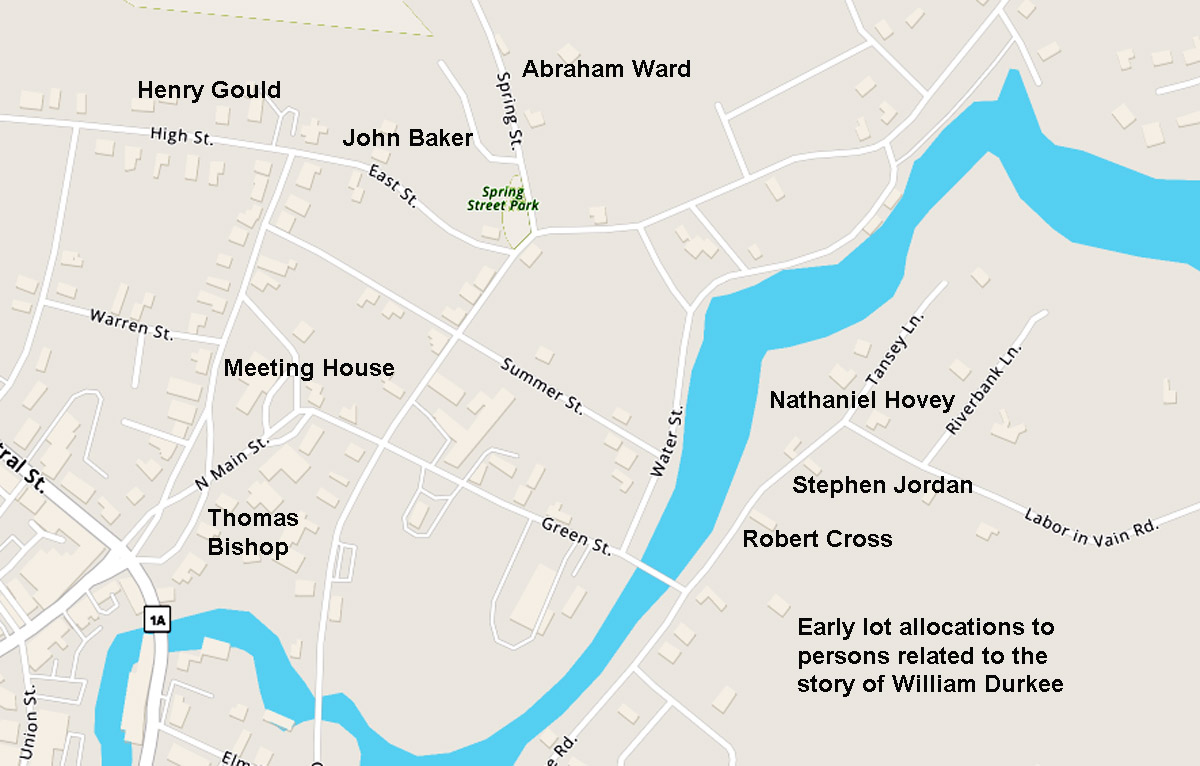
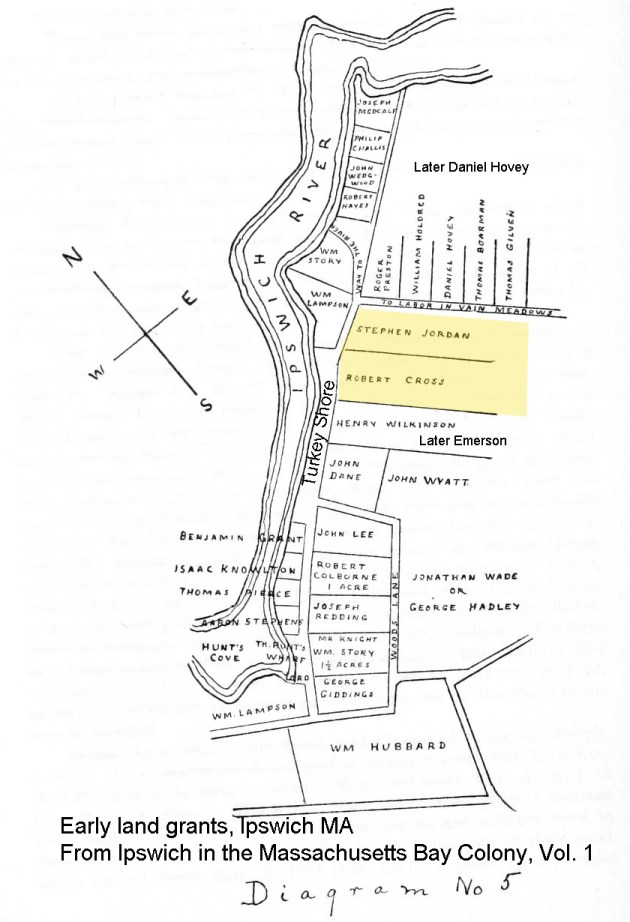
Stephen Jordan and Robert Cross were assigned lots on Turkey Shore, which they soon sold.
The Move to Windham, Connecticut
Between 1711 and 1717, William Durkee’s sons sold their land in Chebacco and Gloucester and moved to Windham (Hampton), Connecticut. The Appaquage Lot” and “land on Little River” were purchased by John Durkee, of Gloucester, in 1715. William Durkee (2 or 3) sold his land in Chebacco in 1713 to John Martin. https://www.salemdeeds.com/salemdeeds/bpimage.aspx?book=00025&page=231.
Capt. William Durkee III’s wife was Abigail Hovey, the daughter of Nathaniel Hovey and his wife Abigail Jennings. There was an old connection between the Hovey, Bidlake (Bidlack), and Durkee families of Ipswich. The early house lots originally assigned to Robert Cross and Stephen Jordan near the intersection of Turkey Shore and Labor in Vain came into the possession of Daniel Hovey. Christopher Bidlake (aka Bidlack) married the widow of Nathaniel Hovey (1) and raised the Hovey children. Several members of the Durkee and Bidlack-Hovey families moved to Windham, beginning in about 1712.
In 1706, a division of four hundred acres to the right, in the northeast part of Windham, CT, was laid out. In January 1709, David Canada, William Shaw, Robert Moulton, and Edward Colburn, all of Salem, MA, purchased one hundred acres of land on both sides of Little River for £23 and began the settlement of a remote section in the northeast section of Windham, which is now included in the township of Hampton in Windham County. The fertile valleys were a favorable site for a settlement, and by land distribution in 1712, the area was opened to purchasers. Twenty-one-year-old Nathaniel Hovey of Ipswich bought land in this vicinity almost immediately and soon settled upon it. Settlers from Ipswich and other towns in Essex County, MA, soon followed.
The early 17th-century settlers in Windham, Connecticut, included Ebenezer Harris and John Fellows from Ipswich. In 1723, a trio of neighbors from Ipswich, Mass., one Grow, one Fuller, and Samuel Kimball settled on three hills in the northern part of Windham. William Bennett and Ebenezer Burnham arrived from Ipswich in the 1730s. Others arrived from Boxford and Andover. A few members of old Windham families joined in the settlement in Hampton, but the greater part of the settlers were newcomers from Massachusetts.
In December 1716, the residents requested “that the northeast part be a parish” (now the town of Hampton). The signatures of Thomas, John, Jeremiah, and William Durkee were on the petition delivered to the General Assembly: “We, inhabitants of the northeast part of Windham, having obtained the consent of said Windham that we should be a society distinct for carrying on the public worship of God, do now pray your Honors to confirm and establish us as a parish.” John and William Durkee were chosen as deacons. The primary inn was kept by Nathaniel Hovey, and the first store is believed to have been kept by Benjamin Bidlack.
The Durkee family thrived in Connecticut. John Durkee, son of William Durkee, was the founder of Norwich’s Sons of Liberty and a famous leader in the Revolutionary War.
Read more at Anna’s Musings and Writings
Sources & references
- Featured image from Amorous Peasants by Albrecht Dürer
- Essex Co., MA court records
- Records and files of the Quarterly Courts of Essex County, Massachusetts
- WikiTree: William Durkee
- Geni.com: William Durkee
- WikiTree: William Durkee
- Waters, Thomas Franklin: Ipswich in the Massachusetts Bay Colony, Vol. 1
- Hammatt, Abraham, Early inhabitants of Ipswich, Mass. 1633-1700
- The Society of Genealogy of Durkee
- Miner Descent: Robert Cross of Chebacco
- Early Settlers of Windham, Connecticut
- Rugh, Dane, “John Durkee: The Story of Norwich’s ‘Bold Bean Hiller’”
- Historic Ipswich: Christopher and Sarah Bidlake
- Whitworth, Kimberly A., “The Exodus From Andover: Migration Case Studies, 1700-1750”
- Lincoln, Allen: History of Windham County, Connecticut, published in 1920
- Bayles, Richard: History of Windham County, published in 1888
- Windham County, Connecticut CT VITAL RECORDS Births, Marriages, Deaths 1692 – 1850
- Butlers and kinsfolk; Butlers of New England and Nova Scotia and related families of other names, including Durkees, descendants of Lieut. William and Sarah (Cross) Butler of Ipswich, Mass. and Eleazer 1st and Lydia (Durkee) Butler of Ashford, Conn.
- Anderson, Robert Charles. “The Great Migration Begins: Immigrants to New England 1620-1633.” Volumes I-III, 3 vols. Boston: New England Historic Genealogical Society, 1995..
- Gould, Benjamin Apthorp, The Family of Zaccheus Gould of Topsfield, published 1895
- Daily Kos: Committing folly before marriage, cranky ancestor edition
- Butler, Elmer Ellsworth, “Butlers and kinsfolk; Butlers of New England and Nova Scotia and related families of other names, including Durkees, descendants of Lieut. William and Sarah (Cross) Butler of Ipswich, Mass., and Eleazer 1st and Lydia (Durkee) Butler of Ashford, Conn., and Yarmouth, N.S.“
Relevant gravestones at the Old North Burying Ground in Ipswich
C-120 Here lies the body of Sarah Cross, dau. to Mr. Thomas and Mrs. Sarah Cross, decd. April 18th, 1736, in the 11th year of her age.
E-100 Here lies the body of Elizabeth Cross, the daughter of Mr. Nathaniel and Mrs. Pheb Cross, who died September 18, 1754, in the 16th year of her age. (F.S.) The child of Mrs. Pheb. Cross.
 Historic Ipswich
[…] Historic Ipswich. The courtship and marriage of William Durkee and Martha Cross. Historic Ipswich on the Massachusetts North Shore (website). The courtship and marriage of William Durkee and Martha Cross – Historic Ipswich […]
William and Martha are among by grandparents with multiple greats before the grand. Information that my aunt had come across was that William was fined each week for not attending church services and that his employer paid the fine
I am a direct descendant and have found evidence of his being Irish Catholic (what’s wrong with being either?). There are additional court cases concerning this and how he was able to marry Hannah, despite being catholic in a Puritan settlement, and they are available through that same courthouse. I don’t know why any of that wasn’t included in this article. There are period sources for him, for a time, in both Ireland and in MA. What I can’t find is much from Barbados or any familial survivors in Ireleand.
Please provide your sources so I can add the information
[…] on the sugar plantations in Barbados,” (see full story). He got himself caught up in a nasty court case involving his future wife, Martha Cross. Surely, the stories of these notorious ancestors were passed down to George Martin? Probably […]
[…] The courtship and marriage of William Durkee and Martha Cross – Historic Ipswich […]
Do you have any period sources for him being Irish Catholic? This trivia bit appears in on-line family trees all the time, but I have never found any documentation from the period saying that he was, and the only citation these trees use is each other. In fact, being allowed to marry Martha Cross in 1664 Massachusetts would indicate that he was *not* Catholic.
The trees claiming that he was Irish and that he was Catholic all trace back to each other, never citing what they’re basing either of those things on. I’ve yet to find anything in Ipswich records supporting either assertion, or the idea that him being Irish Catholic is why he didn’t own land.
The best I can tell, the idea of him being Irish Catholic doesn’t appear until the turn of the 20th Century, during the great boom of “vanity genealogies,” which tended to make the ancestors of the people paying for the genealogies seem a lot more dramatic/notable/exotic than they were. It doesn’t seem to exist in any discussion prior to that — unless you’ve found something definitive from his actual time period, in which case, please share!
Hi there,
Direct descendant of William Durkee and genealogy enthusiast here. I can answer this for you: there are no period sources (as far as I have been able to find) that definitively establish William Durkee as a Catholic. The assumption that he was a Catholic comes from the fact that 1. he was probably from Ireland and 2. he was supposedly fined for not attending the Puritan church, the fine being paid by his master Thomas Bishop, and then “sentenced to receive 25 lashes or pay a fine of five pounds for running away” with Bishop paying once again. However, I’ve looked through the indexes of the Essex County Quarterly Court records in the entries for both William Durkee and Thomas Bishop, and I cannot find a record of Thomas Bishop paying any fines for William Durkee for not attending church.
The source of this claim is one Joseph E. Durkee who was living in Anaheim, California around the turn of the 20th century when the vanity genealogy book “Butlers & Kinsfolk” (subtitle: Butlers of New England and Nova Scotia and related families of other names, including Durkees, descendants of Lieut. William and Sarah (Cross) Butler of Ipswich, Mass., and of Eleazer 1st and Lydia (Durkee) Butler of Ashford, Conn. and Yarmouth, N. S.) by Elmer Ellsworth Butler was written. The book itself was published in 1944 but the title page says “compiled by Elmer Ellsworth Butler Brown University, 1903” so I am assuming that was when the research was originally conducted.
Supposedly “there is a ship’s log in possession of Durkees in Vermont that does confirm William Durgey shipping out from Meath Ireland” (the source for this claim is one Brian Everitt Gamble, Ancestry.com username begamble2010), but the main evidence of William Durkee’s Irish origins seems to be the assumption that he was Irish because he arrived in Massachusetts via Barbados as an indentured servant, which lines up with the timelines of Cromwell’s transportation of the Irish to the Caribbean. According to this same Brian Gamble “there is a record of William’s purchase of 1/4 acre of land from the town of Ipswich in 1693” and “according to the Ipswich, Mass Town Clerk William Durkee Sr had a seat appointed on one of the short seats in the meeting house in 1700,” which would further imply that he was not known in the colony as a “Papist,” and also that the claim that he could not own land is incorrect. I would need to independently verify the existence of these records, though.
There is a Society of Genealogy of Durkee that may or may not still be operating (it’s a shoe-string operation of a few Durkee family members), and there was a book published in 2009 by Bernice B. Gunderson of said Society that may have more records and information than I have been able to find, but for the most part any claims about William Durkee’s origins prior to his arrival in Massachusetts comes from the single source of Joseph E. Durkee quoted in that Butlers & Kinsfolk book. Interestingly, the book does not mention this “Sir William O’Durgy” (sometimes spelled Sir William O’Durge) character supposed to be William Durkee’s father at all. As far as I can tell, unless Bernice B. Gunderson has found Irish records indicating otherwise, he is an invention out of whole cloth by Ancestry.com and similar family tree building site users. You will occasionally see the claim that William Durkee was the “son of a knight” (that would be Sir William O’Durgy/Durge) and that he was taught to read and write, however in the Essex county court records there is a note that William Durkee signed a petition dated 24 Nov 1668 with his mark (https://salem.lib.virginia.edu/Essex/vol4/images/essex077.html) which implies he may not have actually been able to write.
Basically there is a lot of noise out there on the Internet based on apocrypha about William Durkee from that Butlers & Kinsfolk book. I would take anything you don’t have a primary record for with a grain of salt. You could try reaching out to the Society of Genealogy of Durkee to check if they have sources for a particular claim (but it seems Bernice B. Gunderson died earlier this year, and she seemed to be the only one actually researching and looking at records, so I wouldn’t count on getting a response even). You could also try to get a copy of the 2009 book through an inter-library loan or drop $185 for the book on Amazon.
Thanks so much for posting all this information! William Durkee and Martha Cross are my 8th great-grandparents!
The infamous couple is also my 8th great-grandparents on my father’s side. My mother is 1/4 Irish from Counties Sligo and Mayo, so it was interesting to find this County Meath line on my dad’s side. Now I have three tartans to wear.
[…] The Courtship and Marriage of William Durkee and Martha Cross by Gordon Harris on Historic Ipswich […]
Spelling of names was certainly flexible at that time!