

Signatures have been verified for the following resolution, which will appear as an article on the May 2026 Annual Town Meeting warrant:
CITIZEN PETITION FOR 2026 IPSWICH ANNUAL TOWN MEETING
Requested by: Gordon Harris, Ipswich Town Historian
To see if the Town will adopt the following resolution, viz:
RESOLUTION EXPRESSING THE SENSE OF THE TOWN OF IPSWICH, MASSACHUSETTS, REGARDING THE CONDUCT OF THE PRESIDENT OF THE UNITED STATES, AND CALLING UPON CONGRESS TO EXERCISE ITS CONSTITUTIONAL OVERSIGHT AUTHORITY
WHEREAS, the Town of Ipswich is known as the “Birthplace of American Independence,” and that the principles articulated by the Rev. John Wise of Ipswich in 1700 — that “the end of all good government is to cultivate the good of every man in all his rights, life, liberty, and estate without injury or abuse done to any,”— informed the authors of the Declaration of Independence;
WHEREAS, in the judgment of this assembled Town Meeting, the sitting President of the United States has shown disdain for the Constitution’s guarantees of freedom of speech, press, peaceful assembly, and birthright citizenship by depriving persons of life, property, and liberty without due process of law;
WHEREAS, this Town Meeting further finds that the President of the United States has failed to take care that the laws be faithfully executed, including (a) not adhering to the separation of powers as embodied in the Constitution, (b) directing military actions that are in apparent violation of the War Powers Act and the rule of law, (c) accepting gifts in violation of the Emoluments Clauses of the United States Constitution, and (d) violating the Posse Comitatus Act through the use of the military against the civilian population;
WHEREAS, in the words of the 1774 Ipswich Convention to Consider the Late Acts of Parliament, “We hold our liberties too dear to be sported with, and are therefore most seriously determined to defend them;” now, therefore, be it
RESOLVED:
That this duly assembled Town Meeting, as the legislative body of the Town of Ipswich, Massachusetts, respectfully calls upon the Congress of the United States to fully exercise its constitutional duty of oversight and authority, including, but not limited to, the power to impeach and remove the sitting President of the United States.
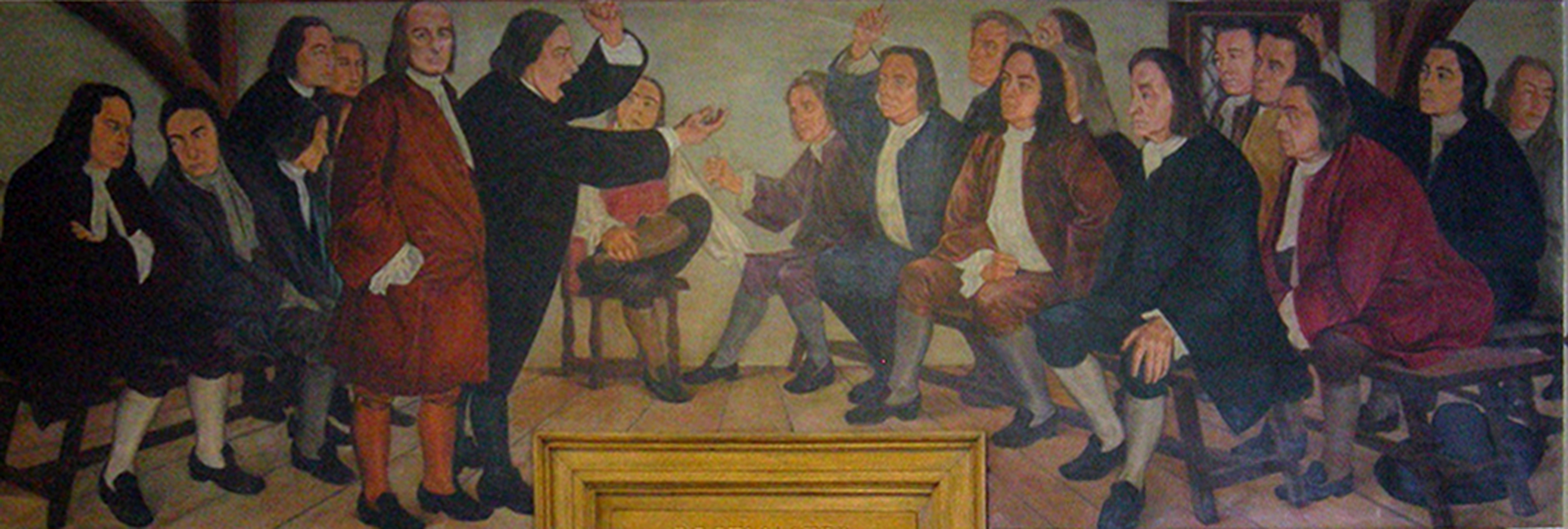
History of Resolutions by Ipswich Town Meetings
In John Adams’ 1765 treatise in opposition to the Stamp Act, he referred to the “Principle of the Ipswich Instructions, vizt. that the first Settlers of America, were driven by Oppression from the Realm, and so dismembered from the Dominions, till at last they offered to make a Contract with the Nation, or the Crown, and to become subject to the Crown upon certain Conditions, which Contract, Subordination and Conditions were wrought into their Charters, which give them a Right to tax themselves.” Because of the Town’s 1687 resistance to taxation without representation, Ipswich is known as the “Birthplace of American Independence.”
In the decade leading up to the Revolutionary War, Ipswich Town Meeting unanimously passed numerous resolutions. On August 11, 1768, Ipswich town meeting went on record, “supporting the Resolves of the Late House of Representatives against rescinding the Circular Letter.”
On Feb. 21, 1770, Ipswich Town Meeting resolved “To prevent the use of that Pernicious Weed Commonly Called Tea, and not to purchase any goods of those who continue to import and refuse to come into the salutatory agreement of the Merchants and others who are Worthily Preferring the good of their country to their Private Interests.”
At a Town meeting on Dec. 28, 1772, Ipswich Town Meeting adopted an elaborate series of resolutions:
- Establishment of a Committee to correspond with the Committees of other towns.
- Asserting the right of the Colonists to enjoy and dispose of their property in common with all other British subjects.
- Condemning the unwarranted assumption of power by Parliament to raise revenue contrary to the minds of the aggrieved and injured people,
- Condemning the neglect of their petitions for redress.
On Sept. 6, 1774, after the colony’s Charter rights were abrogated by the Intolerable Acts, sixty-seven delegates representing every Essex County town arrived in Ipswich for a two-day convention “to consider and determine on such measures as the late acts of Parliament, and our other grievances render necessary and expedient.“
On August 18, 1808, the inhabitants of the town of Ipswich “legally assembled in Town Meeting” petitioned President Thomas Jefferson that “the laws of the United States, laying an embargo on all ships and vessels in the country, had operated in a very grievous manner on all classes of our citizens”, and requested that “the people of this once prosperous country be relieved from their present embarrassed and distressed condition.” On Sep. 2nd, Jefferson sent a reply, and on Nov. 7th, 1808, a majority at Town Meeting voted that the President’s answer was “not satisfactory.”
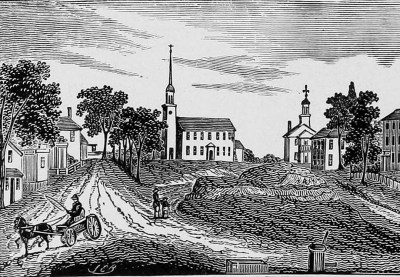 Ipswich Town Meeting - Town meeting has been a cardinal element of local government in New England for about four hundred years. In Massachusetts, they started in the early 1600s and were formally recognized until 1641. No doubt meetings were pretty rocky during the Puritan era. Things got so raucous that the Legislature finally had to impose rules governing all town meetings, some of which, with slight modifications, are still on the books.… Continue reading Ipswich Town Meeting
  Historic Ipswich
Well written and thought out… Other cities and town should follow suit.
I’m a direct descendant of John Wise. My name is Corie Wise. Thank you for recognizing the good he had done. Corie Wise Sent from my iPhone
I wish I lived in Ipswich, so I could vote in favor of this!
>