
What Should You Do With Your Old Home? by Tamsin Venn, North Shore Magazine, February/March, 1989
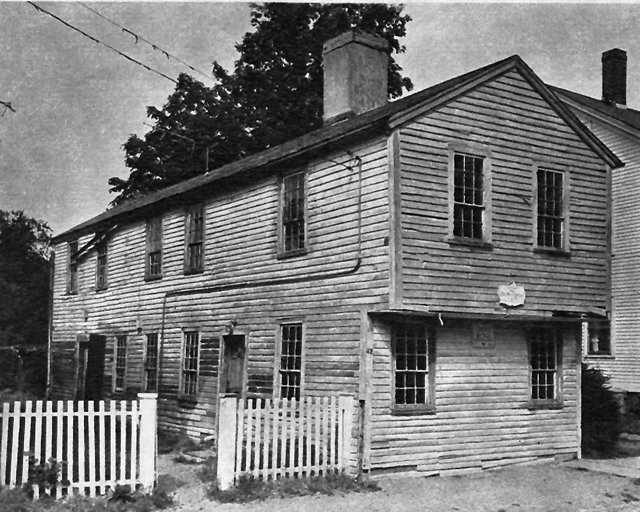
Elliott Krause spent two years restoring what may be the oldest standing building ever used as a post office in the United States. The crumbling structure, built in the 1720s, stood next to the Federal-period home he and his wife, Theodora, bought on North Main Street in Ipswich six years ago in 1983. Krause battled rotting wood, disintegrating walls, a damaged roof, mounting costs, a grumbling Massachusetts Historic Commission, and the federal government. “My carpenter, Bill Barton, was leaning his hand on the wall one day, and the wall started swaying. We thought, ‘Oh no, what have we gotten ourselves into?'” Krause says. But like most Colonial-era homes on the North Shore, the beams and framework were solid, and the chimney and fireplace worked. “OK, it will cost a fortune,” Krause, a sociology professor at Northeastern University, told himself, “We can get new windows and rebuild the walls, put on a new roof, and restore it as it is.”
Krause faced two years of headache frustration, anxiety, and expense. He took “before” photos and a piece of rotten wood to Washington to plead his case for a tax credit under the historical preservation program of the National Park Service. The 25% he received barely offset expenses. Would he do it again? “Of course,” Krause says. “1 couldn’t have lived with seeing that place fall down right next to me. It was a challenge, but it just had to be done.”

Krause is the exception. Most homeowners would rather renovate their old homes than restore them to their original condition. Restoration is time-consuming, expensive, and fraught with contractor misunderstandings. Rewards, other than aesthetic ones, are few. Unless one lives in a historic district, there are practically no restrictions on what owners of historically significant homes can do with their property. Local historic commissions tend more toward education rather than enforcement of preservation. Impetus for restoration comes from the homeowners themselves, and purists such as the Krauses are rare.

“Thorough purists’ restorations are few and far between,” says William G. Barton, a licensed contractor who specializes in restoring old homes and who worked with Krause on the old post office. Architects, contractors, and historical preservation consultants on the North Shore all agree that the trend in home alterations has been toward renovation rather than restoration. They add, however, that with increasing public awareness and education, refurbishing an old home usually falls somewhere between complete renewal and slavish copy.
The temperature is 45 degrees, and the wind is stiff. It’s hard to hold a hammer. Carpenter Bill Barton and his partner have shored up the second-floor deck of a three-family home on Proctor Street in Salem, just around the corner from the Federal manors on Essex Street. New white Greek columns lie strewn about the sidewalk, conjuring up images of the last days of Pompeii. Others frame the double doorway, accenting the new white balustrade. Barton is removing a damaged roof and collapsed deck of this post-Victorian, which was probably built between 1905 and 1910. He remade the pedestal tops and bases, reglued the columns in his Ipswich shop, made the ballasts on the front stair rail, took the staves apart on the porch rail, then reset them for strength with screws, and redid the lattice panels below the front stairs.
An 18-year veteran of restoration projects, Barton says, “We could just tear it down and put up a pressure-treated deck, but I know the difference in quality. The average person is not aware of what is involved unless he has picked up the tools and done it.” Although Barton is an old-house specialist, he is realistic about the concerns of today’s homeowner. “I encourage restoration, but I keep my client’s budget in mind. You’ve got to weigh the cost-effectiveness. If the material is salvageable, I encourage restoration to help meet their budget, but, on the other hand, why fix up something old when you can put a new sash in for them just as easily? More people are looking for the happy medium, rather than trying to be purists. It’s a question of money and time.” For his own home in Ipswich, built in 1710, Barton admits he spent more on the fluids in which to dip the red cedar for the roof than it would have cost to do the entire job in asphalt. “My wife was ready to kill me, but I had to do it. I felt that’s what belonged there,” he says.
When working for clients, Barton abides by certain purist standards. He works on a cost basis, plus materials, rather than bidding on a project. “It’s a scary way of doing things, but I couldn’t do a job on bid. I become my own worst critic. Cost effectiveness is important, but I like a level of completion, too,” he says. Part of those standards comes from respect for the craftsmen of an earlier time. “Two hundred years ago, the old buildings had a lot more quality; the lines were more soothing. I have seen some amazing woodworking in old New England homes, and they had less machinery, yet the quality was still there. Now we have machinery available, and we should be doing a better job of it. I’ve learned a lot from opening things up. When I get into a house built in the 1700s or 1800s, 1 love to get into the mind of the man who built it and learn about the structure! I learn something new every day.”
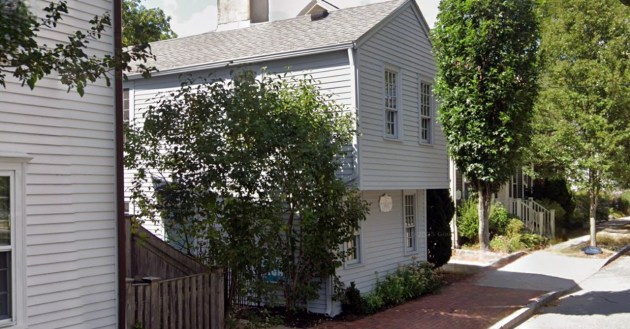
In addition to working with Elliott Krause on the 18th-century post office in Ipswich, Barton headed up the restoration at the old Mt. Kineo resort on Moosehead Lake in Maine, and is converting a barn into a dwelling in Northern Vermont. Barton says restoration and renovation are coming together. “People are looking to get the most for their money while being as authentic as possible. “Besides, the purist’s approach is not always the best. Colonial builders put houses right on the ground, on sills without foundations. When we renovated the post office, we had to shovel sills away, because they were so rotted with water and damage, and lift the sills off the ground,” Barton explains. “In the end, there’s a lot of personal happiness in this kind of work, more than anything else!’ Barton says as he walks across the street to help his partner raise a freshly painted Greek column.
Tamsin Venn is a freelance writer living in Ipswich, and is the publisher of Atlantic Coastal Kayaker. Her updated edition of the Appalachian Mountain Club (AMC) guide, Sea Kayaking Along the New England Coast details 47 trips along the New England coastline.
 Historic Ipswich