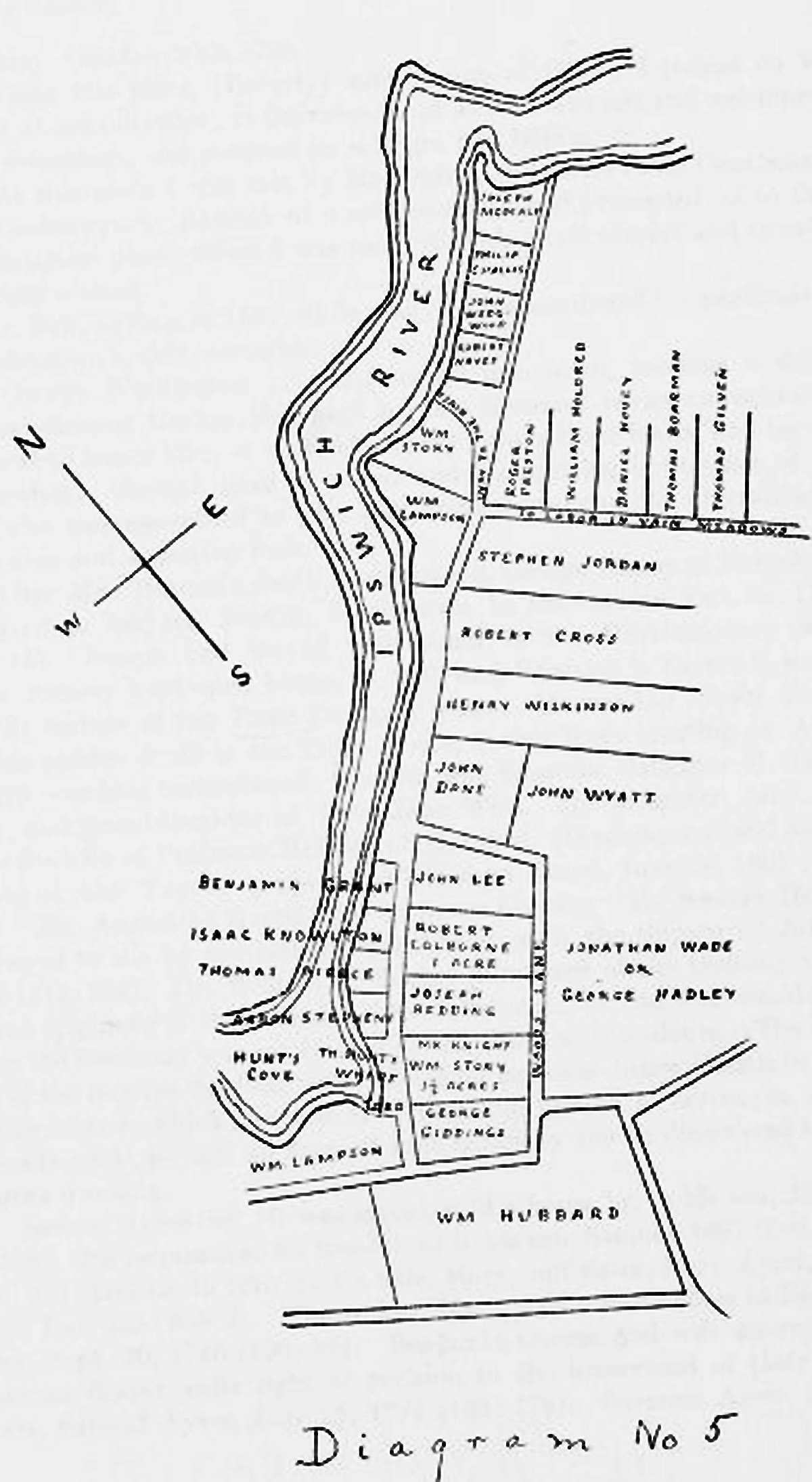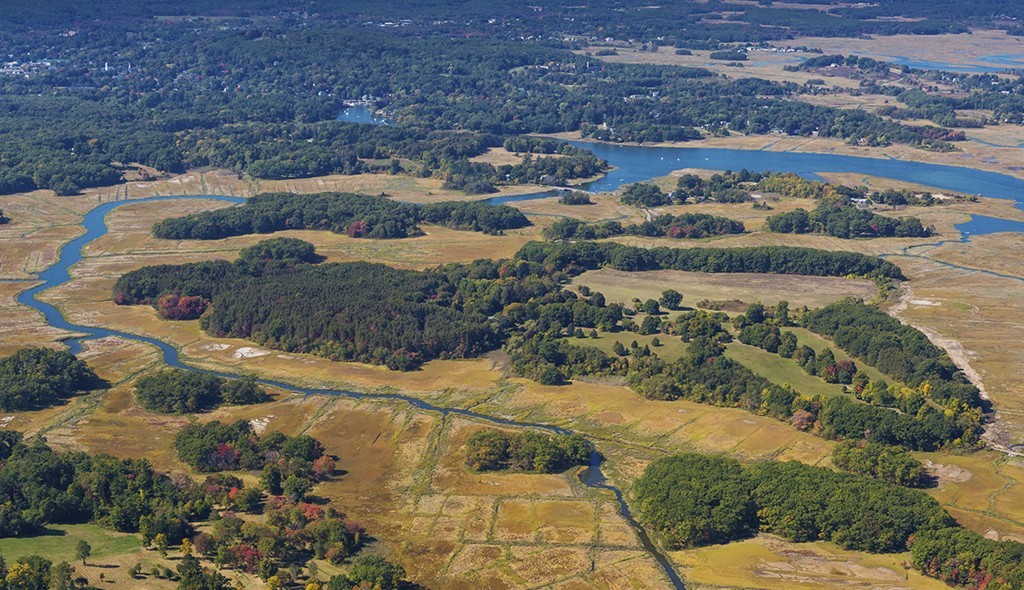
During the first two centuries of the Ipswich settlement, the tidal stream known as Gould’s Creek was known as “Labor-in-Vain Crick.” Having rowed against the incoming and outgoing tides passing under Gould’s Bridge, it’s quite obvious how the creek got its name. For about a mile flowing inward, it saturates the salt marsh between Labor in Vain and Argilla Road. In the first decades of the settlement, salt marsh hay was gathered here. The land between the Labor in Vain Creek and Turkey Shore Road came to be known as the Labor in Vain Fields.
Thomas Emerson
Thomas Emerson was the son of Robert Emerson 3 and was baptized at Bishop’s Stortford parish in Hertfordshire, England, on July 26, 1584. He was familiar with early Ipswich leaders Major General Daniel Denison, who also came from Bishop’s Stortford, and Deputy Governor Symonds, who arrived from nearby Great Yeldham, Essex.
In July 1611, at the age of 27, Thomas Emerson, a baker by trade, married Elizabeth Brewster at Bishop’s Stortford, and their children were all baptized in St. Michael’s, the parish church. According to family tradition, they came to America on the ship Elizabeth and Ann in 1635, but the name Emerson is not listed among the passengers. Another source lists the ship Abigail. Among its passengers were Joseph Emerson and John Fuller.
In America, Thomas Emerson was generally called a yeoman (farmer). He was a commoner in 1641 and a selectman in 1646. Emerson wrote his will in 1658 and was survived by his wife Elizabeth, his sons Joseph, John, James, and Nathaniel, and a daughter, Elisabeth, who married John Fuller in Ipswich in 1644.
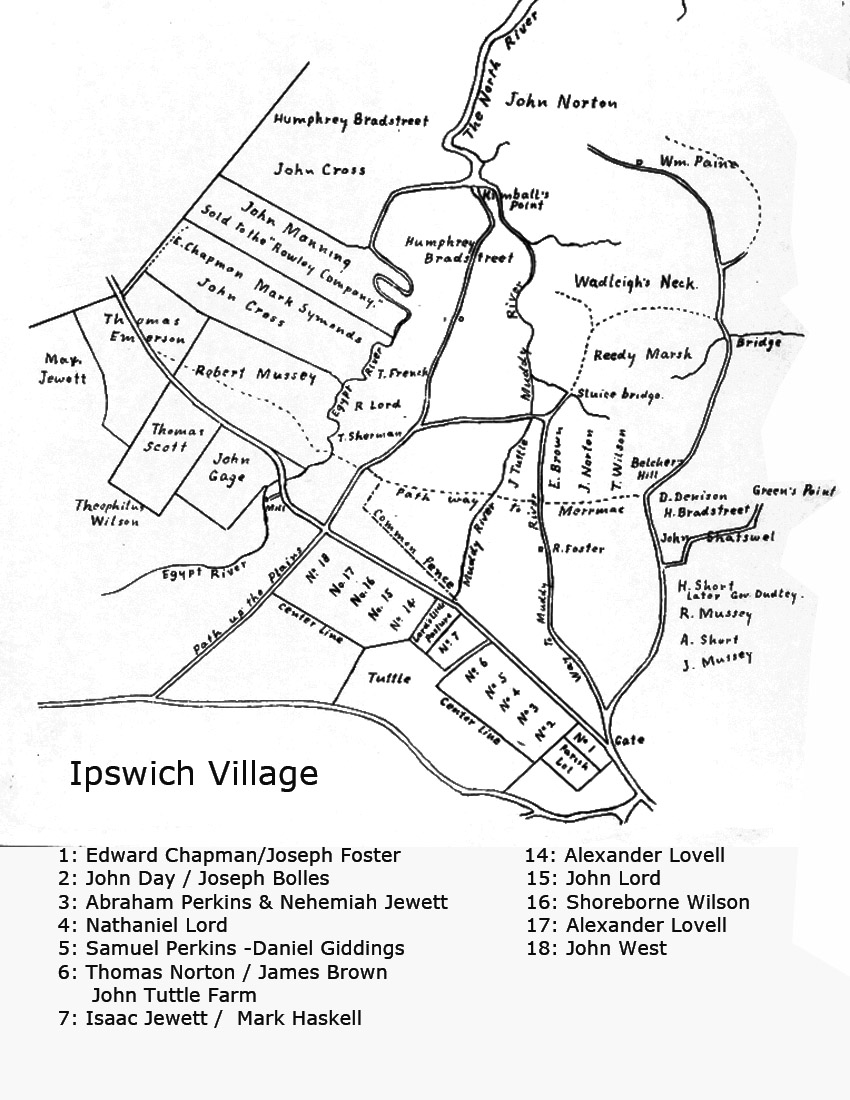
The Ipswich Village Farm (1638-1648)
When Emerson arrived in Ipswich about 1638, he had eighty acres granted to him adjoining the land of Goodman Muzzey, near today’s Ipswich-Rowley town line. This neighborhood came to be called Ipswich Village. On June 13, 1650, Thomas Emerson sold to Joseph Jewett, a farm granted to him by the town of Ipswich, containing four score acres, “situated beyond the north river on the south side of Prospect Hill, having the land of Richard Kimball and John Pickard towards the south east and the land of John Cross towards the north east, a highway of two rods broad lying between the land of Rowley and said farm.” View the deed. Thomas Emerson and his wife never lived on this farm.
Turkey Shore and Labor in Vain
In 1638, the year that Thomas Emerson arrived, Samuel Greenfield sold him a farm of one hundred and twenty acres previously owned by Humphrey Wise. This property extended from Turkey Shore to Labor in Vain Creek, now also called Gould’s Creek. In 1648, he conveyed to his son John a farm of 120 acres that he had obtained from the estate of Humfry Wise, deceased. In the deed, the name was spelled Emberson. On October 6, 1652, Joseph Emerson and Elisabeth, his wife, sold to his father, Thomas Emerson, meadow and upland at Labor-in-Vain. Emerson’s descendants would continue to own lots in the Labor in Vain fields for several generations.
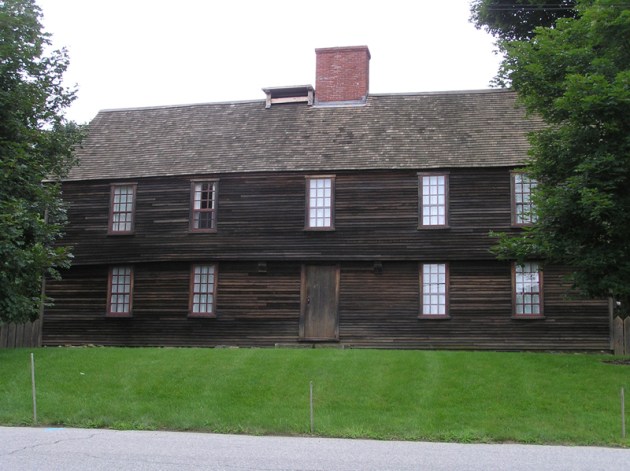
The William Howard House
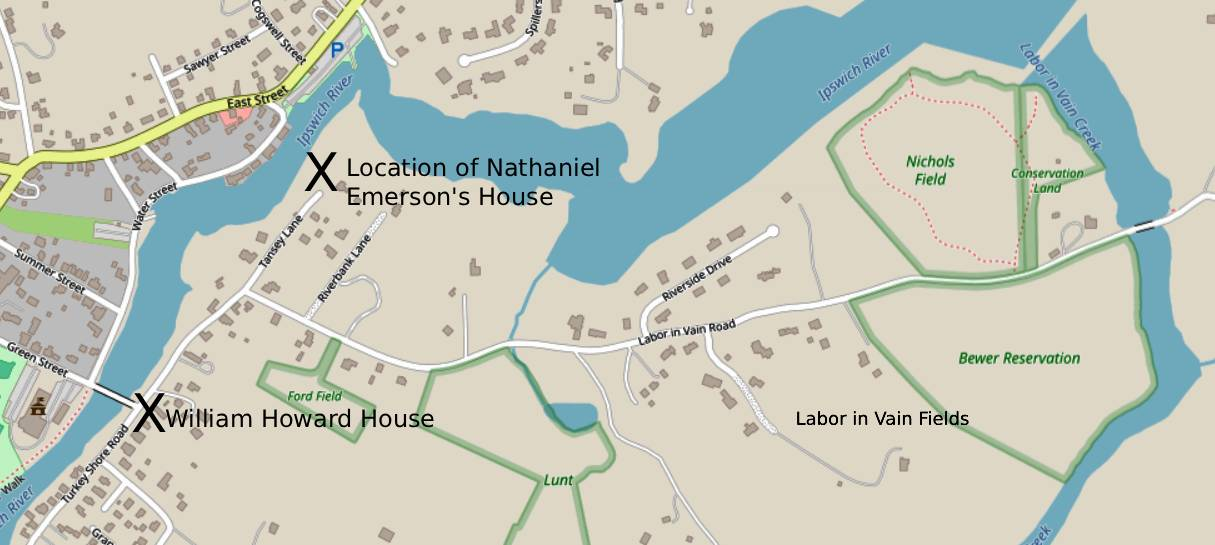
Henry Wilkinson conveyed six acres to Thomas Emerson in 1638, the Town River (Ipswich River) on the north, at the intersection of today’s Turkey Shore Rd. and Green Street. He and Elisabeth lived in the house he built there for ten years, but in 1648, he sold the house with six acres of land to Daniel Ringe. (Ips. Deeds 1: 169): “Be it known unto all men by these presents that I Thomas Emerson of Ipswich for good &valuable consideration & price to me in hand paid have granted, bargained and sold ..unto Daniell Rindge all y’ my dwelling house together with the lott of ground my said house standeth upon, containing by estimation six acres.”
Uzall Wardell, whose son had married Susanna Ringe, acquired the Ringe homestead and sold it to William Howard on April 7, 1679 (Ips. Deeds 4: 289). The house William Howard built at that location still stands today. Architectural evidence indicates that the left side of the William Howard house was built about 1680. The right side was added in 1709.
The Will of Thomas Emerson
Thomas Emerson’s will is dated May 31, 1658. He died in 1666, and the inventory of his estate is recorded Nov. 3, in which he is styled ‘Goodman Emerson, sen’r.” He left a wife, Elisabeth, sons Joseph, John, James, Nathaniel, and a daughter, Elisabeth, wife of John Fuller. James was living in England.
- He bequeathed to his wife, ‘‘the yearly rent of the farm with the six head of cattle, also the house, &c. during the time that she doth continue my widow.”
- To his son Joseph, “the sum of eighty pounds of current pay of New England.”
- To his son James, “the sum of forty pounds to be paid unto him if he shall come over into this country, or send by a certain certificate of his being living within two years after the decease of me & my wife. In case my son die before then, my will is that my son Joseph (and) his son Joseph shall have ten pounds, and my daughter Fuller, (and) her four sons twenty pounds, and my son Nathaniel ten pounds.”
- To Nathaniel, ‘‘my house wherein I now dwell, with all my upland and meadow, and the marsh bought of my son Joseph which was sometime Mr. Woodmans’.”
- To his daughter, Elisabeth Fuller, ‘the best feather bed and bolster with a pair of blankets and the best coverlet and the bedstead, to enjoy for her use until her daughter Susana attains the age of twenty years or the day of her marriage; if it should happen sooner, then she to enjoy them also.” He also gave her “the great carved chest and the carved box with a little trunk with all that’s in it, and a small carved chest with what is in it.”
In a codicil dated Jan. 4, 1660, Thomas Emerson mentions having given unto his son John, ‘‘his portion full in ye consideration of ye agreement between us about my farm. He bequeathed legacies to his daughter Fuller’s two daughters, Susanna and Elisabeth, to be paid to them at ye age of twenty years or at ye day of marriage.” Also that it was to be “understood that my son Nathaniel should pay that forty pounds to my son Joseph the same of ten pounds a year til it be fully discharged, unless said Nathaniel shall sell my house & land I now dwell in, and that it is to be payd to my son Joseph presently.”
Emerson appointed “my loving wife” Elisabeth Emerson as sole executrix, and “do desire my much honored and faithful friends, Mr. Samuel Symonds and Major Gen. Daniel Denison, to be overseers to see this my will be fulfilled.”
Second Generation
John Emerson
John, son of Thomas, graduated from Harvard College in 1656. He was a subscriber to Major Denison’s compensation in 1648 and received a deed for the north Ipswich farm of his father the same year. He married in 1662 Ruth, daughter of Hon. Samuel Symonds, and settled as minister at Gloucester on October 6, 1663, where he continued until his decease. Besides large possessions in Gloucester, he had in Ipswich a farm ‘‘lying by the farm of Mr. Denison on the southeast, having Mr. Emerson, tenant.” Another farm “having the Town river lying upon the northwest of the farm, having 20 acres of meadow land lying by the creek called the Labour-in-Vain crick,” having Capt. Ringe and Mr. Howard tenants.” And another farm “in Argilla in Ipswich, John Ross and James Burly being tenants.” He had inherited the Argilla farm from Samuel Symonds.
Joseph Emerson
Joseph was the oldest son of Thomas and was a subscriber to Major Denison’s compensation in 1648. On October 6, 1652, he, with his wife, sold to his father Thomas, meadow and upland at Labor in Vain. They had children, Mary and James. Joseph married second, Elisabeth Bulkey, and had Peter, Ebenezer, Jane, and Edward, who is an ancestor of Ralph Waldo Emerson.
Joseph Emerson was born in England about 1620. In 1646, he married Elizabeth Woodmansey, daughter of Robert and Margaret Woodsmansey of Boston. They resided at Ipswich, after which he became a pastor in York, Maine. In 1652, he deeded to his father, for sixteen pounds, his meadow and upland at Labor in Vain, which he had received from his wife’s father, Robert Woodsmasey. View the deed. About 1664, he left Wells and became the first minister of Milton. After asking for an increase in salary because of his approaching marriage, he was dismissed.
Joseph Emerson married 2nd, on 7 December, 1665, Elizabeth Bulkeley, daughter of Rev. Edward Bulkeley, of Concord, Mass. They resided in Milton and Mendon, MA. He died in Concord, in the Massachusetts Bay Colony, in January 1680. One of his son Edward’s descendants was Ralph Waldo Emerson.
Nathaniel Emerson
When Thomas Emerson and his wife Elisabeth sold their dwelling house and six acres to Daniel Rindge in 1648, he was now 64 years old. View the deed. He no longer owned the farm near Rowley, which he sold in 1650. But in Emerson’s 1658 will, he granted to his youngest son Nathaniel, ‘‘my house wherein I now dwell.” Elisabeth was to have the house “during the time that she doth continue my widow.”
Nathaniel Emerson was born in 1629 in England and was baptized July 8, 1630. By the time his father has sold the house on Turkey Shore, Nathaniel Emerson’ home was on a lot that had been granted to Ipswich settler Joseph Metcalf (1598-1665), “surrounded by the River on three sides” at the end of today’s Tansey Lane. Thomas Franklin Waters stated that Nathaniel owned it, but the deed is not available. The will indicates that the house was at least partially owned by his father. (See Map 5). Passing down the family homestead to the last-born, known as “Ultimogeniture,” was common in agricultural areas of early 17th-century England. It then became the responsibility of the youngest son to provide for his parents in their old age.
Nathaniel Emerson conveyed to his brother. Rev. John Emerson of Gloucester, twenty acres with his house on Jan. 4, 1677 (Ips. Deeds 4: 488). Nathaniel and his brother John Emerson deeded marshland and this lot, including a house, “adjoining to land of Daniel Hovey late deceased of Ipswich,” to Nathaniel’s son Thomas Emerson in July 1717. (Ips. Deeds 33:129).
In a deed dated Nov. 2, 1694, John Emerson, senior of Gloucester, deeded to his son, John Emerson, of Salem, “all that farm of about 100 acres in Ipswich, bounded by my brother Nathaniel, it being formerly the land of our father, Thomas Emerson.”
During the Salem witch trials of 1692-3, on the ‘Jury for Tryalls’ were Ensign Thomas Jacob, Sargent Nathaniel Emerson, Sen., Mr. Jacob Perkins, Jr., Mr. Matthew Whipple Sen., John Pengery, Seth Story, Thomas Edwards, and John Lamson. The Grand Jury, of which Mr. Paine was foreman, found nothing against thirty who were indicted, and true bills against twenty-six. Of those on trial, three were found guilty and sentenced to death.
The 13th President of the United States, Millard Fillmore, was a descendant of Nathaniel and Sarah Emerson.
Elisabeth Emerson Fuller
Elizabeth Emerson was born in England. She married John Fuller, who died in Ipswich, une 1666. Their home was on Rocky Hill in Ipswich, a short distance from her parents.
William Fuller was one of the subscribers to the fund for Major Denison in 1648, was road surveyor in 1663, and was admitted a commoner of Ipswich in 1664. His will was probated 25 September, 1666. His wife survived him. Elizabeth and John were probably married in England before their emigration. Their daughter Sarah married Christopher Bidlake and were the common ancestors of the Bidlack family of Windham County, Connecticut.
Emerson Gravestones at the Old North Burying Ground
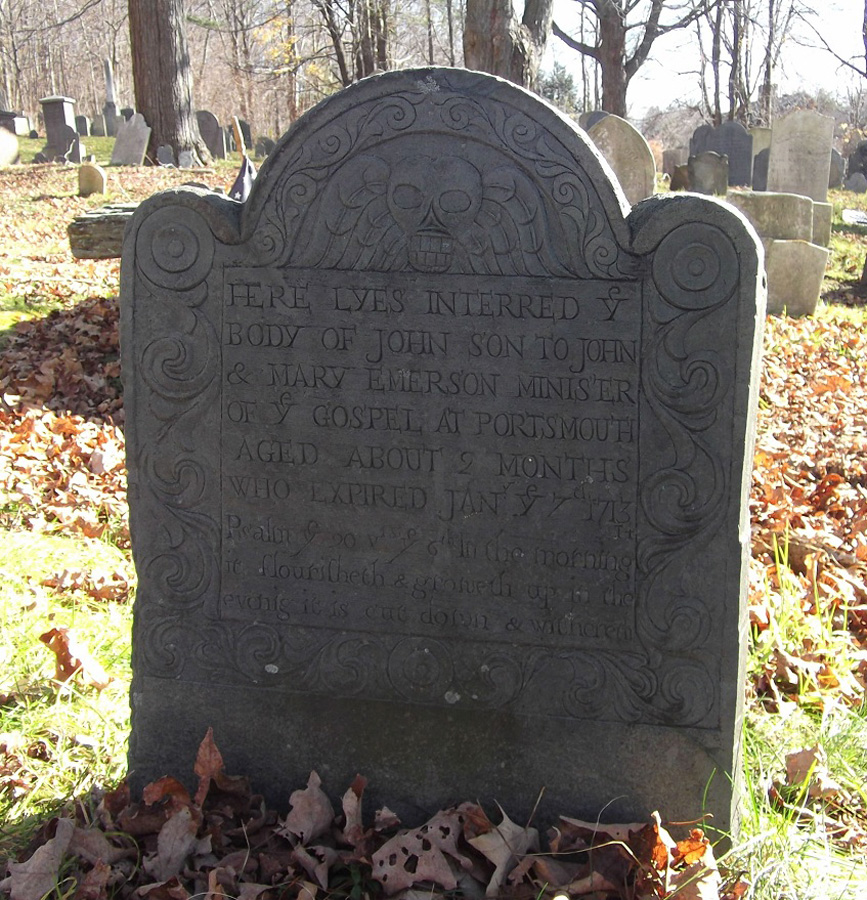
There are three early 18th-century Emerson gravestones at the Ipswich Old Burying Ground: John, Nathaniel, and his wife Mary.


Sources:
- Hammatt Papers: Thomas Emerson
- The Ipswich Emersons 1636-1900 by Benjamin Kendall Emerson (1924)
- The Will of Thomas Emerson
- Family Search
- Wikitree
- Findagrave (Lucy Emerson)
- Ipswich in the Massachusetts Bay Colony by Thomas Franklin Waters
- Ipswich Village and the Old Rowley Road by Thomas Franklin Waters
- https://historicipswich.net/wp-content/uploads/2021/10/ipswich-village-map.jpg
- Nutfield Genealogy: Thomas Emerson
- Ipswich Village and the Old Rowley Road. by Thomas Franklin Waters, 1915
- Genealogy Online: Thomas Emerson
Discover more from Historic Ipswich
Subscribe to get the latest posts sent to your email.