

A Brief History of Native Americans in Ipswich Before English Colonization
Native Americans began moving into New England after the retreat of the Laurentide ice sheet. In the early 1950s, a group of young amateur archaeologists, men now known as the “Bull Brook Boys,” discovered one of the largest Paleo-Indian sites in North America along the banks of the Egypt River in an area being cleared for a sand and gravel operation at the end of Paradise Road. Over 6,000 artifacts were uncovered in a large circle about the size of four football fields and are curated by the Ipswich Museum and the Peabody Essex Museum. The excavated site is now a gravel pit.
Radiocarbon dating at Bull Brook places the encampment at around 11,000 years ago. Sea level was still low enough that the Bull Brook site would have been about ten miles from the coast. Calcified remains of caribou and the constricted valley of the Eagle River suggest that the location may have been ideal for drive-hunting. The Bull Brook site provides some of the oldest physical evidence for large-scale Paleo-Indian gatherings in North America.
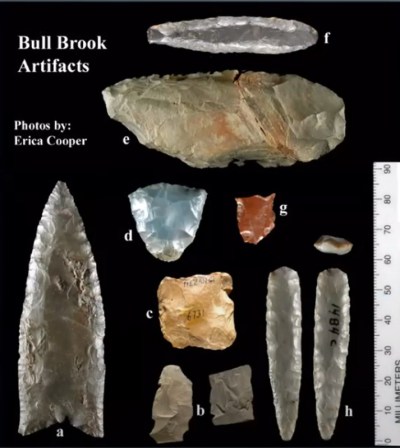
Artifacts discovered at Great Neck and along the riverbanks have been identified as belonging to the later Archaic period, about 8000-5000 years ago. During the Early Woodland Period, influences from peoples living around the Great Lakes and St. Lawrence Valley spread into New England through migration, trade, and cultural interaction. Evidence of a 3000-year-old village was discovered along the Merrimack River in West Newbury. Archaeological records indicate cultural continuity from Late Woodland communities into the seventeenth century.
By the seventeenth century, the Indigenous communities of Essex County were generally identified by English writers as the Pawtucket, an Eastern Algonquian-speaking people whose territory extended into northeastern Massachusetts and southeastern New Hampshire.
The Pawtucket organized as bands of family groups and held homelands in common, and through marriage and trade, established alliances with other Native American groups, including their Merrimac Valley neighbors, the Pennacook; Abenaki in today’s New Hampshire; Nipmuc to the west; and the Neponset, who were part of the large Massachuset tribe in southeast Massachusetts. They moved seasonally along the coastal rivers, forests, marshes, and estuaries of what is now Essex County, taking advantage of changing food resources. During the spring, they gathered along rivers to catch migrating alewives, shad, and salmon, and shellfish were collected from tidal flats. Summer was often spent in larger villages where women cultivated corn, beans, and squash, which they referred to as “the three sisters,” supplemented by berries and other wild plants.
In autumn, families dispersed to hunt deer, bear, turkey, and waterfowl while harvesting nuts such as acorns, hickory nuts, and walnuts for winter storage. Winter was typically spent in smaller inland family groups, living in bark-covered wigwams, hunting game and relying on dried fish, smoked meat, and stored crops. They regularly used controlled burning to reduce undergrowth, improve hunting, encourage the growth of berry-producing plants, and maintain open landscapes. It is said that Heartbreak Hill was cleared for Native cornfields.
The indigenous population north of Mexico before the first Europeans set foot in North America is estimated to have been five to eighteen million, with up to 100 million when including all of the Americas and West Indies. Native Americans in the North Shore area are believed to have once numbered in the thousands. With the arrival of Europeans in the 17th and early 18th centuries, they fell victim to epidemics of smallpox, influenza, typhus, diphtheria, scarlet fever, plague, and whooping cough, resulting in a catastrophic collapse of the indigenous population. The well-documented epidemic of 1616–1619 occurred before permanent English settlement and likely killed the majority of the coastal population.

By the time Ipswich was settled, the Agawam people were reduced to a small remnant of their population. Without the epidemics, the establishment of English towns in Essex County would have faced Indigenous resistance. Joseph Felt wrote in his book, History of Ipswich, Essex and Hamilton, published in 1834, “When we look back on the Aborigines, as the sole proprietors of our soil, on the places which once knew them, but are now to know them no more forever, feelings of sympathy and sadness come over our souls. In the light of history, a tribe of men immortal as ourselves…have irrevocably disappeared from the scenes and concerns of earth. A plague swept off most of the New England Indians about 1617.”
In 1675, historian Daniel Gookin wrote, “There are about twenty-five live at or about Ipswich, under the government of authority there; some of the children were ordered to be put to service (indentured).”
In April of 1614, Captain John Smith sailed off the shore of Ipswich and wrote, “Here are many rising hills, and on their tops and descents are many corne fields and delightful groves.”The Pilgrims in Plymouth debated pulling up roots and sailing to Agawam, a land of promise. When the first Puritan colonists arrived in this area in 1626, the land, lakes, and rivers were collectively owned by the Agawam family groups. The sagamore (leader) of the Essex County Pawtucket at the time of English settlement was Masconomet, who had residences on the Castle Neck River in Ipswich, Choate Island in Essex Bay, and on the Essex River at Chebacco Lake.
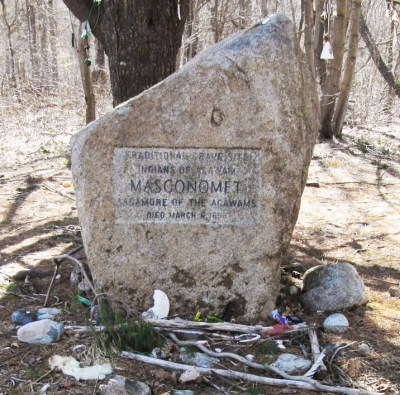
In 1630, Masconomet greeted John Winthrop, governor of the new Massachusetts Bay Colony, aboard the Arbella off the coast of Beverly. Three years later, the governor’s son John Winthrop Jr. was sent to Agawam to establish a Puritan outpost, which in the following year was incorporated as the Town of Ipswich. Lots and farms were granted, with vast outlying areas designated as common land.
Indigenous peoples recognized well-defined territorial rights, but those rights emphasized collective use, stewardship, kinship, and seasonal access. They would have been unfamiliar with the English concept of land ownership when John Winthrop Jr. conducted what the English regarded as a purchase of all of the traditional Agawam land, stretching from Salem to the Merrimack River, from the sachem Masconomet for the sum of £20. He was allowed to keep six acres for himself. During the following decades, the Puritan settlers cleared the forests and populated fields with tens of thousands of sheep and cattle, and planted English hay in the new fields. English livestock destroyed Native cornfields and damaged riverbanks and shellfish habitat. The land became so vastly altered that the Native American way of life became impossible.
During 1636-38, Ipswich men actively fought in the Pequot War in southern New England, and by 1640, many surviving Pawtucket families relocated northward to Passaconaway’s large Pennacook Confederacy in today’s New Hampshire. Masconomet died in 1658 and is buried on Sagamore Hill in Hamilton. The few remaining Pawtucket homelands in Essex County were divided among the surviving descendants of Masconomet, Nanepashemet, and Passaconaway. During King Philip’s War from 1675–1678, Ipswich was never attacked by Indians, but the destruction of Brookfield on August 2, 1675, resulted in the deaths of a dozen Ipswich settlers in that former Nipmuc land. After the war, Native people were indiscriminately killed, sold into slavery, indentured to towns, disarmed, and confined to reservations.
Although their traditional villages disappeared and their political independence was lost, the descendants of the Pawtucket and Agawam people did not vanish. Many became part of Native communities elsewhere in New England and the Canadian Maritimes, while others remained in Massachusetts, where their descendants continue to preserve their Indigenous heritage. Emma Safford, a descendant of Massasoit, is still remembered by many Ipswich residents.
Sources and further reading:
- Brian S. Robinson, Jennifer Ort, William A. Eldridge, Adrian L. Burke, Bertrand G. Pelletier: Paleoindian Aggregation and Social Context at Bull Brook, July 2009, American Antiquity
- Lothrop, Lowery, Spiess, Ellis: PaleoAmerica: A journal of early human migration and dispersal
- William Cronon, Changes in the Land: Indians, Colonists and the Ecology of New England
- Sydney Perley, Indian Land Titles, Essex Institute, Salem, MA
- Native Americans of Cape Ann
- Ipswich in the Massachusetts Bay Colony by Thomas Franklin Waters
- The history of the Indian wars in New England: from the first settlement to the termination of the war with King Philip in 1677 by William M. Hubbard
- Indian narratives: containing a correct and interesting history of the Indian wars.. by Henry Trumbull, Mrs. Johnson (Susannah Willard), Zadock Steele
- The Significance of Disease in the Extinction of the New England Indians by Sherburne F. Cook
- Counting the Dead: Estimating the Loss of Life in the Indigenous Holocaust, 1492-Present, David Michael Smith, University of Houston-Downtown
- The Great Dying: New England’s Coastal Plague, 1616-1619
- Miraculous Plagues: An Epidemiology of Early New England Narrative by Chritobal Silva
- King Philip’s War: based on the archives and records of Massachusetts, Plymouth, Rhode Island, and Connecticut, Ellis and Morris
- New England Frontier: Puritans and Indians, 1620-1675
- Ipswich Public Library: Emma Safford Papers, Manuscripts, photographs, articles, correspondence, and artifacts relating to Emma Safford (1879-1958), an Ipswich resident and descendant of the Wampanoag Sachem Massasoit. The collection contains information on Native Americans in Massachusetts
More articles about Indigenous Peoples on this site
Articles by Mary Ellen Lepionka
Discover more from Historic Ipswich
Subscribe to get the latest posts sent to your email.


Excellent! Thank you.
*Five-time winner of the New England Newspaper Association’s Best Column Award. *
My books – Ipswich On My Mind and Ipswich Out Of My Mind – are available from Amazon and as a Kindle eBook.** Proceeds go to the not-for-profit Local News.
Robert E. Waite Managing Partner Waite + Co. Boston-Ottawa-Toronto Head Office 1430 Yonge Street Suite 307 Toronto, ON M4T 1Y6 1-613-295-8259 (C) 1-416-944-0116 (H) https://www.linkedin.com/in/robert-waite-0651897/