
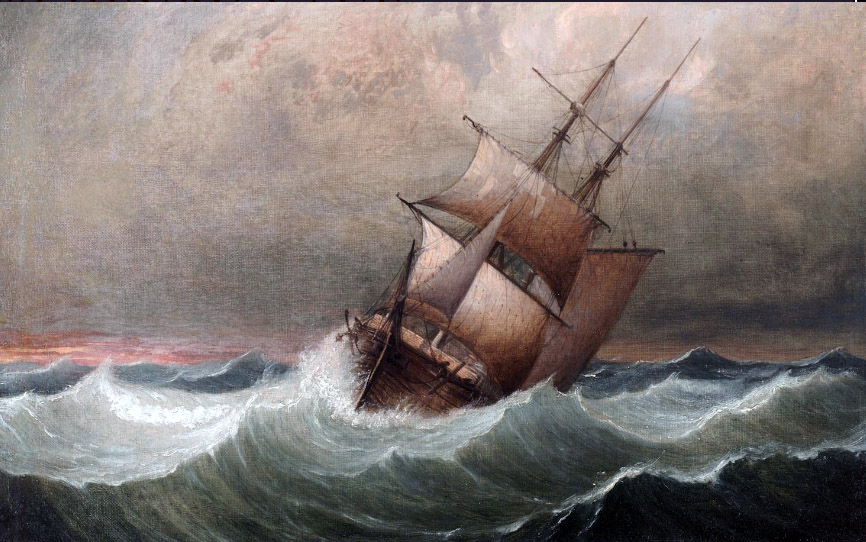
Painting by Fitz Henry Lane

A strong hurricane stayed offshore of the Carolinas in early October 1841. As it continued moving north, it pulled cold air into its circulation and intensified as an extra-tropical storm, with a direct hit on New England on October 3. The Georges Bank fishing fleet was destroyed, with the loss of 81 fishermen’s lives. The storm wrecked at least 190 vessels along the Eastern coast, including thirty to forty fishing schooners out of Gloucester and Marblehead. Four dozen ships were lost on Cape Cod, where fifty bodies floated onto shore. The Green Mountains of Vermont and the White Mountains of New Hampshire were covered with snow the next day.
The following is an excerpt from Historic Storms of New England by Sidney Perley, published in 1891.
“In the latter part of September, 1841, was a long, unbroken spell of uncomfortable weather, which culminated in a violent and cold storm of wind, snow and rain on the night of October 2, continuing four days. At sunset on Saturday, the second of the month, the wind came lightly from the northeast. It soon freshened and at eleven o’clock was blowing very hard. At midnight it blew a gale, and rain began to fall in Massachusetts and snow in New Hampshire. The violence of the wind continued to increase during the hours of darkness, until it became the cause of disaster on both sea and land.
“On Sunday morning, the sun rose clear, but it immediately went into black clouds, and the sky looked wild. At eleven o’clock in the forenoon a heavy sea was running all along the coast, and vessels were being thrown upon the rocks and beaches. The wind continued to blow all day, and at eight o’clock in the evening was still a gale. In fact, it did not produce its strongest force until two o’clock Monday morning. At daybreak it seemed as fierce as ever, having veered slightly to the north, but during the afternoon it abated considerably and continued to moderate until Tuesday morning. By ten o’clock a beautiful autumn day was gladdening the hearts made heavy by the destruction of property and lives.
“On the land, trees were stripped of many of their small branches and leaves, a great deal of fruit was destroyed, and chimneys and buildings were blown down. On the sea, the gale was so terrific that it tore the newest and strongest canvas into shreds and masts and spars of vessels were carried away. The ocean roared as though with unbridled madness, and its waves ran mountain high, throwing their spray far into the sky, and forming a majestic yet fearful sight. Many vessels were wrecked on the water and on the shores. In the harbors, vessels broke away from their moorings and collided or dashed against the wharves or upon the shore, some being sunk or afterward found at sea without a person on board.
“The greatest loss of life and property in this storm occurred on Cape Cod. The beach from Chatham to the highlands was literally strewn with parts of wrecks. Between forty and fifty vessels went ashore on the sands there. Fifty-seven from Truro were lost and buried in the great ocean cemetery. There was scarcely a person to whom some of them were not related, thus making it in the most literal sense a public bereavement. In commemoration of the event, there was erected in the town a plain marble shaft, rising from a brownstone base, which is inscribed on the front face as follows:
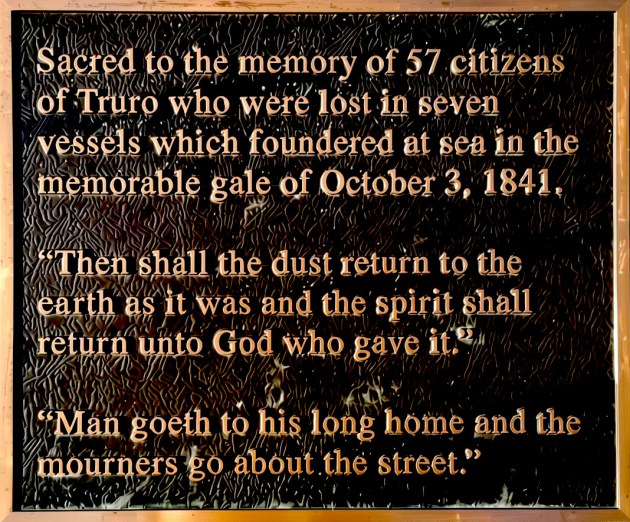
“To the memory of Fifty-seven Citizens of Truro, who were lost in seven vessels, which foundered at sea in the memorable gale of October 3, 1841. Then shall the dust return to the earth as it was, and the spirit shall return to God who gave it. Man goeth to his long home, and the mourners go about the streets.“
c
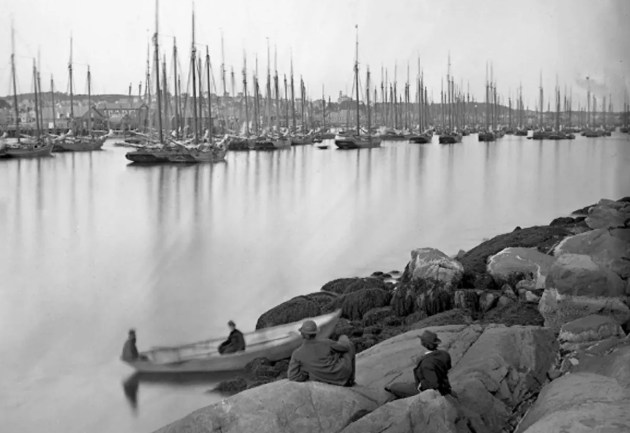
“At Cape Ann, vessels were snatched as it were from the waves and dashed into fragments among the rock. The gale was most disastrous at Pigeon Cove. The fisher dwellers there lost fourteen of their entire fleet of sixteen vessels. Many fish houses and fish flakes, together with about sixty barrels of mackerel, two hundred hogsheads of salt, and three hundred empty barrels were destroyed.
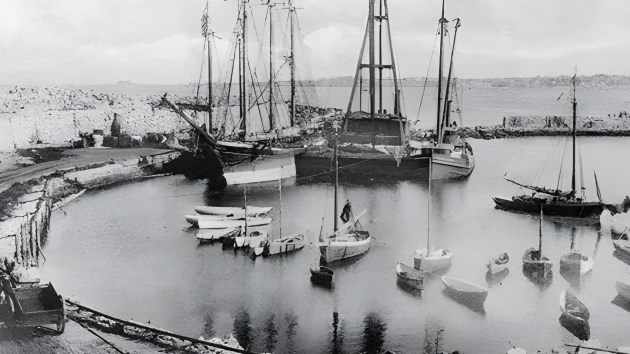
“This great loss of about fifty thousand dollars in value fell upon a class that was little able to bear it, for nearly all they had was invested in the fishing interest, and the vessels and other things necessary in carrying on the business. Public meetings were held at Rockport, Salem, and other places, in behalf of these honest, hardworking and worthy fishermen. The great loss there was on account of the destruction of the breakwater, that had been built in 1832 at an expense of seventeen thousand dollars.”
“Only one person perished on Cape Ann, but the schooner Forest of Gloucester, fishing for mackerel off of Cape Cod, was lost with the entire eight-man crew, leaving thirty-one children fatherless. Stephen Rich, Robert S. Sawyer, Asa L. Collins, Benjamin Robinson, Joseph Gerring, Francis Williams, John Quincy Adams and Abraham Ober went down with the ship.”
Further reading:
- Historic storms of New England by Sidney Perley
- Down to Sea
- The Deadly October Gale of 1841 – New England Historical Society
- Fitz Henry Lane
Shipwrecks
 Wrecks of the Coal Schooners - Walking near Steep Hill Beach, you might be surprised to see lumps of anthracite coal lying on the sand. This would be a mystery were it not for the tragic history of brigs and schooners transporting coal in the 19th century.… Continue reading Wrecks of the Coal Schooners
  Wreck of the Watch and Wait, August 24, 1635 - Many ships and lives were lost in the Great Colonial Hurricane, including 21 passengers who had set out from Ipswich on August 21, 1635 on a small bark named "Watch and Wait." As they rounded Cape Ann they were suddenly met by the force of the winds.… Continue reading Wreck of the Watch and Wait, August 24, 1635
  Wreck of the Hesperus, Dec. 15, 1839 - "It was the schooner Hesperus,
That sailed the wintry sea;
And the skipper had taken his little daughtèr, To bear him company."… Continue reading Wreck of the Hesperus, Dec. 15, 1839
Wreck of the Hesperus, Dec. 15, 1839 - "It was the schooner Hesperus,
That sailed the wintry sea;
And the skipper had taken his little daughtèr, To bear him company."… Continue reading Wreck of the Hesperus, Dec. 15, 1839  Wreck of the Falconer, December 17, 1847 - On December 17, 1847 the brig Falconer, loaded with bituminous coal, wrecked at Crane Beach during a fierce winter storm. A dozen of the crew and passengers are buried in a common grave at the Old North Burying Ground. … Continue reading Wreck of the Falconer, December 17, 1847
  Wreck of the Edward S. Eveleth, October 1922 - In October 1922, the sand schooner Edward S. Eveleth rolled over when a wave rushed over her deck and pushed her onto the edge of Steep Hill Beach. Filled with sand, each tide buried her deeper. Her remains were visible for several years. The skeleton of the hull is just off-shore a short distance from the wreck of the Ada K. Damon.… Continue reading Wreck of the Edward S. Eveleth, October 1922
  Wreck of the Deposit, December 23, 1839 - Dec. 23, 1839 two days before Christmas a storm caught the schooner "Deposit" on her passage out of Belfast, Maine. Capt. Cotterall was lost, and several of the crew were buried at the Old South Cemetery.… Continue reading Wreck of the Deposit, December 23, 1839
 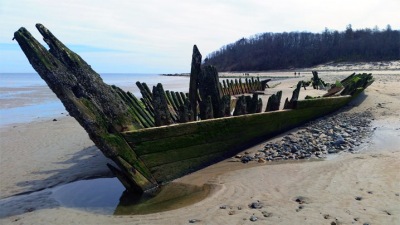 Wreck of the Ada K. Damon - Christmas, 1909 witnessed the heaviest storm in many years. The ship was wrecked during the captain's first trip for a load of sand from the plentiful supply on Plum Island.… Continue reading Wreck of the Ada K. Damon
  The Spectre Ship of Salem - On the fourth day after the ship left port, the sun came out and in the distance could be seen the same ship sailing effortlessly back into port directly into the wind. As the Noah’s Dove approached, its passengers including the young couple were visible but ghost-like.… Continue reading The Spectre Ship of Salem
  The Shipwrecks at Ipswich Bar - The Ipswich Bar has a long history of tragic shipwrecks. Its swift currents and shallow waters are especially dangerous during storms, and many ships have gone aground. The hull of the Ada K. Damon sits on Steep Hill Beach.… Continue reading The Shipwrecks at Ipswich Bar
 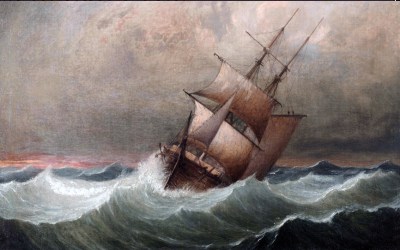 The October Gale of 1841 - In the latter part of September, 1841, was a long, unbroken spell of uncomfortable weather, which culminated in a violent and cold storm of wind, snow and rain on the night of October 2, continuing four days. … Continue reading The October Gale of 1841
 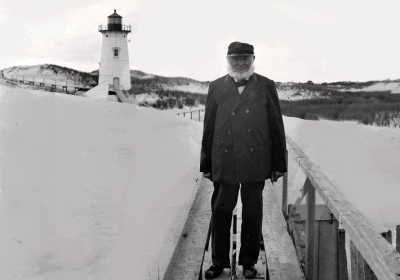 The Ipswich Lighthouse - In 1881, a 45-foot cast iron lighthouse was erected at Crane Beach, replacing an earlier structure. By 1913, the sand had shifted so much that the lighthouse was 1,090 feet from the high water mark. Use of the light was discontinued in 1932 and in 1939 the Coast Guard floated the entire lighthouse to Edgartown on Martha's Vineyard.… Continue reading The Ipswich Lighthouse
  The Great Colonial Hurricane and the Wreck of the Angel Gabriel, August, 1635 - In August 1635, the 240-ton Angel Gabriel sank in Pemaquid Bay after sailing into the most intense hurricane in New England history. Among the survivors were members of the Cogswell, Burnham and Andrews families, who settled in an area of Ipswich known as Chebacco.… Continue reading The Great Colonial Hurricane and the Wreck of the Angel Gabriel, August, 1635
 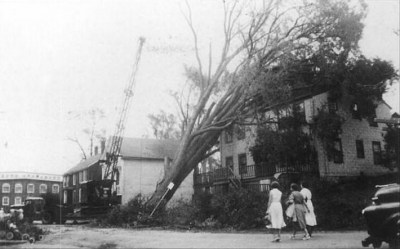 Hurricanes and Winter Storms - Massachusetts has the highest probability of all of the states to be hit by an ocean storm, which includes hurricanes and nor'easters.… Continue reading Hurricanes and Winter Storms
  Awful Calamities: the Shipwrecks of December, 1839 - Three gales of unequaled fury and destructiveness swept along our coast carrying desolation and death in their stormy pathway, and overwhelming many families in the deepest mourning.… Continue reading Awful Calamities: the Shipwrecks of December, 1839
 Discover more from Historic Ipswich
Subscribe to get the latest posts sent to your email.

