
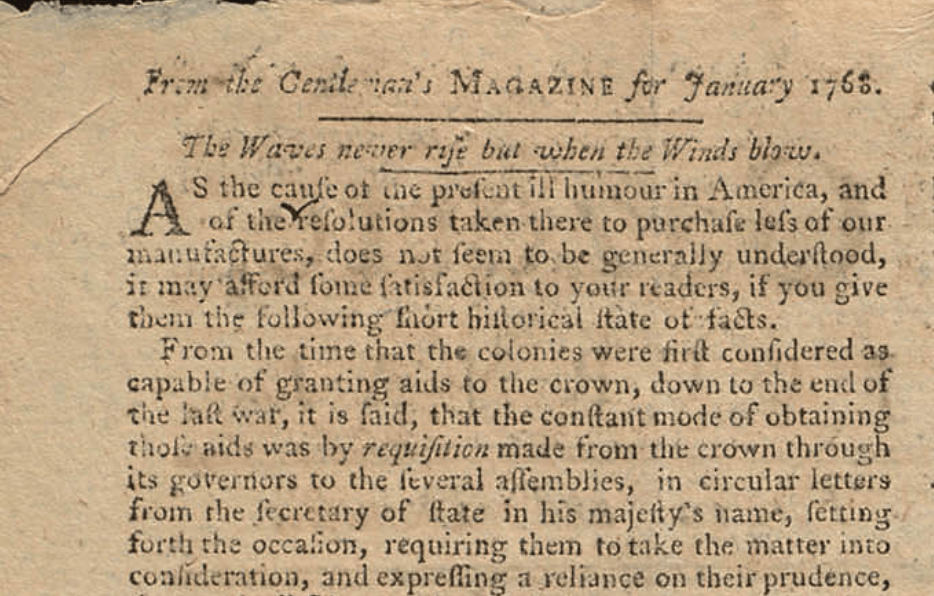
A letter in The London Chronicle, January 5-7, 1768, believed to have been penned anonymously by Benjamin Franklin, using the pseudonym “F†S” (abbreviated)
To the Printer of the London Chronicle
Sir,
As the cause of the present ill humour in America, and of the resolutions taken there to purchase less of our manufactures, does not seem to be generally understood, it may afford some satisfaction to your Readers, if you give them the following short historical state of facts.
From the time that the Colonies were first considered as capable of granting aids to the Crown, down to the end of the last war, it is said, that the constant mode of obtaining those aids was by Requisition made from the Crown through its Governors to the several Assemblies, in circular letters from the Secretary of State in his Majesty’s name, setting forth the occasion, requiring them to take the matter into consideration; and expressing a reliance on their prudence, duty and affection to his Majesty’s Government, that they would grant such sums, or raise such numbers of men, as were suitable to their respective circumstances. The Colonies being accustomed to this method, have from time to time granted money to the Crown, or raised troops for its service, in proportion to their abilities; and during all the last war beyond their abilities, so that considerable sums were returned them yearly by Parliament, as they had exceeded their proportion.
Had this happy method of Requisition been continued, (a method that left the King’s subjects in those remote countries the pleasure of showing their zeal and loyalty, and of imagining that they recommended themselves to their Sovereign by the liberality of their voluntary grants) there is no doubt but all the money that could reasonably be expected to be raised from them in any manner, might have been obtained, without the least heart-burning, offence, or breach of the harmony of affections and interests that so long subsisted between the two countries.
It has been thought wisdom in a Government exercising sovereignty over different kinds of people, to have some regard to prevailing and established opinions among the people to be governed, wherever such opinions might in their effects obstruct or promote publick measures….This had been the wisdom of our Government with respect to raising money in the Colonies. It was well known, that the Colonies universally were of opinion, that no money could be levied from English subjects, but by their own consent given by themselves or their chosen Representatives: That therefore whatever money was to be raised from the people in the Colonies, must first be granted by their Assemblies, as the money raised in Britain is first to be granted by the House of Commons: That this right of granting their own money, was essential to English liberty: And that if any man, or body of men, in which they had no Representative of their choosing, could tax them at pleasure, they could not be said to have any property, any thing they could call their own.
The person then who first projected to lay aside the accustomed method of Requisition, and to raise money on America by Stamps, seems not to have acted wisely, in deviating from that method (which the Colonists looked upon as constitutional) and thwarting unnecessarily the fixed prejudices of so great a number of the King’s subjects. It was not, however, for want of knowledge that what he was about to do would give them great offence; he appears to have been very sensible of this, and apprehensive that it might occasion some disorders, to prevent or suppress which, he projected another Bill, that was brought in the same Session with the Stamp Act, whereby it was to be made lawful for military Officers in the Colonies to quarter their soldiers in private houses. This seem’d intended to awe the people into a compliance with the other Act.
Great opposition however being raised here against the Bill by the Agents from the Colonies, and the Merchants trading thither, the Colonists declaring, that under such a power in the Army, no one could look on his house as his own, or think he had a home, when soldiers might be thrust into it and mix’d with his family at the pleasure of an officer, that part of the Bill was dropt; but there still remained a clause, when it passed into a Law, to oblige the several Assemblies to provide quarters for the soldiers, furnishing them with firing, bedding, candles, small beer or rum, and sundry other articles, at the expence of the several Provinces. And this Act continued in force when the Stamp Act was repealed, though if obligatory on the Assemblies, it equally militated against the American principle abovementioned, that money is not be raised on English subjects without their consent.
It might have been well if the matter had thus passed without notice; but a Governor having written home an angry and aggravating letter upon this conduct in the Assembly of his Province, the outed Projector of the Stamp Act and his adherents then in the opposition, raised such a clamour against America, as being in rebellion, and against those who had been for the repeal of the Stamp Act, as having thereby been encouragers of this supposed rebellion, that it was thought necessary to inforce the Quartering Act by another Act of Parliament, taking away from the Province of New York, which had been the most explicit in its refusal, all the powers of legislation, till it should have complied with that act. The news of which greatly alarmed the people everywhere in America, as (it has been said) the language of such an act seemed to them to be: Obey implicitly laws made by the Parliament of Great Britain to raise money on you without your consent, or you shall enjoy no rights or privileges at all.
But perhaps it may be some satisfaction to your Readers to know what ideas the Americans have on the subject. They say then as to Governors, that they are not like Princes whose posterity have an inheritance in the government of a nation, and therefore an interest in its prosperity; they are generally strangers to the Provinces they are sent to govern, have no estate, natural connection, or relation there, to give them an affection for the country; that they come only to make money as fast as they can; are sometimes men of vicious characters and broken fortunes, sent by a Minister merely to get them out of the way; that as they intend staying in the country no longer than their government continues, and purpose to leave no family behind them, they are apt to be regardless of the good will of the people, and care not what is said or thought of them after they are gone.
Their situation at the same time gives them many opportunities of being vexatious, and they are often so, notwithstanding their dependence on the Assemblies for all that part of their support that does not arise from fees established by law; but would probably be much more so, if they were to be supported by money drawn from the people without their consent or good will, which is the professed design of this new act. That if by means of these forced duties Government is to be supported in America, without the intervention of the Assemblies, their Assemblies will soon be looked upon as useless, and a Governor will not call them, as having nothing to hope from their meeting, and perhaps something to fear from their enquiries into and remonstrances against this Mal-administration. That thus the people will be deprived of their most essential rights.
That it being, as at present, a Governor’s interest to cultivate the good will by promoting the welfare of the people he governs, can be attended with no prejudice to the Mother Country, since all the laws he may be prevailed on to give his assent to are subject to revision here, and if reported against by the Board of Trade, are immediately repealed by the Crown; nor dare he pass any law contrary to his instructions, as he holds his office during the pleasure of the Crown, and his Securities are liable for the penalties of their bonds if he contravenes those instructions. This is what they say as to Governors.
As to Judges they allege, that being appointed from hence, and holding their commissions not during good behaviour, as in Britain, but during pleasure, all the weight of interest or influence would be thrown into one of the scales, (which ought to be held even) if the salaries are also to be paid out of duties raised upon the people without their consent, and independent of their Assemblies’ approbation or disapprobation of the Judges’ behaviour. That it is true, Judges should be free from all influence; and therefore, whenever Government here will grant commissions to able and honest Judges during good behaviour, the Assemblies will settle permanent and ample salaries on them during their commissions: But at present they have no other means of getting rid of an ignorant or an unjust Judge (and some of scandalous characters have, they say, been sometimes sent them) but by starving him out.
I do not suppose these reasonings of theirs will appear here to have much weight. I do not produce them with an expectation of convincing your readers. I relate them merely in pursuance of the task I have impos’d on myself, to be an impartial historian of American facts and opinions.
A new kind of loyalty seems to be required of us, a loyalty to Parliament; a loyalty, that is to extend, it is said, to a surrender of all our properties, whenever a House of Commons in which there is not a single member of our choosing, shall think fit to grant them away without our consent; and to a patient suffering the loss of our privileges as Englishmen, if we cannot submit to make such surrender. We were separated too far from Britain by the Ocean, but we were united to it by respect and love, so that we could at any time freely have spent our lives and little fortunes in its cause: But this unhappy new system of politics tends to dissolve those bands of union, and to sever us for ever.
These are the wild ravings of the at present half distracted Americans. To be sure, no reasonable man in England can approve of such sentiments, and, as I said before, I do not pretend to support or justify them: But I sincerely wish, for the sake of the manufactures and commerce of Great Britain, and for the sake of the strength which a firm union with our growing colonies would give us, that these people had never been thus needlessly driven out of their senses.
I am, yours, F†S
- Read the entire letter in the Franklin Papers
- View an original reprint of the letter in the The Boston-Gazette, and Country Journal, 18 April 1768, courtesy of MassHistory.org
Discover more from Historic Ipswich
Subscribe to get the latest posts sent to your email.

