
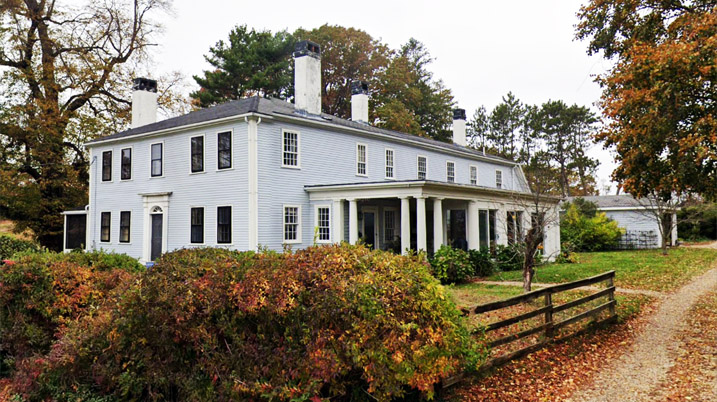
The Federal-style house on Sagamore Hill at 232 Argilla Road is a short distance from Castle Hill, which was bequeathed to Ipswich founder John Winthrop Jr. In 1644, Castle Hill was sold by Winthrop to Samuel Symonds, who sold it in 1660 to his stepson, Capt. Daniel Eppes, and it was passed on to his only son, Samuel Eppes, who sold the property to John Patch in 1741. Sometime after Patch made the purchase, he moved into the center of Ipswich to the Patch–Burnham House on Turkey Shore Road, but he continued farming and other operations on his growing Argilla Road estate.
John Patch married Abigail Patch on 21 June 1740 in Ipswich, where he was a member of the town’s Committee on Correspondence leading up to the Revolutionary War, and is said to have become wealthy as a privateer. He purchased the farm on Sagamore Hill in 1785. When he died in 1799, his will divided his various properties. The Sagamore Hill farm, which was known then as the “Island,” went to his grandson Tristram Brown, who built the house that stands there today.
The Essex Memorial for 1836 lists a “public house” on the way to the beach, operated by Tristam Brown. It passed to Tristam’s son Nehemiah, then to his John, then to John’s son John, and was later purchased by Dr. E.A. Crockett.” It was still being used as a county inn known as “Smith’s Boarding House” run by Mr. Frank Smith when Dr. Eugene A. Crockett bought the property along with its dairy and hay farm in November 1897. Shortly after he purchased the boarding house, Dr. Crockett married Elizabeth LeBourgois of New Orleans. After his death, his daughter, author Adele Crockett Robertson, took up permanent residence in the house, and later wrote “The Orchard,” a memoir of her life there.
The old John Patch House, which he had probably constructed after purchasing the land in 1741, was still standing in the early 20th century, being used as a shed or storehouse by Dr. Crockett. The old John Patch House had originally been across the road to the south, according to a letter from the son of Nehemiah Patch to Thomas Franklin Waters in 1907.
Sources:
- A casual history of the upper part of Argilla Road, Ipswich, Mass., since 1897, Author: Shurcliff, William Asahel, 1908-
- History of Argilla Road, Sidney Shurcliff
- Ipswich in the Massachusetts Bay Colony, Vol. 2 by Thomas Franklin Waters
 Historic Ipswich