

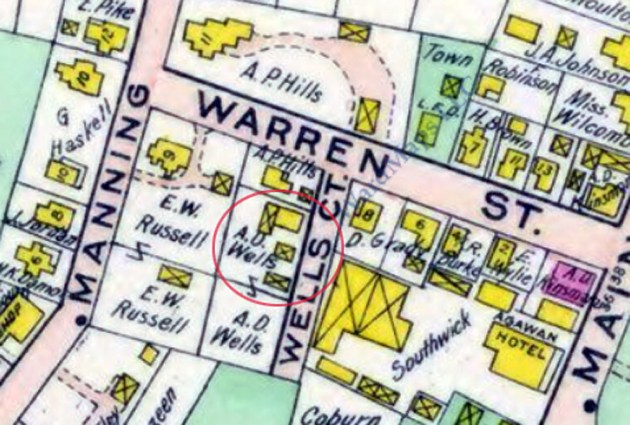
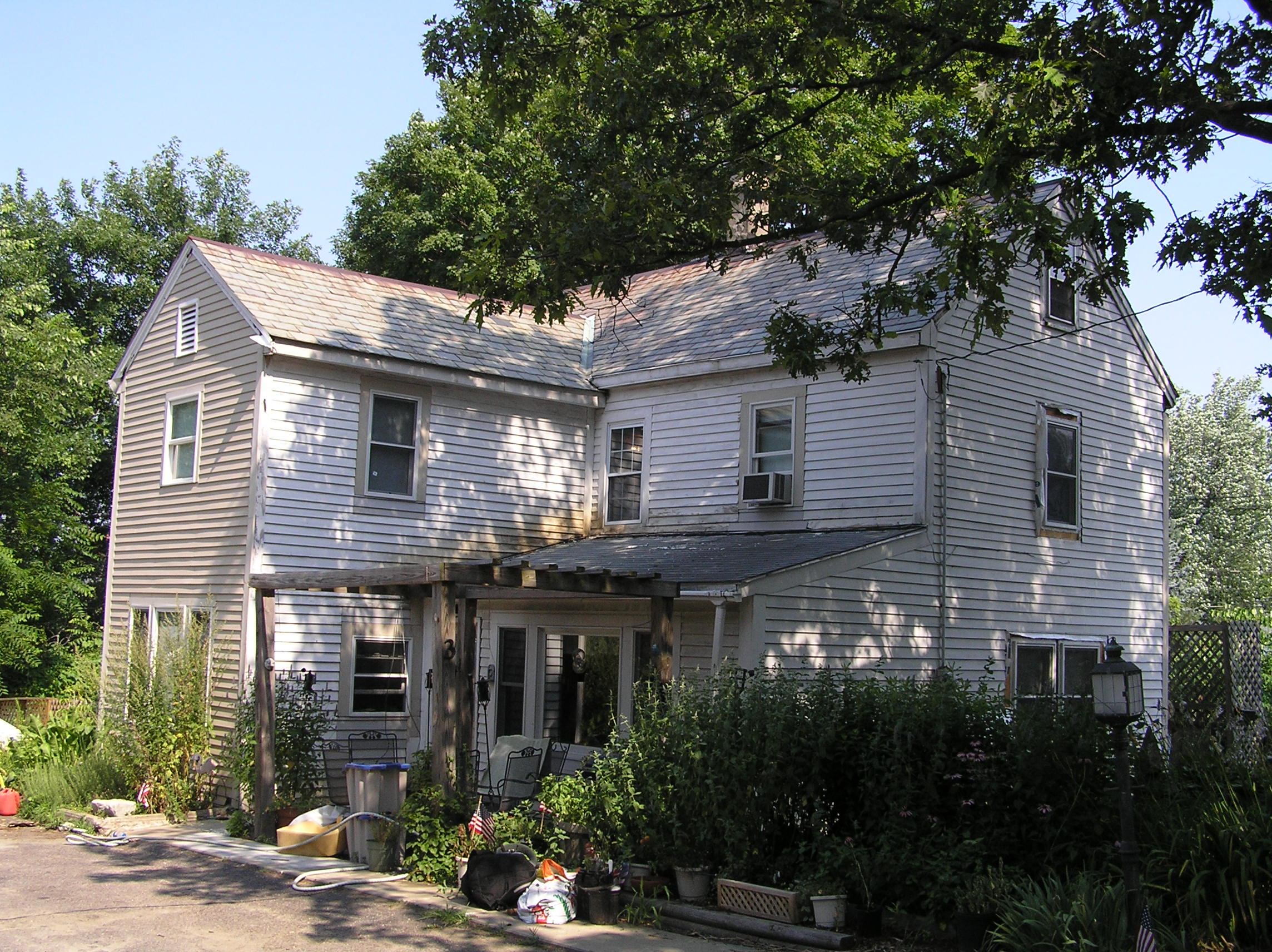
Although the Ipswich assessors’ site shows an unsubstantiated date of construction of this house as 1788, historical and architectural evidence points to a construction date in the mid-19th Century, possibly sitting on an earlier foundation. This house first appears on Ipswich Maps in 1856 as the home of J. (John) Wells. John Wells transferred the deed to this property to Aaron Day Wells in 1862.
The interior has been completely remodeled and provides no indication of the house’s antiquity. The long side facing Warren Street appears to be the oldest part of the house. The foundation is a mix of rubble stone and brick with several partitions and the remains of a large stone base for a fireplace, which indicates that this house may have been built on the foundation of an earlier structure, perhaps the home of Thomas Pindar (1716-?).
In the 20th century, this was known as the “Banana house.” The owners at that time bought green bananas in bulk and ripened them in the basement for resale.

An early balloon-framed house
The attic shows that the house was built with balloon framing and full-dimensional lumber. George Washington Snow, an “architect and practical builder,” constructed a balloon-frame Chicago warehouse in 1832, the first in America. Solon Robinson of Indiana (1803 – 1880) popularized the revolutionary new framing system in his 1846 article, “A Cheap Farm-House,” consisting of standard 2×4 or 2×3 lumber nailed together at 16″ intervals.
Balloon framing was a radical departure from post and beam construction, which is found in all 17th and 18th-century houses, but nowhere in this house. Balloon-framed houses did not become prevalent in New England until after the Civil War.
The framing in the house has the straight saw marks found in sash saws and band saws. By the 1850s to 1870s, most New England sawmills replaced their sash saws with the more efficient circular saw blades; modern band saws were invented even later.
Loney’s Lane
Loney’s Lane is named for Anthony Loney, who owned the lot at 12 N. Main St. from 1739 to 1742. He sold that lot to Nathaniel Treadwell, who opened a well-known inn.

Thomas Franklin Waters wrote,
“Loney’s Lane, as it has been called, but formerly Pinder’s Lane, was originally an open thoroughfare which descended the hill back of the North Main Street Lots. Originally, the Old Pinder Lane crossed the present Central St. and led across the low lane to the ancient Bridge Street.” A hand-drawn map from 1717 shows six house lots on the west side of Pindar’s Lane, but there were only two houses, Symon Pinder’s and Thomas Pinder’s, which stood at 3 Loney Lane, where Aaron Well’s house is located.
In the 1832 Anderson Ipswich map, the lots on Loney’s Lane were devoid of houses. The Town Pound was on the corner of the lane and Warren Street, which circled back to North Main Street at that time.
John Wells
The John Wells house first appears in the 1856 map. The 1910 Ipswich map shows the owner as A. D. (Aaron) Wells, and the lane had been renamed again as “Wells Court.”
Salem Deeds shows that Joseph Wells transferred property in Ipswich to an earlier Aaron Wells in 1774. The location is not listed; the lot number is “123 210.” Ipswich Vital Records shows Aaron Wells, son of Moses and Eunice Wells, born Apr. 11, 1742.
Ipswich Vital Records shows that Aaron Day Wells was born to Stephen Wells, a laborer, and his wife, Louisa, on Dec. 17, 1845. The 1888 Agawam Directory of Ipswich lists Louisa, widow of Stephen Wells.
John Wells was listed as a private in 1814. Salem Deeds (633-281) shows that John Wells transferred the deed to this property on “Town Pound and Lane” to Aaron D. Wells in 1862. He mortgaged property on Loney’s Lane and the Town Pound to Louisa Wells in 1876 (934: 221).

Harold Bowen wrote for Ipswich Today in the 1970s about Aaron Wells:
“Old Aaron Wells resided on Loney’s Lane in the house now occupied by the Markos family, and each year he was a candidate for Selectman. He promised that if he won, he would have a tunnel dug under Town Hill so that people would not have to climb it. There are three things one could remember Aaron by. He sold horseradish and firewood, and he maintained a dump in his backyard. The backyard was on the same level as Warren Street, part of the same hill. Using his dump, Aaron brought his yard up to level. He allowed people to dump there, but he was very fussy. He wouldn’t accept garbage or brush, and when you dumped it there, it was where he told you to put it. He was always there, and he kept the dump very neat. There are bottles buried there that must be nearly 100 years old. Aaron was not a rich man, but neither was he poor. He was a good and kind man. He never won a seat on the Board of Selectmen, so there is no tunnel through Town Hill.”
Sources:
- Waters, Franklin, Ipswich in the Massachusetts Bay Colony, Vol. 1
- Descendants of Thomas Wells
- Nutfield Genealogy
- Genealogy of the Wells Family of Maine
- Common Landscape of America, 1580 to 1845
- OldHouseFix.com
- Field Guide to New England Barns and Farm Buildings
- James L. Garvin, A Building History of Northern New England
- Ipswich Vital Records
- Bowen, Harold, “Tales from Olde Ipswich”
 Historic Ipswich