

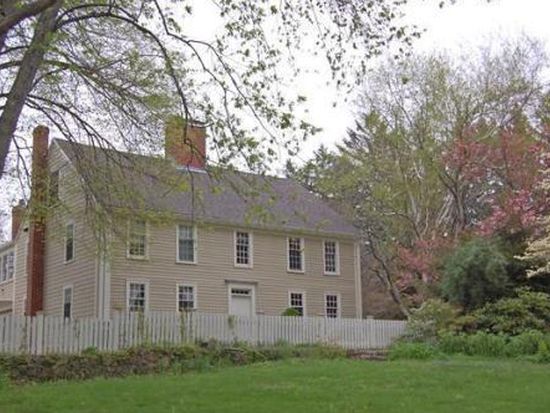
Robert Kinsman, who was arrested in the 1687 Ipswich revolt against Gov. Andros, is said to have constructed a house on this location before 1714. Stephen Kinsman inherited the house in 1726 and, with his wife Elizabeth Russell, brought up a family of twelve children. They lived in the old Robert Kinsman homestead until 1767, when he sold his farm, 47 acres, and buildings to Samuel Patch.
According to Thomas Franklin Waters, it was said that the old Robert Kinsman dwelling burned sometime after it was sold to Samuel Patch, and that this house was built by his son John Patch in 1800. While the symmetrical façade and double bay depth may support the later date, the central chimney suggests construction in the middle to late 18th century. The original section of this house has pine plank floors, raised paneling, exposed posts and beams, and six fireplaces throughout the home.
Members of the Kinsman family lived all along this road, and several of their houses still exist, including the Jeremiah Kinsman house at 59 Candlewood and the Rhoda Kinsman house just beyond it. Candlewood Road was one of the preferred farming areas in Ipswich for early settlers and the Agawam Indians before them. The name may have come from the pitch pine bark that early inhabitants used to light their homes.
History of the Lot
from Candlewood, an Ancient Neighborhood in Ipswich, by Thomas Franklin Waters
- Robert Kinsman, the immigrant, a glazier by trade, received an acre of land on the south side of the way now known as Green St. near the corner of County Street in Ipswich. He died Jan 28, 1664, and his will gave his dwelling to Tabitha, his only unmarried daughter. His son Robert was born in 1629.
- Robert Kinsman2, born in 1629, followed his father’s trade. He married Mary Boreman, daughter of Thomas, whose dwelling was on East Street. He purchased his Candlewood farm in 1652. He died on February 19, 1712, and was buried in the old High Street Burying Ground, where his gravestone still stands. They had nine children, including Robert, Thomas, and Stephen. His son, Robert3, made his home in the Fellows homestead at the corner of Candlewood and Fellows Road but moved to Norwich, Connecticut, with his wife.
- Stephen Kinsman1, born about 1688, with his brother Thomas, received from their grandfather, Quartermaster Robert Kinsman2, the title to their father’s farm. He bought his brother’s interest and eventually acquired a considerable landed estate.
- On Dec. 19, 1729. Joseph Thomas Kinsman, mariner, conveyed to his brother Steven Senior,” the tenement of housing and land given me by my grandfather Robert and a part that my father Thomas bought of the Town of Ipswich, Jan. 3, 1714.“
- Stephen Kinsman gradually acquired a large tract in what was called Walker’s Swamp or Walker’s Swamp Island, which had been apportioned on the basis of old and new rights as the larger “Inner Common of the South Eighth” (Ipswich was divided into “Eighths” for accounting purposes.) By trade, Stephen Kinsman was a weaver. In 1711, he married Lucy Kimball, daughter of Caleb and Lucy Kimball of High Street, who died February 22, 1715, at the age of 23 years. His second wife was Lydia Kimball, daughter of Richard and Lydia Kimball, published Nov. 19, 1716. Stephen Kimball died in the home of his birth on Dec. 8, 1756. His son Stephen (2) inherited the farm in 1756. His dwelling was on the original farm, but he had built a house on Walker’s Island, which was occupied probably by his son Jeremiah, whose home still stands nearby.
- Stephen Kinsman (2) was born on March 30, 1718. He married Elizabeth Russell on April 10, 1739. His father’s will, proved in 1756, bestowed on him “that part of the dwelling (i.e., his grandfather’s house) he now lives in, with the old barn and shop with all my looms and weaving tackling, etc.” The parlor end of the dwelling was given to Lydia, his widow. Stephen Kinsman sold his farm to Samuel Patch in 1767. During their residence in the old farmhouse, twelve sons and daughters were born.

 Historic Ipswich
Jeanette, I’m a Kinsman (maiden name) & own the original Kinsman Family book that has been handed down to me through generations. My 90 yr old aunt has done all of the family tree history, that I now have. Let me know if you have any questions. I can be reached at Kinsmancastro@gmail.com
Hello Stacey, that is wonderful there is such a book. I really appreciate your offer if I have questions. Thank you so much.
Jeanette
Thank you Gordon. Yes, I have the book and have read all pertinent sections. Still is puzzling why everyone from my line left the town, especially with such a big family and extended family too. Guess there are some things that will always remain a mystery. Thanks anyway!
Another link for your research: https://archive.org/details/ipswichinmassac00wisegoog/page/n286
Here’s one member of the Kinsman family who stayed in Ipswich. https://www.findagrave.com/memorial/44791642
I’m doing some research on my Kinsman family roots and I am wondering why the entire Stephen Kinsman family moved away from Ipswich after they sold 49 Candlewood to the Patch family. It was such a large family…don’t know why none of them stayed in Ipswich. Do you have any information to share or a suggestion where I might look? Thank you.
You probably already have this link, but let us know if you find an answer to your question. https://books.google.com/books?id=qXaq2HmOeYYC&printsec=frontcover&source=gbs_atb#v=onepage&q&f=false