
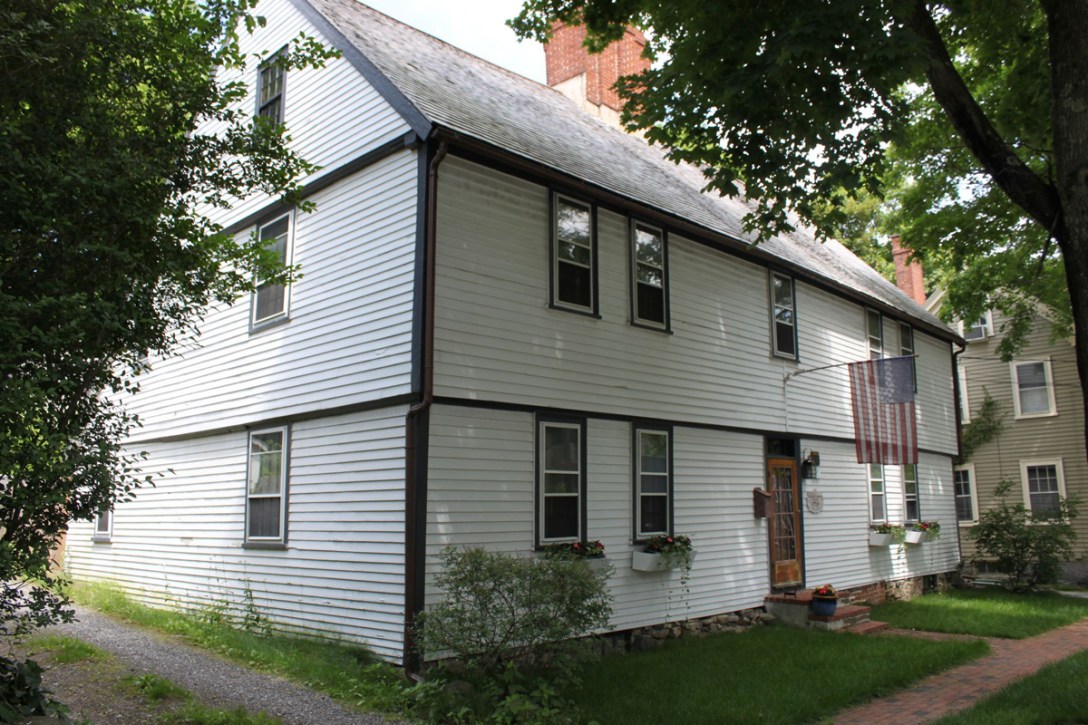

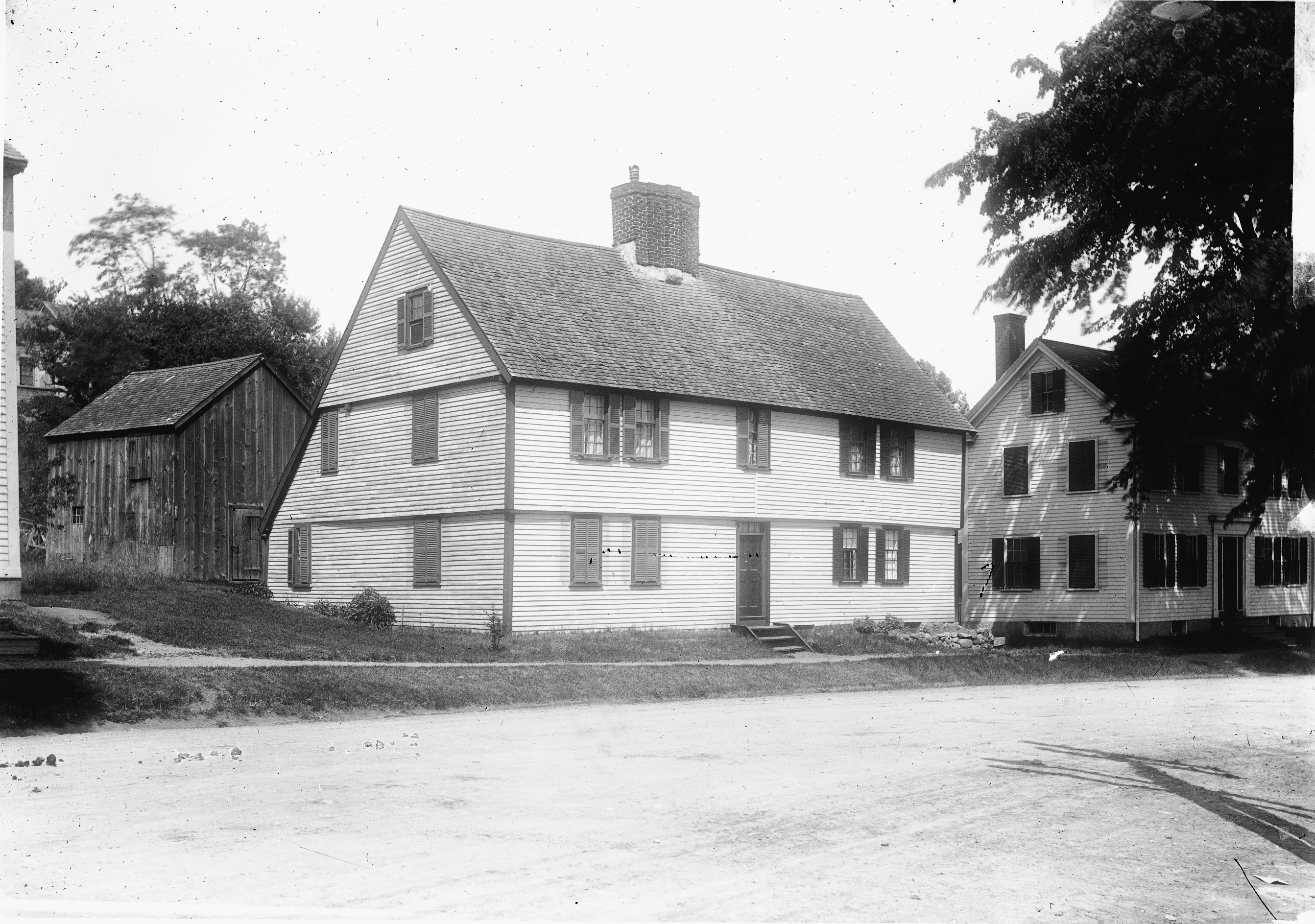
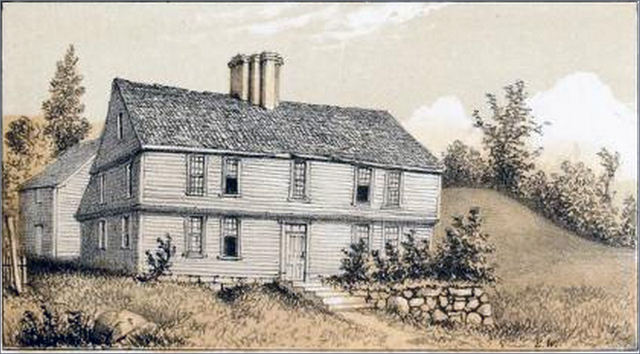
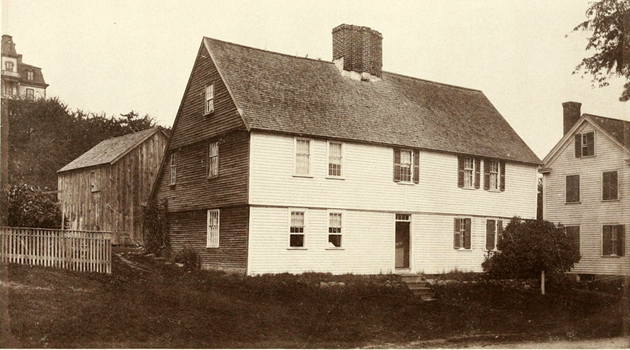
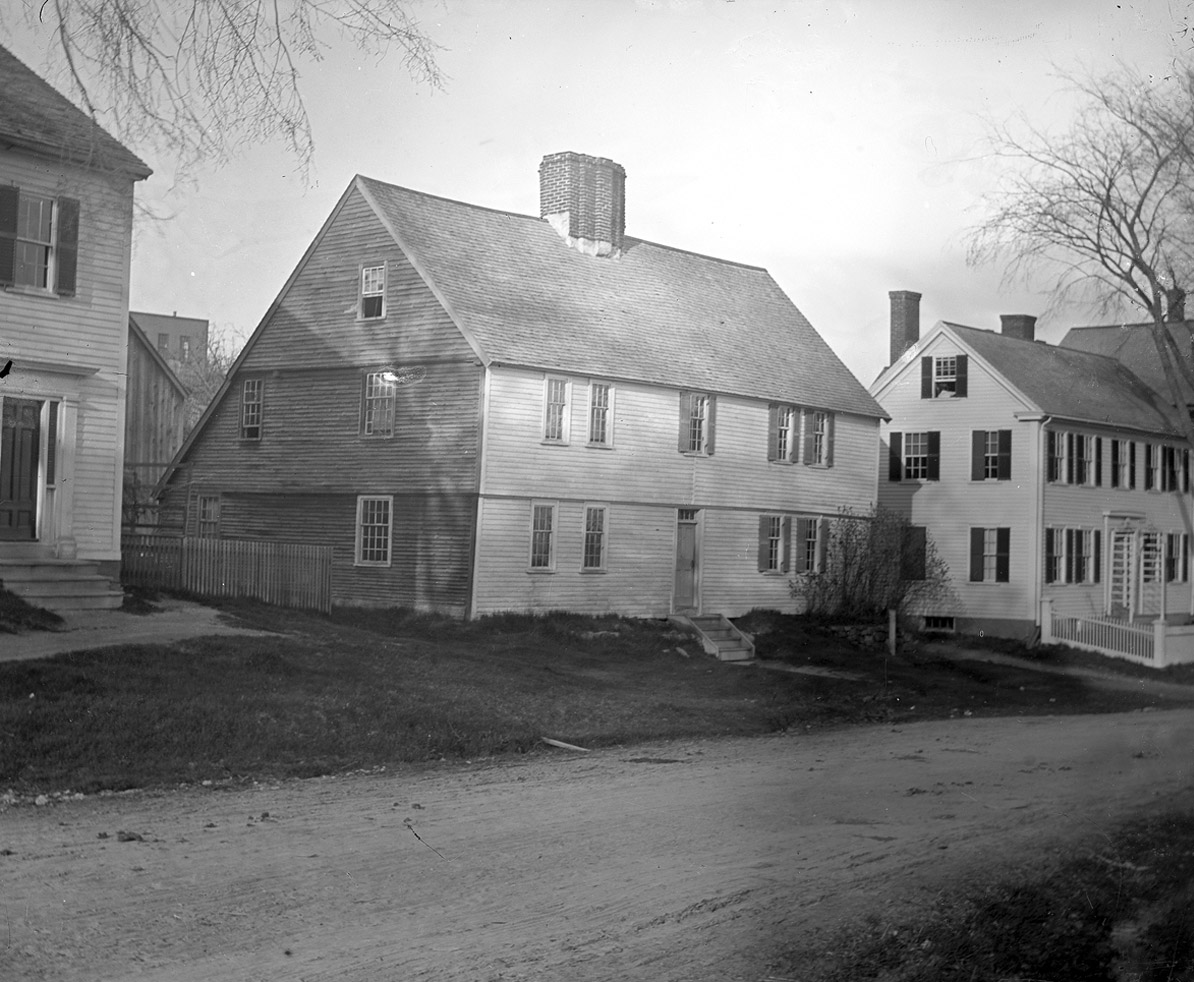
The Captain Matthew Perkins House at 8 East St. in Ipswich was the winner of the 1991 Mary Conley Award. The land on which the house sits was at one time part of an orchard lot and was sold to Matthew Perkins, a weaver and soldier, by Major Francis Wainwright in 1701 (17:108). Wainwright, the wealthiest man in Ipswich, owned a nearby house known as the Old Brick. Matthew Perkins was the son of Jacob Perkins and Elizabeth Whipple and the grandson of John Perkins and Judith Gator, the early Ipswich settlers.
In the 19th century, this was known as the Norton-Corbett house, but the home of the two pastors was next door and was torn down in 1818. The First Period 2-story structure has a timber frame, clapboard siding, an elaborate pilastered chimney, a rear ell, post-medieval overhangs front and side, and one of the best Jacobean staircases in New England.
Thomas Franklin Waters wrote the following information about Matthew Perkins:
“Capt. Matthew Perkins built a house for himself on the orchard lot, which descended to his daughters and was owned successively by William Dodge, Sanmel Williams, Benjamin Brown, Jonathan Newmarch, Ephraim Kendall, Samuel Sawyer, Richard Sutton, Abraham Caldwell, and Daniel Russell. The deed of Esther Caldwell for herself and her brother Abraham Perkins to Richard Sutton specified that it was the homestead of their great-grandfather, Capt. Matthew Perkins, July 26, 1768. At that time, the southeast half of the house was owned by Mr. Daniel Hodgkins, and he built a new residence on land to the eastward of the ancient dwelling, which had been originally used as the barnyard.”
In 1701, an old conflict in Europe reignited into what is known in America as Queen Anne’s War. The Marquis of Vaudreuil, the French Governor at Quebec, sent parties of French and Indians to attack the frontier towns of the Colony. Ipswich sent a company of forty-eight men, detached by Major Francis Wainwright on an expedition to York and Salmon Falls, Maine, in the “Eastward Front,” under Major John Cutler, with Lieutenant Perkins second in command. Fierce discord arose in the ranks regarding the commander, who sold his provisions and kept his men short. Perkins brought formal charges against Cutler, and a court-martial at Newbury in February 1703-4 cashiered Major Cutler and declared him ineligible for further service.
Captain Matthew Perkins served under Col. Francis Wainwright in an expedition to Front Royal (the city of Annapolis Royal, Nova Scotia) in 1707. A third expedition against Port Royal was decided upon early in 1710. Capt. Matthew Perkins commanded a company of which George Hart was an Ensign. The Ipswich sloop, “Hopewell,” 55 tons, John Chadwell, Commander, was included among the transports, conveying Capt. Perkins and his company of 60 men. During Queen Anne’s War, there was a New England blockade of Port Royal and then three attempts to lay siege to the capital. This third siege ultimately resulted in the British conquest of Acadia and Nova Scotia.
In 1719, the Selectmen approved an application by Matthew Perkins for a license as an innholder in this house, “at the sign of the blue anchor.” By 1723, Capt. Matthew Perkins was known as “Taverner Perkins.”
Matthew Perkins’s widow, Esther, continued to live in the house after his death. Divided ownership of the house began when it was inherited in 1749, with daughter Esther Harbin inheriting the western half and the heirs of her deceased daughter, Mary Perkins Smith, inheriting the eastern half. The deed for the division was “a line running southwesterly through ye Sd Dwelling House & Midl of ye chimney to ye Road…together with ye privilege of passing and repassing through the other part of sd cellar.” (Essex County Registry of Deeds Docket #21382).
After Esther died, her half of the house was divided between her daughter, Esther Porter, and her son, William. (Essex County Registry of Deeds Docket 21305). with Esther owning “the Lower Room & the Garritt Over it”, part of the cellar and “and the Easterly End of the Seller [cellar] twelve feet in length with “ye liberty of passing through ye other part of sd seller”. William received “The Chamber & Linter chamber & the Back Room of said Mansion House with the other part of the cellar”
Lt. Richard Sutton and Capt. Richard Sutton.
Richard Sutton Sr. and Elizabeth Foster married in 1758 and purchased or inherited the eastern half of the Matthew Perkins House on July 26, 1768. For many years, it was known as “The Sutton House.” Richard’s profession was “leather breeches maker.” During the Revolutionary War, he was a First Lieutenant in Col. Timothy Pickering’s regiment, which marched to Providence and Danbury, CT. He or his son, Capt. Richard Sutton was one of the signers in the establishment of the Baptist Church in Ipswich in 1806.
The Matthew Perkins house is where Captain Richard Sutton was born in 1780. Captain Richard Sutton married Lucy Lord in 1802. His ships included an older ship called “The Boxer” and “The General Kleber.” He sailed a steamboat, the Potomac, to Buenos Aires in 1835. In 1845, while in Buenos Aires, he became paralyzed on one side. He died in Buenos Aires in 1857, and his wife, Lucy, died of yellow fever in Buenos Aires in 1871. The Matthew Perkins house remained in divided ownership until 1944, when both halves were acquired by Charles and Dorothy Pickard, who sold the home to the Society for the Preservation of New England Antiquities (SPNEA, now Historic New England) in 1966.
Arthur Wesley Dow
This house was the birthplace of Ipswich artist Arthur Wesley Dow in 1857. His family moved to a home on Spring Street in 1861. Dow’s summer art school was at the Howard House at the intersection of Green Street and Turkey Shore Road, and he had a studio at the top of Spring Street.
The Captain Matthew Perkins House, 8 East Street Preservation Agreement
- East-8-matthew-perkins-spnea-page-1
- East-8-matthew-perkins-spnea-page-2
- East-8-matthew-perkins-spnea-page-3
- East-8-matthew-perkins-spnea-page-4
- East-8-matthew-perkins-spnea-page-5
- East-8-matthew-perkins-spnea-page-6
- East-8-matthew-perkins-spnea-page-8
The Matthew Perkins house is featured in The Framed Houses of Massachusetts Bay Colony by Abbot Lowell Cummings. It is protected by a Preservation Agreement between the owners, the Town of Ipswich, and the Ipswich Historical Commission. Protected elements include:
Exterior:
- The south elevation faces East St, and the north, east, and west facades, including all doors, door frames, windows, window sash, window frames, wall sheathing, clapboards, transoms, cornices, moldings, and other decorative elements.
- The massing of the roof profile, and the roof’s wooden shingle covering, skylights, dormers or other roof additions.
- The entire chimney.
- The foundation, specifically its drywall stone construction.
Interior:
- All structural members, interior beams, posts, girts, plates, rafters, purlins, and other framing members.
- Existing space configuration and door locations of the first and second floors, and of the east room at the attic, with the subdivision or enlargement of such spaces.
- All floors of the first and second floors of the south-facing rooms, the east attic room, and both stairwells at all floors, with the sanding of all but hardwood floors, are forbidden. Excluded: modern floors in first and second-floor north-facing rooms.
- Plaster walls and ceilings in the first and second-floor south and northeast rooms, the second-floor northwest room, and the attic east room, and clay plaster in the attic east and first-floor northeast rooms may not be painted or repaired.
- All woodwork in the south rooms of the first and second floors and both stair halls on all floors, including but not limited to cornices, mantel pieces, paneling, baseboards, stairs, and railings. balusters, newels, doors, door casings, windows, window sash, window casing, and other decorative elements.
- Paint removal is forbidden without approval.
- All fireplaces. The restoration of the former kitchen fireplace, with approval.
- The cellar’s masonry partitions, chimney arch, and clay parging at the north wall of the main cellar shall not be disturbed.
- First, and second floors and attic; woodwork, interior beams and framing, floors, fireplaces, and plaster, etc. shall not be covered without approval.
Sources and further reading
- MACRIS
- Cummings, Abbot Lowell: First Period Houses of Massachusetts
- The Framed Houses of Massachusetts Bay Colony
- Thomas Franklin Waters, “Ipswich in the Massachusetts Bay Colony”
- Archipedianewengland.org
- Library of Congress
- archipedianewengland
- Archipedianewengland: Matthew Perkins House
- HABS – Matthew Perkins House (formerly Morton-Corbett House)
- Cummings, Abbott Lowell. The Framed Houses of Massachusetts Bay, 1625-1725. (published, 1979): Pages 99, 100, 124, 126, 165 & 169.
- Matthew Perkins Genealogy
- Southern Essex County Deeds
- Book 121, page 253
- Book 21382 – Page 1749
- Book 21305 – Page 1752
- Book 26859 – Page 1826
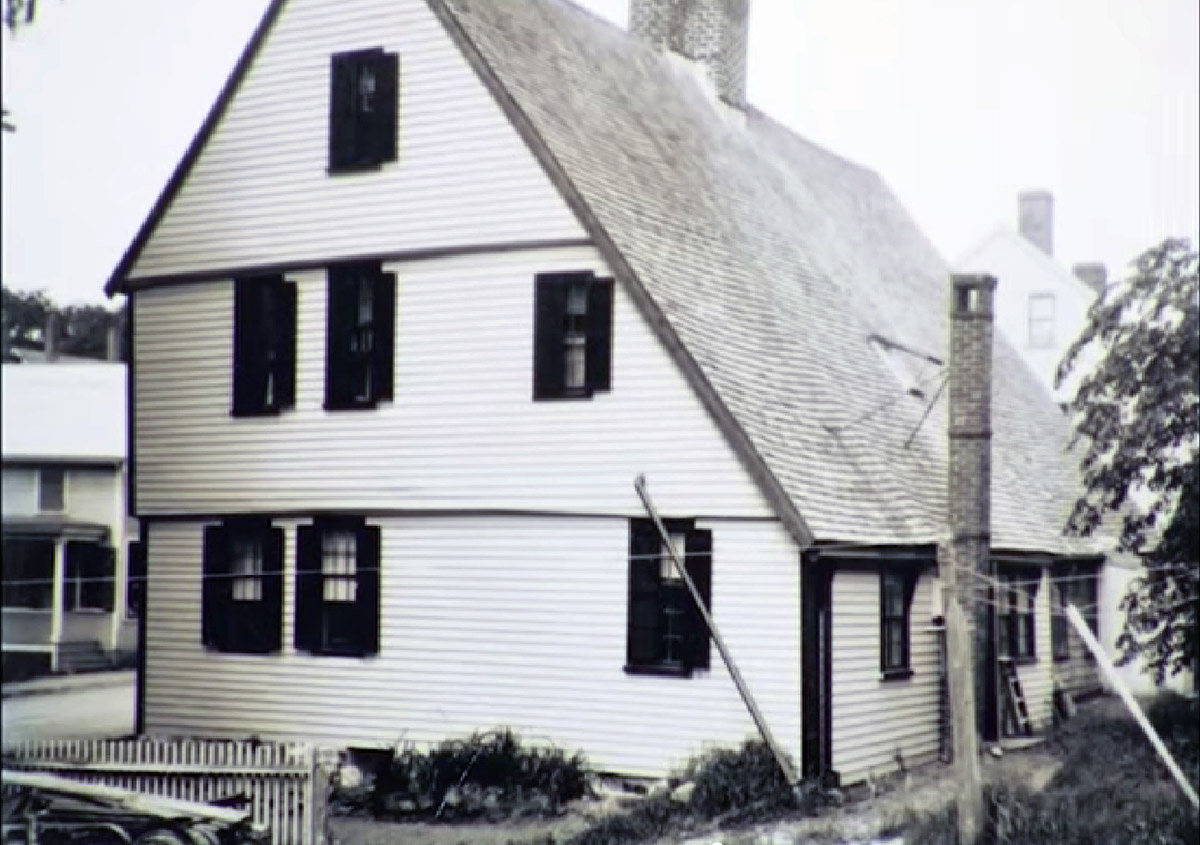
Matthew Perkins’ first house
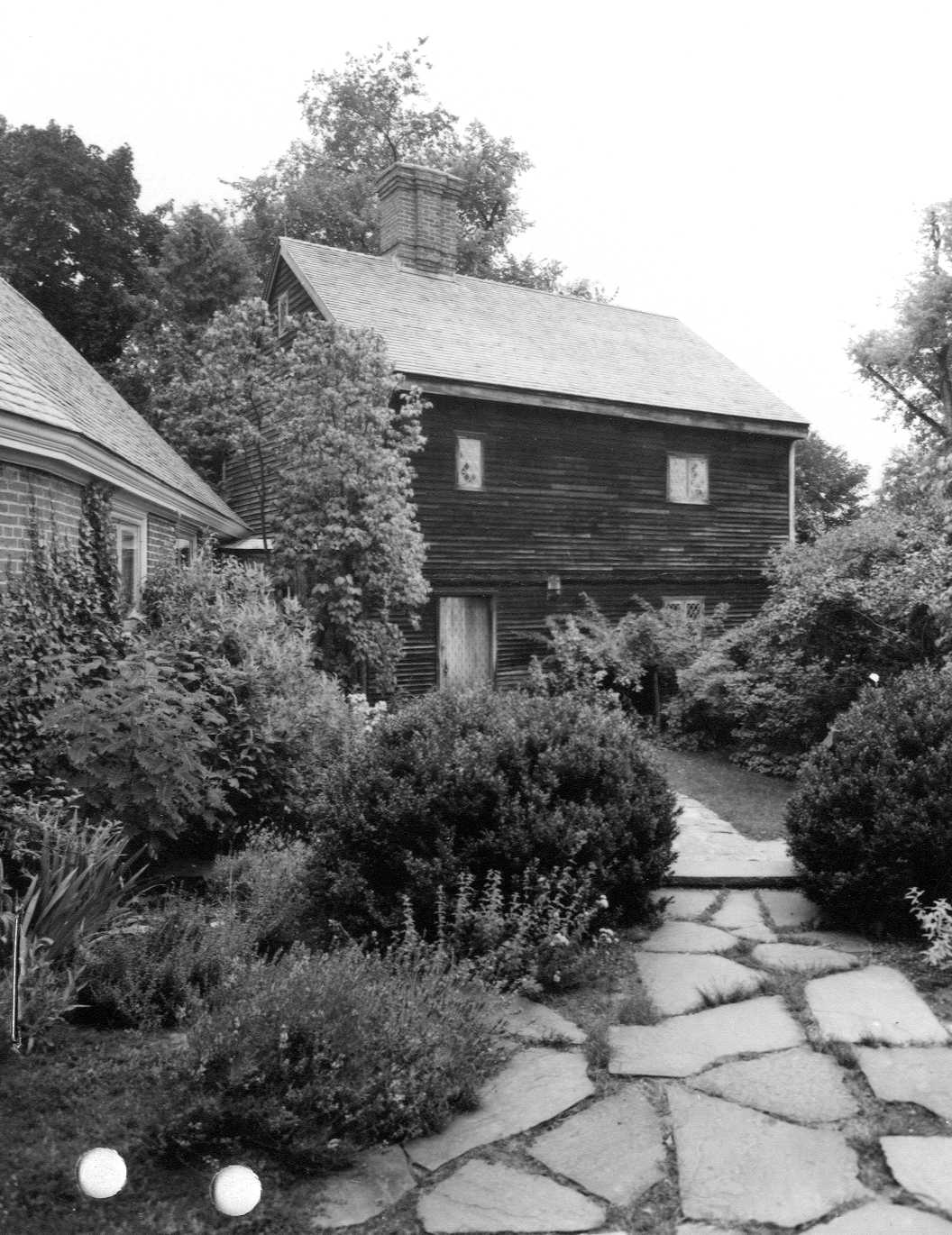
Captain Matthew Perkins’ first home was a two-room central chimney house constructed on East Street, beyond the intersection with Jeffreys Neck Road. Perkins conveyed the house in 1709 to his son, Matthew, Jr., after building the finer house at 8 East Street nearer the town. The house and some land came into the possession of Andrew Burley Esq. His inventory dated 1753, included “y” house and land that was Capt. Matthew Perkins” (Pro. Rec. 335: 419).
William Sutton of Peabody acquired the fifty-acre tract on October 24, 1870. Thomas Franklin Waters wrote that Gen. Sutton “made extensive repairs and enlargement of the ancient dwelling, and it attained such a modern look that its venerable age would never be suspected.”
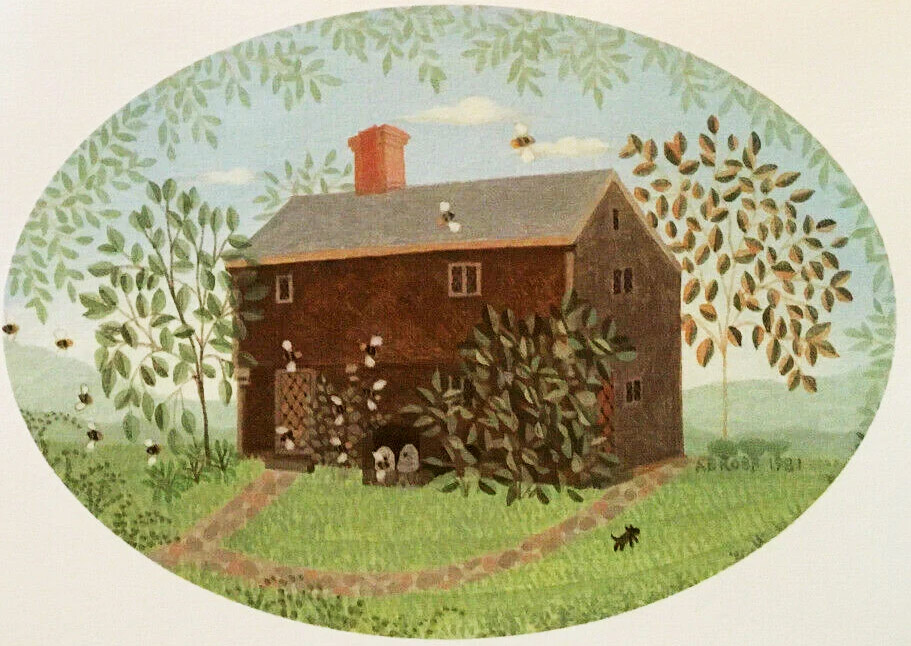
When the Perkins-Sutton house was dismantled in 1939, the original two-room section constructed by Matthew Perkins Sr. was reassembled on the grounds of the Concord Antiquarian Society. In 1989, it was moved from the Museum to a new location in Connecticut. (MACRIS listing).
Sources for the first Matthew Perkins House:
- Cummings, Abbot Lowell: Colonial Society of Massachusetts
- MACRIS
- Thomas F. Waters, Ipswich in the Massachusetts Bay Colony 1633-1700, p.401
- Russel H. Kettell, “The Reconstruction of the Captain Matthew Perkins House at the Concord Antiquarian Society”
- New York Times Machine, article about Concord
 Historic Ipswich