

This was the north end of town in the early days of the Ipswich settlement. The lot was first owned by Daniel Bosworth, a cowherd. His widow, Abigail, sold the lot with a dwelling in 1702 to William Baker (1655-1743). The house and land came into the possession of Richard Sutton Jr., who was born in 1736, (and thus was unlikely to have purchased the property before 1760). Sutton and his wife Elizabeth sold the house to Jeremiah Day in 1794.
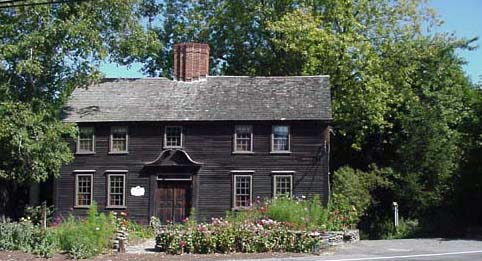
Exterior and interior structural evidence, including the integral lean, central chimney, the existence of an original facade gable, and the lack of chamfered or shaped interior beams and posts, suggests that the house at 115 High Street in Ipswich was built no earlier than 1725.
Renowned First Period expert Abbott Lowell Cummings visited the house very early in his career in 1956 and wrote, “Most of the surviving trim throughout the house, including the stairs, dates to the early 19th century. The east room (in particular) has a (*boxed) summer beam together with the remains of feather-edged paneling behind a wall of early 19th-century vintage, all of which suggests the possibility that the house is basically of the Second Period, “built perhaps before the Revolution, with an extensive overlay of later material.” The presence of an original facade gable on the east side suggests construction at the end of the transitional period from First Period to Georgian architecture, around 1725.
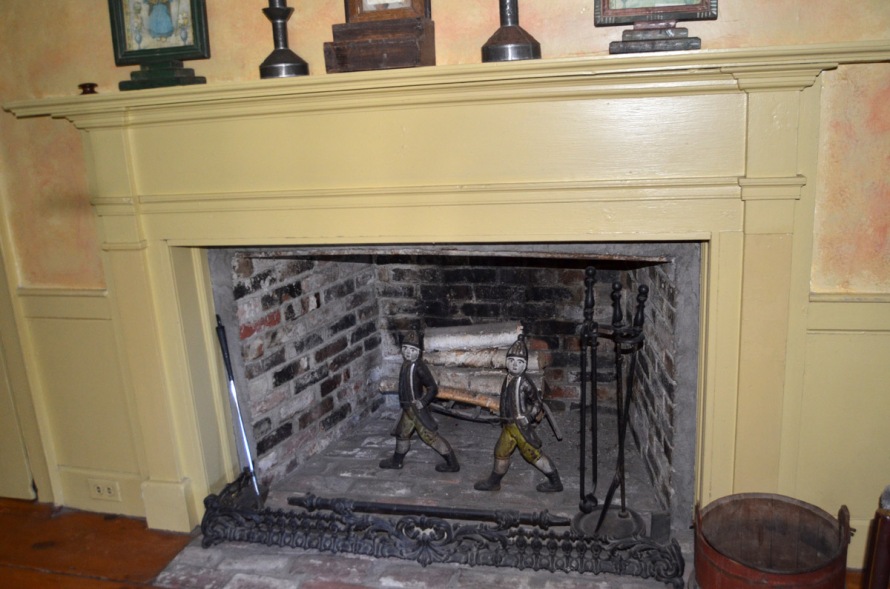
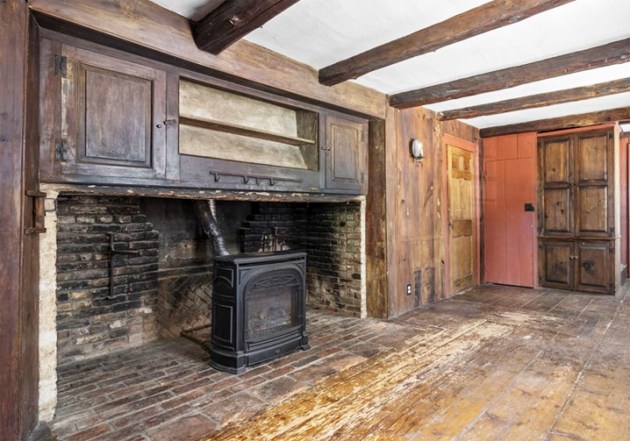
The house was restored in 1972 by Phillip Ross of Byfield. Ross installed an elaborate two-leaved Connecticut Valley doorway on the exterior, which he designed and built himself (and signed and dated). On the interior, he removed the later finishes that Cummings referred to and exposed the original finish and beams. He installed new or salvaged shadow-molded sheathing on the fireplace wall in the east room. The massive chimney stack rests on a base of modern bricks, and all fireplaces have modern mortar, suggesting that they were rebuilt or restored by Phillip Ross. The present exterior section of the chimney was constructed during the 1972 renovation.
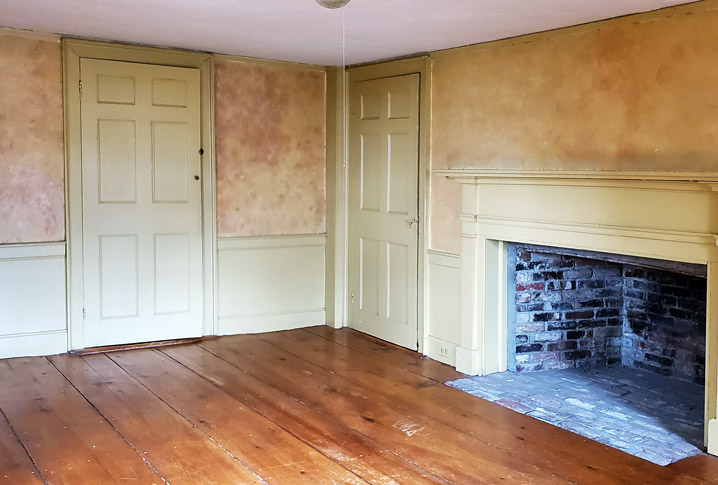
It is said that the house may have been moved about 50 feet from its original location when the bridge over the railroad was constructed in the early 20th Century, but this is not confirmed by earlier photos and maps. The vertical feather-edged paneling on the front wall appears to be original, predating the restoration. Much of the other finished details date to the Georgian or Federal periods. In the right front downstairs room, the plaster ceiling was removed, and the rough unchamfered summer beam was sheathed with beaded casings to provide the appearance of beams during the transition from the First to Second Period, approximately 1725. Most of the other rooms retain lower ceilings and what may be the original plaster

This lot was first owned by Daniel Bosworth, a cowherd. Being beyond the common fence, his house was the only dwelling on this side of the road for nearly a century. His widow, Abigail, sold the dwelling in 1702 to William Baker (16:61), a hatter and glover, who probably built the present dwelling. In the early-mid 18th century, a guild of hatters all lived on High Street in Ipswich, including Samuel Baker and Richard Sutton. William Baker, “glover in Ipswich”, wrote his will on 14 June 1731 and proved 19 September 1743, making bequests to his wife Anna, sons William Baker and John Baker, and his remaining children Sarah White, Mary Heard, Thomasin Abee & Margaret Stacey, with his son William & son-in-law Daniel Heard to be executors. Witnesses were John Appleton Jr., Samuel Waite, and Mary Appleton.
From Thomas Franklin Waters, Ipswich Village and the Old Rowley Road
“The wedge-shaped lot between the Rowley road and the road to Muddy River was owned in 1653 by Moses Pengry and subsequently by Haniel Bosworth, the cowherd, and here he dwelt. Every morning in Summer, he rose before the sun, and having received the herd of cows at Mr. Paine’s, now Dodge’s Corner, he and his helpers drove the herd with sounding horns and clanging bells up High Street and out into the great Cow Commons, where they watched them all day, and at sunset, brought them home again. His two daughters were seen wearing finery beyond their station in life and were summoned to court in 1675.
“The widow Abigail Bosworth sold her dwelling and about an acre of land to William Baker (1655-1743), Aug. 3, 1702 (16:61), and at that date, the sharp end of the wedge was owned by Richard Sutton. John Baker, son of William, succeeded in the ownership, but the Sutton family gained possession. Ebenezer Sutton sold the lot and buildings, measuring about two acres, to Jeremiah Day, on Dec. 27, 1794 (243: 3). William Gould bought the property, on July 10, 1826 (242:64) and sold half the house and part of the land to Timothy Ross, July 13, 1832, who acquired the remainder from Joseph Wait, Dec. 3, 1838 (310:113).
“When the Eastern Railroad was built in 1840, Mr. Ross was building a new house on the opposite side of the street still known as the “Ross house,” and conveyed part of his land to the Railroad Co. June 20, 1840 (320:27). He sold his former dwelling to Ebenezer Kimball, June 30, 1840 (320:59), and it came through several owners to Asa Lord, April 22, 1880 (1036:108), whose son, Thomas H. Lord, inherited. The building of the bridge over the railroad, with the elevation of the highway, has obliterated the original house lots and occasioned the removal of several of the dwellings from their original locations.”
Sources
- Thomas Franklin Waters, Ipswich Village and the Old Rowley Road, p. 11.
- Wikitree: John Baker
- Probate records for William Baker
- WikiTree: William Baker
- Form B study by Ann Grady for the Ipswich Historical Commission in 1986
- Form B study by Margaret Welden for the Ipswich Historical Commission 1978




 Historic Ipswich