
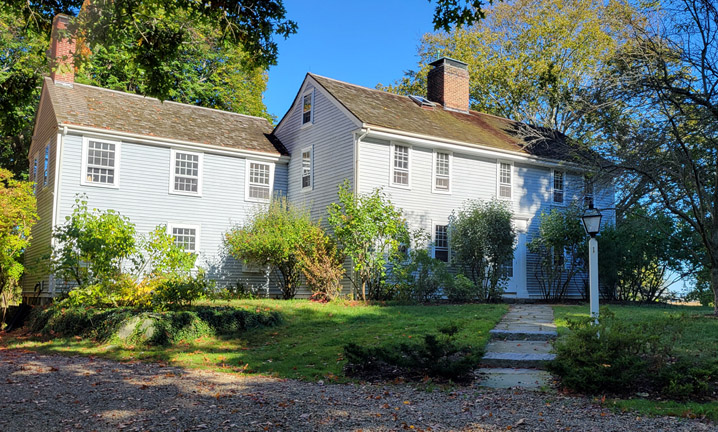

The 284-acre property at 51 Labor in Vain Road was formerly known as the Beloselsky estate and the Labor In Vain Road House. This private extension of Labor in Vain was the Beloselsky private driveway and connects via Fox Creek Rd. to Argilla Road. The oldest part of the house is believed to have been constructed around 1680 by Henry Bennett. The original part of the house is 5 bays wide, one room deep, and 2 1/2 stories high with a rear lean-to. The house was extended by an ell to the left rear c. 1810 and by a full lean-to dormer in the late 19th or early 20th century. A second ell of 2 stories and a screened porch were added to the rear, very likely in conjunction with the use of the building in the 20th century by the Crane family as the Labor-in-Vain Country Club.

First Period features, in the form of an exposed, decorated frame, are seen in the rooms constituting the original part of the house. The longitudinal summer beam, the chimney girt, the front (southeast) corner post, and the chimney posts have inch-wide flat chamfers and lamb’s tongue stops. A chimney post is embellished with a taper stop near the floor.
In the right-hand chamber, all the framing is exposed, with inch-wide flat chamfers and lamb’s tongue stops. Rising braces are exposed in the rear wall of this room, possibly indicating plank frame construction. The 18th-century entrance staircase is embellished with a molded handrail and turned balusters with a Georgian profile. Abbott Lowell Cummings conservatively estimated the construction date as around 1720, within the transitional period between the First Period and Georgian, when frames began to be boxed with beaded boards rather than exposed. From the last quarter of the 17th century until the transitional period, the houses of wealthy men often had beaded frames. The three earliest owners of this house, William Bennett, John Wainwright, and the Smith family, had considerable wealth. No dendrochronology study has been conducted to determine the actual date of construction.


The house retains Second Period trim on the fireplace walls in the right-hand room and left-hand chamber, including paneled cupboard doors in the downstairs room, raised-field paneling, and a bold bolection-molded fireplace surround in the upstairs room. Federal-period trim, including the mantelpiece, is found in the right-hand chamber and the c. 1810 wing to the left.

Henry Bennett
Henry Bennett (c.1629-1707), born in England, was in Ipswich by 1650, when he married Lydia, daughter of John and Judith Perkins, of Ipswich. She died probably before 1672, and he married, second, Mary (Smith) Burr, the widow of John Burr, who was her second husband. Her first husband was Philip Call, whose house still stands on High Street in Ipswich. Her father was Richard Smith of Shropham, Norfolk, England
Lydia Perkins Bennett was the daughter of John and Judith Gator Perkins of Ipswich, and was the mother of most or all of Henry Bennett’s children. The children of John Perkins and his wife Judith Gator included John (who identified himself as “Quartermaster”), Abraham, Jacob, Thomas, Elizabeth Sargent, Anna Bradbury, and Lydia Bennett.
Read: Descendants of John and Judith Gator Perkins of Ipswich. There are several early 18th-century gravestones of the Perkins family at the Old North Burying Ground.
Bennett’s Farm
In 1654, at about age 25, Henry Bennett bought from Jonathan Wade a farm of two hundred acres situated in what is now the southeastern part of Ipswich, bounded by Castle Neck Creek and the lands of Mr. Symonds, Mr. Saltonstall, and the Rev. Nathaniel Rogers. He occupied the farm on Labor in Vain Road for more than forty years. He was a voter in town affairs in 1679, was listed as a Freeman, and had the right of commonage. He obtained land on Hog Island and Plum Island when the town’s common land was divided among the commoners. Henry Bennett was frequently referred to as Farmer Bennet. Although he made many conveyances of
land, from 1672 to 1698, the name of his wife, Lydia, appears on none of his deeds; the first deed signed by his second wife is dated May 14, 1680.
The Loyal Petition of 1666
The year 1660, when Charles II came to the throne, ushered in a threat to the independent existence of the Massachusetts Bay Colony. When the King sent the “Clarendon Commissioners” in 1664 to examine how the Charter was being maintained, the Governor and General Court received them coldly, and in some instances openly defied them. Receiving the news, the King wrote that it was very evident to him, “that those who governed the Colony of Massachusetts believe that His Majesty had no jurisdiction over them…but can not appeal to His Majesty.” In 1666, Henry Bennett was one of 73 signers of the lengthy Ipswich Petition to the general court, disapproving of the action of Massachusetts authorities in opposing the king’s commissioners. They called for “perpetual care to be taken, lest by refusing to attend his Majesty’s orders for clearing pretenses unto right and favour in that particular, we should plunge ourselves into greater disfavour and danger.” The signature of Col. John Appleton headed the list of the Ipswich petitioners, arousing the indignation of the General Court, which ordered Appleton and leading citizens from other petitioning towns to appear for questioning and removed Appleton from his position as a member of the House of Deputies. The Town of Ipswich responded by reinstating Appleton. The town’s leader, Daniel Denison, supported the petition, while Deputy Governor Samuel Symonds, who was Henry Bennett’s neighbor, was aggressive in his opposition. Partisan feelings ran high during this lengthy episode.
William Bennett’s Will
In 1672, Henry Bennett’s brother William, a vintner of Bishopsgate, London, died and left Henry in his will one hundred pounds sterling. The collection of this legacy, through the officiousness of one of his neighbors, caused him considerable trouble. Harlakenden Symonds (son of Samuel Symonds, afterwards Deputy Governor), who appears to have been seeking an occasion to go to England, offered to collect this one hundred pounds for the modest commission of fifty pounds, which offer was of course refused. He then made a second proposal to collect the amount of the legacy for ten pounds, to which Bennet replied that if he employed him, he would give him ten pounds, and if he didn’t, he should be “at his liberty what to give him.”
Despite this slight encouragement, Symonds went to England and began negotiations with the executor of William Bennet’s will, but although he brought his highly respectable friends in Essex up to London to endorse him, he made no progress in the business for lack of proper authority to give a full discharge on payment of the money. He therefore wrote to Bennet for a letter of attorney, which he would not send him unless his father, Samuel Symonds, would become bound for him; this the elder Symonds declined to do.
Harlakenden Symonds, however, remained in England, waiting for the letter of attorney and keeping up the show of agency for Bennet, until he learned that the executor had paid the legatee’s bill of exchange in favor of a merchant in Boston. (*Henry Bennet’s inheritance apparently included a bill of exchange, perhaps an IOU or payment order that directed the payment of part of the inheritance to a merchant in Boston rather than being paid directly to Henry himself.) Soon after his return, Symonds brought a suit against Bennet for damages as well as services in which he was not successful. In his statement, sworn to in court, he says he was in England “for better than fifteen months, and was absent from New-England and the occasions of his family above one year and nine months.”
Indian Boy Lyonel
A suit was brought against Henry Bennett in 1684 by Daniel Epps, who owned the area around Castle Hill, for enticing away and harboring his Indian boy, Lyonel, who had come to Ipswich with his destitute mother and grandmother and camped on Wigwam Hill on Castle Neck. Thomas Franklin Waters’ telling of the story identifies the farm on Labor in Vain as belonging to Henry Bennett: “A young Indian lad was bound out to Mr. Henry Bennett, the owner of the farm east of Argilla. With a little company of Indians, a squaw, whose husband had been slain by hostile Indians near Lake Winnepesaukee, drifted down to Castle Hill, with her two little children and her old mother-in-law. She died not long after, leaving her children to the care of Captain Daniel Epes and his excellent wife. The younger boy, named Lionel after Captain Epes’s younger son, grew up in the family, but when he was a well-grown boy, his uncle Robin, a shiftless Indian who was in debt to Mr. Bennett, stole him away from Captain Epes and indentured him to Mr. Bennett.”
The court determined that the boy had been regularly indentured to Bennet by his grandmother and uncle, who had been living on Epps’s bounty, and had promised to give the boy to him. At the time, they were the last Indian family living in Ipswich. Mr. Epps lost the case and appealed to the general court, but probably did not prosecute the appeal. The indenture of the Indian boy bears the signature of Jacob Perkins, brother to Lydia, having signed as a witness, and Jacob Perkins, Jr. subsequently adding witness that he was present when it was signed.
Children of Henry and Lydia Bennett
Henry and Lydia Bennett had no daughters, but were the parents of:
- Jacob Bennett (1651 – abt. 1685)
- John Bennett (1655 – 1675) was killed by Indians at Bloody Brook, Sept 18, 1675
- William Bennett Sr. (1657 – bef. 1722)
- Henry Bennett (1664 – 1739) died in Portsmouth. Married, May 20, 1685, Frances, daughter of John and Mary (Smith) Burr. He married, second, Margaret. His children were Mary, b. March 3, 1685-6, Frances, b. Sept. 8, 1694, Margaret, b. March 22, 1697-8, Joanna, b. Oct 7, 1701, Lucy, b. Nov. 29, 1703.
- Thomas Bennett (abt. 1666 – 1701). In 1692, his father deeded to him a small portion of his farm, which the widow, as administrator, sold in small lots at various times from 1703 to 1707. It is not known that he had any children
- Stephen Bennett (1668 – 1680)
- Benjamin Bennett (abt. 1669 – 1722) died in Ipswich
Jacob Bennett
Jacob Bennett, son of Henry and Lydia, was born in 1651. He married about 1675, Sarah Buckley, who was born on 6 April 1652 to William Buckley of Salem and his wife Sarah, who was brought from England to Ipswich as a child with her parents, Thomas and Joanna Smith, in 1638. Sarah (the mother) was accused of witchcraft in 1692 and was acquitted in January 1693. Read the story.
Jacob’s father, Henry Bennett, conveyed to him by deed of gift, March 1, 1682-3, fifteen lots of upland and marsh on Hog Island, now known as Choate Island. He may have occupied this farm for some years before he came into possession and built his home on it. According to the Bennett Family of Ipswich, Jacob was walking with his father a short distance from his house, fell forward on the ice and groaned, but spoke no word, and was presently quite dead” on March 5, 1685-6.
Sarah Buckley Bennett outlived her husband, Jacob. After Jacob’s children had come of age, they joined with their mother in deeding their patrimonial estate, which then comprised twenty-one lots as originally laid out, to Captain Thomas Choate, who had long been a resident of the island, on March 4, 1704. Sarah died the following year (1705).
The children of Jacob and Sarah Bennett were Jacob, b. Oct. 9, 1676, Sarah, Stephen, Mary, and Ebenezer, born June 20, 1686; died young.” Jacob Bennett was an ancestor of the late Captain Parker Burnham, whose mother’s maiden name was Hannah Bennett. The 1731 Bennett House-Caldwell House at 11 County St. was constructed by Jacob Bennett’s grandson Joseph Bennett.
The Early Owner of This Property
Jonathan Wade’s Grant
Jonathan Wade received a grant in 1641 of “two hundred acres at Cheboko, having Mr. Winthrop’s farm on the northwest, Mr. Samuel Dudley’s northeast, and a creek called Chebacco Creeke on the Southeast.” On April 1, 1654, he made an ” indenture” to Henry Bennet of “his farm called and known by the name of said Wade, his farm, and given him by ye town of Ipswich.” It was bounded by the land of Mr. Samuel Symonds on the north, the land of Mr. Saltonstall on the east, and of Mr. Rogers on the west, and a creek on the south containing about two hundred acres with houses, etc.”9″
In 1698, at about the age of 69, Henry Bennett sold his large farm to John Wainwright Sr. for £800 (12:157), an unusually high sum. Bennett died in 1707. The deed included two hundred acres with dwelling houses, barns, etc., and the description of its boundaries was as before, except that it is specified that Major Saltingstall’s farm is “now in ye tenure of Isaack Fellows.” (View source)
Later Owners of this Property
John Wainwright
John Wainwright, son of wealthy Francis Wainwright, was a merchant whose large estate on East Street extended to the wharves, with a spacious mansion. He also owned a farm at the end of Town Farm Road, which he leased to Samuel Cars of Hampton on May 27, 1700. When John Wainwright’s will was probated in 1708 (Probate Records 310; 19-21), the estate was valued at £20,000. He is interred under a large horizontal marker at the Old North Burying Ground.
Col. John Wainwright Jr.
In John Wainwright Sr.’s will, he bequeathed his land to his sons Samuel and John. Samuel inherited his father’s East Street house, and John Jr. received Bennett’s Farm. In 1726, John Jr. initiated the construction of a new house on East Street. Col. John Wainwright was born in 1691, was a Harvard graduate, served as Clerk of the House, and became a Justice of the Court and Common Pleas. He was chosen Town Clerk in 1719-20 and held the office for many years. He died on Sept 1, 1739, at age 48, leaving his wife, Christian Wainwright, a widow with children and considerable debt. In 1741, the estate of Col. Wainwright was probated by Rowland Houghton. The widow Christian conveyed “one acre of upland situated within Bennet’s Farm so called, now in the possession of Stephen & Jacob Smith in Ipswich.” (Salem Deeds 81:182). She acquired a house on North Main Street to raise her children, and the great wealth that had passed from Col. Francis Wainwright to his sons and grandsons was depleted.

John, Stephen & Jacob Smith
Before 1721, John Wainwright sold part of his farm to John Smith (1654-1737). In 1730-1, John Smith and others of “Little Chebacco,” as the Argilla neighborhood was often called, petitioned for a school in their neighborhood (Waters Vol. II, p 283).
John Smith’s sons, Stephen & Jacob Smith, “husbandmen,” purchased Bennett’s Farm from the administrator of John Wainwright’s estate, Rowland Houghton, for £100.00 for the payment of Wainwright’s debts in November 1740 (Salem Deeds 81:183). This was far less than the £800.00 John Wainwright Sr. had paid Henry Bennett in 1698, perhaps because Wainwright had already begun dividing the estate, but it suggests that the William Bennett house had not been replaced or greatly improved.
Stephen Bennett had previously owned land in the vicinity of Bennett’s Farm. On January 16, 1722 Stephen Smith “yeoman” sold to Joseph Bennett (one of Henry Bennett’s sons), “in consideration of seventeen pounds money by Joseph Bennett” all his rights in housing and land “that did formerly belong or appertain unto Thomas Bennet Sr. late of said Ipswich which the said Smith bought of Thomas Bennett Jr., son of aforesaid Thomas, which lands are scituate lying and being in Ipswich and are part of that farm formerly called Bennet’s farm, bounded as followeth, northerly, easterly, and westerly upon lands formerly Col. John Wainwright’s and now in possession of John Smith Sen. of said Ipswich and southerly upon land of Robert Kinsman, containing in the whole seven acres…which I purchased from said Joseph Bennett (Salem Deeds 41:23).
Jacob Smith died March 4, 1789, at age 92 years, and is buried at the Old North Burying Ground (map D-10) beside his wife Lydia (map D-11), who died in 1772 at age 77. Stephen Smith died Oct. 29, 1744, and his wife Prudence died in 1721, at age 34 (map C-177). His house is still standing on Argilla Road.

John Choate
It is unknown how long the Smith family owned the farm, but the 1832 Ipswich map shows this location as “John Choate’s Farm.” Thomas Franklin Waters wrote that the area between Argilla Road and Essex Road was originally granted by the Town to John Winthrop Jr. Part of the Argilla farm came into the possession of John Choate before 1832, was inherited by his heirs, and later by Nathaniel Kinsman and his heirs. The 1910 Ipswich map shows the owner as E. M. Haskell. The Haskell heirs sold it to Richard Teller Crane.

Sources and Further Reading:
- Anne Grady, for the Massachusetts Historical Commission, 1986. View MACRIS
- The Bennett Family of Ipswich by John M. Bradbury
- Ipswich Bennett: Y-DNA Project for Descendants of Henry Bennett of Ipswich
- WikiTree: Henry Bennett
- Hammatt Papers: Early Inhabitants of Ipswich, Massachusetts
- Waters, Thomas: Ipswich in the Massachusetts Bay Colony Vol. 2, pp 232, 739
- Vital Records of Ipswich, MA to the year 1849
- Colonial Society of Massachusetts: Notes on the Wainwright Family by Albert Matthews
- Vital Records of Ipswich, MA to 1849
- Waters, Thomas Franklin: Publications of the Ipswich Historical Society, Vol. IX The Old Argilla Road
- Ipswich Bennett Y-DNA Project
- The Family of John Perkins of Ipswich, Massachusetts
- Henry Bennett History and Related Houses in Ipswich
Deeds:
- Ipswich Deeds 1:228: Jonathan Wade to Henry Bennet
- 1698, Henry Bennett to John Wainwright (12:157)
- July 5, 1903: Everett K. Brown, guardian to Adeline Haskell, (Salem Deeds book 1711, page 436) (adjoining land)
- October 9, 1923: Edward M. Haskell to Rena Haskell (Salem Deeds book 2583, page 300)
- January 12, 1924: Rena Haskell to Richard T. Crane (Salem Deeds book 2585, page 421)
- Ipswich Deeds: Volumes 1 and 2 by George Freeman Sanborn Jr.
Vital records of Ipswich, Massachusetts, to the end of the year 1849
BENNET (Bennet, Bennet, Bennit) CR = Church Records
Abbreviations: CR1 – First Congregational Church. CR2 – South Church. CR3 – Linebrook Parish Church. CR4 – Chebacco Parish Church. CR5 -the Hamlet Parish Church. CR6 -Methodist Church. CR7 – Fourth Church (a Separatist church in Chebacco).
Births
Aaron, s. Benjamin and Mary, bp. Aug. 25, 1728.
Abigail, d. Benjamin and Elizabeth, bp. Aug. 17, 1745.
Abigail, d. Henry and Abigail, bp. Oct. 13, 1734.
Daniel, s. Stephen and Mercy, bp. Sept. 8, 1728.
David, s. Aaron and Bethiah, bp. June 14, 1752. CR7
Ebenezer, s. Jacob and Sarah, June 20, 1686
Ebenezer, s. Stephen, deceased, and Mercy, bp. July 8, 1733.
Eleanore, d. William and Sarah, bp. June 30, 1728. CR4
Elizabeth, d. Joseph and Elizabeth, bp. Aug. 16, 1724.
Eunice, d. John and Sarah, bp. Aug. 15, 1731.
Frances, d. Henry and Margaret, Sept. 8, 1694.
Frances, d. Henry and Margarett, Apr. 8, 1694.
Frances, d. Stephen, bp. Sept. 30, 1716. CR5
Francis, s. Stephen and Mercy, bp. July 22, 1728.
Hannah, d. Joseph, bp. Apr. 12, 1761. CR2
Isaac, s. William and Sarah, bp. Mar. 19, 1737-8. CR4
Jacob, s. Jacob, Oct. 9, 1676. CTR
Jane, d. William and Sarah, bp. Oct. 27, 1734. CR4
Joanna, d. Henry and Margarett, Oct. 7, 1701.
Job, s. twin, William and Sarah, bp. May 7, 1727. CR4
John, s. Aaron, jr., bp. Oct. 15, 1752. CR7
John, s. John and Sarah, bp. July 5, 1724.
John, s. John, bp. Mar. 14, 1741-2. CR5
Joseph, s. _, bp. July 20, 1728.
Joseph, s. Joseph and Elizabeth, bp. Nov. 14, 1725.
Joseph, s. Stephen and Mercy, bp. May 9, 1731.
Joseph, s. Stephen, bp. May 3, 1730.
Lucy, d. Henry and Margarett, Nov. 29, 1703.
Lucy, d. John and Sarah, bp. May 13, 1733.
Lydia, d. Joseph and Mary, bp. Oct. 13, 1728.
Lydia, d. William and Sarah, bp. July 2, 1732. CR4
Margarett, d. Henry and Margarett, Mar. 22, 1697.
Mary, d. Henry and Frances, Mar. 3, 1685.
Mary, d. John and Sarah, bp. July 4, 1736.
Mary, d. Joseph, deceased, and Mary, bp. June 13, 1731.
Mary, d. Steven, bp. Jan. 11, 1718-19. CR5
Mary, d. Thomas and Mary, bp. July 30, 1721.
Mary, d. William and Sarah, bp. July 26, 1730. CR4
Mehetabel, d. Benjamin and Abihall, May 4, 1700.
Sarah, d. John and Sarah, bp. July 3, 1726.
Sarah, d. Joseph and Sarah, bp. Nov. 23, 1755.
Stephen, jr., bp. Mar. 20, 1725.
Stephen, s. Joseph and Sarah, bp. Feb. 25, 1758. [Feb. 26. CR2]
Stephen, s. Stephen and Mercy, bp. Aug. 7, 1726. CR4
Stephen, s. Stephen and Susanna, bp. June 3, 1722.
Stephen, s. Stephen, bp. July 31, 1726.
Steven, s. Stephen, bp. Aug. –, 1720. CR5
Susannah, d. Stephen and Susannah, bp. 21: 7m: 1712.
Thomas, s. Henry and Mary, bp. Sept. 21, 1729.
Thomas, s. Thomas and Mary, bp. Mar. 8, 1719.
William, s. twin, William and Sarah, bp. May 7, 1727. CR4
William, s. William and Sarah, bp. Dec. 26, 1736. CR4
Marriages
Benjamin, of Manchester, and Martha Burnham, Apr. 7, 1768.*
David, and Rebekah Buller, at Rowley, Feb. 14, 1682.
Elisabeth, and Isaac Sands, Oct. 16, 1770.*
Elizabeth, and Benjamin Hodgkins, int. Oct. 18, 1740.
Frances, and James Clarke, Sept. 20, 1739. CR5*
Hannah, and Enoch Burnham, Feb. 11, 1779.*
Henry, and Abigail Silby of Salem, int. Nov. 18, 1732.
Henry, and Frances Barr [Burr. CTR], May 20, 1685.
Henry, and Mary Giddings, Oct. 12, 1727. CR5*
Jacob, and Lydia Bragg, int. Aug. 27, 1709.
Jacob, and Mary Pearce of Manchester, int. 8: 4m: 1706.
James, and Sarah Dodge, July 3, 1751.*
John, and Sarah Proctour, int. May 11, 1723.
John, Jr., and Sarah Fellows, int. Mar. 30, 1754.
John, of Rowley, and wid. Elizabeth Perkins, June 17, 1730.*
Joseph, and Mary Jewett, int. Nov. 18, 1727.
Joseph, and Mrs. Sarah Morss of Holliston, int. Nov. 30, 1754.
Lydia, and Aaron Stephens, int. Mar. 2, 1722-3.
Lydia, and Seth Davis of Barnstable, int. Oct. 15, 1720.
Lydia, of Beverly, and Matthew Coy of Wenham, Dec. 14, 1730.
Mary, and Eliphalet Wood of Norwich, May 22, 1746. CR4*
Mary, and John Bragg, May 28, 1711.*
Mary, and Nathaniell Knoulton, Jr., Apr. 29, 1703.*
Mary, and Solomon Lakeman, Jr., int. June 13, 1744.
Mary, wid., and Joseph Burnum, Jan. 3, 1736.*
Mary, wid., and Solomon Lakeman, int. Mar. 3, 1732.
Moses, of Manchester, and Rachel Rust, Feb. 15, 1738-9. CR4*
Sarah, and Stephen Adams, Sept. 25, 1770.*
Sarah, and Thomas Richards, Nov. 21, 1727.*
Stephen, and Mercy Merrifield, int. Sept. 11, 1725.
Stephen, and Susannah Fuller, int. 24: 7m: 1709.
Stephen, Jr., of Topsfield, and Elizabeth Clark, int. Dec. 20, 1746.
Susanna [Mrs. int..], and Samuel Low, 3d, both of the Hamlet, Apr. 19, 1770. CR2*
Susanna, and Simon Browne, Dec. 23, 1734. CR5*
Thomas, and Mary Wells, int. 23: 9m: 1717.
William, and Abigail Biggsbee, int. Apr. 20, 1720. CR4
William, and Sarah Giddings, int. Dec. 23, 1721. CR4
William, of Manchester, and Lydia Whittington of Beverly, Aug. 26, 1729.
William, of Sandown, and Prudence Andrews, Oct. 19, 1779.
Deaths
Aaron, numb palsy, at Manchester, Oct. 22, 1780, a. abt. 75 y. CR4
Abigail, wid., Feb. 17, 1754. CR3
David, unm., Feb. 7, 1728.
Elizabeth, wid. Thomas, Sept. 21, 1731.
Eunice, d. John and Sarah, Jan. 22, 1737.
Jacob, Apr. 9, 1733.
John, s. John and Sarah, Jan. 3, 1737.
John, “one of the Towns poor,” Jan. –, 1805.
John, general decay, at the poorhouse, Jan. 28, 1805, a. 81 y.
Joseph, Mar. 29, 1731.
Lydia, w. Jacob, Nov. 27, 1728.
Lidia, Apr. 18, 1751.
Mary, w. Henry, Nov. 9, 1730.
Mary, d. John and Sarah, Jan. 22, 1737.
Mary, wid., Feb. 1, 1749.
Molly, Oct. 20, 1815, a. 86 y.
Sarah, d. John and Sarah, Jan. 27, 1737.
Sarah, wid. May 28, 1796, a. abt. 62 y. CR4
Sally, unm. lung fever, Feb. 8, 1810, a. 54 y. 3 m. 4 w. CR4
Stephen, “latter end of” July, 1680. CTR
Stephen, Oct. –, 1747.
Thomas, s. Joseph and Elizabeth, July 9, 1724.
Abiell, unm., Nov. 23, 1722.
Benjamin, May 31, 1722.
Daniel, s. Benjamin, Nov. 15, 1722.
Elizabeth, w. Joseph, Feb. 13, 1725.
Jacob, Mar. 5, 1685.
Joseph, s. Joseph, July 20, 1726.
Mary, w. Henry, “before the widow of Mr. John Burr, also the former Wife of Mr. Phillip Call.” Jan. 12, 1707-08.
Related Posts:
 Descendants of John and Judith Gator Perkins of Ipswich - John Perkins, who identified himself as "the Elder," and his wife Judith Gator were the immigrant ancestors of the Ipswich Perkins family from the mother country.… Continue reading Descendants of John and Judith Gator Perkins of Ipswich
  Historic Ipswich
Thank you from the great grandson of Sir Edward Bennett of Virginia and Massachusetts from the 1600s
This is my families house there as a historical site the same as Virginia governor Richard Bennett that was around
Also.
And much more all the to the river named Bennett Creek in Virginia the home for the Bennett family and also
Bennett welcome or Bennett plantation.
The family Started North America.
Hi I meant my name is
Marc Bennett
I am the relation to Sir Edward Bennett,
From Virginia of the 1600s
Hi Ian Marc Bennett
The grandson of Sir Edward Bennett of Virginia and Massachusetts from 1600s
I wish to learn the history of the name “Labor in Vain”. I understand there is a creek, a road, and a house of that name.
Henry Bennett was my 8th great grandfather. There is a website called Ipswichbennett. com where many of Henry ‘s dna tested descendants have connected. Check it out if you think you might be related to us.