


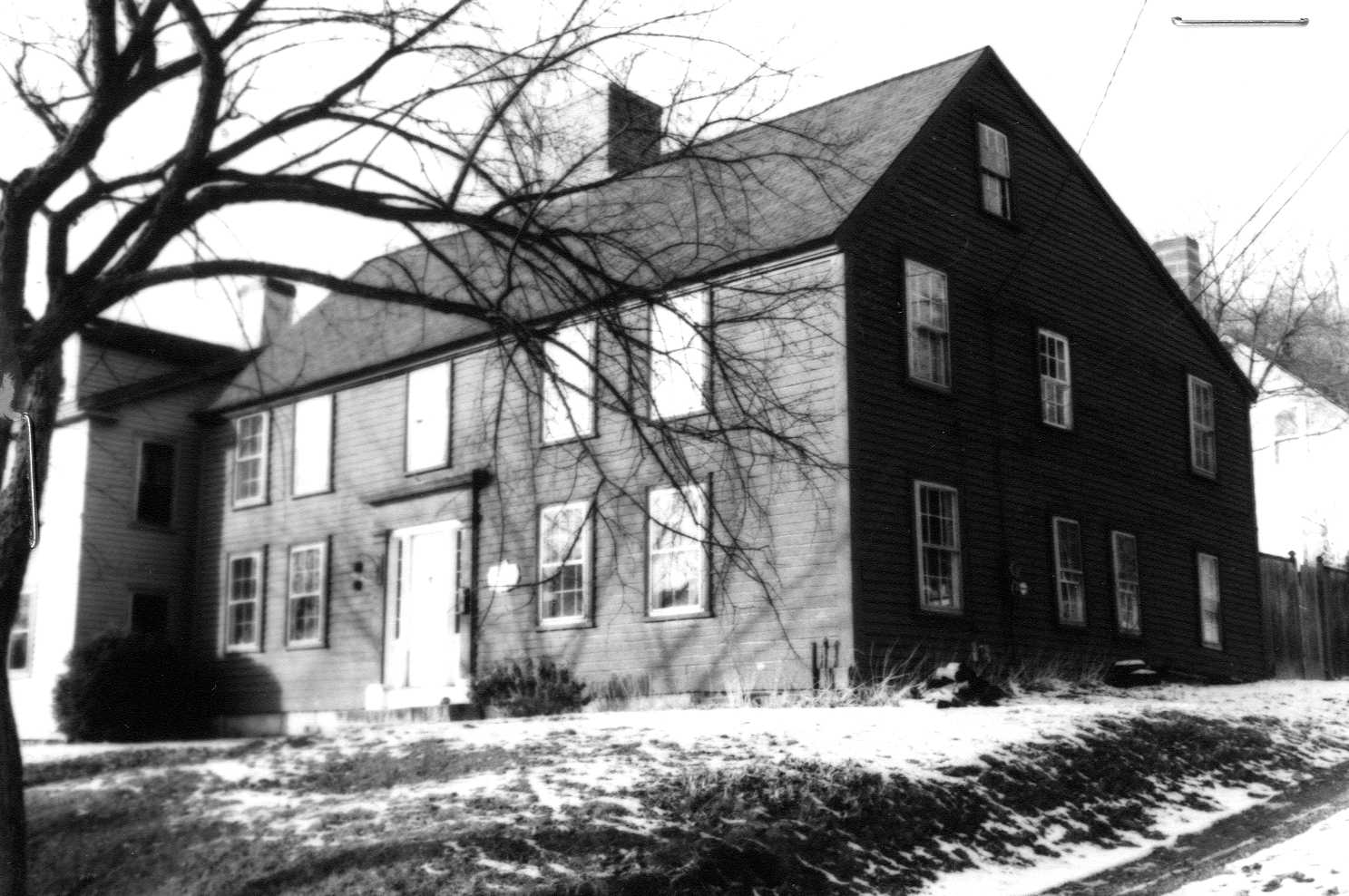
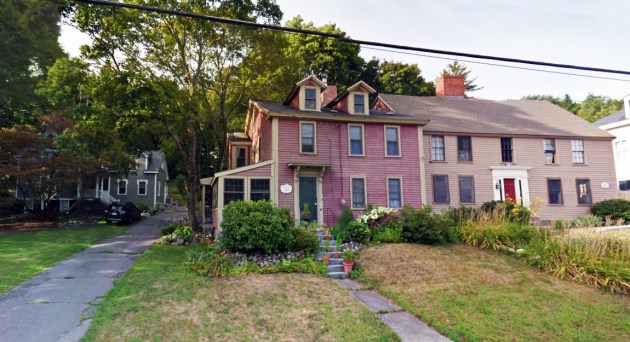
The Ipswich Historical Commission awarded the Mary P. Conley Preservation Award in August 2025 to Tracy and Greg Hendrickson, owners of the historic Edward Brown House at 27 High Street.
Edward Brown came to Ipswich with the original settlers, married Faith Lord, and served as a marshal for the town. This house, and the later house almost abutting it on the west, were owned by descendants of Edward & Faith Brown well into the 19th Century. John Brown, third generation, created a large farm in the Candlewood area, and two of his descendants’ homes are still standing.
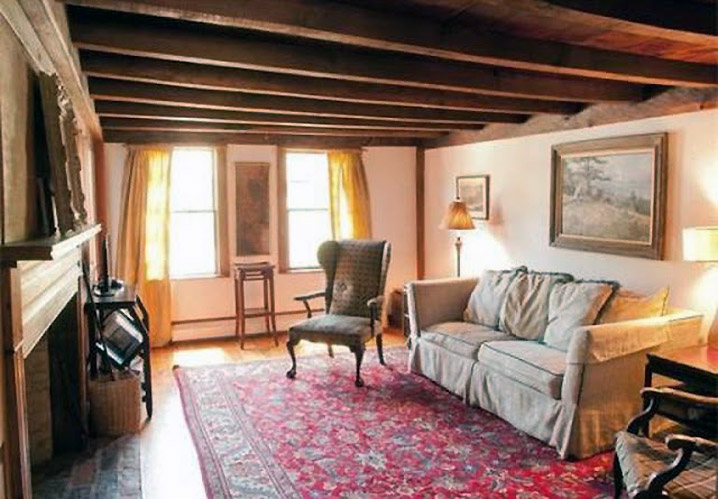
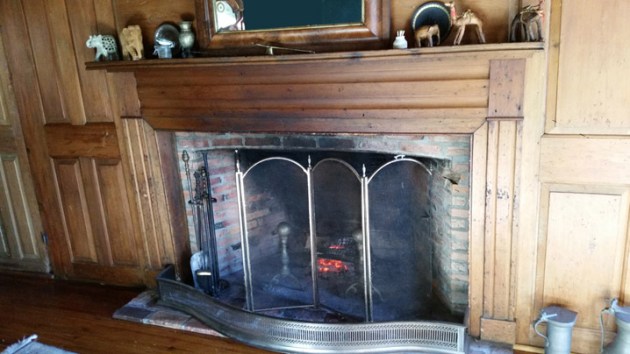
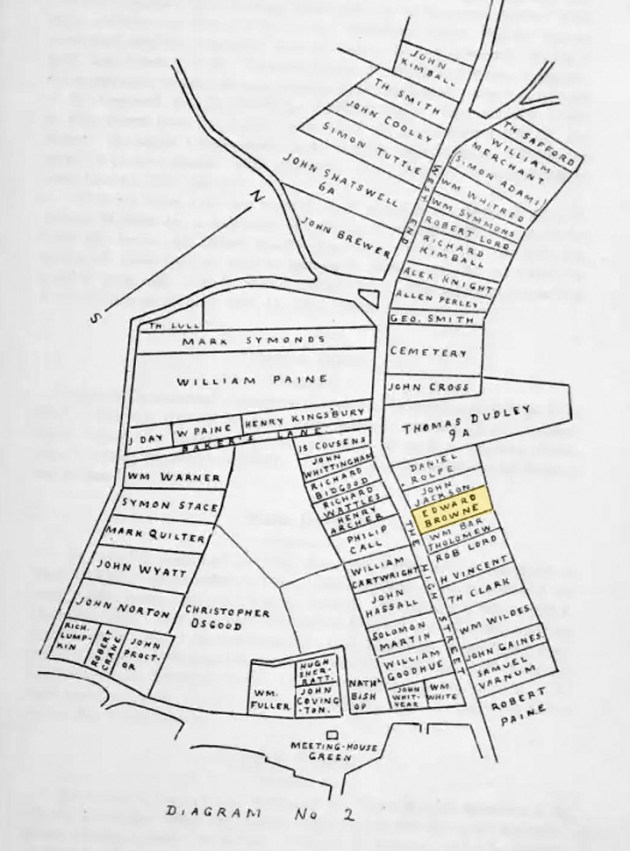
The east side of the house at 27 High St. is a one-room over-one-room floor plan and may have been constructed by Edward Brown, who was allocated the lot in 1639 and died in 1659. The summer beam in the downstairs room of that side has flat bevels; irregular saw marks on the floor joists above it indicate the use of a pit saw. The beams and posts in the second-floor room above it are cased and thus have not been investigated for their age. The left side of the house and the leanto were added in the 18th century. A visit to the attic reveals that the chimney was constructed with different-sized bricks in three stages, the east side being the oldest. The original rear rafters of the house remain in place, with the shed rafters above them.
17th century structural elements
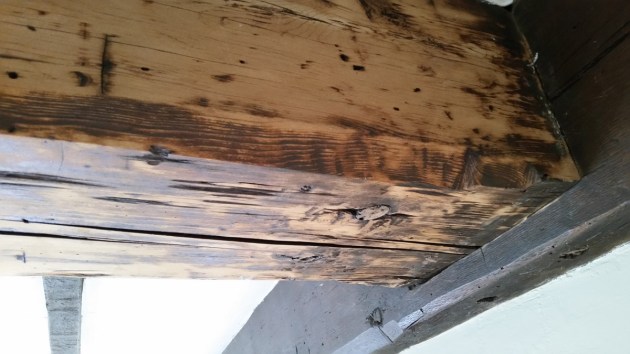
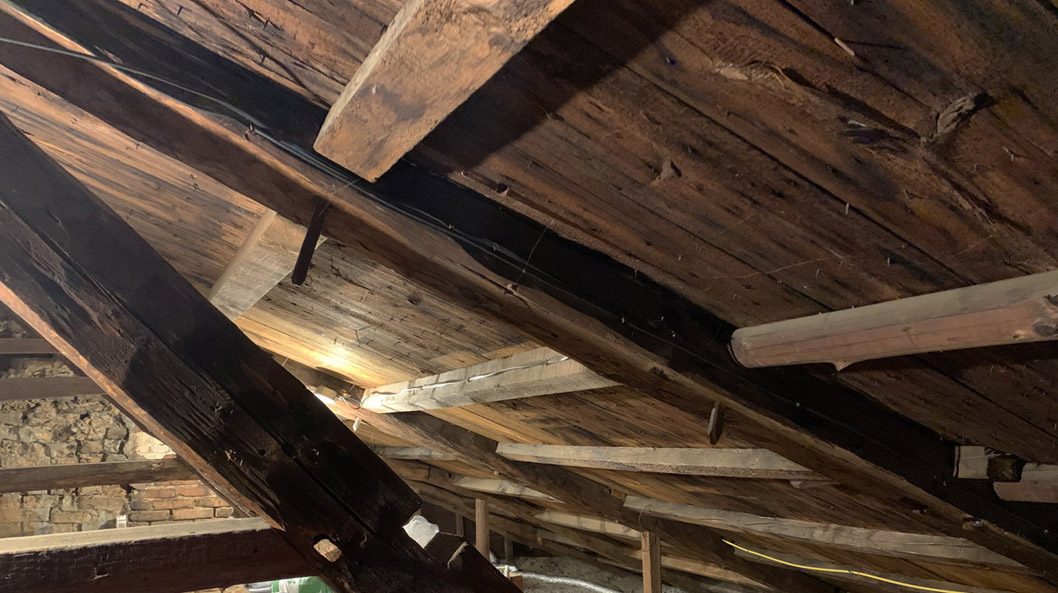
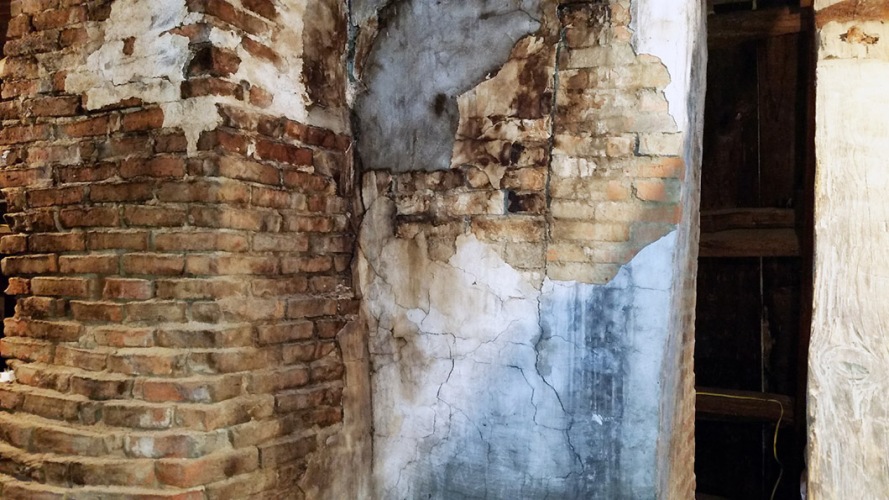
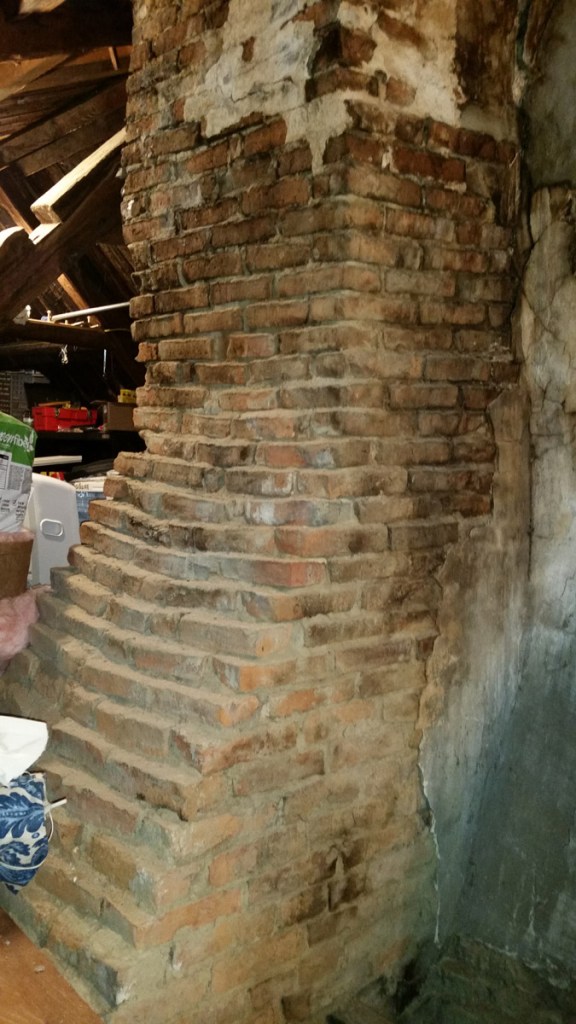
18th-century structural elements
It is not clear when the lean-to (saltbox) extension was added. In the mid-18th century, the west side of the house was built, completing the common central chimney, two-over-two configuration. The rear lean-to was extended to the new length, greatly increasing the depth of the house. Most of the present trim dates to the 18th and early 19th centuries. Significant architectural features of this house are said to be protected by an agreement between the owners and the Ipswich Historical Commission.
Owners of the lot
Edward Brown (through 1659)
Edward Brown came to Ipswich with the original settlers and married Faith Lord. Although he served as a Marshal of Ipswich, he and several other men were brought to court because their wives were seen wearing finery above their station. Puritan law required one to prove 200 pounds in savings to justify such extravagances. He made his will on Feb. 9, 1659, to his wife, Faith; sons Thomas, Joseph, and John; and daughters, although their names were not mentioned, and his brother Bartholomew, of whom he purchased the land on which this house sits.
Thomas Franklin Waters wrote about the Edward Brown house in his book, Ipswich in the Massachusetts Bay Colony Volume I: “The Edward Brown lot of one acre was southeast from (Simon) Bradstreet. He had a son, John, who resided in Wapping, England, in 1683, when he sold land in the common fields left by his father Edward (Ips. Deeds 4: 533).
From the Probate records of Essex County, Massachusetts: “Edward Browne was of Ipswich, a colony of Massachusetts Bay, between 1654 and 1660, and is the same who, from 1656 to 1659, bore the title of ‘Marshall’ Browne, indicating the office he held in the colony. He died February 9, 1659-60, in Ipswich, leaving a will which read, “My will is that after my said wife’s decease, my son Joseph shall have and enjoy my dwelling house & appurtenances & privileges belonging there unto, together with all the rest of my land & meadow.”
The will mentions his wife Faith and his brother Bartholomew, and his estate was appraised at a little more than £250.00. By comparison, the cost of Massachusetts houses constructed during that era ranged from £12 for modest homes to £200 and more for finer ones (“Prices and Wages by Decade“). Edward Browne’s widow survived him and married second, July 1, 1660, Daniel Warner.” (Genealogical and personal memoirs relating to the families of Boston and eastern Massachusetts).
2nd Generation, Joseph Brown (through 1694)
The widow Sarah Caldwell’s deed to her son, Dillingham, describes the eastern boundary as “land formerly Joseph Brown’s.” Joseph Browne, son of Edward and Faith Browne, born about 1639, was a turner, living in Ipswich. He married in Ipswich on February 27, 1671, Hannah Asselbie, who survived her husband; he died on September 30, 1694. His estate was inventoried at two hundred seventy-five pounds five shillings, having not improved significantly over that of his father. In 17121, the estate was divided between their sons, John and Benjamin. (Probate records 313: 559, 560).
Third Generation, John Brown (through 1758)
Children of Joseph Brown, all born in Ipswich:
- 1. Joseph, born February 18, 1672-3. He was a cordwainer and was still living in 1742.
- 2. John, March 12, 1674; yeoman and turner; died May 7, 1758. John inherited the house.
- 3. Hannah, February 26, 1675-6; married Simon Pinder before 1721, but she was a widow in 1740.
- 4. Thomas, December 26, 1678.
- 5. Elizabeth, who married John Holland on November 5, 1701.
- 6. Lieutenant Samuel, house carpenter; married Martha Jacobs of Ipswich (published February 21, 1708). He died August 16, 1763.
- 7. Benjamin, yeoman and miller. He bought three-quarters of the Adams and Farley mill in 1732; married Elizabeth, widow of Thomas Foss, and died February 16, 1733-4.
- 8. Sarah, married Richard Rindge in 1716; was a widow in 1741.
Fourth generation: Daniel Brown (through 1796)
John Brown, Turner, granted in his will, proved in 1758, to Elizabeth, his wife, “all the household goods she brought to me, and all the linen she hath made since I married her, to be at her Disposal.” To his son John, the improvement of the two lower rooms and the northeast chamber, and some real estate; to his daughter Esther Adams, and the children of his daughter Mary Lord, the household goods; and all the residue of real estate to his son Daniel (Probate Records 335: 229). In his will, the house, barn, and land were valued at £60 (Probate Records 336: 17). Daniel Brown bequeathed the improvement of his property to his widow Hannah, during her life or until her second marriage.
Fifth generation: Daniel Smith (through 1844)
Daniel Brown made his nephew, Daniel Smith, his sole heir. The will was approved on Jan. 4, 1796 (Probate Records 364: 232). Daniel Smith’s will, proved in 1844, provided for the division of his estate among his sons, Daniel Brown Smith, Thomas, and Benjamin, and the Probate Record contains this interesting item: ‘Daniel Smith was a Revolutionary pensioner, that he died on the 28th day of January 1844, that he left no widow, and that he left seven children and no more, viz. Daniel B., Thomas, Benjamin, Polly Lord, Elizabeth Treadwell, Sarah Perkins, & Anna Kimball, and that all of them are living and each of them is of full age” (Pro. Rec. 412: 315, 310).’
Fifth generation: Thomas Smith
Thomas Smith received the homestead and occupied it until his death at a great age. He bequeathed it to his nephew Charles Smith, who removed some old buildings and built his present residence in the rear of the site of the homestead. Daniel Brown Smith, a cabinet maker, received a part of the house lot and built a house upon it, which he sold to his son, Nathaniel P. Smith, on March 1, 1866 (Essex Deeds 707: 16). The house Daniel Smith built at 29 High St. almost touches the Edward Brown house.
Resources and further reading:
- Hammatt Papers
- View photos from inside this house
- Ipswich in the Massachusetts Bay Colony
- Genealogical and personal memoirs relating to the families of Boston and eastern Massachusetts, Volume III
- MACRIS
- Records and files of the Quarterly Courts of Essex County, Massachusetts
- 29 High Street, the Daniel Brown Smith house (1819). Daniel B. Smith, cabinet maker, received a small section at the eastern edge of his father’s lot and built a house upon it.
- Descendants of John Brown of Ipswich by Sidney Perley
- “Genealogical Record of the Descendants of John Brown” by Thomas Franklin Water
Homes of the Brown family of Ipswich
 Brown Stocking Mill Historic District - At the beginning of the 20th century, Harry Brown established a hosiery mill and laid out Brownsville Avenue with 22 workers houses just south of his factory, which were added to the National Registry of Historic Places in 1996… Continue reading Brown Stocking Mill Historic District
  92 Central St., the Abbie G. Lord House (1871) - The house at 90 Central St., was constructed after Andrew Geyer purchased the lot from Amos Smith in 1869. He sold the finished house to Abbie G. Lord in 1873, who sold to Maria J. Brown in 1897.… Continue reading 92 Central St., the Abbie G. Lord House (1871)
 86 County Road, the Burnham – Brown House (1775) - This house was built in 1775 on a lot on Candlewood Rd., probably by Thomas Burnham. In 1821 Nathan Brown bought the house from Oliver Appleton, and 3 years later he removed it to its present site on County Rd. Brown and others enlarged and remodeled the old Burnham House, but some 18th century features remain. … Continue reading 86 County Road, the Burnham – Brown House (1775)
  83 County Road, the Rogers-Brown-Rust House (1665-1723) - In 1836 the house and lot were conveyed to the South Parish as a church site. Asa Brown bought the house and removed it to its present location.… Continue reading 83 County Road, the Rogers-Brown-Rust House (1665-1723)
  82 County Road, the Brown – Manning House (1835) - The widow Judith Manning and single woman Mary Brown had the house at 82 County Rd. built for them in 1835. It remained in the family until the late 19th century.… Continue reading 82 County Road, the Brown – Manning House (1835)
  68 Essex Rd., the Levi Brown House (1832) - George W. Heard sold an acre and a half to Levi Brown, who had bought a half acre from his father, March 21, 1832. He built a dwelling and other buildings. … Continue reading 68 Essex Rd., the Levi Brown House (1832)
 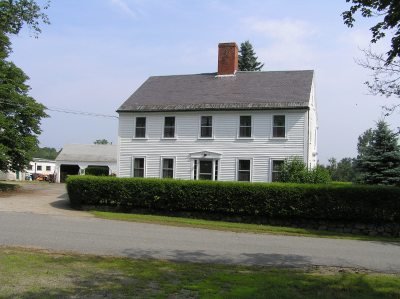 56 Fellows Road, the Josiah Brown House (1812) - The pasture land along Fellows and Candlewood Roads was purchased in the mid-17th Century by John Brown. His descendant Josiah Brown built this house in 1812. For over two hundred and forty years after John Brown bought the farm, it remained by inheritance in the Brown family through successive generations.… Continue reading 56 Fellows Road, the Josiah Brown House (1812)
  50 North Main Street, the James Brown House (1700 / 1721) - The James Brown house is part of a larger 1700 house that was divided into three houses in the 19th Century. The chamfered oak frame in the southern portion indicates late First period, while the northern section appears to date from the 1720s. The Morley house next door was separated and turned sideways. … Continue reading 50 North Main Street, the James Brown House (1700 / 1721)
  41 Washington Street, the George Brown House (1883) - John A. Brown sold this lot to George B. Brown in 1883 and he built a house shortly thereafter. Brown’s house is one of the few Stick Style Victorian homes in Ipswich. Brown built a grist mill, also located on Washington St., in 1881. He started with a single team and by 1888 employed 6 men. Brown was the first in the area to install a roller mill, which removed all foreign iron substances from the grain before it entered the mill… Continue reading 41 Washington Street, the George Brown House (1883)
  37 Washington Street, the Brown-Grossman-Doucette House (1884) - This house was built by 1884 by George V. Brown, one of several houses he built on a large parcel. Brown operated a large hay & grain business nearby at Brown Square and lived on Liberty Street. In 1916 this house was occupied by Charles (& Mary) Grossman and Denis (& Maggie) Doucette.… Continue reading 37 Washington Street, the Brown-Grossman-Doucette House (1884)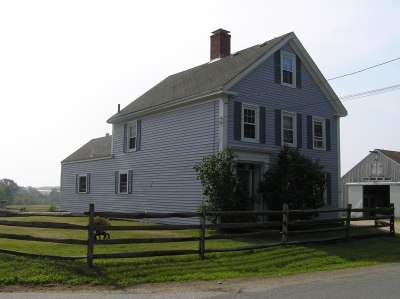
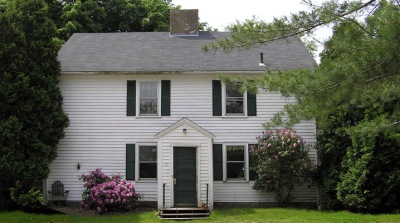 3 Candlewood Rd., the Brown-Whipple House (1812) - Joseph Brown built this house in 1812 as a dwelling for his son, James, and sold him the house and 3 acres, Dec. 23, 1817. The entire estate of Joseph Brown eventually was inherited by James. In 1852, D. F. Brown and the other heirs sold their interest to Hervey Whipple, who had married Martha P., daughter of James Brown, July 3, 1852. The heirs of Hervey Whipple still occupied into the 21st Century. … Continue reading 3 Candlewood Rd., the Brown-Whipple House (1812)
  27 High Street, the Edward Browne House (c. 1650-1750) - Edward Brown was the original owner of this site in 1639, and the east side of the present house is believed to have been constructed under his ownership around 1650 as a one-room over-one-room floor plan.… Continue reading 27 High Street, the Edward Browne House (c. 1650-1750)
  232 Argilla Road, the Brown-Crockett House (c. 1800) - John Patch died in 1799 leaving the Sagamore Hill farm to his grandson Tristram Brown, who built the dwelling, which he operated as a boarding house on the way to the beach. Dr. Eugene A. Crockett bought the property along with its dairy and hay farm in November 1897. … Continue reading 232 Argilla Road, the Brown-Crockett House (c. 1800)
  14 Liberty Street, the George B. Brown House (1898) - The elegant Victorian house at 14 Liberty Street in Ipswich was built between 1896-98 by George B. Brown, who owned a grain mill on Washington Street.… Continue reading 14 Liberty Street, the George B. Brown House (1898)
  14 Candlewood Road, the Joseph and Elizabeth Perkins Brown House (1779) - Elizabeth Brown, descendant of the early Candlewood settler John Brown, was the wife of Captain Perkins. In December, 1779, their daughter, Elizabeth, became the wife of Joseph Brown, of the same family line, who built this house.… Continue reading 14 Candlewood Road, the Joseph and Elizabeth Perkins Brown House (1779)
  13 Argilla Road, Thomas and Elizabeth Brown House (c. 1844) - The simple exterior is enlivened by Victorian elements, including two door hoods with elaborate scroll brackets decorated with incised floral motifs and sunbursts. Thomas Brown is the first known owner of the house (shown in a map dated 1856). … Continue reading 13 Argilla Road, Thomas and Elizabeth Brown House (c. 1844)
  117 High Street, Brown’s Manor (1886) - Abraham Lord sold 30 acres to George A. Brown on Nov. 6, 1886. The Browns built this imposing brick Mansard with white alternating quoins, a fine entrance porch, and a round-headed, double-leaf door.… Continue reading 117 High Street, Brown’s Manor (1886)
  11 Topsfield Road, the Jacob and Brown House (b. 1832) - William Gray Brown, occupied this house after his fathers death and continued his father’s ice and coal business. He also owned and operated the Agawam House hotel facing Meeting House Green. The turret and porch are Victorian additions.… Continue reading 11 Topsfield Road, the Jacob and Brown House (b. 1832)
  Historic Ipswich