

Great ingenuity was displayed in getting more hand frames into the country. Careful drawings were made of the heavier and more bulky parts of the machines, and these parts were manufactured in the United States from the plans, while the more essential and intricate mechanism came concealed in all manner of clever ways.
With one accord, the coming stockingers sought Ipswich as their home. Fewkes and Warner had settled there; what better place could there be in America, and so to the names of the pioneers were added a long list of expert workmen who graced their calling and founded a great industry among the sturdy hills of New England.

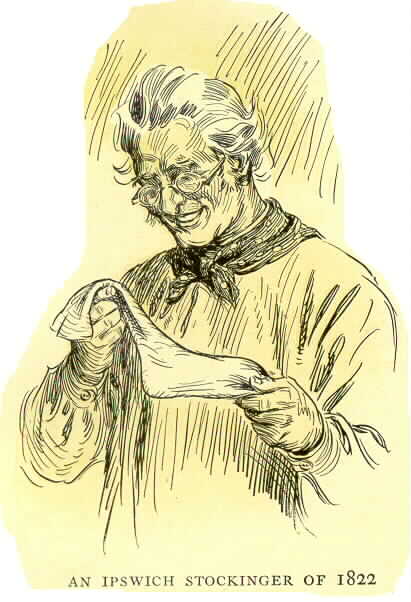
The three Peatfield brothers, James, Joseph, and Sanford, Samuel Gadd, George Gadd, Samuel Hunt, Sr., James Clark, John Truman, Charles Watts, John Morley, James Cartwright, Sr., Charles Bamford, Sr., and James Harrison are some of the men mentioned by historian Jesse Fewkes as stockingers of Ipswich. Later, some of these men’s sons were associated with them, and we read of the boys, Thomas and William Gadd, William and Henry Fewkes, Samuel Hunt, Jr., and Charles Bamford, Jr., as workers in the industry. Any account of the manufacture of hosiery in America would be incomplete without our mention of these men, wh,o coming to a new land, gave that land their best not only as stockingers but as citizens.
The first hosiery, good as it was, was nowhere near the product of today. The machines were crude, and the texture of the work turned out coarse and open. While it imitated hand knitting of the coarser grade, it did not equal it, nor was the machinery capable of producing the finer grades and stitches.
Mr. Jesse Fewkes, a descendant of the first “Stockinger” of Ipswich, has written a most interesting and authoritative account of the early hosiery manufacture at Ipswich. From his writings, we find that most of the stockings were engaged in the kindred pursuit of weaving lace in the years around 1828.
The New England Lace Company used hand frames, and the operatives, all Ipswich men, women, girls, and boys, helped to build up a fine business, which prospered exceedingly.
Now, the fine linen thread used in the manufacture of lace could not at that time be produced in the dry atmosphere of this country. It had always been spun by secret methods in the damp cellars of England and France. So it came about that the English Government at last realized that the hand frames and their operators had reached America and were weaving lace with imported linen thread. The Government at once put a very high duty on the export thread and allowed the English lace to leave the country free. This ruined the lace business at Ipswich, and the skilled workmen promptly resumed the knitting of hosiery, with native cotton.
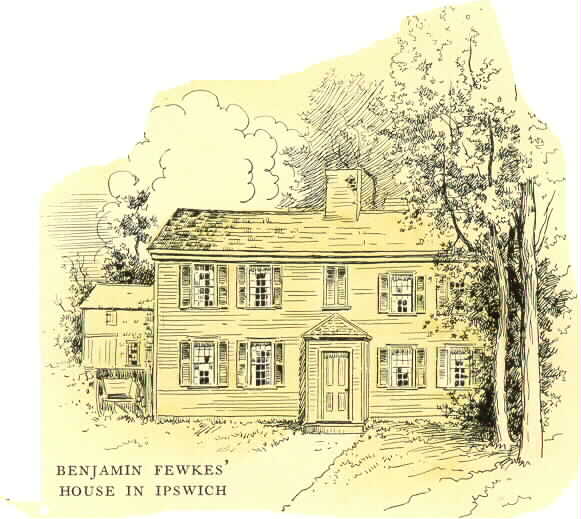
In 1832, James and Joseph Peatfield, expert machinists, made for Benjamin Fewkes two stocking frames, probably the first made in this country. Mr. Fewkes built a small shop near his house and started a business. George Warner opened another shop, as did Samuel Hunt and Charles Bamford. Continue to Page 4.
Ipswich Hosiery, Page 1
Page 2
Page 3
Page 4
Page 5
Page 6
Page 7
Page 8
Page 9
Ipswich Mills and Factories
Fine Thread, Lace, and Hosiery
 Historic Ipswich