

The frame of the oldest part of the house is typical of the “I-house form” brought to America by English colonists, identifiable by its tall two-story construction, three to five bay construction, side gables, and one-room-deep floor plan. Colonial Revival features include the extended boxed eave and the door with an entablature, portico, pediment, and pilasters on either side. The Colonial Revival movement of the 19th Century represented a renewed interest in English Colonial architecture at a time when Greek Revival, Italianate, and Victorian construction had become the fashion.
Thomas Franklin Waters wrote in Ipswich in the Massachusetts Bay Colony, “The present dwelling was built in 1849 from lumber taken from the old Meeting House of the First Church when it was torn down, prior to the building of the present edifice. ” (Ipswich in the Massachusetts Bay Colony, vol. I, page 419, published 1905).

An engraving of Meeting House Hill dated 1839 shows the First Church to the right of its steeple, just a few years before the building was removed and the Gothic church was constructed. The Fourth sanctuary of First Church in Ipswich was built in 1749 and served the community until 1846 when it was torn down to build the fifth church on that spot.
Waters describes the construction of the old Meeting House: “It stood exactly in front of the present edifice. Its dimensions were sixty feet in length, forty feet in width, and twenty-four feet stud. The frame had been raised at the time of the ordination, and the house was occupied May 22nd, 1748.”
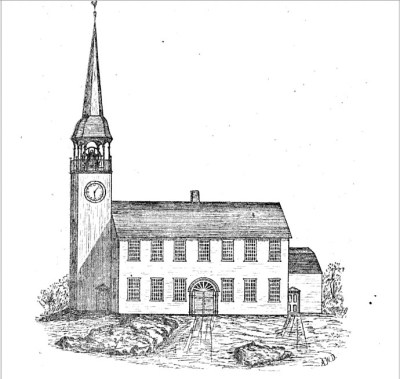
“The new meeting house was severely plain with large windows without blinds destitute of steeple or belfry Doors opened on three sides cast south and west directly into the audience room The great alley, as the middle aisle was called led from the south door to the unpretentious pine pulpit, painted white at the north end and a cross aisle extended from the east to the west door...As the old meeting house, built in 1747, had become antiquated and inadequate, land was acquired in the rear in 1837. The dwellings which occupied the spot were removed, and a new house of worship was erected. It was dedicated on January 1st, 1838. The old meeting house was then torn down.” (The current First Church in Ipswich is the sixth building. The Gothic church that was erected in 1846 burned in 1965.)
The timbers in the Jewett house date to 1749 and were already 100 years old when the house was built. The now-exposed frame confirms the antiquity of the beams, posts, and joists, with an absence of any earlier mortises. Bowed floor/ceiling joists set perfectly in the notches of the massive beams in the first and second floors of the front section of this house. The stone walls of the basement are also intact, capped with a few rows of brick at the top. Several years ago, a person working in the basement found a Bible in the walls dating to 1710.

The land along Water Street from Green Lane (now Green Street) was originally granted to Humphrey Bradstreet and Thomas Clark, who were among the first settlers of Ipswich. A small “3 rod lot” on the corner of Green Lane and Water Street was split off, and a house on that lot was owned by two different parties for many years. By the turn of the 20th Century, only the cellar of that house remained. The other half of the lot was sold in 1848 to brothers William H. Jewett and Thomas L. Jewett from the estate of their father, Moses Jewett. The Thomas Jewett House stands at this location in the 1856 Ipswich map. The 1884 map shows the owner as J. E. Jewett. In the 1930s, this house was known as the home of Joseph F. Claxton an Ipswich selectman.

Sue Nelson, the Ipswich Historical Commission’s esteemed architectural historian, commented about this post: ” This is very interesting information regarding 4 Water. When I put together the inventory, I relied on existing “B” forms. Long after I put together the inventory, I had a chance to run through the house during a real estate open house. At that time, I saw a lot of material that suggested a much earlier date than 1880, so I agree that 1880 is too late. So interesting about the reuse of the 1749 meetinghouse. It makes me want to look at 4 Water much more closely. Many of the building receipts for construction work on the 1749 meetinghouse were collected by Thomas Dennis (1706-1771), who served as treasurer for the project. He was the son of John Dennis and grandson of the famous 17th-century joiner Thomas Dennis.”
Sources
- Massachusetts Historical Commission site, MACRIS
- History and genealogy of the Jewetts of America
- Partial List of Historic Houses in Ipswich, Ipswich Historical Commission (PDF download).
- Thomas Franklin Waters, “Ipswich in the Massachusetts Bay Colony,” vol. I, page 419, published 1905).
- History of the Jewetts in America
 Historic Ipswich
Curious what the color on the house is. Anyone know?