
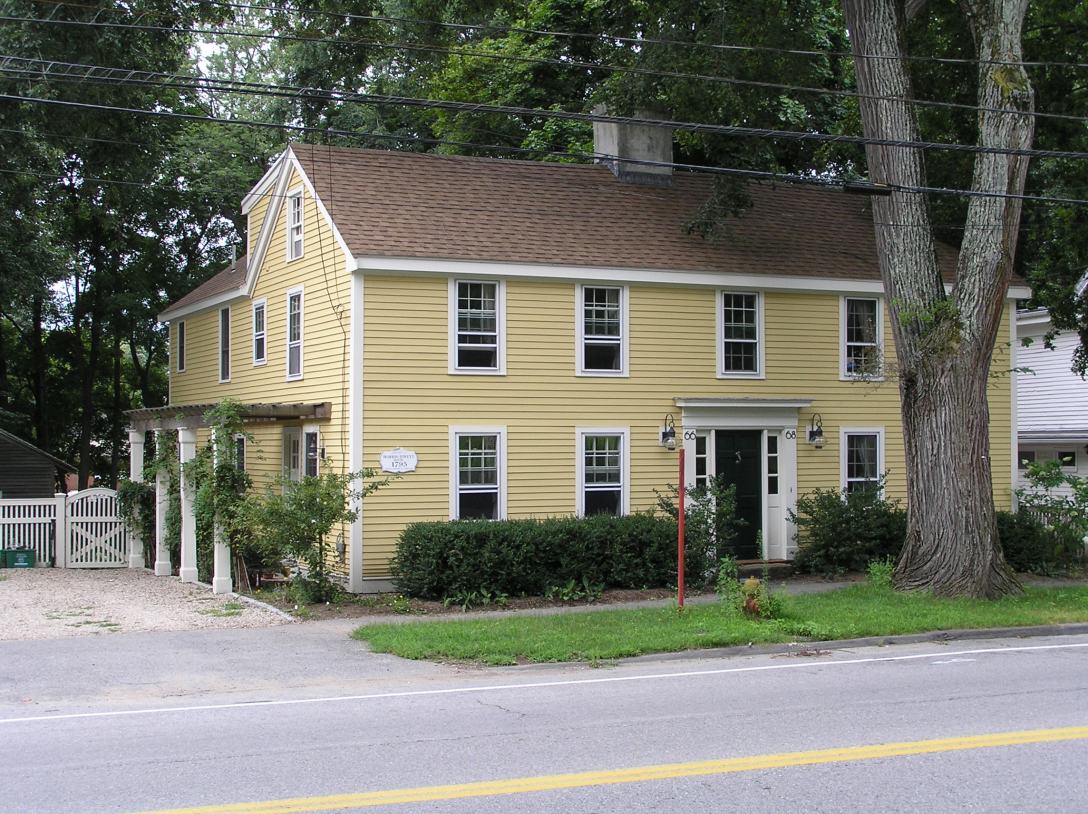
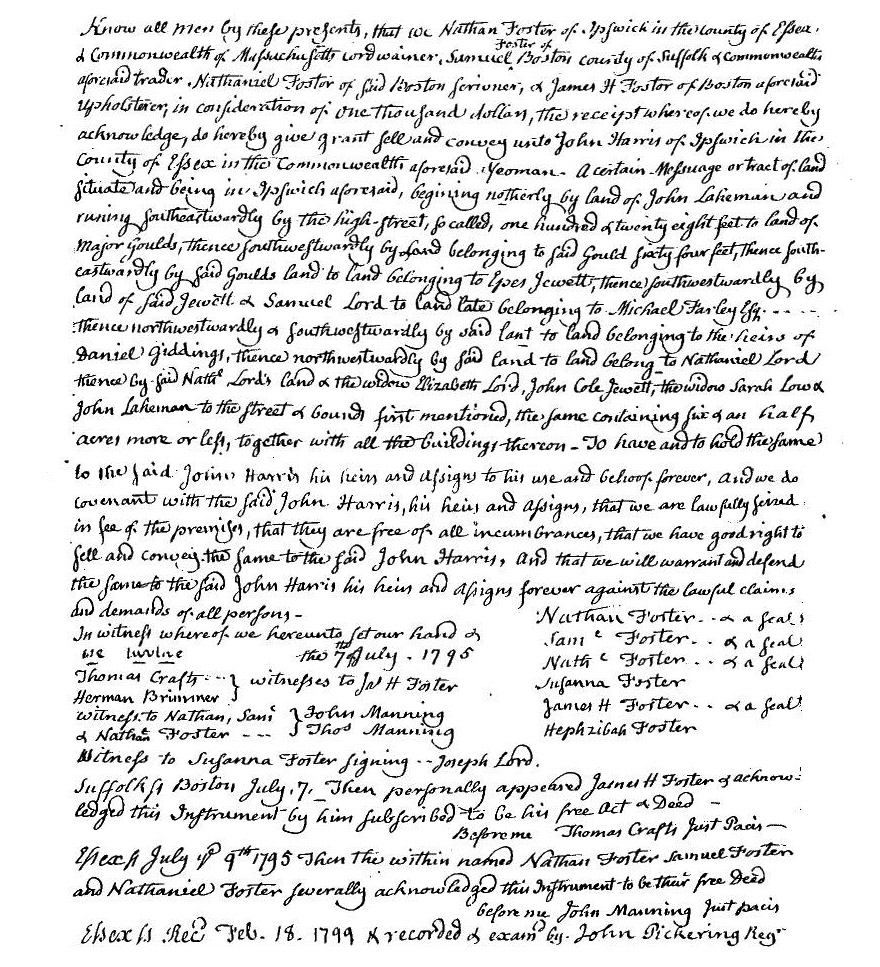
In 1795, John Harris bought for $1000.00, “a certain messauge or tract of land..a half acre or more with all the buildings thereon” from Nathan Foster of Boston. (164:236). See the deed at the end of this post. Several dwellings on this side of High Street burned in 1858, leaving this house at 66 High Street, which is assumed to have been built by Harris in 1795.
Mark Jewett bought the property in 1833, and it remained in his family for many years. Jewett was a housewright and built the Linebrook Parish House in 1828. He also contracted to rebuild the First Church. The finished work was accepted on the condition that he repaint the pulpit “in a sacred color”.

In 1784, the town poorhouse on Loney’s Lane had fallen into disrepair, and John Heard convinced the town that if it would buy John Harris’s previous home at the corner of High and Manning, he would provide $400 annually for the care of the poor. The contract was so controversial with residents in the affluent Hamlet section of town that they succeeded in breaking away in 1793 to create the town of Hamilton.
John Harris sold his land (two acres) and house to the Town on July 10, 1795 (166: 106). It was occupied as the Town Poor House until the Poor Farm on Town Farm Road was constructed in 1817. The Town then sold the “work house” and land to Jacob Manning Jr., May 10, 1818 (224: 176). The upstairs frame of the Manning Street house is on display at the MFA in Boston.
Sources
- MACRIS
- T.F. Waters, Ipswich in the Mass. Bay Colony, vol. I, pp. 364-365.
Deed from Nathan Foster to John Harris
 Historic Ipswich