
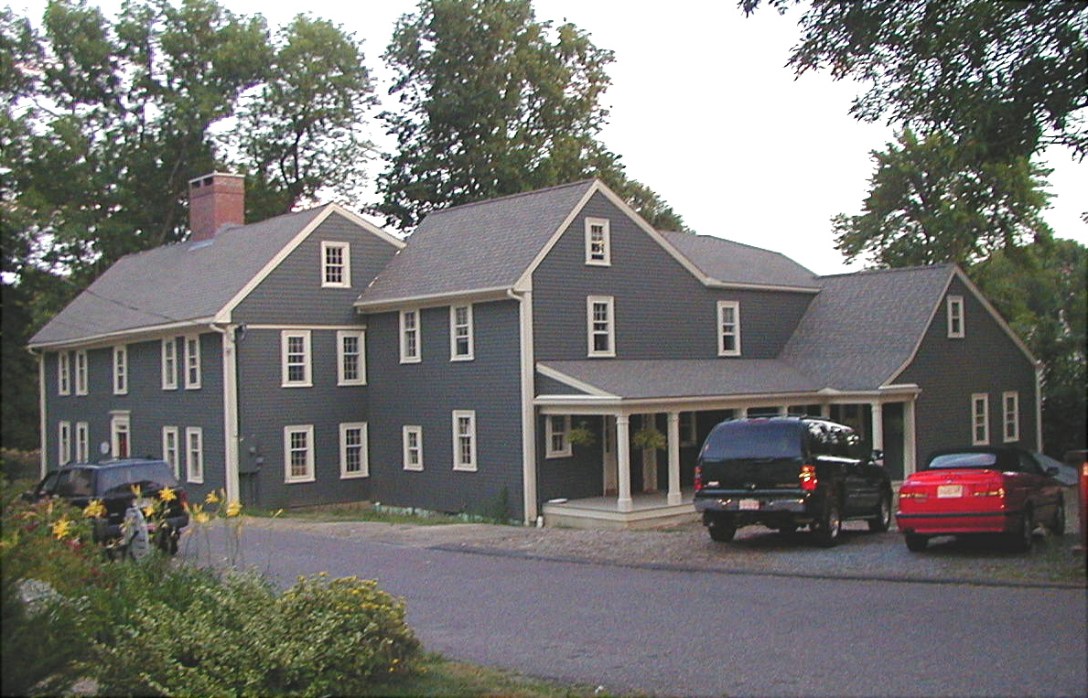
The construction of this house has been historically attributed to John Kendrick, a cooper, who acquired a large lot at this location in 1665. In 1702, he sold an acre of the land to Thomas Staniford for £70, and five years later, he and his son John sold the remaining parcel with a “messuage”, shop, and barn to Staniford for £27. The house acquired its present dimensions during the 40-year ownership by the Staniford family. In 1742, a half acre with a “large house” was sold to David Pulcifer for £310. Well-preserved interior woodwork dating to the late 18th or early 19th centuries is found in the first-floor rooms and lean-to.
Although there is little to indicate a 17th-century house, there is some structural evidence of a possible date of around 1670 for the earliest section. Within the attic is evidence of a heavily pilastered chimney. The facade gable visible on the side facing the river dates to no later than the first decade of the 18th Century. The lean-to (saltbox extension) was added later, and the original rear rafters were left in place, as they are in the Edward Brown house at 27 High St. This private residence has a preservation agreement with the Ipswich Historical Commission. Read more about the Kendrick-Staniford house at the Historic Ipswich site.
The John Kendrick House at 3 Hovey St. in Ipswich was the winner of the 2002 Mary P. Conley Award. (Also spelled Kenrick, Kendricks). The architect for the renovation was Olson Lewis Architects.
John Kendrick House, 3 Hovey Street Preservation Agreement
This house is protected by a preservation agreement between the owners and the Ipswich Historical Commission. Protected elements include:
- All front and side exterior features of the building
- Central chimney
- Central frame and roof, including primary and secondary members
- Wooden architectural elements include doors, paneling, molding, stairs, windows and frames, and other early details of the 17th-century house and its 18th-century additions.

History from Ipswich in the Massachusetts Bay Colony
“John Kenrick or Kendrick, a cooper by trade, owned a large lot which was bounded by East St., Hovey’s Lane and Water St., in 1665. He sold his house and two acres to his son, John, on Nov. 30, 1702 (15: 114), but father and son united in conveying to Thomas Staniford, an acre and a half of the land, fronting on East St. and extending down the lane “to four foot from the dwelling house of said John Kendrick Sr., and so close along by the garden fence and barn and then reaching down to low water mark,” Dec. 30, 1706 (21: 54). The next year, the Kendricks sold the remainder, with house, barn, shop to Staniford, Dec. 23, 1707. The venerable house still standing may be the Kendrick homestead.”
Information provided by the Ipswich Historical Commission for MACRIS
Stylistic evidence supports a date of about 1670 for the oldest parts of this house. Although much of what is now visible is later, some excellent 17th-century elements are exposed, signaling a house of surpassing architectural interest. Important First Period fabric includes rare fragments of a three-part casement window frame in the southern gable, rear rafters of the original roof that are visible in the attic, and remnants in the chimney stack of what must have been a handsome pilaster. Roof repairs in 1978 uncovered evidence at the tie beams’ ends of a plastered cove cornice, found on two late First Period houses in this neighborhood.
Much of the present trim dates from the late 18th or early 19th centuries, including the stairs and detailing in the principal first-floor rooms. Notable 18th-century interior elements are found in the two main rooms of the lean-to, and include corner fireplaces with fine mid-century woodwork and an excellent corner cupboard.
Sources:
- MACRIS, the Massachusetts Historical Commission site
- Ipswich in the Massachusetts Bay Colony by Thomas Franklin Waters
 Historic Ipswich