

John Proctor, the settler, arrived in New England on the ship Susan and Ellen in 1635, at the age of forty; Martha Proctor, his wife, was twenty-eight years old. With them were their son John, 3 years old, and daughter Marie, one year old. He was a commoner in 1641 and was one of the 27 richest inhabitants, with two shares in Plum Island in 1664. Proctor had two house lots; one adjoining Christopher Osgood on today’s Market Street, and another in 1635, where he built his house near the Cove on the south side of the river. This lot with a dwelling house, he sold to Thomas Firman, on May 1, 1647, in exchange for a farm. In the same year, he had a planting lot, “on the east side of the great hill called Heartbreak adjoining the lots of Mr. Samuel Dudley, Thomas Wells, and “the way leading to Mr. Saltonstall’s Farm (Argilla Rd.).” In 1647, John Procter Sr. purchased a 100-acre farm on Island Road from Thomas Firman, who had been granted the land by the town of Ipswich in 1636.

received a house lot on today’s Market St., where the Ipswich Post Office now stands.
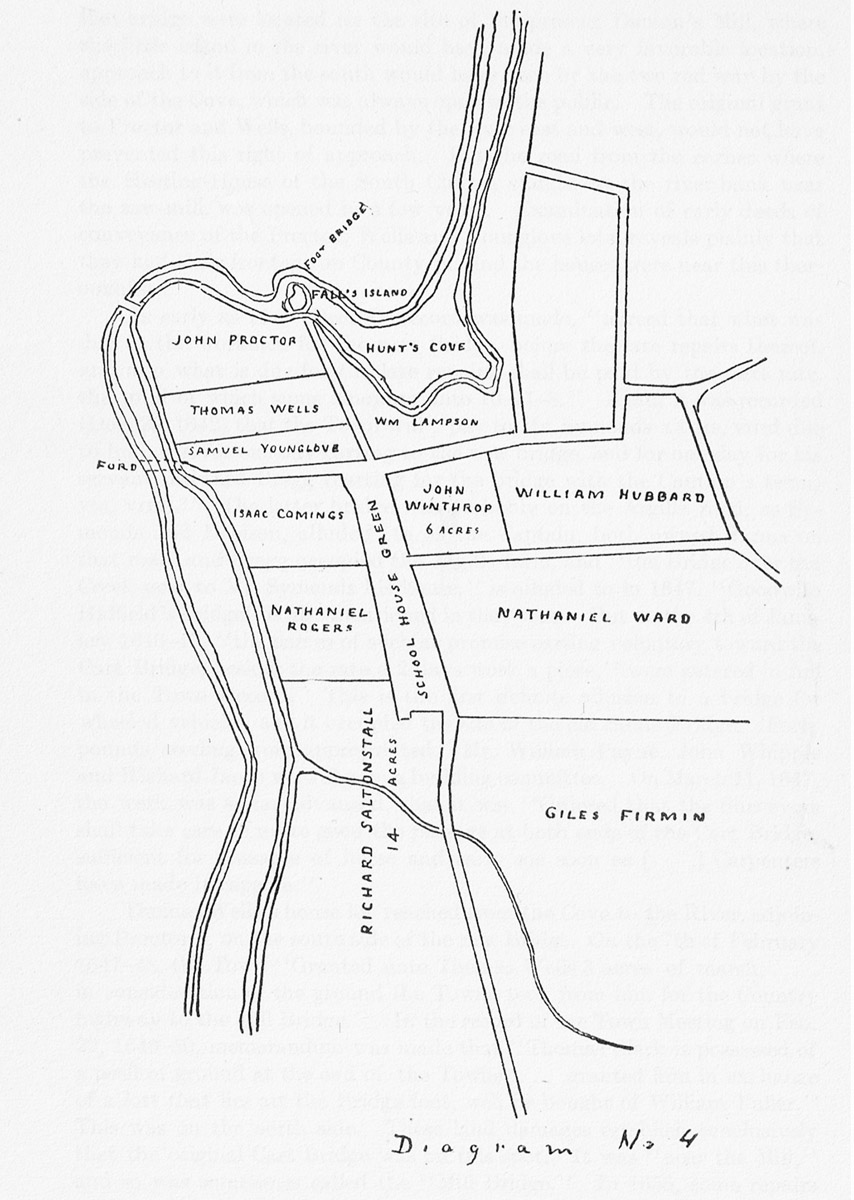
John Proctor’s will was dated August 28 and proved Nov. 28, 1672. In it, he spoke of himself as aged and infirm. His first wife, Martha, had died on June 13, 1659. He remarried and left a widow, Martha. His sons were John, Joseph, and Benjamin. His daughters were Martha White, Abigail Proctor Varney, Sarah Dodge, and Hannah Widden. The son Benjamin, who was listed as a commoner in 1678, married Deborah Hart in February 1673. His will divided the Procter Farm into three equal shares between his three sons – John Jr., Joseph, and Benjamin. In a mortgage written in 1687, John Procter Jr. listed 45 acres of land on this farm, which he owned, including the 25-acre pasture that is now the Trustees’ Stavros Reservation on Island Road.
John Proctor II
John 2, son of John 1, was born in 1632. He married Elizabeth Thorndike on December 1662. Children born to them in Ipswich were Mary, born Jan. 1, 1657; Benjamin, born June 10, 1659, and Martha, born April 1, 1665. Their home was in Chebacco Parish, now the Town of Essex. The Essex Quarterly Court records and deeds document that John Procter Jr. moved to Salem Village to be the tenant farmer on the Downing Farm in 1666, but he maintained connections in Chebacco Parish for the rest of his life. In 1692, he was hanged as a witch.
John Proctor and his wife, Elizabeth, with four others, were tried by the Court on August 5th, 1692. A petition for a reprieve was signed by thirty-two of his former Ipswich neighbors, testifying to the goodness of his character, but it availed nothing. While in Salem Prison, Mr. Proctor addressed a letter to Rev. Cotton Mather and other ministers imploring their ”favorable assistance of this our humble petition to his excellency, that if it be possible our innocent blood may be spared, which undoubtedly otherwise will be shed, if the Lord doth not mercifully step in; the magistrates, ministers, juries, and all the people in general, being so much enraged and incensed against us by the delusion of the devil, which we can term no other, by reason we know in our own consciences we are all innocent persons…My son William Proctor, when he was examined, because he would not confess that he was guilty, when he was innocent, they tied him neck and heels till the blood gushed out at his nose, and would have kept him so twenty-four hours, if one, more merciful than the rest, had not taken pity on him, and caused him to be unbound.“
In Hurd’s History of Essex County (1888) in the chapter on the Town of Essex by John Prince, he writes (in Vol. 2 pages 1186 – 1187) that John Procter was so well known and respected by residents of Chebacco that thirty-two of his neighbors and acquaintances signed a petition, headed by the signature of Rev. John Wise, appealing for clemency for John Procter and his wife, who had both been convicted and sentenced. “The Chebacco petitioners admitted the reality of witchcraft itself, but interposed in behalf of Procter and his wife as persons innocent of it.” He lists the names of the thirty-two signers of the petition.
Proctor requested that if they could not have their trials in Boston, some other magistrates might hold court in Salem. But all was of no avail, and he was condemned to death. He was hanged on August 19, pleading to the last moment for a little respite, saying that he was not fit to die. John Proctor’s will, made in prison after his conviction on August 2, 1692, directed his property to be equally divided among his children. It amounted to a little more than £17 for each: Benjamin, Martha, Mary, William, Joseph, Samuel, John, Elizabeth Verry, Thorndike, Sarah, Elizabeth Proctor, and Abigail. His wife, Elizabeth Proctor, was pregnant when she was found guilty and was reprieved and eventually pardoned by the Governor Sir William Phipps:
“Essex, Ss. By ye Hon’ble Barth’o Gedney, Esq., Judge of Wills, &c., for said County, April 19th, 1697:
Whereas Elizabeth Proctor Producing from under the hand & seal of Sr William Phips, late Gov’en’r, a Repreve after her being Indicted, arraigned, convict and sentenced of & for the detestable crime of Witchcraft: and the said Gov’ernor in the names of their most Gracious Majesties Wm & Mary, by ye Grace of God of England, Holland & France & Ireland, King & Queen, defenders of the faith, freely, clearly & absolutely Pardon the said Elisa’h Proctor of the sd Crime of Witchcraft of & for which she stood convicted & sentenced as afores’d, so as she may enjoy her life & liberty in as free & full manner as before, as in & by sd Pardon at large may appear: & whereas the sd Eliza’h being looked upon as dead in law & left out ye will of her Hus’d, John Proctor, & nothing given her ye’in, nor ordered her upon the distribution of the Estate of the said Proctor, but since which producing the aforesaid pardon she becomes alive in law, whereby to Recover her right of Dowry, and upon her Request a citation went forth to the exector of her deceased husband’s Will.
John Procter’s land in Chebacco Parish was eventually consolidated as part of his brother Joseph Procter’s farm, and Joseph also took over the land of his younger brother after Benjamin purchased the Hog Island farm in 1688.
Further Reading:
- Hammatt Papers: Early inhabitants of Ipswich, Mass. 1633-1700 by Abraham Hammatt
- Salem Witchcraft Museum: John Proctor
- Wikipedia: John Proctor
- Ipswich in the Massachusetts Bay Colony, Vol. 1 by Thomas Franklin Waters.
- Thanks to Tom Bedall for sharing research about the Proctor land and family
 Historic Ipswich