


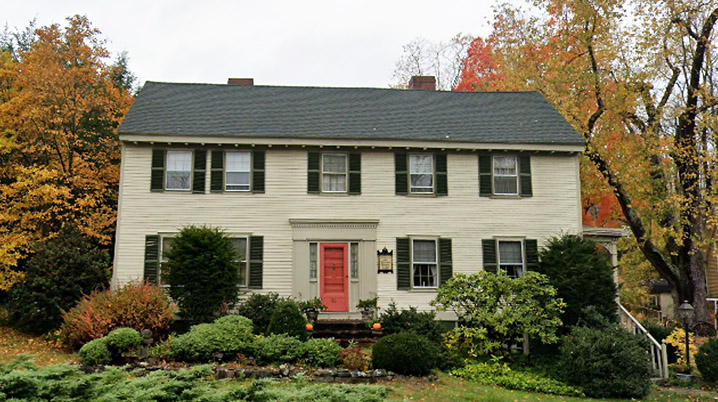
The Rogers-Brown-Rust House is described on the Massachusetts Historical Commission site MACRIS: “The Rust Mansion is a 2 1/2 story end-gable structure with twin rear wall chimneys. It is constructed with a heavy timber frame and is sheathed with clapboards. Its asymmetrical five-bay facade reflects its seventeenth-century date, while its pilastered entry with side lights and its modillion cornice represent Federal period alterations. It is one of the few First Period houses located outside of the districts. It typifies a First Period house which has been expanded through the nineteenth century to meet changing needs.
In the 19th Century, this house came into the possession of Asa Brown, who moved it in 1836 when the Second Congregational Church was constructed in the house’s original location. The 1832 map shows that Brown owned an existing house at 83 County Rd., which is believed to now be the ell on the northwest side of the house. Although the house was greatly remodeled, giving it a Federal appearance, its asymmetrical facade and heavy timbers lend credibility to the early date of construction, and the rustic ell appears to be even older. This house was traditionally referred to as the Nathaniel Rust mansion and is listed in the National Register of Historic Places.
Nathaniel Rust had a tanning operation at this location in the late 17th Century, using water from Saltonstall’s Brook, also known as Norton’s Brook, which runs by the house. Rust’s “mansion” was a quarter mile away, where County Road bears left to become South Main Street. In 1710, he sold Thomas Norton and Daniel Ringe, who had married his two daughters, his house and land. The date of construction for the main part of the house is uncertain, but it may date to 1723 under the ownership of Major Ammi Ruhami Wise. The house was inherited by Dr. Samuel Rogers, whose wife was Major Wise’s daughter.
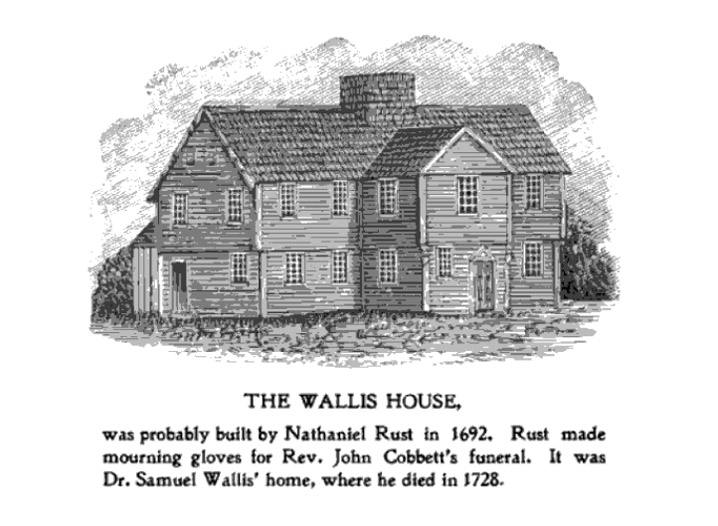
The Rogers and Brown House (also known as the Nathaniel Rust House) at 83 County Road is believed to be three houses joined together, at least one from the First Period. The exact date of the building and the identity of the original owner are uncertain. The first known owner was William Goodhue, and the house occupied the site where the South Meeting House later stood. Goodhue conveyed the house to Nathaniel Rust on June 2, 1665. Rust was a tanner and glover. His tanning establishment stood on the present site of this house. In 1684, Nathaniel Rust2, son of the senior Daniel, married Joanna, the daughter of Robert Kinsman 2, who was born April 25, 1665.
Rust sold to his sons-in-law on March 9, 1710, and in subsequent years, the house changed hands many times. Dr. Samuel Rogers bought the house on June 19, 1750. Madame Rogers kept a school for young ladies, which was of great repute.
In 1836, the house and lot were conveyed to the South Parish as a church site. Asa Brown bought the house and moved it to its present location in 1837. (*The 1832 map shows that Asa Brown already owned a house at that location, so it is now believed that he attached the elegant home from the South Green to the house he owned, which may have been the Nathaniel Rust tanning shop or house.) Brown remodeled the house at this time, and it became the home of his sister, Rhoda B. Potter. The north section is the oldest part of the house and contains 2 diminutive parallel summer beams.
Thomas Franklin Waters also wrote a history of the house in his book Ipswich in the Massachusetts Bay Colony. The following excerpts relate to the lot on which the house now stands, and to its original location across from the South Green:
“Ezekiel Woodward sold to Nathaniel Rust, senior, 1685, one acre of this property, the eastern portion, with the house, reserving a right of way, where Elm Street now is, then on the same day, he sold Shoreborne Wilson the remainder, the western part on South.
Richard Saltonstall owned fourteen acres, about eight acres of which lay to the south of the (Saltonstall) brook. In 1689, Nathaniel Rust owned the part south of the brook. Rust sold an acre, bounded by the brook and the street, including buildings, tan-yard, etc., to Thomas Norton in March 1700, and in November of that year, Norton married Mercy Rust, daughter of Mr. Nathaniel Rust.
In 1701, Rust sold his son-in-law the seven acres adjoining the tan-yard lot, and in 1710, he sold Norton and Daniel Ringe, who had married his two daughters, his house and land where the South Church now stands (*no longer standing). Norton and Ringe sold out to Ammi Ruhamah Wise in 1723.
Despite its fresh appearance, the comfortable house lately owned and occupied by Mrs. Potter is of venerable age. It was built on the corner now occupied by the Meeting House of the South Parish, and when that edifice was erected in 1837, it was removed to its present location.
Rogers purchased the property of Daniel Wise in June 1750. Wise received it from his father, Major Ammi Ruhamah Wise, son of the celebrated Rev. John Wise of the Chebacco Parish. Major Wise purchased from Daniel Ringe and Thomas Norton, in 1723, who bought the estate of Nathaniel Rust, their father-in-law, in 1710. Rust acquired the property, with a house and barn, on June 2, 1665, by purchase from Deacon William Goodhue.
The date of construction of the three sections is uncertain. The main part of the house may have been constructed in 1723 by Major Ammi Ruhami Wise, who was the son of Rev. John Wise. It became the residence of Dr. Samuel Rogers. The house was sold to Asa Brown, who moved it to the current location on County Road in 1837 so that the Old South Church could be built facing the Green. (The South Parish church burned in 1977.)
Brown remodeled the house after it was moved to this location, changing the look of the original house. There are several periods of construction evident; the front parlor rooms have 10-foot ceilings, while the possibly first-period rear wing has exposed summer beams and low ceilings. The asymmetrical 5 bay façade reflects its early construction, while its pilastered entry with side lights and modillion cornice indicates Federal period alterations.
Thomas Franklin Waters wrote more about the history of this house in his book, “Ipswich in the Massachusetts Bay Colony.” (Read an amusing story at the end of this page about when the house was a school for young ladies.)

The first known owner of this property was William Goodhue, who conveyed his house to Nathaniel Rust in 1665. Rust was a glover whose tanning establishment stood on the present site of this house.
Nathaniel Rust, “the glover,” took the Ipswich freemen’s oath on May 27, 1674. He was appointed quartermaster in the expedition to Canada on June 19, 1690, and was representative to the legislature in 1690 and 1691. His father, Nathaniel Rust, Sen. of Ipswich, was also a glover and died intestate. His sons-in-law, Capt. Daniel Ringe and Mr. Thomas Norton were appointed administrators of his estate in December 1713.
In the Antiquarian Papers, it is recorded that Major Wise resided in this house when it was on the South Green in the first half of the 18th Century.
“Rev. Augustine Caldwell writes, ‘Major Ammi Ruhami Wise lived on the very site of the present South Church. His house was owned after his death by Dr. Samuel Rogers, a most noted physician and strong man of the town whose wife was Major Wise’s daughter.”
Major Ammi Ruhami Wise commanded a company of troops in a military expedition to the Spanish West Indies in the year 1740, was a noted merchant and Justice of the Court of Sessions, and served as representative to the General Court in 1739 and 1740. On July 6th, 1749, Major Ammi Ruhami Wise died in Boston at the age of 61 of fever. (source: History of the Town of Essex).
Dr. Rogers purchased the property of Daniel Wise in June 1750. Abraham Hammatt in “Early Inhabitants of Ipswich, Massachusetts 1633-1700 recorded that “Dr. Rogers’ later home was the house which stood on the site of the present South Meeting house; built by Ammi Ruhamah Wise, and then possessed by Doctor Rogers.” Major Wise’s daughter, Hannah, married Dr. Samuel Rogers, a noted physician and town leader.
Madame Rogers
When Samuel Rogers died in 1772, Hannah was obliged to sell half of her home to cover her husband’s debts. In 1774, she began teaching the girls of Ipswich in her diminished living quarters. Madame Rogers was a singularly intellectual and cultivated woman to whom wealthy families sent their young ladies for assistance with mental development. Saturdays were devoted to the study of 107 questions and answers about God, known as the The Shorter Catechism. It was considered the important lesson of the week, and no girl could possibly be excused without a most valid reason.
According to an old legend, Lucy Martin was a bright girl with that excess of young life that must find expression. Once, as the girls were arranged before their instructor to receive the usual Saturday drill, Mrs. Rogers was horrified to hear a titter which amounted to almost a laugh. Her keen eyes ran up and down the class, and the trembling Lucy made a full confession.
The teacher immediately discoursed upon the sin of laughter as “a crackling of thorns under a pot and vanity,” and so glaring did the fault appear that Lucy was not only severely reprimanded but smartly chastised with a rod. The young ladies were much incensed and determined to justify the sufferer. Accordingly, the whole school went to Lucy’s mother, the wife of another respected town physician. As they approached the house, they begged Lucy to cry harder so that the indignity might be more apparent. Mrs. Martin quietly listened and then inquired, “What did Lucy do?” “She only tittered in Catechism,” they replied. “Tittered in Catechism”, said the astounded Matron. “If my Lucy tittered in Catechism, I have not a word to say against the punishment.”
Sources:
- Genealogical Record of the Descendants of Robert Kinsman of Ipswich, Mass
- Wikitree: Nathaniel Rust
- Waters, Thomas Franklin: Ipswich in the Massachusetts Bay Colony, Vol. 1
 Historic Ipswich